
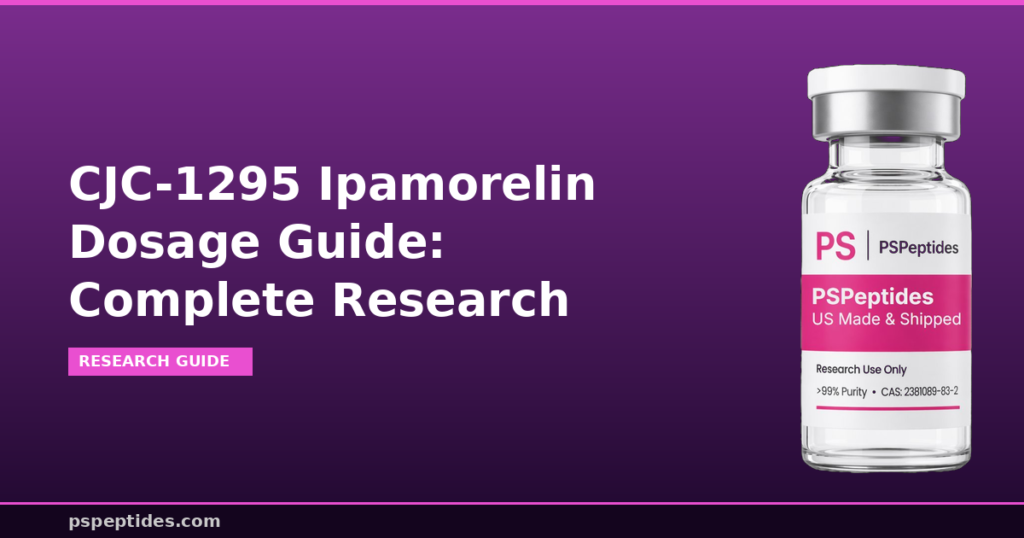
CJC-1295 Ipamorelin dosage is one of the most frequently researched protocol topics in the growth hormone peptide literature, because the combination’s effectiveness in research models depends heavily on how the two compounds are dosed relative to each other.
CJC-1295 Ipamorelin dosage is one of the most frequently researched protocol topics in the growth hormone peptide literature, because the combination’s effectiveness in research models depends heavily on how the two compounds are dosed relative to each other. The published research base documents specific dosing patterns, timing relationships, and concentration ranges that distinguish effective research protocols from suboptimal ones, making dosage design a central consideration for researchers working with this combination.
This guide covers CJC-1295 Ipamorelin dosage as documented in the research protocol literature, the mechanistic reasons certain dosing patterns recur across published research, the difference between CJC-1295 with DAC and without DAC for dosing schedule design, and the reconstitution and timing considerations that affect research outcomes. All dosing information here reflects patterns documented in the research literature and is provided strictly for laboratory and research reference.
Why Researchers Combine CJC-1295 and Ipamorelin
The CJC-1295 + Ipamorelin combination pairs a synthetic GHRH analog with a selective GHSR (growth hormone secretagogue receptor) agonist, targeting the two distinct receptor pathways that regulate pituitary growth hormone release. CJC-1295 amplifies pituitary somatotroph sensitivity through the GHRH pathway; Ipamorelin triggers the actual GH-release pulse through the GHSR pathway. The combination produces a synergistic research signal larger than either compound alone at equivalent total doses. This dual-pathway synergy is the central rationale behind CJC-1295 Ipamorelin dosage research.
This dual-pathway mechanism is why CJC-1295 Ipamorelin dosage requires coordinated design rather than simply dosing each compound independently. The two compounds work together — the CJC-1295 dose establishes the amplified pituitary sensitivity that the Ipamorelin dose then acts upon. The CJC-1295 Ipamorelin complete research guide covers the full combination mechanism, and the peptide stacking research guide covers the broader combination design principles. For background on the GHRH pathway that CJC-1295 targets, Wikipedia’s growth hormone-releasing hormone overview provides foundational context.
How CJC-1295 Ipamorelin Dosage Works in Research Protocols
CJC-1295 and Ipamorelin dosing in published research protocols centers on a key distinction: CJC-1295 exists in two forms with dramatically different pharmacokinetics. CJC-1295 with DAC (Drug Affinity Complex) binds to serum albumin and extends the half-life to approximately 8 days, allowing infrequent dosing. CJC-1295 without DAC — sometimes called Modified GRF (1-29) or Mod GRF 1-29 — has a short half-life measured in minutes, requiring frequent dosing aligned with each Ipamorelin administration.
This distinction fundamentally shapes CJC-1295 Ipamorelin dosage protocol design. With-DAC protocols use less frequent CJC-1295 dosing (often weekly or twice weekly) while administering Ipamorelin more frequently. Without-DAC protocols dose both compounds together multiple times daily to match the short CJC-1295 half-life. Researchers select between these based on the research question — sustained elevation research favors DAC, while pulsatile-pattern research favors without-DAC. The DAC decision shapes every downstream CJC-1295 Ipamorelin dosage choice.
The peptide half-life reference covers the pharmacokinetic data that determines dosing frequency for each form. PubMed research on CJC-1295 pharmacokinetics indexes the foundational half-life literature that informs CJC-1295 Ipamorelin dosage protocol design.
Common CJC-1295 Ipamorelin Dosage Patterns in Published Research
The research protocol literature documents recurring CJC-1295/Ipamorelin dosing patterns. For CJC-1295 with DAC, research protocols commonly reference doses in the range of 1-2mg per week, sometimes split into two administrations. For Ipamorelin, research protocols commonly reference doses in the range of 100-300mcg per administration, often administered one to three times daily depending on the research design. These per-administration figures form the Ipamorelin half of the CJC-1295 Ipamorelin dosage schedule.
For CJC-1295 without DAC combined with Ipamorelin, the research literature commonly documents matched dosing — both compounds administered together at the same time points, typically 100mcg of each per administration, two to three times daily. This matched-dosing approach maintains the pulsatile GH-release pattern that more closely mimics natural physiology in research models. Matched microdosing is the defining feature of without-DAC CJC-1295 Ipamorelin dosage.

The timing of CJC-1295 Ipamorelin dosage matters as much as the quantity. Research protocols frequently align administration with natural GH-release windows. The largest endogenous GH pulse occurs during early sleep stages, so research protocols commonly include an evening administration to align with this natural pulse. Additional daytime administrations extend the research signal window. The growth hormone peptide research guide covers these timing relationships in detail.
CJC-1295 Ipamorelin Dosage Comparison Table
| Protocol Type | CJC-1295 Pattern | Ipamorelin Pattern | Research Application |
|---|---|---|---|
| With DAC, sustained | 1-2mg per week | 100-300mcg, 1-3x daily | Sustained GH elevation research |
| Without DAC, pulsatile | ~100mcg per dose, matched | ~100mcg per dose, matched | Pulsatile pattern research |
| With DAC, twice weekly | ~1mg, twice weekly | 200mcg, daily evening | Convenience-focused protocols |
| Pre-sleep single | Form-dependent | 100-200mcg, evening only | Sleep-aligned GH research |
| Three-times-daily matched | 100mcg, 3x daily (no DAC) | 100mcg, 3x daily | Maximum pulse frequency research |
Reconstitution Considerations for the Combination
Accurate CJC-1295 Ipamorelin dosage depends on correct reconstitution, because the final concentration determines how much volume corresponds to each target dose. Both compounds arrive as lyophilized powder requiring reconstitution with Bacteriostatic Water before use. The reconstitution volume directly determines the per-unit concentration that researchers calculate doses against.
For example, reconstituting a 5mg CJC-1295 vial with 2mL of bacteriostatic water produces a concentration of 2.5mg/mL, meaning a 1mg dose corresponds to 0.4mL drawn into the research syringe. Reconstituting the same vial with 2.5mL — the most its 3mL vial takes with room to swirl — produces 2mg/mL, where a 1mg dose corresponds to 0.5mL. Researchers should calculate these relationships carefully before establishing their dosing protocol. The peptide reconstitution research guide covers the calculation procedures in detail.
The peptide dosage calculator research overview covers tools that simplify these concentration calculations. Researchers working with both compounds simultaneously must track two separate reconstitution concentrations and two separate dosing volumes, which adds complexity compared to single-compound research.
Timing and Frequency in Research Protocols
The frequency component of CJC-1295 Ipamorelin dosage depends heavily on which CJC-1295 form is used. With-DAC protocols decouple the two compounds’ dosing frequencies — CJC-1295 dosed weekly maintains the amplified pituitary sensitivity continuously, while Ipamorelin is dosed more frequently to trigger pulses against that sustained background. Without-DAC protocols couple the frequencies, dosing both together to match the short CJC-1295 half-life.
Research protocols frequently specify administration on an empty stomach because elevated blood glucose and insulin can blunt the GH-release response in research models. Many published protocols recommend a window of no food intake before and after administration to optimize the research signal. This timing consideration applies regardless of which CJC-1295 form the protocol uses.
The subcutaneous vs intramuscular peptide injection research overview covers administration route considerations. Both compounds are typically administered subcutaneously in research protocols. The peptides for muscle growth and recovery research overview covers the broader research context for GH-axis protocols.
Protocol Duration and Cycling Considerations
Beyond the per-dose CJC-1295 Ipamorelin dosage, research protocols address duration and cycling. Published GH-axis research protocols frequently run 8-16 weeks, with some research traditions incorporating cycling patterns — periods of administration followed by off-periods. The cycling rationale relates to receptor sensitivity research: continuous GHSR stimulation may produce receptor desensitization over extended periods in some research models.
The peptide cycling research overview covers the desensitization considerations relevant to extended dosing for this combination’s protocols. Researchers should reference the specific published literature for the research model and question being studied, as cycling patterns vary across research traditions.
For researchers comparing GH-axis compounds, the MK-677 Ibutamoren research guide covers the orally bioavailable GHSR agonist alternative, which can substitute for Ipamorelin in research protocols where oral administration is preferred. The dosing logic differs because MK-677 has a much longer half-life than Ipamorelin.
Research Quality Standards for Combination Protocols
Accurate CJC-1295 Ipamorelin dosage research depends on compound purity. If either compound has lower-than-stated purity or content, the actual administered dose differs from the calculated dose, compromising research validity. Research-grade peptides should have batch-specific Certificates of Analysis showing third-party HPLC purity testing and mass spectrometry molecular identity confirmation, plus peptide content verification confirming the actual peptide mass per vial.
The peptide purity and COA interpretation guide covers what researchers should verify in vendor documentation — particularly the net peptide content figure, which affects dosing accuracy directly. PSPeptides supplies research-grade peptides at 99%+ verified purity with batch-specific third-party HPLC testing and US-based manufacturing. Researchers can browse the PSPeptides catalog for current availability.
The peptide side effects research overview covers the broader safety framework relevant to GH-axis research protocols. The research peptide legal framework 2026 guide covers the current US regulatory landscape. All dosing information here is provided strictly for research and laboratory reference.
One practical consideration for sustained CJC-1295 and Ipamorelin dosing research: the storage and stability of reconstituted compound across the protocol timeline. Once reconstituted, both compounds require refrigeration and have finite use windows before potency declines. Researchers running multi-week protocols should plan their reconstitution volumes to match their dosing schedule — reconstituting only what will be used within the stable window prevents waste from compound degradation. The peptide storage guide covers the stability windows for reconstituted peptides, which directly affect how researchers plan their CJC-1295 Ipamorelin dosage logistics across extended research timelines.
Calculating CJC-1295 Ipamorelin Dosage from Reconstitution
The most common source of CJC-1295 Ipamorelin dosage error is the conversion between target dose and syringe volume. Because both compounds arrive as lyophilized powder reconstituted to a researcher-chosen concentration, the same target dose can correspond to very different syringe volumes depending on the reconstitution choice. Working through the calculation carefully prevents the dosing errors that compromise research validity.
Consider a worked CJC-1295/Ipamorelin dosing example. A 2mg Ipamorelin vial reconstituted with 2mL of bacteriostatic water produces a concentration of 1mg/mL, or 1,000mcg/mL. At this concentration, a 100mcg target dose corresponds to 0.1mL — which on a standard 1mL insulin syringe marked in 100 units equals 10 units. A 200mcg dose equals 0.2mL or 20 units. Researchers reading their syringes in units must convert their target microgram dose into the corresponding unit mark based on this concentration relationship.
For CJC-1295, the same logic applies with the compound’s own reconstitution. A 5mg CJC-1295 vial reconstituted with 2.5mL produces 2mg/mL. A 1mg weekly dose then corresponds to 0.5mL or 50 units on the insulin syringe. Researchers running combination protocols must track both concentration relationships independently, since the two compounds use different dose ranges and frequently different reconstitution volumes. The peptide dosage calculator research overview covers tools that automate these conversions.
Common Errors in Combination Research Protocols
Several recurring CJC-1295 Ipamorelin dosage errors appear in research protocol literature and discussion. The first is confusing CJC-1295 with DAC and without DAC — using a with-DAC dosing frequency for a without-DAC compound (or vice versa) produces either insufficient signal or wasteful overdosing. The half-life difference between the two forms is roughly 8 days versus minutes, so the dosing frequency mismatch is dramatic.
The second common error is unit-versus-milliliter confusion on insulin syringes. A researcher targeting 100mcg who draws to the 100 mark on a syringe is drawing 100 units (1mL) rather than the intended 0.1mL — a tenfold dosing error. Careful concentration calculation prevents this. The third error is failing to account for net peptide content versus total vial mass, since the labeled milligram figure may include counter-ions and the actual peptide content is what determines the real CJC-1295 Ipamorelin dosage delivered.
The fourth error relates to timing. Administering near food intake blunts the GH-release response in research models, so protocols that ignore the empty-stomach window produce smaller research signals than the dosing quantity would predict. These errors are all avoidable with careful protocol design. The peptide purity and COA interpretation guide covers the net peptide content verification that prevents the third error.
How the Combination Affects IGF-1 Research Endpoints
Growth hormone’s downstream research effects operate substantially through IGF-1 (insulin-like growth factor 1) mediation. The dosing protocol directly affects the magnitude of IGF-1 elevation, which is the primary biomarker endpoint in much of the published GH-axis research. Pituitary GH release stimulates hepatic IGF-1 production, and circulating IGF-1 then mediates many tissue-level effects relevant to research.
Published research on the combination documents that sustained, appropriately-dosed protocols produce measurable elevations in both growth hormone and IGF-1 across multi-week research timelines. The dose-response relationship means that the CJC-1295 Ipamorelin dosage chosen affects the magnitude of the IGF-1 research signal — within the constraints of receptor saturation, where additional dose beyond a certain point produces diminishing additional signal. The NIH literature on insulin-like growth factor 1 covers the IGF-1 biology underlying these endpoints.
This dose-response consideration informs why research protocols rarely exceed the documented dose ranges. Beyond the saturation point, additional CJC-1295 Ipamorelin dosage produces little additional IGF-1 elevation while increasing compound consumption and potential side effects. The peptides for muscle growth and recovery research overview covers the broader IGF-1 mediated research context, and the peptide side effects research overview covers the considerations at higher dose ranges.
How the Combination Compares to Single-Compound Protocols
Understanding This combination’s dosing in context requires comparing it to single-compound GH-axis research protocols. Researchers sometimes study CJC-1295 alone, Ipamorelin alone, or alternative secretagogues like MK-677 as standalone compounds. Each single-compound approach has a different dosing logic than the combination, and the comparison clarifies why the combination dosing is designed the way it is.
CJC-1295 alone, without an accompanying secretagogue, amplifies pituitary somatotroph sensitivity but does not strongly trigger the GH-release pulse itself. The result in research models is a smaller GH signal than the combination produces, because the amplified sensitivity has nothing acting strongly upon it. This is the mechanistic reason CJC-1295 Ipamorelin dosage protocols pair the two compounds — the GHRH analog primes the system that the GHSR agonist then activates.
Ipamorelin alone triggers GH-release pulses through the GHSR pathway, producing a research signal, but without the CJC-1295 sensitivity amplification the magnitude is smaller than the combination. Standalone Ipamorelin dosing therefore uses similar per-dose quantities but produces a smaller research effect than the same Ipamorelin dose within a combination protocol. The synergy between the two pathways is what makes the combination dosing more efficient per unit of compound. For solo ipamorelin protocols, see our dedicated ipamorelin dosage guide.

MK-677 represents a different single-compound approach entirely. As an orally bioavailable GHSR agonist with a long half-life, MK-677 dosing uses a single daily oral dose rather than the multiple injections of an Ipamorelin protocol. Some researchers substitute MK-677 for the Ipamorelin component, producing a hybrid where MK-677 provides the sustained GHSR signal and injectable CJC-1295 provides the GHRH amplification. This changes the CJC-1295 and Ipamorelin dosing logic substantially, since the oral compound’s pharmacokinetics differ from injectable Ipamorelin. The choice among these approaches depends entirely on the specific research question, the preferred administration route, and the research timeline being studied. Researchers should also recognize that the combination’s per-unit efficiency means that a well-designed combination protocol frequently achieves a larger research signal at a lower total compound cost than a single-compound protocol producing the same effect, which is part of why the combination dosing approach dominates the published GH-axis research literature.
Further Reading
For additional peer-reviewed research, see: PubMed research on CJC-1295 pharmacokinetics.
Understanding cjc-1295 ipamorelin dosage
Frequently Asked Questions
What is the typical CJC-1295 Ipamorelin dosage in research protocols?
Research protocols commonly reference CJC-1295 with DAC at 1-2mg per week and Ipamorelin at 100-300mcg per administration, one to three times daily. Without-DAC protocols typically use matched dosing of approximately 100mcg of each compound, two to three times daily.
Does CJC-1295 with DAC change the dosing schedule?
Yes. CJC-1295 with DAC has an approximately 8-day half-life allowing weekly or twice-weekly dosing, while CJC-1295 without DAC has a short half-life requiring frequent dosing matched to each Ipamorelin administration. The DAC choice fundamentally shapes the protocol frequency.
When are CJC-1295 and Ipamorelin administered in research protocols?
Research protocols frequently align administration with natural GH-release windows, particularly an evening dose to coincide with the early-sleep GH pulse. Many protocols specify administration on an empty stomach because elevated glucose can blunt the GH-release response in research models.
How does reconstitution affect CJC-1295 Ipamorelin dosage?
Reconstitution volume determines the final concentration, which determines how much liquid corresponds to each target dose. Researchers must calculate the concentration after reconstitution to convert target doses into syringe volumes accurately.
All PSPeptides products are sold exclusively for research and laboratory use.