AOD-9604 is a modified 16-amino acid fragment of human growth hormone (hGH), corresponding to the C-terminal region (amino acids 176–191) with an added tyrosine residue at position 177. Developed at Monash University in Australia during the late 1990s, the peptide was engineered to isolate the lipolytic activity of growth hormone from its growth-promoting and diabetogenic effects. For a broader overview of fragment peptides and how they fit into modern research programs, see our complete guide to peptides.
AOD-9604 holds FDA GRAS (Generally Recognized As Safe) status for food use — a rare regulatory distinction among research peptides that reflects an established safety profile across multiple toxicology studies and chronic-exposure models. Researchers frequently compare it to other metabolic peptides such as those described in our best peptides for weight loss research guide, where it is often positioned as a selective, non-GH-axis alternative with a narrow pharmacological footprint.
Within the broader family of growth hormone secretagogues and fragments, AOD-9604 stands out because it does not bind or activate the GH receptor in the classical sense. Instead, its activity is believed to be mediated via adipocyte-specific signaling cascades, which gives the fragment a uniquely narrow pharmacological footprint for a peptide of its molecular size and makes it attractive to investigators who want clean lipolytic readouts.
Detailed Mechanism of Action
AOD-9604 is designed to replicate the lipolytic C-terminal tail of growth hormone while excluding the sequence regions responsible for IGF-1 elevation and insulin antagonism. In laboratory adipocyte cultures, the peptide has been observed to stimulate lipolysis — the enzymatic breakdown of stored triglycerides into free fatty acids and glycerol — while simultaneously inhibiting lipogenesis, the re-esterification of fatty acids back into storage triglyceride. Both effects operate through pathways that appear independent of the canonical growth hormone receptor.
Research indicates that AOD-9604 may act, at least in part, through beta-3 adrenergic receptor (β3-AR) signaling — a pathway tightly associated with fat oxidation in visceral and brown adipose tissue. This receptor-level mechanism distinguishes the fragment from other growth hormone fragments and mimetics and makes it a valuable tool compound in studies of selective adipose metabolism and thermogenic physiology.
Unlike full-length growth hormone, AOD-9604 does not upregulate IGF-1, does not induce insulin resistance in reported toxicology models, and does not measurably affect linear growth in adult animal models. These distinctions were central to its development as a targeted metabolic peptide and continue to inform its use as a pharmacological reference in fat-metabolism research today.
Beyond adipose tissue, AOD-9604 has been evaluated in cartilage research. Studies of chondrocyte cultures suggest that it promotes proteoglycan and type II collagen synthesis, which has driven exploration of potential utility in joint and cartilage repair models. For broader context on peptides in regenerative science, see our peptides for joint and tendon repair guide, which catalogs candidates under active investigation.
On a molecular level, AOD-9604 is compact enough to achieve good solubility in aqueous diluents yet large enough to retain the structural motif needed for its adipocyte-targeting activity. This balance between size and specificity is frequently cited as a design achievement of the original Monash research program and is one reason the molecule has endured as a reference compound across multiple laboratories.
Pharmacokinetic profiles for the compound place its plasma half-life in the neighborhood of 45 minutes after parenteral administration in animal models, which informs typical dosing intervals in published experiments. Tissue distribution data suggest preferential accumulation in adipose depots, consistent with the mechanism-based selectivity investigators have come to expect.

Published Research
The foundational Monash University research program produced multiple peer-reviewed papers characterizing the AOD-9604 lipolytic activity. Ng and colleagues (2000) demonstrated that the fragment stimulated lipolysis in isolated rat adipocytes with potency comparable to full-length hGH, while failing to elicit growth-promoting or glucose-disrupting effects. You can review related indexed studies on PubMed, where the compound appears under both its development code and its full descriptive name.
Subsequent work by Heffernan and coworkers (2001) confirmed the peptide’s effects in obese mouse models, with chronic administration associated with reduced body weight gain and decreased adiposity without concurrent changes in food intake. Cartilage-focused research, including work summarized in the NIH PubMed database, explored chondrocyte effects relevant to joint repair models and suggested a potential adjunct role alongside established biologics.
Human tolerability data comes from Phase I and II clinical investigations in obese adult volunteers. While efficacy endpoints for weight loss in those trials were modest, the compound exhibited a favorable safety profile, supporting its later GRAS designation for food use. For background on how to interpret peptide research literature, see our peptide glossary, which defines terms such as EC50, receptor affinity, and bioavailability.
More recent literature has revisited the fragment in the context of combination studies, where researchers pair it with secretagogues to separate direct adipose effects from endogenous GH-axis activation. These designs have been useful in dissecting which weight-related endpoints depend on IGF-1 and which are truly GH-independent — a question of ongoing interest in obesity and metabolic science.
Finally, in vitro work has looked at cellular signaling downstream of β3-AR engagement, providing mechanistic support for the lipolysis-without-hyperglycemia profile that investigators consistently observe. Students designing follow-on experiments often start with these signaling maps to frame their hypotheses.
AOD-9604 vs Alternatives
| Feature | AOD-9604 | Tesamorelin | CJC-1295 |
|---|
| Class | hGH fragment (176-191) | GHRH analog | GHRH analog |
| Primary action | Direct lipolysis | Endogenous GH release | Endogenous GH release |
| IGF-1 impact | None reported | Elevated | Elevated |
| Insulin sensitivity | Not impaired (reported) | May decrease | May decrease |
| Typical form | Lyophilized powder | Lyophilized powder | Lyophilized powder |
| Half-life | ~45 minutes | ~26 minutes | ~8 days (DAC) |
| Research focus | Targeted fat metabolism | Lipodystrophy, aging | Muscle, recovery |
| Regulatory status | FDA GRAS (food use) | FDA-approved drug | Research use |
Compared to GHRH analogs such as tesamorelin or CJC-1295, which act upstream by stimulating pituitary GH release and downstream IGF-1, AOD-9604 operates further down the pathway with a narrower receptor footprint. This makes the fragment a useful reference in studies designed to isolate lipolytic endpoints from GH-axis side effects. Researchers planning fragment-vs-analog comparisons often review our CJC-1295 and Ipamorelin guide alongside this product page, plus our peptide half-life reference.
Reconstitution & Handling
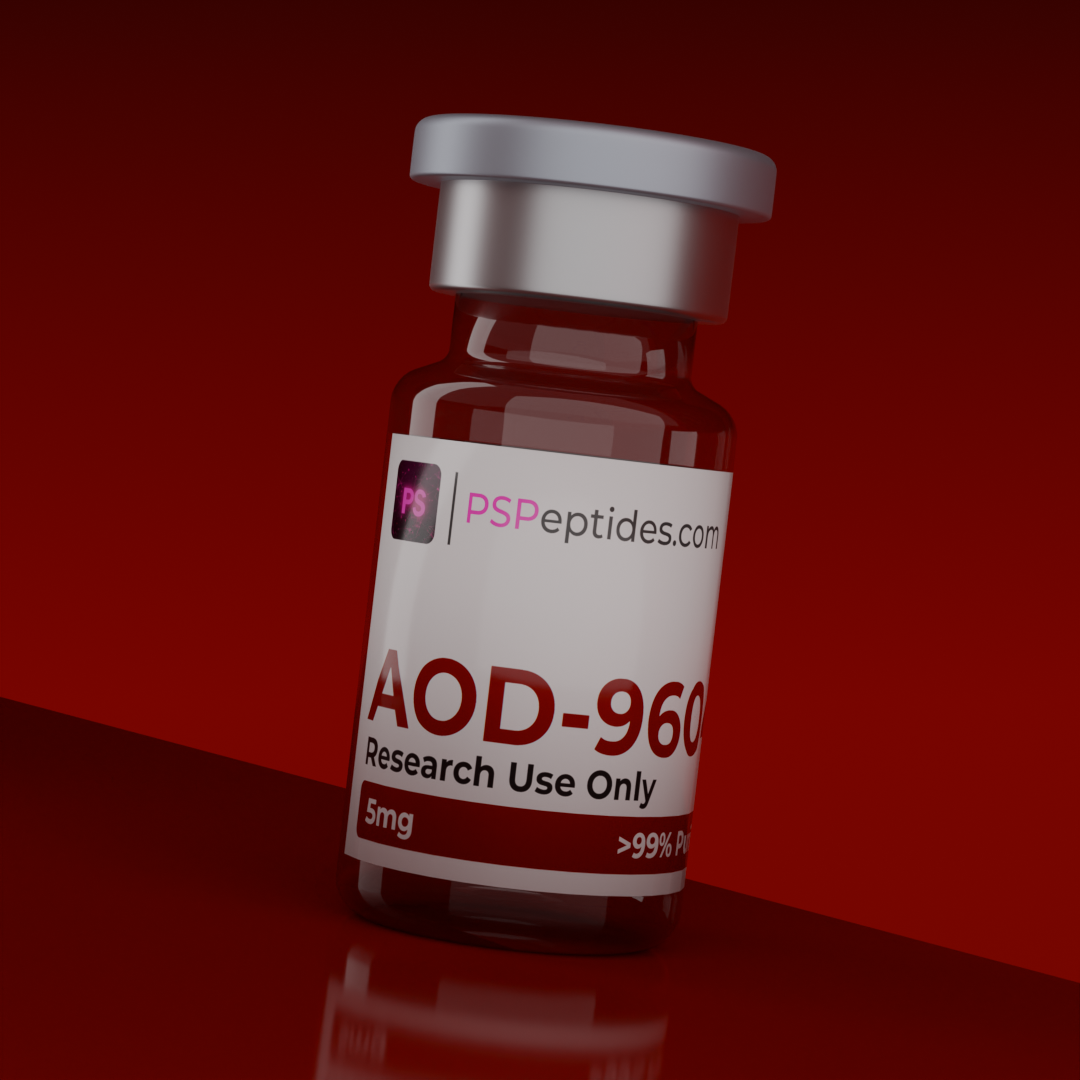
Each 5 mg vial is typically reconstituted with 2 mL of bacteriostatic water, yielding a 2.5 mg/mL working stock, though investigators may adjust volumes based on study design and dosing precision needs. Always inject the diluent slowly down the inner glass wall of the vial and avoid direct jets onto the lyophilized cake, which can damage peptide tertiary structure and cause aggregation.
After reconstitution, gently swirl — do not shake — until the powder fully dissolves. Store the reconstituted solution at 2–8°C and use within 4 weeks for peak potency. If you work with bacteriostatic water regularly, our bacteriostatic water overview explains why the 0.9% benzyl alcohol preservative matters for multi-draw protocols. For step-by-step preparation, see our how to reconstitute peptides walkthrough and dosage calculator guide.
Laboratories using the compound in time-course or dose-response work should prepare fresh aliquots where possible, recording reconstitution date and storage temperature alongside each experimental block. This discipline reduces variability and makes published results more reproducible — a recurring theme in peer review of peptide studies and a small but important contributor to data quality.
Storage & Stability
Lyophilized material is most stable when stored at -20°C, protected from light and moisture, where it retains activity for 24+ months under typical laboratory conditions. Short-term storage at 2–8°C is acceptable for active research periods but will shorten overall shelf life and is not recommended once the vial has been opened.
After reconstitution, the solution should remain refrigerated at 2–8°C and protected from freeze-thaw cycles, which can cause peptide aggregation and measurable loss of bioactivity. Full storage best practices are detailed in our peptide storage guide, and visual and functional signs of degradation are described in peptide degradation: how to tell.
Investigators who rotate multiple peptides through the same lab freezer should label vials clearly and log each thaw cycle; even small temperature excursions accumulate across weeks of active use, and careful logging makes it straightforward to correlate experimental drift with material handling.
Certificate of Analysis
Every AOD-9604 order from PSPeptides ships with a batch-specific Certificate of Analysis (COA) generated by an independent third-party laboratory. The COA reports HPLC purity (≥99%), mass spectrometry identity confirmation, visual appearance, residual solvents, and moisture content for the exact lot shipped. This level of documentation is essential for reproducibility in published research and for audit trails at institutional laboratories.
If you are new to reading COAs, our how to read a peptide COA guide explains each field, typical acceptance criteria, and the red flags that may indicate substandard or mislabeled material. We encourage every researcher to verify the COA that arrives with their shipment before beginning any experiment, and to retain a digital copy alongside lab notebooks for future reference.
Why Researchers Choose PSPeptides
- US Manufactured: Every batch is synthesized in US facilities with strict QC oversight and documentation.
- Third-Party Tested: Independent HPLC and mass spectrometry verification for every lot — no exceptions.
- Fast Shipping: Free UPS 2nd Day Air over $200, with same-day dispatch on orders placed before 2 PM EST on business days.
- Flexible Payments: Credit cards, Afterpay, Klarna, Apple Pay, and Google Pay all accepted at checkout.
- 7-Day Support: Email support from our research team, including weekend coverage for urgent protocol questions.
- Responsible Sourcing: All materials are procured from vetted US synthesis partners; no grey-market resale.
Ordering & Shipping Details
Orders placed before 2 PM Eastern on weekdays typically ship the same business day from our US fulfillment center. No cold packs are needed — lyophilized powder ships stable at ambient temperature in a durable, discreet bubble mailer, and the current lot’s Certificate of Analysis is published on this page. Refrigerate once received.
All domestic shipments include tracking and signature confirmation options at checkout. For laboratories purchasing this product alongside ancillary research supplies such as bacteriostatic water or sterile syringes, our warehouse consolidates items into a single shipment wherever possible to reduce carbon footprint and arrival variability across a research week.
International orders are handled through a restricted list of countries that permit research peptide import; customers outside those jurisdictions should contact customer support before placing an order to confirm eligibility and any documentation requirements.
Frequently Asked Questions
What is AOD-9604 used for in research?
The peptide is primarily studied for targeted lipolysis — the breakdown of stored triglycerides — as well as adipose tissue metabolism, body composition endpoints, and more recently chondrocyte and cartilage repair models. The compound is intended strictly for in vitro and preclinical laboratory investigation and should never be used outside a research context.
How is AOD-9604 different from full-length growth hormone?
The molecule retains only the 176–191 C-terminal fragment of hGH, which carries the lipolytic signal but lacks the sequence regions responsible for IGF-1 elevation and growth-promoting activity. This makes the compound a cleaner tool for isolating fat-metabolism effects in experimental research where mitogenic side effects would confound results.
Does AOD-9604 affect blood sugar or IGF-1?
In published studies, the fragment has not demonstrated meaningful impact on blood glucose, insulin sensitivity, or IGF-1 concentrations at research-relevant doses. This metabolic neutrality is one of the most-cited advantages over full-length hGH in the scientific literature and a key reason the compound was pursued as a metabolic-selective candidate.
How should the vial be reconstituted and stored?
Reconstitute the 5 mg vial with 2 mL of bacteriostatic water, swirl gently, and store at 2–8°C, using within 4 weeks. The lyophilized vial itself should be held at -20°C for long-term stability. See our reconstitution and storage guides for full step-by-step protocols and best practices.
Is AOD-9604 legal to purchase for research?
This material is sold exclusively for laboratory and research applications by qualified investigators and institutions. For a broader overview of the regulatory landscape, see our are research peptides legal in 2026 explainer.
How long does reconstituted solution remain stable?
Under refrigerated storage at 2–8°C and protected from light and freeze-thaw cycles, reconstituted solution is generally used within four weeks. Researchers working with extended time courses should validate stability for their own assay conditions rather than assuming a fixed window.
Related Resources
All PSPeptides products are sold exclusively for laboratory and research use. Not intended for human consumption.
AOD-9604 Assay Design Considerations
When incorporating AOD-9604 into a new lipolysis assay, researchers commonly include vehicle controls, a well-characterized positive control such as isoproterenol, and a dose range spanning two to three orders of magnitude. Because AOD-9604 acts via adipocyte-specific pathways, primary adipocytes or 3T3-L1 differentiated cells are typical matrices of choice; HepG2 and skeletal myocyte lines are less informative for this particular compound.
Readouts most often include glycerol release and free fatty acid quantification in the supernatant, alongside cellular ATP or viability measures to confirm that observed lipolysis reflects genuine metabolic signaling rather than cytotoxic membrane disruption. Running AOD-9604 in parallel with a GHRH analog or a pure β3-AR agonist helps clarify receptor-pathway contributions for any new mechanistic question.
For teams publishing AOD-9604 data, reporting the lot number, reconstitution diluent, and storage interval alongside assay results improves inter-laboratory comparability. Our published-research FAQs recommend keeping a dedicated spreadsheet of vial usage so that reviewers can trace any observed variability back to material handling rather than biology.
Summary
AOD-9604 is a compact, well-studied growth hormone fragment with a narrow lipolytic mechanism, a strong safety record in toxicology studies, and a clear position in metabolic research as a GH-receptor-independent tool compound. Whether your interest is adipose metabolism, β3-AR signaling, cartilage chondrocyte biology, or the broader question of how to separate IGF-1-mediated effects from direct lipolysis, AOD-9604 provides a clean, characterized research peptide with abundant published literature.





 Made & Shipped