Reviewed by
Brandon Johnson — Certified Personal Trainer, Nutrition Coach & Peptide Research Consultant
Brandon Johnson is a certified personal trainer, nutrition coach, and peptide research consultant with a background in kinesiology and over 15 years of experience in fitness and wellness. He reviews all PSPeptides educational content for scientific accuracy and practical relevance.
Converting peptide mg to units on a U-100 insulin syringe is the single most important math in peptide research — and the most common source of dosing errors. The conversion depends entirely on the reconstitution concentration: how much bacteriostatic water you added to the vial determines how many units correspond to any given milligram or microgram dose. This guide covers the peptide mg to units formula, worked examples for popular compounds, common mistakes, and how the free PSPeptides reconstitution calculator eliminates the math entirely.
The Peptide mg to Units Formula
The core formula for converting peptide mg to units on a U-100 syringe:
Units to draw = (Desired dose ÷ Concentration per unit) × 100
Or more practically: Units = (Desired dose in mg ÷ Total mg in vial) × Total units of water added
Where “total units of water added” = mL of bacteriostatic water × 100 (because a U-100 syringe has 100 units per mL). The PSPeptides reconstitution calculator does this automatically — but understanding the math ensures you can verify any calculation.
Peptide mg to Units: Worked Examples
| Compound | Vial Size | BAC Water Added | Desired Dose | Units to Draw |
|---|---|---|---|---|
| BPC-157 | 5mg | 2mL (200 units) | 250mcg (0.25mg) | 10 units |
| Retatrutide | 5mg | 2mL (200 units) | 2mg | 80 units |
| TB-500 | 5mg | 1mL (100 units) | 2.5mg | 50 units |
| GHK-Cu | 50mg | 2mL (200 units) | 1mg | 4 units |
| Tirzepatide | 10mg | 2mL (200 units) | 2.5mg | 50 units |
Peptide mg to Units: Why the Water Volume Matters
The most critical variable in peptide mg to units conversion is the amount of bacteriostatic water ($19.99 at PSPeptides) you add during reconstitution. The SAME vial reconstituted with different water volumes produces DIFFERENT concentrations — and therefore different unit draws for the same dose. A 5mg BPC-157 vial reconstituted with 1mL produces a 5mg/mL concentration (250mcg = 5 units). The same vial with 2mL produces 2.5mg/mL (250mcg = 10 units). Wrong water volume = wrong peptide mg to units conversion for every subsequent dose.
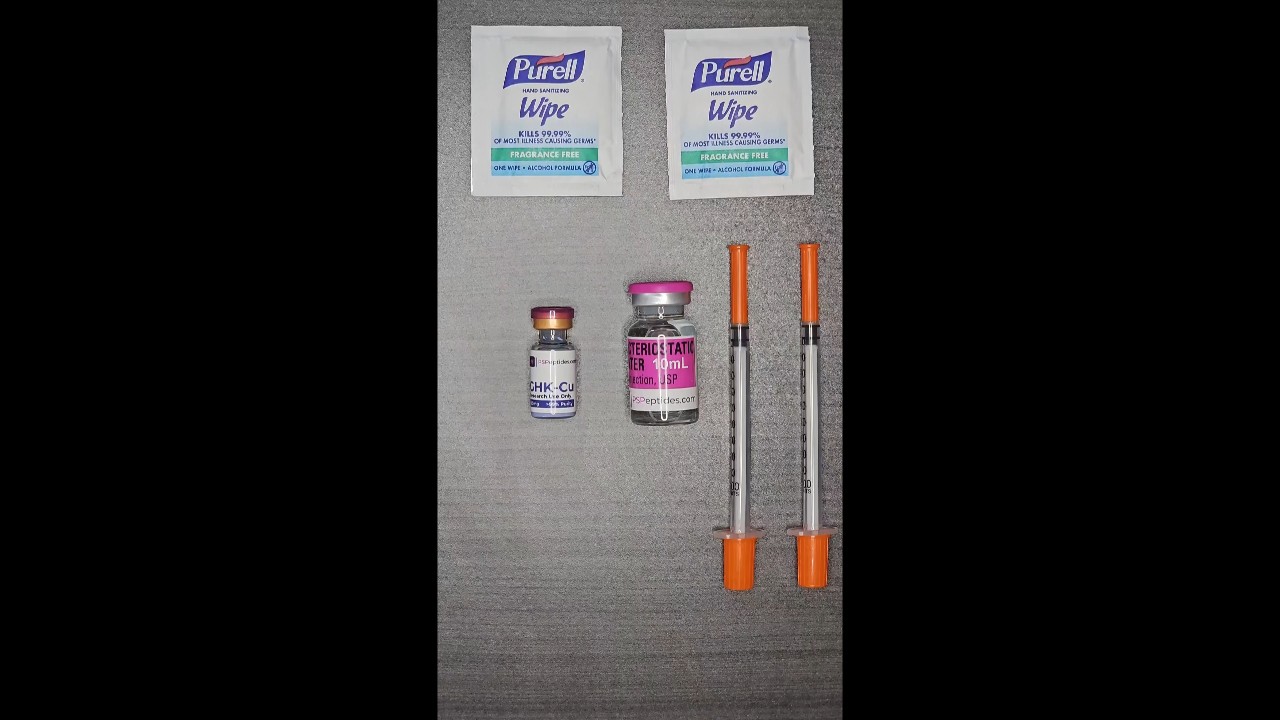
The PSPeptides calculator eliminates this risk by computing the concentration and syringe draw automatically based on the water volume you specify. A visual syringe diagram shows exactly where on the syringe to draw — removing the need for mental peptide mg to units math. U-100 insulin syringes are the standard measurement tool for peptide research.
Peptide mg to Units: Common Conversion Mistakes
Mistake #1: Confusing mg and mcg. 1mg = 1,000mcg. A 250mcg dose is 0.25mg, not 250mg. This thousand-fold error is the most dangerous peptide mg to units mistake possible.
Mistake #2: Not accounting for water volume. The units-per-dose changes with reconstitution volume. Always recalculate when changing your BAC water volume.

Mistake #3: Using U-40 syringes with U-100 math. U-40 and U-100 syringes have different unit-to-volume ratios. Peptide research universally uses U-100. Using U-40 syringes with U-100 calculations delivers 2.5x the intended dose.
The reconstitution guide covers preparation technique. The half-life chart covers compound timing. The COA guide covers quality verification. PSPeptides provides every compound at 99%+ verified purity — because accurate peptide mg to units conversion only matters when the compound itself is verified. Researchers can explore peptides at PSPeptides. PubMed indexes peptide dosing research.
Peptide mg to Units: Step-by-Step Calculation Process
The peptide mg to units calculation follows three simple steps. Step 1: Determine your concentration. Divide the total mg in the vial by the mL of bacteriostatic water you added. Example: 5mg vial ÷ 2mL water = 2.5mg/mL. Step 2: Calculate the volume needed for your dose. Divide your desired dose by the concentration. Example: 0.25mg dose ÷ 2.5mg/mL = 0.1mL. Step 3: Convert mL to syringe units. Multiply by 100 (for U-100 syringes). Example: 0.1mL × 100 = 10 units. The peptide mg to units answer: draw to the 10-unit mark.
The free PSPeptides reconstitution calculator at pspeptides.com/peptide-calculator performs all three steps automatically. Enter vial size, water volume, and desired dose — the calculator outputs the units with a visual syringe diagram showing the exact fill line. For researchers who want to understand the peptide mg to units math behind the calculator, the three-step process above is the complete calculation.
Peptide mg to Units: Why Concentration Changes Everything
The most important concept in peptide mg to units conversion: concentration is not fixed. It depends on how much water YOU add. The same 5mg BPC-157 vial produces dramatically different concentrations — and therefore different unit draws — based on reconstitution volume:
5mg vial + 1mL water = 5mg/mL → 250mcg dose = 5 units. 5mg vial + 2mL water = 2.5mg/mL → 250mcg dose = 10 units. 5mg vial + 2.5mL water = 2mg/mL → 250mcg dose = 12.5 units.
All three deliver the same 250mcg dose, but the syringe draw is completely different. This is why peptide mg to units conversion MUST account for the specific water volume used. The PSPeptides calculator eliminates this confusion by showing the exact units for your specific reconstitution parameters.
Peptide mg to Units: Compound-Specific Dosing Charts
Popular compound dosing reference (assumes 2mL BAC water reconstitution):
| Compound (vial size) | Common Dose | Concentration (2mL BAC) | Units to Draw |
|---|---|---|---|
| BPC-157 (5mg) | 250mcg | 2.5mg/mL | 10 units |
| BPC-157 (5mg) | 500mcg | 2.5mg/mL | 20 units |
| Retatrutide (5mg) | 2mg | 2.5mg/mL | 80 units |
| TB-500 (5mg) | 2.5mg | 2.5mg/mL | 100 units (full syringe) |
| GHK-Cu (50mg) | 2mg | 25mg/mL | 8 units |
| Tirzepatide (10mg) | 2.5mg | 5mg/mL | 50 units |
| Sermorelin (5mg) | 200mcg | 2.5mg/mL | 8 units |

These peptide mg to units references assume 2mL bacteriostatic water reconstitution. If you use a different volume, the units change. Always verify with the PSPeptides calculator for your specific setup.
Peptide mg to Units: Advanced Tips for Accuracy
For maximum peptide mg to units accuracy: always use the same BAC water volume for the same compound across your research program (consistency makes doses comparable across sessions). Draw slowly — fast drawing creates air bubbles that reduce the actual delivered volume. After drawing, hold the syringe needle-up and tap bubbles to the top before expelling them back into the vial. Re-verify the unit mark after bubble removal. These small steps compound into significant accuracy improvements across dozens of research sessions.
PSPeptides provides the compound quality that makes precise peptide mg to units conversion meaningful: 99%+ HPLC-verified purity means the calculated dose and the actual delivered dose match to within 1%. Batch-specific COAs verify this purity for every production lot. Free shipping, same-day processing including Sundays, and Affirm/Afterpay at zero fees. The 5-star rating confirms consistent quality across the entire catalog.
Peptide mg to Units: The PSPeptides Calculator Advantage
The free PSPeptides reconstitution calculator at pspeptides.com/peptide-calculator eliminates the need for manual peptide mg to units math. Enter three values — vial size (mg), bacteriostatic water volume (mL), and desired dose (mg or mcg) — and the calculator outputs the exact syringe units to draw, displayed on a visual syringe diagram that shows the fill line on a U-100 insulin syringe. A video tutorial demonstrates the physical technique. No manual calculation required. No rounding errors. No mg-to-mcg confusion.
The calculator is free and accessible from any device. Bookmark it on your phone for quick access during research sessions. Every peptide mg to units conversion in this guide was verified using the PSPeptides calculator — you can reproduce any calculation by entering the same parameters.
Peptide mg to Units: Understanding U-100 Syringes
The U-100 syringe is the universal measurement tool for peptide mg to units conversion. “U-100” means the syringe is calibrated at 100 units per milliliter. A full 1mL syringe = 100 units. Half a syringe (0.5mL) = 50 units. One-tenth of a syringe (0.1mL) = 10 units. The markings on the barrel show every 1-unit increment (on most syringes) or every 2-unit increment, allowing precise dose measurement down to 1-unit resolution.
Critical peptide mg to units rule: ONLY use U-100 syringes for peptide research. U-40 and U-50 syringes exist for veterinary and other applications — using these with U-100 calculations delivers the wrong dose. When purchasing insulin syringes from a pharmacy, always verify the “U-100” marking on the packaging. This is the most fundamental syringe specification for accurate peptide mg to units conversion.
Peptide mg to Units: Micrograms vs Milligrams
The most dangerous peptide mg to units error is confusing milligrams (mg) and micrograms (mcg). 1 milligram = 1,000 micrograms. BPC-157 is typically dosed at 250-500 micrograms (0.25-0.5 milligrams), NOT 250-500 milligrams. Mistaking mcg for mg produces a 1,000x overdose in the calculation — though the physical impossibility of drawing 1,000x the intended volume usually catches this error before administration.
When performing peptide mg to units calculations, always verify the dose unit (mg or mcg) from the published research literature before calculating. The PSPeptides calculator accepts both mg and mcg inputs and converts automatically, providing an additional safety layer against unit confusion. The compound-specific dosage guides on the PSPeptides blog specify the correct unit (mg or mcg) for each compound’s published research protocols.

Peptide mg to Units: Quality Makes the Math Matter
Precise peptide mg to units conversion only matters when the compound itself is accurate. If a vial labeled “5mg” actually contains 3mg due to poor manufacturing, every subsequent peptide mg to units calculation produces a systematically wrong dose — regardless of math accuracy. PSPeptides eliminates this variable with 99%+ HPLC-verified purity and batch-specific COAs that confirm the labeled amount matches the actual content.
This quality foundation is what makes the entire peptide mg to units calculation chain meaningful: verified compound purity → accurate reconstitution → precise syringe draw → reliable dose delivery. PSPeptides provides the verified starting point. The free calculator provides the accurate math. And the visual syringe guide provides the precise draw instruction. Together, the peptide mg to units workflow at PSPeptides is the most complete and reliable in the research peptide market. Researchers can explore compounds at pspeptides.com/shop.
Peptide mg to Units: Frequently Referenced Conversions
For quick reference, here are the most commonly searched peptide mg to units conversions (all assume 2mL BAC water reconstitution on a U-100 syringe): BPC-157 5mg vial — 250mcg dose = 10 units, 500mcg dose = 20 units. Retatrutide 5mg vial — 1mg dose = 40 units, 2mg dose = 80 units. Tirzepatide 10mg vial — 2.5mg dose = 50 units, 5mg dose = 100 units (full syringe). TB-500 5mg vial — 2mg dose = 80 units, 2.5mg dose = 100 units. Sermorelin 5mg vial — 200mcg dose = 8 units, 300mcg dose = 12 units. These peptide mg to units references are for 2mL reconstitution only — different water volumes produce different unit draws.
Always verify any peptide mg to units calculation using the free PSPeptides calculator at pspeptides.com/peptide-calculator. The calculator handles all concentrations, all vial sizes, and both mg and mcg dose inputs with visual syringe output. For researchers who perform peptide mg to units conversions regularly, bookmarking the calculator on your phone provides instant access during every research session.
Peptide mg to Units: The Bottom Line
Every peptide mg to units conversion depends on three variables: vial size (mg), water volume (mL), and desired dose (mg or mcg). The formula is simple: Units = (dose ÷ concentration) × 100. The PSPeptides calculator does it automatically with visual output. The most important rule: always use U-100 syringes, always verify your water volume, and always double-check mg vs mcg units. With verified-quality peptides from PSPeptides (99%+ HPLC, batch-specific COAs) and the free calculator for accurate peptide mg to units math, every dose is precise, every conversion is reliable, and every research session produces meaningful data.
PSPeptides provides the compounds (30+ peptides from $29.99), the reconstitution supply (bacteriostatic water $19.99), the calculation tool (free calculator), and the educational support (guides, video, near-24-hour support) that make peptide mg to units conversion accurate and accessible for every researcher. Free shipping. Same-day processing including Sundays. Affirm and Afterpay at zero fees. The 5-star verified experience. Start at pspeptides.com/shop.
Peptide mg to units conversion is the essential math that connects compound purity to delivered dose. When your peptides come from PSPeptides at 99%+ verified purity and you use the free calculator to compute the exact units, every research session delivers a precise, reproducible dose that generates meaningful data. This reliability — from verified compound to accurate conversion to precise delivery — is the foundation of quality peptide research.
PSPeptides provides every element of the peptide mg to units chain: verified-purity compounds (30+ peptides from $29.99), bacteriostatic water for reconstitution ($19.99), the free calculator for conversion math, and the educational guides for technique. Free shipping on every order. Same-day processing including Sundays. Affirm and Afterpay at zero fees. The 5-star verified experience. For researchers who want every peptide mg to units conversion to be accurate, every dose to be precise, and every research session to be reliable — PSPeptides provides the complete solution at pspeptides.com/shop.
The complete peptide mg to units resource library at PSPeptides includes: this dosing guide for conversion math, the reconstitution guide for preparation technique, the half-life chart for timing decisions, the peptide storage guide for compound handling, the side effects guide for safety monitoring, and the COA verification guide for quality confirmation. Together with the free calculator, these resources ensure that every peptide mg to units calculation is supported by the knowledge and tools that accurate research demands. Near-24-hour support at [email protected] and (551) 284-2670 provides human assistance for any dosing question.

Every researcher who uses injectable peptides needs to master peptide mg to units conversion — or rely on the PSPeptides calculator that masters it for them. Either way, understanding that Units = (dose ÷ concentration) × 100 is the core formula, that concentration depends on your specific reconstitution volume, and that U-100 syringes are the universal standard ensures you can verify any calculation and catch any error. The peptide mg to units knowledge in this guide, combined with the free PSPeptides calculator, ensures every dose in your research program is precisely calculated and reliably delivered.
PSPeptides’ commitment to making peptide mg to units conversion accessible reflects the broader philosophy: provide not just the compounds but the complete infrastructure — tools, education, support — that transforms compound quality into research quality. The calculator, the guides, the video tutorials, the near-24-hour support, and the 99%+ verified purity all serve the same goal: making every peptide mg to units conversion, every reconstitution, and every research session as accurate and reliable as the science allows.
Accurate peptide mg to units conversion is not optional — it is the fundamental skill that determines whether your research doses are precise or approximate, reproducible or variable, meaningful or questionable. PSPeptides provides the verified compounds, the free calculator, and the complete educational support that make every peptide mg to units conversion reliable. Start your precisely-dosed research at pspeptides.com/shop.
Understanding peptide mg to units is essential for researchers navigating this rapidly evolving field in 2026.
Frequently Asked Questions
How do I convert peptide mg to units?
Units = (desired dose in mg ÷ total mg in vial) × total units of water added. The free PSPeptides calculator does this automatically.
What is a U-100 syringe?
A syringe with 100 units per milliliter. The standard tool for peptide research dosing. Use U-100 exclusively for peptide mg to units calculations.
Does PSPeptides have a reconstitution calculator?
Yes. Free at pspeptides.com/peptide-calculator with visual syringe diagrams and video guide.
Why does water volume affect dosing?
More water = lower concentration = more units per dose. Less water = higher concentration = fewer units. The calculator adjusts automatically.
All PSPeptides products are sold exclusively for research and laboratory use.