Semax is a synthetic heptapeptide developed at the Institute of Molecular Genetics of the Russian Academy of Sciences. As an analog of the adrenocorticotropic hormone fragment ACTH(4-10), the molecule retains the neurotropic activity of the parent hormone without stimulating cortisol release from the adrenal cortex. This separation of actions is why the compound has drawn sustained interest in cognitive and neuroprotection research. For a broader discussion of short-chain brain peptides, see our cognitive enhancement guide.
Approved in Russia since 1994 for neurological indications such as transient ischemic attack, stroke recovery, and cognitive disorders, the compound has become one of the most extensively studied short-chain regulatory peptides for brain research worldwide. Laboratories across Europe, Asia, and North America have incorporated the molecule into models of learning, neuroplasticity, ischemic injury, and age-related cognitive decline.
The heptapeptide sequence Met-Glu-His-Phe-Pro-Gly-Pro resists enzymatic degradation better than the native ACTH(4-10) fragment, extending its biological half-life. This structural stabilization is one reason researchers prefer the analog for in vivo studies where consistent exposure is required over a sampling window of several hours.
Detailed Mechanism of Action
The heptapeptide acts through multiple overlapping neurochemical pathways. The primary researched mechanism involves upregulation of brain-derived neurotrophic factor and nerve growth factor in the hippocampus and frontal cortex. These neurotrophins support neuronal survival, synaptogenesis, dendritic branching, and activity-dependent synaptic plasticity, all of which underpin learning and memory formation.
A second key pathway involves modulation of dopaminergic and serotonergic neurotransmission. Microdialysis studies in rodents report changes in extracellular dopamine in the striatum and prefrontal cortex following administration, along with serotonergic shifts that may contribute to observed effects on attention, motivation, and mood regulation in preclinical work.
Intranasal delivery allows for rapid central nervous system uptake via the olfactory pathway, bypassing first-pass hepatic metabolism and the blood-brain barrier. This route of administration is consistently used in published pharmacokinetic studies and contributes to the fast onset of measurable behavioral and biochemical effects in rodent experiments.
Additional pathways investigated include inhibition of enkephalin-degrading enzymes, which prolongs endogenous opioid peptide signaling and modulates pain perception and stress response. Effects on melanocortin receptors, immune signaling, and vascular endothelial function have also been described in preclinical transcriptomic profiles. Unlike the parent ACTH molecule, the analog produces no measurable adrenocortical stimulation. For mechanistic terminology, review our peptide glossary.

Published Research Highlights
The heptapeptide has been the subject of extensive peer-reviewed research since the 1990s. Dolotov and colleagues (2006) demonstrated measurable upregulation of BDNF expression in the rat hippocampus within hours of intranasal administration. Shadrina and colleagues (2010) reported modulation of serotonergic and dopaminergic systems in rodent models following acute dosing, with gene expression changes persisting beyond the immediate pharmacokinetic window.
Preclinical stroke research has repeatedly shown reduction of infarct volume and improved functional recovery in middle cerebral artery occlusion models. Investigators have reported preserved motor coordination, faster sensorimotor recovery, and reduced neuroinflammatory markers when dosing is initiated early in the post-ischemic window.
Further studies have explored the compound in models of optic nerve injury, peripheral nerve regeneration, chronic cerebral hypoperfusion, and age-related cognitive decline. Neuroimaging and electrophysiological endpoints have been combined with behavioral testing to triangulate mechanistic claims about neuroplasticity and attention.
Relevant external citations are indexed on PubMed and PubMed BDNF studies. For a broader nootropic peptide comparison, see our nootropic comparison article and our peptides for longevity guide.
Comparison With Related Nootropic Peptides
| Feature | This Product | Selank | Noopept |
|---|
| Structural class | Heptapeptide | Heptapeptide | Dipeptide (small molecule derivative) |
| Parent analog | ACTH(4-10) | Tuftsin | Piracetam derivative |
| Primary research focus | Cognition, neuroprotection | Anxiolytic, calm focus | Memory, learning |
| BDNF upregulation | Strong preclinical evidence | Moderate preclinical evidence | Moderate preclinical evidence |
| HPA stimulation | None reported | None reported | None reported |
| Typical research route | Intranasal | Intranasal | Oral |
| Country of origin | Russia, 1994 | Russia, 2000s | Russia, 1996 |
| Form supplied | Lyophilized powder | Lyophilized powder | Crystalline powder |
Reconstitution and Laboratory Handling
Laboratory reconstitution typically uses bacteriostatic water or sterile water for injection. A common research approach is to reconstitute the vial with two to three milliliters of bacteriostatic water, producing a stable solution suitable for refrigerated storage. Gently swirl the vial until fully dissolved rather than shaking vigorously, which can introduce shear stress and denature the peptide backbone.
Accurate dosing in research protocols depends on calculating concentration based on the mass in the vial and the reconstitution volume. Laboratories typically verify the final concentration by UV spectrophotometry at 280 nm or by analytical HPLC before proceeding with animal or in vitro studies.
For step-by-step protocols, see our reconstitution guide and the dosage calculator walkthrough. Additional background on diluent selection, bacteriostatic agents, and sterility best practices is available in our bacteriostatic water article and our injection route primer.
Storage and Stability Considerations
Unreconstituted lyophilized material should be stored at -20°C, protected from light and moisture. The lyophilized form is highly stable for extended periods under proper freezer conditions, and brief transit at ambient temperatures is generally tolerated because the dry powder is resistant to thermal stress and hydrolytic degradation.
Once reconstituted, the solution should be refrigerated at 2-8°C and used within approximately four weeks. Avoid repeated freeze-thaw cycles of reconstituted material, as temperature cycling promotes aggregation, precipitation, and measurable loss of potency. Store working solutions in amber vials or wrapped in foil to minimize photodegradation.
Long-term handling, cold-chain considerations, and degradation indicators are covered in our storage guide and our degradation article. For half-life context across the research peptide catalog, see our peptide half-life chart.
Certificate of Analysis and Third-Party Testing
Every lot is accompanied by a batch-specific Certificate of Analysis documenting identity, purity, mass accuracy, and residual solvent testing. Analytical methods include reversed-phase HPLC for purity assessment and electrospray ionization mass spectrometry for molecular weight confirmation. Additional testing may include water content by Karl Fischer titration and endotoxin screening depending on lot specifications.
Independent third-party verification protects researchers from lot-to-lot variability that has historically plagued the research chemical market. For a plain-language walkthrough of interpreting these documents, see our how to read a COA guide. Peer-reviewed background is available on NIH PMC publications.
Why Researchers Choose PSPeptides
- US Manufactured: Domestic production under controlled laboratory conditions with documented chain of custody.
- Third-Party Tested: Independent HPLC and mass spectrometry verify every lot before release.
- Fast Shipping: Free UPS 2nd Day Air over $200, with same-day dispatch on orders placed before 2 PM EST.
- Flexible Payments: Credit cards, Afterpay, Klarna, Apple Pay, and Google Pay are all supported at checkout.
- 7-Day Support: Reach our support team by email, seven days a week for questions before and after purchase.
- Transparent COA Access: Batch documents available on request for every order.
Frequently Asked Questions
What is this heptapeptide used for in research?
The compound is used in laboratory research on cognition, neuroprotection, and neurotrophin upregulation. It is a common tool in preclinical studies of stroke recovery, working memory, attention, and mood-related pathways, often selected for its favorable stability and lack of adrenocortical activity.
How is the compound typically administered in studies?
In published research, the analog is most often administered intranasally due to favorable CNS bioavailability through the olfactory pathway. Some rodent studies also use subcutaneous or intraperitoneal routes depending on the experimental endpoint and pharmacokinetic goals.
How does this analog differ from Selank?
The ACTH(4-10) analog is primarily investigated for cognition and neuroprotection, while Selank, derived from tuftsin, is more frequently studied for anxiolytic and calm-focus effects. Both are heptapeptides from the same Russian research lineage and share some structural and pharmacological similarities, but their downstream signaling profiles diverge.
Is the product from PSPeptides third-party tested?
Yes. Every batch is independently tested by accredited third-party laboratories using HPLC and mass spectrometry. A batch-specific Certificate of Analysis is provided with every vial, documenting identity, purity, and molecular weight.
Can I use this product for human consumption?
No. All PSPeptides products are sold strictly for laboratory and research use. They are not supplements, cosmetics, or therapeutics, and they are not intended for human or veterinary consumption.
Related Resources
Additional Context for Semax Researchers
Laboratories considering Semax for nootropic screens often begin with dose-ranging pilots to establish signal-to-noise on their chosen endpoint. Because Semax has a well-characterized pharmacokinetic profile in rodents following intranasal administration, pilot studies can be completed efficiently and the resulting dose-response curves can guide larger confirmatory experiments.
Endpoint selection matters as much as dosing. For cognitive research, attention and working memory paradigms tend to show larger effect sizes than tasks dominated by motor components. For neuroprotection research, early-window dosing relative to insult onset consistently produces stronger effects than delayed dosing. Reviewing published methods carefully before designing a new study helps avoid common pitfalls, such as using a rodent strain known to be unresponsive in a particular task or adopting a delivery vehicle that complicates interpretation.
Finally, reproducibility is improved by keeping meticulous records of lot numbers, reconstitution dates, and storage conditions across every experiment. Pairing these operational records with the batch-specific COA creates an evidentiary trail that peer reviewers and collaborators increasingly expect when Semax or similar research peptides are involved.
All PSPeptides products are sold exclusively for laboratory and research use. Not intended for human consumption.
Semax Research Protocols
Research protocols involving Semax typically combine careful reconstitution, accurate dosing, and rigorous endpoint selection. Laboratories studying Semax in cognitive paradigms often pair Semax administration with behavioral assays such as the Y-maze, novel object recognition, or passive avoidance tests. When Semax is investigated for neuroprotection, the typical design involves inducing an ischemic or excitotoxic insult and then administering Semax at defined time points to measure lesion volume, neurological scores, and molecular markers.
Because Semax is studied at relatively low absolute doses, microgram-level precision is critical. Investigators using Semax in chronic dosing designs should plan for cold-chain stability across the full study duration, since reconstituted Semax is less stable than the lyophilized Semax starting material. Blinded dosing and vehicle-matched controls help isolate Semax effects from handling stress and solvent effects.
Semax has also been incorporated into combination studies with other research peptides, such as Selank, to explore complementary anxiolytic and nootropic endpoints. In such combination work, Semax is usually the primary agent for cognitive endpoints while Selank is used to probe stress-reactivity measures. Reviewing Semax dosing logs against pharmacokinetic time courses helps align sampling windows with peak central exposure.
Semax Purity, Identity, and Batch Consistency
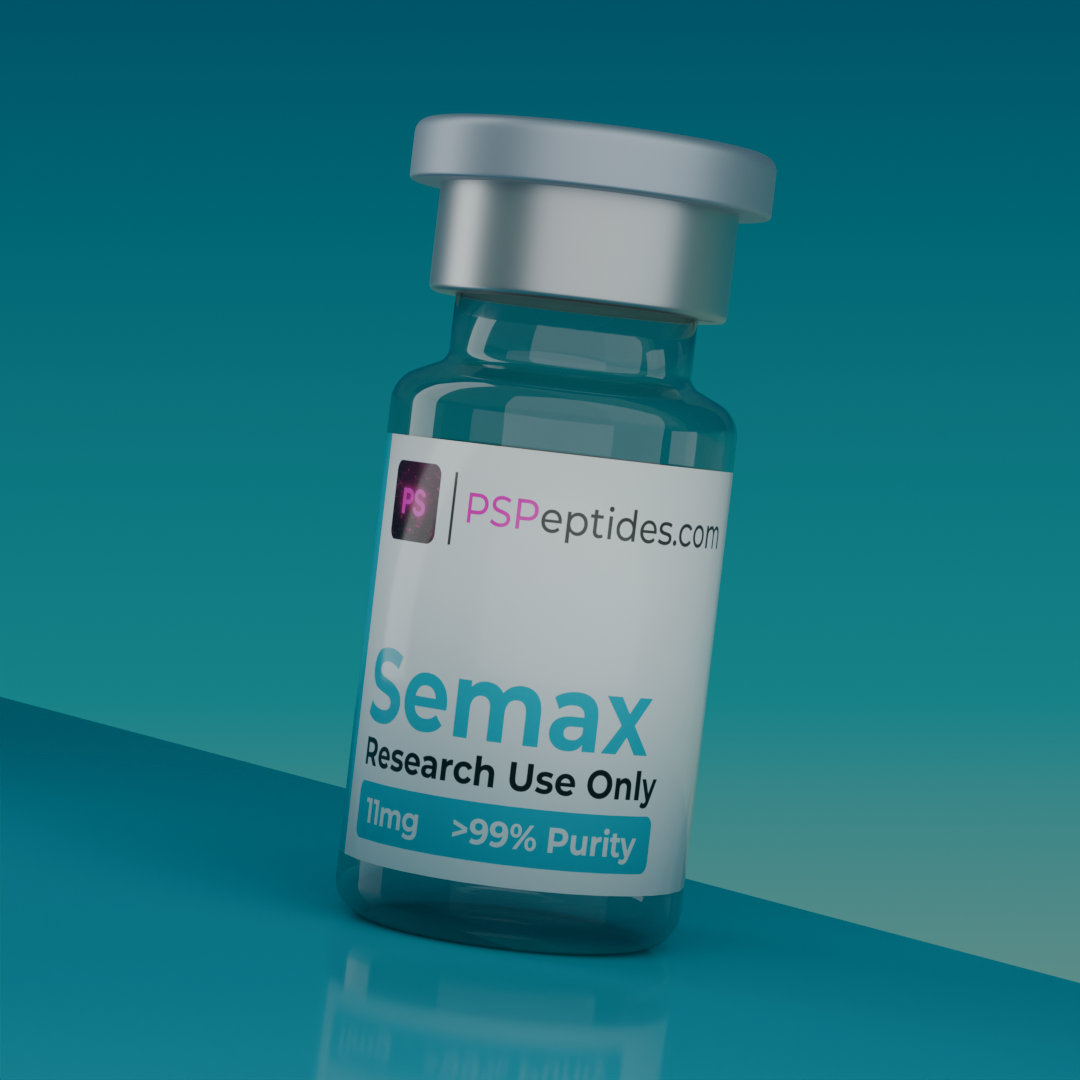
Semax supplied by PSPeptides is manufactured to a minimum purity specification of 99% and each lot ships with an independent Certificate of Analysis. The identity is confirmed by mass spectrometry against the expected molecular weight of 813.93 g/mol, and Purity is quantified by reversed-phase HPLC using gradient elution and UV detection. Batch-to-batch consistency is monitored against internal specifications, and any lot falling outside spec is rejected before release.
Documenting identity and purity matters because subtle impurities can confound research endpoints, particularly in sensitive behavioral or neurochemical assays. Researchers working in long-term studies should request the COA for every new lot and archive the batch identifiers alongside their raw data. This level of provenance tracking is standard for any research program aiming for publication-grade reproducibility.
Semax Safety Notes and Handling Precautions
This compound is a research material and should be handled with the precautions appropriate to any bioactive peptide. Laboratory personnel should wear appropriate PPE, including nitrile gloves and eye protection, and should reconstitute the material in a clean biosafety cabinet or laminar flow hood when sterility is required. Spills of the powder or solution should be contained promptly and decontaminated per institutional SOPs.
The product should not be consumed by humans or animals outside of formally approved research protocols. It is not a dietary supplement, cosmetic, or drug, and no claim of therapeutic benefit is made sold as a research compound. Laboratories procuring Semax agree to use the material strictly for in vitro or preclinical in vivo research in accordance with applicable institutional and regulatory requirements. Additional regulatory context for compounds like this one is discussed in our legal status article.
Shipping, Packaging, and Order Handling for Semax
Lyophilized Semax is stable in transit and needs no cold pack. Orders ship from US warehouses in durable, discreet bubble mailers; refrigerate on receipt for long-term storage. Each shipment includes the vial or vials ordered plus the batch COA either in-box or by email on request.
Researchers ordering the product for time-sensitive studies should place orders well in advance of critical experimental windows to accommodate potential carrier delays. Orders placed before 2 PM Eastern on business days typically ship the same day, and free UPS 2nd Day Air applies to orders over $200. Support staff can help coordinate split shipments across multiple addresses for multi-site research programs.
Semax in the Broader Research Peptide Landscape
Within the broader landscape of research peptides, the compound occupies a distinctive niche at the intersection of cognitive, neuroprotective, and neurotrophic research. Unlike growth-factor-mimicking peptides focused on tissue repair, it is primarily a central nervous system agent. Unlike GLP-1 class peptides aimed at metabolic endpoints, research on this molecule centers on brain signaling, plasticity, and recovery from injury. This focus has kept Semax relevant across decades of nootropic and neuroprotection literature.
Researchers exploring the heptapeptide alongside peptides such as Selank, Cerebrolysin-like products, or neurotrophic fragments often build comparative matrices that rank Semax by endpoint sensitivity, stability, and reproducibility. Because Semax has been manufactured to a published specification since 1994, there is a relatively large literature base against which new results can be benchmarked. This depth of prior work makes Semax a useful positive control in exploratory nootropic screens.
For researchers new to this class, our complete guide to peptides and our glossary provide vocabulary and mechanistic framing that complement any hands-on work. Comparative nootropic context is available in our Semax versus Selank comparison.





 Made & Shipped