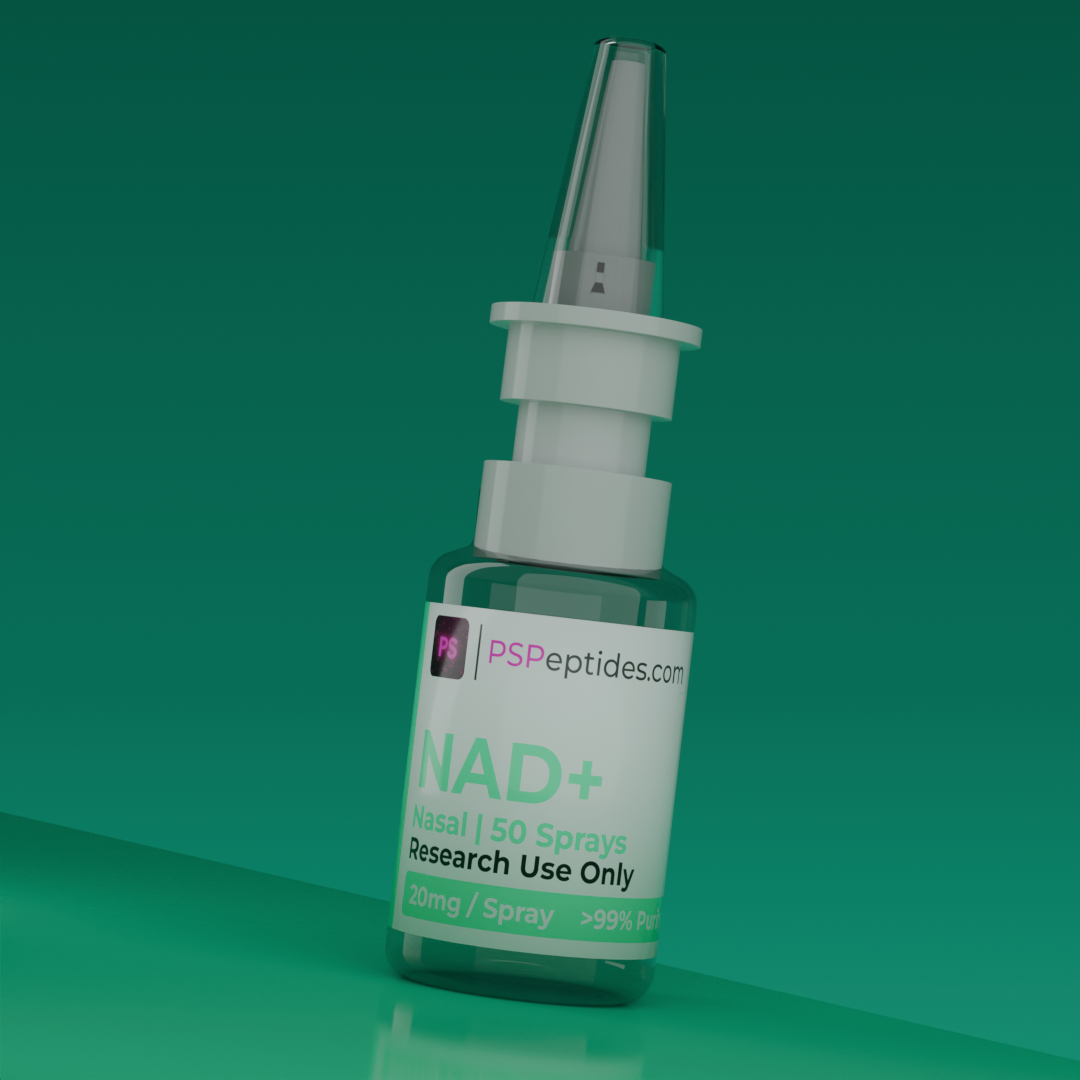
NAD+ Spray
Price range: $89.99 through $139.99
NAD+ Spray — US-manufactured research formulation, 99%+ purity, third-party tested with batch COA. For laboratory research use only.




 Made & Shipped
For laboratory and research use only. This product is not a drug, food, or cosmetic and is not for human or animal consumption. It is not intended to diagnose, treat, cure, or prevent any disease. These statements have not been evaluated by the FDA. Sold solely to qualified researchers and licensed laboratories. Certificate of Analysis available on request.
Description
NAD+ spray from PSPeptides is a US-manufactured, third-party tested research formulation of nicotinamide adenine dinucleotide (NAD+), a coenzyme central to cellular energy metabolism. Each batch ships at 99%+ purity with a batch-specific Certificate of Analysis, giving researchers a consistent, verifiable starting material for laboratory work. This NAD+ spray is intended strictly for laboratory and research use, not for human consumption.
What Is NAD+ Spray?
NAD+ is a coenzyme present in every living cell, where it shuttles electrons during cellular respiration and acts as a required substrate for enzymes that regulate DNA repair, gene expression, and mitochondrial function. Because NAD+ is difficult to deliver intact across cell membranes, its handling and delivery format are active areas of laboratory interest.
This NAD+ spray delivers the coenzyme in a ready-to-use liquid format, removing the need for reconstitution and giving researchers a stable, easily measured starting point for their own experimental protocols.
Key Research Applications
- Cellular Energy Metabolism: NAD+ is studied for its role as an electron carrier during glycolysis, the citric acid cycle, and oxidative phosphorylation, all of which depend on a steady NAD+/NADH ratio.
- Sirtuin Pathway Research: Investigators use NAD+ to model activation of sirtuin (SIRT1-7) enzymes linked to metabolic regulation, mitochondrial biogenesis, and cellular stress resistance.
- DNA Repair Studies: NAD+ is a required substrate for PARP enzymes involved in genomic stability and DNA damage response research following induced cellular stress.
- Cellular Aging Models: Declining tissue NAD+ levels are a widely studied biomarker in cellular aging and senescence research across multiple organ systems.
Product Specifications
| Available Sizes | 500mg and 1000mg spray options |
| Purity | 99%+ (third-party HPLC and mass spectrometry) |
| Form | Liquid oral spray |
| Storage | Cool, dry location, protected from direct light |
| Testing | Batch-specific COA included |
| Origin | US manufactured |
A Brief History of NAD+ Research
NAD+ was first identified in 1906 by British biochemists Arthur Harden and William Young, who observed a heat-stable factor that accelerated fermentation in yeast extracts and called it “cozymase.” Later biochemists, including Otto Warburg, characterized its structure and clarified its role as a hydrogen-carrying coenzyme in cellular respiration during the 1930s.
Since then, decades of biochemistry research have mapped the pathways that build, consume, and recycle NAD+ within cells. This long research history is part of why NAD+ remains one of the most extensively studied coenzymes in metabolic science today, and why demand for a reliable NAD+ spray for laboratory use continues to grow.
Detailed Mechanism of Action
NAD+ exists in a constant redox cycle with its reduced form, NADH, shuttling electrons through glycolysis, the citric acid cycle, and oxidative phosphorylation. This electron transfer underpins the majority of cellular ATP production, making NAD+ availability a limiting factor for mitochondrial output in many experimental models.
Beyond energy metabolism, NAD+ is consumed as a substrate by three major enzyme families: sirtuins (SIRT1-7), poly-ADP-ribose polymerases (PARPs), and CD38. Sirtuins regulate transcription, mitochondrial biogenesis, and stress resistance; PARPs respond to DNA damage; and CD38 acts as the primary NAD+-degrading enzyme in mammalian tissue, a pathway of particular interest to aging researchers.
Because intact NAD+ does not cross cell membranes easily, a substantial body of research instead focuses on precursor molecules such as nicotinamide riboside (NR) and nicotinamide mononucleotide (NMN), which cells convert into NAD+ through the Preiss-Handler and salvage pathways. This NAD+ spray provides the finished coenzyme directly, which is useful for researchers who need the compound itself rather than a precursor for their study design.
Tissue NAD+ concentration is not static. It reflects a balance between synthesis through these pathways and consumption by NAD+-dependent enzymes, which is why researchers often measure both production and consumption pathways together rather than NAD+ levels in isolation.

Published Research
NAD+ metabolism has been reviewed extensively in the scientific literature. Imai and Guarente discussed the relationship between NAD+, sirtuins, and aging biology in a widely cited 2014 review in Trends in Cell Biology, outlining how sirtuin activity depends on adequate NAD+ availability across tissues.
Rajman, Chwalek, and Sinclair examined a broad set of NAD-boosting compounds and their preclinical effects in a 2018 Cell Metabolism review, summarizing findings across multiple animal models. Yoshino, Baur, and Imai further reviewed the biology of NAD+ intermediates such as NMN and NR in the same journal that year, noting consistent age-related declines in tissue NAD+ levels observed across species.
These reviews collectively describe NAD+ decline as a consistent finding across many tissue types studied in aging research, though the underlying causes and downstream consequences remain an active area of investigation rather than a settled question. Researchers continue to publish new findings on tissue-specific NAD+ dynamics on a regular basis.
For further reading, see current literature on NAD+ and sirtuin research and on nicotinamide riboside and NAD+ metabolism via the National Library of Medicine’s PubMed database.
NAD+ Precursors and Research Context
Researchers studying NAD+ biology often work with more than one form of the molecule. Direct NAD+ administration, as provided by this NAD+ spray, delivers the finished coenzyme, while precursors like NR and NMN require enzymatic conversion inside the cell before they contribute to the NAD+ pool.
Choosing between direct NAD+ and a precursor typically depends on the specific research question: studies of immediate coenzyme availability may favor direct administration, while studies of biosynthetic pathway regulation often use precursors instead. Many labs run both in parallel to compare outcomes and control for pathway-specific effects.
Documenting which form was used, at what concentration, and under what storage conditions is important for reproducibility, since NAD+ and its precursors can behave differently depending on formulation and delivery method.
NAD+ Spray vs Other Research Formats
| Feature | Oral Spray | Lyophilized Powder | Capsule |
|---|---|---|---|
| Preparation Needed | None | Reconstitution required | None |
| Dosing Precision | Metered per spray | Variable, depends on technique | Fixed per capsule |
| Shelf Stability | Good when stored properly | Excellent before reconstitution | Good |
| Ease of Use in Lab Setting | High | Moderate | High |
| Typical Use Case | Quick, repeatable dosing in protocol design | Long-term storage before use | Fixed-quantity studies |

Quality Control and Analytical Testing
Confirming the identity and purity of any research compound starts with analytical testing. High-performance liquid chromatography (HPLC) separates a sample into its component substances and measures their relative concentrations, which helps confirm that a batch of NAD+ matches its labeled purity.
Mass spectrometry complements HPLC by measuring the precise molecular weight of the separated compound, helping confirm identity rather than just relative purity. Running both methods together, as PSPeptides does for this NAD+ spray, gives researchers a more complete picture of what is actually in the bottle.
Batch-to-batch consistency matters for reproducibility. Researchers comparing results across experiments run weeks or months apart benefit from working with a supplier that documents testing methodology and provides a Certificate of Analysis for every batch produced.
Research Design Considerations
When incorporating this NAD+ spray into a study, it helps to record the batch number, storage conditions, and time elapsed since opening alongside your experimental results. These details make it easier to troubleshoot unexpected variability later.
Because NAD+ can degrade under poor storage conditions, researchers sometimes include a fresh-versus-stored comparison as an internal control, particularly for longer studies that span multiple shipments or batches.
Related Cofactors: NADH, NADP+, and FAD
NAD+ does not act alone. Its reduced form, NADH, carries the electrons NAD+ collects during metabolism, while a phosphorylated relative, NADP+, supports biosynthetic reactions and antioxidant defense rather than energy production. Flavin adenine dinucleotide (FAD) performs a parallel electron-carrying role in other steps of cellular respiration.
Researchers studying this NAD+ spray alongside related cofactors often track the NAD+/NADH ratio specifically, since that balance, rather than the absolute amount of either molecule, is frequently what drives downstream metabolic effects in a given model system.
Common Experimental Models
NAD+ biology has been examined across a wide range of experimental systems. Yeast models were central to its initial discovery and remain useful for studying basic biosynthetic pathways because of their short generation time and well-mapped genetics.
Mammalian cell culture allows researchers to study NAD+-dependent signaling in a specific cell type under controlled conditions, while whole-animal models are typically used when tissue-level or systemic effects, such as age-related decline, are the focus of the study. Each model has tradeoffs in relevance, cost, and experimental control that researchers weigh when designing a protocol involving this NAD+ spray.
Choosing a Research Peptide Supplier
Sourcing decisions matter as much as experimental design. Batch-specific testing, transparent documentation, and consistent manufacturing all affect whether results can be reproduced by other labs using the same material. For a broader look at what to check before ordering, see our guide to choosing a research peptide supplier.
Usage & Handling Guidelines
This NAD+ spray should be handled only within a controlled laboratory environment by qualified personnel. Keep the container tightly sealed between uses, avoid cross-contamination with other samples, and follow your institution’s standard operating procedures for handling research compounds.
Exact study protocols, measurement schedules, and administration routes should be determined by the research team based on their specific experimental design, not by marketing material or general guidance found online.
Storage & Stability
Store this NAD+ spray in a cool, dry location away from direct sunlight and heat sources. NAD+ is sensitive to light, heat, and repeated temperature fluctuations, so refrigeration after opening is recommended to help preserve stability across an extended research timeline.
Avoid leaving the bottle in a warm vehicle or near heat sources, and check the included documentation for any batch-specific storage notes before beginning a study.
Certificate of Analysis
Every batch of this NAD+ spray ships with a batch-specific Certificate of Analysis confirming identity and purity via third-party HPLC and mass spectrometry testing. Reviewing the COA before starting a study helps confirm the material matches the concentration and purity your protocol requires.
For guidance on interpreting these results, see our guide to reading a peptide COA.
Why Researchers Choose PSPeptides
- US Manufactured: Produced domestically under consistent quality controls.
- Third-Party Tested: Independent HPLC and mass spectrometry confirm identity and purity for every batch.
- Free Shipping: Free UPS 2nd Day Air on orders over $200.
- Secure Checkout: Encrypted payment processing for all major credit cards.
- Responsive Support: A support team available to answer research and order questions.

NAD+ in Combination Research
Some researchers study NAD+ alongside other compounds of interest, such as mitochondrial peptides or longevity-focused molecules, to compare or combine mechanisms of action within a single experimental design. Because NAD+ sits upstream of so many metabolic pathways, it is frequently included as a reference point when characterizing a newer compound’s effect on cellular energy status.
When combination protocols are used, tracking each compound’s source, concentration, and timing separately is important, since interaction effects can be difficult to interpret without a clear baseline. For general guidance on structuring multi-compound research protocols, see our peptide stacking guide.
Understanding Batch Documentation
Each shipment of this NAD+ spray is tied to a specific production batch, and the accompanying Certificate of Analysis reflects the testing performed on that batch alone rather than a general product specification. Keeping a copy of the COA with your lab records makes it easier to reference exact purity and testing dates if questions come up during peer review or replication attempts.
If a study spans multiple orders, note the batch number for each shipment used, since even small formulation differences between batches can occasionally affect sensitive assays.
Frequently Asked Questions
Is this NAD+ spray intended for human use?
No. This NAD+ spray is sold exclusively for laboratory and research use and is not intended for human consumption, diagnostic, or therapeutic purposes.
What purity level does this NAD+ spray ship at?
Each batch is independently tested to 99%+ purity using HPLC and mass spectrometry, with results documented on a batch-specific Certificate of Analysis.
How should this NAD+ spray be stored?
Keep it in a cool, dry location away from direct light, and refrigerate after opening to help preserve stability during your research timeline.
What sizes are available for this NAD+ spray?
This NAD+ spray is currently offered in 500mg and 1000mg options, allowing researchers to select the quantity that fits their project scope.
Does this NAD+ spray require reconstitution?
No. Unlike lyophilized powders, this NAD+ spray is supplied ready to use, which removes a preparation step from the researcher’s workflow.
How is this NAD+ spray different from NAD+ precursor products?
Precursors such as NR and NMN require enzymatic conversion inside the cell to become NAD+, while this NAD+ spray delivers the finished coenzyme directly for studies that require it in its active form.
Where can researchers find the batch Certificate of Analysis?
The Certificate of Analysis for each batch of this NAD+ spray is available through PSPeptides and documents third-party HPLC and mass spectrometry results specific to that production run.
Can this NAD+ spray be combined with other research compounds?
Combination protocols are determined by the research team based on study goals; researchers should document each compound’s source and concentration separately when designing multi-compound experiments.
Documentation Checklist for NAD+ Studies
- Batch Number: Record the batch identifier for every bottle of this NAD+ spray used in a study.
- Storage Conditions: Note temperature and light exposure throughout the study period.
- Time Since Opening: Track how long a bottle has been in use, since stability can shift over time.
- Concentration Used: Log the exact amount of NAD+ applied in each experimental condition.
- Model System: Specify whether the study used cell culture, yeast, or an animal model.
Limitations of Current Research
Much of the published work on NAD+ decline and supplementation comes from cell culture and animal studies rather than large-scale human trials, and findings do not always translate directly between species or experimental systems. Researchers should treat NAD+ literature as an evolving field rather than a fixed set of conclusions.
Variability in measurement techniques across labs also means that reported NAD+ levels are not always directly comparable between studies, which is another reason batch documentation and consistent methodology matter when designing new experiments with this NAD+ spray.
Summary
This NAD+ spray gives researchers a ready-to-use, third-party tested source of NAD+ for studying cellular energy metabolism, sirtuin activity, DNA repair pathways, and aging biology. Every batch includes a Certificate of Analysis confirming 99%+ purity, and the liquid spray format removes the reconstitution step required by lyophilized powders.
As with any research compound, proper storage, careful documentation, and adherence to institutional protocols help ensure that results generated with this NAD+ spray are reliable and reproducible. Consistent recordkeeping across a project, from initial ordering through final analysis, remains one of the simplest ways to strengthen confidence in any set of laboratory findings.
Is this NAD+ spray the same as NAD+ found in over-the-counter wellness products?
No. This NAD+ spray is manufactured and sold specifically for laboratory and research applications, with testing and documentation aimed at research use, not consumer wellness marketing.
Related Resources
- The Complete Guide to Peptides
- Best Peptides for Longevity & Anti-Aging Research
- MOTS-c Mitochondrial Peptide Guide
- Epithalon and Telomere Research
- How to Read a Peptide COA
- Peptide Storage Guide
- Are Research Peptides Legal in 2026?
All PSPeptides products, including this NAD+ spray, are sold exclusively for laboratory and research use. Not intended for human consumption.
Additional information
| Weight | 0.03 lbs |
|---|---|
| Dimensions | 2 × 2 × 2 in |
| Spray Size | 500mg – 25 Sprays: 20mg / Spray, 1000mg – 50 Sprays: 20mg / Spray |
Related products
-
 Cellular Energy Research Peptides
GHK-Cu Spray
$49.99 Select options This product has multiple variants. The options may be chosen on the product page -
Cellular Energy Research Peptides
Epitalon Spray
Price range: $54.99 through $99.99 Select options This product has multiple variants. The options may be chosen on the product page