

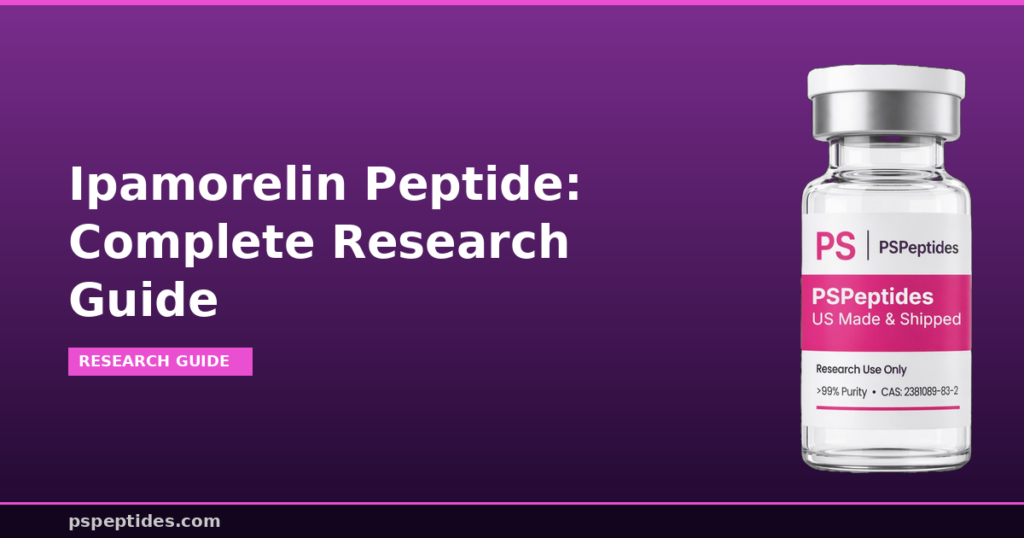
Ipamorelin peptide stands apart in the growth hormone secretagogue class as the most selective ghrelin receptor agonist available to researchers. Since its initial characterization in 1998, ipamorelin has become the reference compound for studies requiring clean, predictable GH release without the cortisol spikes, prolactin elevation, or appetite stimulation associated with older ghrelin mimetics.
Ipamorelin is available from PSPeptides as a 5mg research vial.
This standalone guide examines ipamorelin’s mechanism of action, its unique selectivity profile, published dosing protocols, clinical research findings, and how it compares to GHRP-2, GHRP-6, and hexarelin for different research objectives.

What Is Ipamorelin and Why Is It Called the Cleanest GH Secretagogue?
Ipamorelin is a synthetic pentapeptide (Aib-His-D-2-Nal-D-Phe-Lys-NH2) that acts as an agonist at the growth hormone secretagogue receptor type 1a (GHS-R1a), the same receptor activated by the endogenous hormone ghrelin. When ipamorelin binds GHS-R1a on anterior pituitary somatotrophs, it triggers intracellular calcium mobilization and phospholipase C activation, resulting in growth hormone vesicle release.
What distinguishes ipamorelin from other GHS-R1a agonists is its remarkable selectivity. In the landmark study by Raun and colleagues, ipamorelin produced dose-dependent GH release comparable to GHRP-6 but without measurable effects on ACTH, cortisol, prolactin, or FSH at GH-stimulating doses (Raun et al., 1998, Eur J Endocrinol). This selectivity profile is unique among characterized GHS-R1a agonists and has made ipamorelin the preferred compound for research requiring isolated GH variable manipulation.
The term “cleanest GH secretagogue” refers specifically to this absence of off-target hormonal effects. In comparative studies, GHRP-2 elevated cortisol by 40 to 60% at GH-stimulating doses, GHRP-6 increased appetite and cortisol significantly, and hexarelin showed the strongest cortisol and prolactin co-release. Ipamorelin produced none of these confounding effects, even at doses substantially above the ED50 for GH release.
Ipamorelin GH Release Profile and Pharmacokinetics
The GH release kinetics of ipamorelin follow a characteristic pattern that researchers should understand for optimal experimental design. After subcutaneous injection, plasma ipamorelin concentrations peak within 15 to 30 minutes, with GH levels reaching maximum at approximately 40 to 60 minutes post-dose.
The GH pulse generated by a single ipamorelin injection typically returns to baseline within 2 to 3 hours, creating a well-defined secretory window. This predictable kinetic profile makes ipamorelin particularly useful for acute GH stimulation tests and timed-sampling protocols.
Dose-response studies demonstrated a ceiling effect on GH release. At low doses (1 mcg/kg), GH elevation was modest but significant. The response increased linearly through 100 to 300 mcg doses, then plateaued at higher amounts. Importantly, even at supramaximal doses, cortisol and prolactin remained at baseline levels, confirming the selectivity is not merely a dose-dependent phenomenon but reflects genuine receptor pathway specificity.
Comparison with Endogenous Ghrelin
While both ipamorelin and ghrelin activate GHS-R1a, their downstream signaling profiles differ. Ghrelin activates the full complement of GHS-R1a signaling cascades including appetite stimulation via hypothalamic NPY/AgRP neurons, gastric motility enhancement, and adipogenic signaling. Ipamorelin appears to preferentially activate the somatotroph-specific signaling arm while showing weak engagement of appetite and metabolic pathways.
This biased agonism may explain ipamorelin’s selectivity and represents an area of active pharmacological investigation.

How Does Ipamorelin Compare to GHRP-2, GHRP-6, and Hexarelin?
The growth hormone releasing peptide family includes several compounds with varying selectivity, potency, and side-effect profiles. Understanding these differences is critical for selecting the appropriate GHS-R1a agonist for specific research questions.
Ipamorelin vs GHRP-2
GHRP-2 is a hexapeptide that produces robust GH release, often cited as the most potent GHS-R1a agonist by peak GH elevation. However, GHRP-2 also stimulates ACTH and cortisol release at therapeutic doses, with cortisol elevations of 40 to 60% above baseline reported in human studies. GHRP-2 also modestly increases prolactin levels.
For research designs where GH is the primary variable of interest, ipamorelin’s lack of cortisol co-stimulation eliminates a major confounding variable. For studies specifically investigating GHS-R1a’s role in the hypothalamic-pituitary-adrenal axis, GHRP-2 may be more informative. Our detailed GHRP-2 vs ipamorelin comparison explores these trade-offs further.
Ipamorelin vs GHRP-6
GHRP-6 was one of the earliest characterized GHS-R1a agonists and remains widely used in research. Its distinguishing features are potent appetite stimulation (via hypothalamic ghrelin pathway activation) and significant cortisol co-release. GHRP-6 also increases gastric motility and stomach acid secretion more than other family members.
In head-to-head comparisons, ipamorelin and GHRP-6 produce comparable peak GH levels at equivalent doses, but GHRP-6 triggers substantially more hunger signaling and cortisol elevation. For more on the GHRP family differences, see our GHRP-2 vs GHRP-6 comparison.
Ipamorelin vs Hexarelin
Hexarelin is the most potent GHS-R1a agonist by raw GH-releasing capacity, but it also produces the most pronounced off-target effects. Hexarelin significantly elevates cortisol, prolactin, and ACTH. Additionally, hexarelin shows more rapid tachyphylaxis than ipamorelin; repeated dosing leads to progressive attenuation of the GH response over weeks, likely due to receptor desensitization.
Ipamorelin demonstrates substantially less tachyphylaxis in chronic dosing studies, making it preferable for longitudinal research designs requiring sustained GH stimulation over weeks or months.
Ipamorelin Dosage Protocols in Published Studies
For detailed dosing protocols, reconstitution, and syringe calculations, see our dedicated ipamorelin dosage guide.
What Are the Research Benefits of Ipamorelin?
The published literature documents several areas where ipamorelin benefits have been observed in controlled research settings.
Body Composition
Chronic ipamorelin administration in animal models has demonstrated increased lean mass accrual and reduced visceral adiposity, consistent with the known anabolic and lipolytic effects of pulsatile GH elevation. These effects were achieved without the insulin resistance or glucose intolerance sometimes associated with sustained GH elevation from exogenous GH or long-acting GH secretagogues.
Bone Density
Ipamorelin has shown promise in bone metabolism research. A study in ovariectomized rats, a standard model for postmenopausal osteoporosis, demonstrated that ipamorelin treatment increased bone mineral density and improved trabecular bone architecture markers over 12 weeks of administration (Svensson et al., 2000, J Endocrinol).
Post-Surgical Recovery
Clinical trials have evaluated ipamorelin for post-operative ileus (delayed return of bowel function after abdominal surgery). Although results were mixed in phase III trials, the research demonstrated that ipamorelin could be safely administered in post-surgical settings without cardiovascular or endocrine adverse events, further validating its safety profile (PubMed: ipamorelin and postoperative ileus).

Side Effects and Safety Considerations
Ipamorelin’s safety profile is one of its primary advantages. In published clinical trials involving over 1,000 subjects, the adverse event rate was comparable to placebo for most parameters.
Mild injection site reactions (transient redness or discomfort) were the most common complaint, occurring in approximately 10 to 15% of subjects. Transient headache was reported in roughly 5% of subjects. Nausea occurred infrequently and was typically mild.
Critically, ipamorelin did not produce clinically significant changes in cortisol, aldosterone, prolactin, or thyroid hormone levels at any dose tested in clinical trials. Blood glucose and insulin sensitivity parameters remained stable during chronic administration, distinguishing ipamorelin from exogenous GH therapy, which can impair glucose homeostasis.
No tachyphylaxis was observed in studies lasting up to 12 weeks, though longer-term data is limited. This sustained efficacy over time is a notable advantage compared to hexarelin, which shows progressive response attenuation.
Reconstitution, Storage, and Handling for Ipamorelin Research
Proper preparation and storage of ipamorelin are essential for maintaining compound integrity across research protocols. Ipamorelin is supplied as a lyophilized powder that should be stored at minus 20 degrees Celsius prior to reconstitution for maximum long-term stability.
Reconstitution is performed with bacteriostatic water at volumes typically ranging from 1 to 2 mL per vial, depending on desired concentration. The reconstituted solution should be stored at 2 to 8 degrees Celsius and used within 30 days. Researchers conducting chronic dosing studies should prepare fresh aliquots to avoid repeated freeze-thaw degradation.
As a pentapeptide, ipamorelin is relatively compact and demonstrates good stability in aqueous solution compared to longer peptide chains. However, standard peptide handling precautions apply: avoid vigorous shaking (gentle swirling is preferred for reconstitution), minimize light exposure during storage, and use aseptic technique to prevent microbial contamination in multi-use vials.
For in vitro assays, ipamorelin stock solutions can be prepared at higher concentrations (1 to 10 mM) in DMSO for cell culture work, then diluted into aqueous media immediately before use. The DMSO concentration in final assay media should remain below 0.1% to avoid solvent-related cellular effects.
Emerging Ipamorelin Research Applications
Beyond the established applications in GH biology, newer ipamorelin research directions are expanding the compound’s utility. Sleep architecture studies have demonstrated that GHS-R1a activation during the pre-sleep period enhances slow-wave sleep duration and quality, consistent with the known coupling between nocturnal GH pulses and deep sleep stages.
Musculoskeletal recovery research represents another growing area. The combination of GH-mediated collagen synthesis, IGF-1 upregulation in connective tissue, and the anti-inflammatory signaling downstream of pulsatile GH release makes ipamorelin a candidate compound for studying tendon, ligament, and joint recovery mechanisms in preclinical models.
Skin and wound healing studies have also begun incorporating ipamorelin. Growth hormone signaling promotes dermal collagen production, fibroblast proliferation, and angiogenesis in wound beds. Ipamorelin’s selective GH release without cortisol elevation is particularly advantageous in this context, as cortisol is a potent inhibitor of wound healing. Preclinical wound models using ipamorelin have shown accelerated closure rates and improved tensile strength in healed tissue.
Age-related cognitive research is another emerging frontier. GH receptors are expressed in hippocampal neurons, and the age-related decline in GH pulsatility correlates with cognitive performance measures. Ipamorelin’s ability to restore physiological GH pulsatility without hypothalamic-pituitary axis disruption makes it a cleaner tool than exogenous GH for investigating these neuroendocrine-cognitive relationships in aged animal models.
Ipamorelin in Peptide Stacking Research
The dual-pathway synergy between GHS-R1a agonists and GHRH-R agonists has made ipamorelin a staple component in peptide stacking research. When combined with a GHRH analog, the resulting GH pulse is typically 3 to 5 fold greater than either compound alone.
The most common pairing is ipamorelin with CJC-1295 without DAC (Modified GRF 1-29). This combination provides dual receptor activation with matched pharmacokinetics, as both compounds have similar onset and duration profiles. More advanced stacking approaches are covered in the best peptide stacks for muscle growth guide.
Researchers have also explored the sermorelin vs CJC-1295 vs ipamorelin comparison to determine which GHRH analog pairs optimally with ipamorelin for specific experimental endpoints.
Where to Buy Ipamorelin for Research
Research-grade ipamorelin must meet strict purity and identity standards to produce reliable experimental results. Impurities, degradation products, or incorrect peptide sequences can introduce confounding variables that undermine study validity.
PSPeptides provides research-grade ipamorelin backed by documentation and quality controls designed for serious research applications:
- Lot-specific Certificates of Analysis published online
- Same-day shipping on qualifying orders to minimize transit time
- Afterpay and Klarna payment options available for flexible research budget management
- Research supplies bundling including bacteriostatic water, reconstitution supplies, and syringes alongside peptide orders for complete experimental setup
Third-party analytical verification ensures batch-to-batch consistency, a critical factor for longitudinal studies where compound variability could compromise data integrity.

Frequently Asked Questions About Ipamorelin
Why is ipamorelin considered the cleanest GH secretagogue?
Ipamorelin activates the GHS-R1a receptor to stimulate growth hormone release without measurably affecting cortisol, prolactin, ACTH, or appetite signaling at GH-stimulating doses. This selectivity is unique among characterized GHS-R1a agonists. GHRP-2, GHRP-6, and hexarelin all produce dose-dependent elevations in cortisol and prolactin alongside GH release.
What is the standard ipamorelin dosage in research?
Published protocols typically use 200 to 300 mcg per injection administered subcutaneously. Acute studies use a single injection, while chronic protocols employ two to three injections daily spaced at least 3 hours apart. Bedtime dosing is commonly included to synergize with the natural nocturnal GH surge.
Can ipamorelin be combined with GHRH analogs?
Yes. The combination of ipamorelin (GHS-R1a agonist) with a GHRH analog such as CJC-1295 without DAC or sermorelin (GHRH-R agonist) produces synergistic GH release 3 to 5 times greater than either compound alone. This dual-pathway approach is one of the most studied peptide combination protocols.
Does ipamorelin cause appetite stimulation like GHRP-6?
No. While both compounds activate GHS-R1a, ipamorelin demonstrates biased agonism that preferentially engages somatotroph GH release pathways while showing minimal activation of the hypothalamic appetite circuits strongly stimulated by GHRP-6 and endogenous ghrelin.
All PSPeptides products are sold exclusively for research and laboratory use.