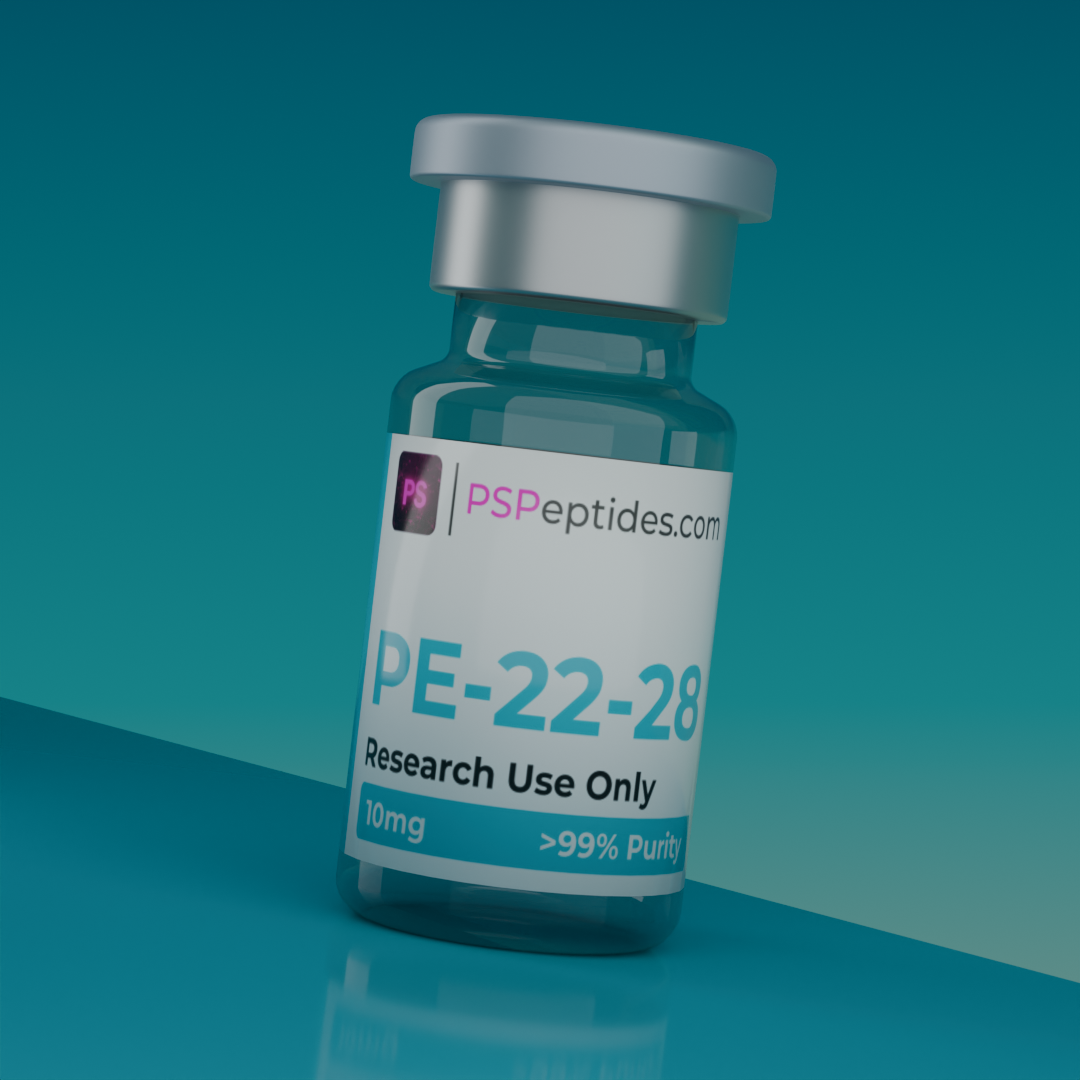
PE-22-28 (1 Vial)
$44.99
PE-22-28 (1 Vial) — Buy PE-22-28 research peptide, 10 mg spadin-derived TREK-1 inhibitor. Tested to 99%+ purity by HPLC, US manufactured, lot COA published on this page.
Vials count across your whole order — mix any peptides and sizes.
40% OFF Need 10+ vials? Build your own kit — 40% off every vial



 Made & Shipped
For laboratory and research use only. This product is not a drug, food, or cosmetic and is not for human or animal consumption. It is not intended to diagnose, treat, cure, or prevent any disease. These statements have not been evaluated by the FDA. Sold solely to qualified researchers and licensed laboratories. Certificate of Analysis available on request.
Description
Buy PE-22-28 — a research-grade, spadin-derived heptapeptide supplied as a single 10 mg lyophilized vial. Tested to 99%+ purity by third-party HPLC, with identity confirmed by mass spectrometry, and US manufactured. Each lot’s batch-specific Certificate of Analysis is published on this page. In published assays PE-22-28 inhibits TREK-1 with an IC50 of 0.12 nM, against 40 to 60 nM for full-length spadin (Djillani et al., 2017), and it is studied primarily as a selective TREK-1 potassium channel inhibitor in depression, neurogenesis and stroke-recovery research models.
What Is PE-22-28?
PE-22-28 (sequence Gly-Val-Ser-Trp-Gly-Leu-Arg, or GVSWGLR) is a seven-amino-acid fragment of spadin, a natural peptide released from the propeptide of the sortilin (NTSR3) receptor. In 2017, researchers at the CNRS Institute of Molecular and Cellular Pharmacology reported that this shortened analog inhibits the TREK-1 (K2P2.1) background potassium channel with an IC50 near 0.12 nM, more than 300 times more potent than full-length spadin.
Because TREK-1 inhibition increases the firing rate of serotonergic neurons and triggers hippocampal neurogenesis within days, PE-22-28 has become a reference tool compound for laboratories investigating rapid-acting antidepressant mechanisms. PSPeptides supplies the same GVSWGLR sequence used in the published studies. For a comparison with other neurological peptides, see our Semax research guide.
Key Research Applications
Laboratories buy PE-22-28 for four main areas of investigation:
- TREK-1 channel pharmacology: Sub-nanomolar, selective inhibition of TREK-1 with no effect on TREK-2, TRAAK, TRESK or TASK-1 channels at 100 nM.
- Rapid-onset antidepressant models: Reduced immobility in forced swim and learned helplessness tests after a single dose or four days of treatment in rodents.
- Hippocampal neurogenesis: Nearly doubled BrdU-positive proliferating cells in the dentate gyrus after four days of treatment in mice.
- Stroke recovery and post-stroke depression: Sortilin-derived peptides are under active investigation for functional recovery after cerebral ischemia.
Product Specifications
| Amount | 10 mg per vial (1 vial) |
| Purity | Tested to 99%+ by third-party HPLC; identity by mass spectrometry |
| Form | Lyophilized white powder in a sealed glass vial |
| Sequence | Gly-Val-Ser-Trp-Gly-Leu-Arg (GVSWGLR) |
| Molecular Formula | C35H55N11O9 (MW 773.9 g/mol); CAS 1801959-12-5 |
| Storage | Lyophilized: -20°C long term; reconstituted: 2-8°C, use within 28 days |
| Testing | Batch-specific COA published on this page |
| Origin | US manufactured (Temecula, CA) |
Ready to buy PE-22-28? Add this 10 mg vial to your cart for free UPS 2nd Day Air on orders over $200, same-day shipping on orders placed before 2 PM EST, and email support seven days a week.
▼ Read Full Research Description (click to expand or collapse)
Detailed Mechanism of Action
TREK-1 (TWIK-related potassium channel 1, encoded by the KCNK2 gene) is a two-pore-domain background potassium channel expressed throughout the hippocampus, prefrontal cortex, striatum and dorsal raphe nucleus. It opens in response to membrane stretch, heat, intracellular acidification and polyunsaturated fatty acids, and it leaks potassium ions out of the neuron to keep the resting membrane potential hyperpolarized and the cell electrically quiet.
In 2006, Heurteaux and colleagues reported that mice lacking TREK-1 display a depression-resistant phenotype with enhanced serotonergic neurotransmission, and that fluoxetine and other SSRIs inhibit TREK-1 currents directly. That discovery established TREK-1 as a validated antidepressant target and launched a search for selective blockers that would not require weeks of treatment to act.
Spadin, the parent peptide of PE-22-28, is a 17-residue fragment (residues 12 to 28) of the sortilin propeptide. Mazella and co-workers showed in 2010 that spadin binds TREK-1 with roughly 10 nM affinity and inhibits the channel with an IC50 of about 70 nM.
PE-22-28 keeps only residues 22 through 28 of that sequence, yet it inhibits TREK-1 with an IC50 of approximately 0.12 nM, a potency gain of several hundred-fold over the parent peptide.
When TREK-1 is blocked, serotonergic neurons in the dorsal raphe depolarize and fire more frequently, raising serotonin release in the hippocampus and cortex. Downstream, CREB phosphorylation increases and progenitor cells in the dentate gyrus begin to proliferate.
In cultured mouse cortical neurons, 0.1 µM PE-22-28 roughly doubled levels of the synaptic scaffold protein PSD-95 within 36 hours, a marker of synaptogenesis. Patch-clamp studies typically test it across the 0.01 to 100 nM range.

Published Research on PE-22-28
The defining paper is Djillani et al., Frontiers in Pharmacology 2017: “Shortened Spadin Analogs Display Better TREK-1 Inhibition, In Vivo Stability and Antidepressant Activity.” In the forced swim test, mice given 3 to 4 µg/kg of PE-22-28 intraperitoneally spent 91.8 seconds immobile versus 161.7 seconds for saline controls, at a dose 25 to 30 times lower than the 100 µg/kg required for spadin.
After four days of treatment, the shortened analogs reduced immobility to 89.6 seconds compared with 107.5 seconds for spadin and 158.3 seconds for saline. In a seven-week corticosterone model of chronic stress, PE-22-28 at 3 µg/kg lowered immobility to 98.1 seconds against 164.9 seconds in controls, and in the novelty-suppressed feeding test it cut feeding latency from 226.1 to 153.2 seconds.
Hippocampal BrdU-positive cell counts rose from 899 in saline-treated mice to 1,736 with PE-22-28 after only four days.
The same study measured duration of action. Where spadin’s antidepressant-like effect faded within 6 to 7 hours, the shortened analogs stayed active for 14 to 23 hours depending on dose, and PE-22-28 remained active after oral gavage at 1 mg/kg. Selectivity screening showed no effect on TREK-2, TRAAK, TRESK or TASK-1 channels at 100 nM and no hERG (IKr) inhibition at 10 µM.
Foundational work includes Mazella et al., PLoS Biology 2010, which introduced spadin as the first peptide TREK-1 antagonist. That study reported a 43.2% reduction in forced-swim immobility after only four days of treatment, a 146% increase in dorsal raphe serotonergic firing and a doubling of hippocampal BrdU-positive cells.
Heurteaux et al., Nature Neuroscience 2006 supplied the genetic proof of concept with TREK-1 knockout mice, which behaved as though they had already received a full course of antidepressant treatment.
Later work from the same Sophia Antipolis group extended sortilin-derived peptides into stroke models, reporting improved functional recovery and reduced post-stroke depressive behavior in mice, and clinical studies have found lower serum sortilin propeptide levels in patients with major depression. PE-22-28 research builds on more than fifteen years of peer-reviewed TREK-1 work.
PE-22-28 vs Alternatives
| Feature | PE-22-28 | Spadin | Semax |
|---|---|---|---|
| Peptide length | 7 amino acids | 17 amino acids | 7 amino acids |
| Origin | Spadin residues 22-28 | Sortilin propeptide residues 12-28 | Synthetic ACTH(4-10) analog |
| Primary target | TREK-1 (K2P2.1) channel | TREK-1 channel | Melanocortin / BDNF signaling |
| TREK-1 IC50 | ~0.12 nM | ~40-70 nM | Not a TREK-1 ligand |
| Active rodent dose (forced swim) | 3-4 µg/kg | 100 µg/kg | 50-600 µg/kg (intranasal) |
| Duration of in vivo effect | 14-23 hours | 6-7 hours | Short (rapid serum degradation) |
| Oral activity in rodents | Active at 1 mg/kg by gavage | Not reported | Primarily intranasal |
| Main research focus | Depression, neurogenesis, stroke recovery | Depression | Cognition, neuroprotection |
Spadin remains valuable as the natural reference ligand, and Semax or Selank suit cognition and anxiety models (see our Semax vs Selank comparison).

Research Protocols and Experimental Models
Groups that buy PE-22-28 for in vitro work characterize it by whole-cell patch-clamp recording in HEK293 cells stably expressing human TREK-1, with channel activity stimulated by arachidonic acid or membrane stretch before the peptide is applied. Dose-response curves are typically built from 0.01 nM to 1 µM, and selectivity is checked against TREK-2, TRAAK, TRESK and TASK-1 expressed in the same cell background.
In vivo, the standard behavioral battery includes the forced swim test, tail suspension test, learned helplessness paradigm and novelty-suppressed feeding test, usually after a single intraperitoneal injection or a four-day sub-chronic regimen. The chronic corticosterone model adds a stress-induced depressive phenotype so that reversal, not just baseline behavior, can be measured.
Neurogenesis endpoints rely on BrdU incorporation and doublecortin immunostaining in the dentate gyrus, while pCREB Western blotting and PSD-95 quantification in cultured cortical neurons serve as molecular readouts. Multi-vial pricing for these studies is available from our support team.
Selectivity and Safety Profile in Research Models
One reason researchers buy PE-22-28 instead of small-molecule TREK-1 blockers is selectivity. Fluoxetine, certain antipsychotics and other non-peptide inhibitors block TREK-1 only at micromolar concentrations and act on many additional targets. PE-22-28 reaches full TREK-1 inhibition at sub-nanomolar concentrations while leaving related K2P channels and the cardiac hERG channel untouched.
In the published mouse studies, the shortened spadin analogs produced no sedation, no change in locomotor activity in the open field and no evidence of toxicity at doses up to 40 µg/kg. These are preclinical observations in animal models and are not evidence of safety or efficacy in humans.
Reconstitution & Handling
PE-22-28 ships as a lyophilized powder and must be reconstituted before use. For a 10 mg vial, add 2 mL of bacteriostatic water to produce a 5 mg/mL stock solution, or 2.5 mL, the most the 3 mL vial takes, for a 4 mg/mL stock. Let the diluent run slowly down the inside wall of the vial and swirl gently, never shake, until the powder dissolves completely.
For sub-nanomolar electrophysiology, prepare serial dilutions from this stock in assay buffer immediately before recording. Our step-by-step reconstitution guide and peptide dosage calculator walk through every volume calculation so that concentrations stay standardized across experiments.
Use sterile, low-binding polypropylene tubes for dilutions. Short hydrophobic peptides that contain tryptophan can adsorb to glass and standard plastics at low concentrations, which silently lowers the effective dose.
Storage & Stability
Store unopened lyophilized vials at -20°C, where PE-22-28 remains stable for 24 months or longer. Short-term storage at 2-8°C for up to 30 days is acceptable during active experiments. Keep vials sealed in their original packaging, away from light and humidity, until the day you reconstitute.
Once reconstituted, store solutions at 2-8°C and use within 28 days, or divide into single-use aliquots and freeze at -20°C for up to three months. Avoid repeated freeze-thaw cycles, which fragment the peptide. See our peptide storage guide and learn how to tell if a peptide has degraded.
Lyophilized PE-22-28 tolerates ambient-temperature shipping for the two to three days a UPS delivery takes. Orders ship in durable, discreet bubble mailers.

Certificate of Analysis
Every lot of PE-22-28 is tested by an independent third-party laboratory using reverse-phase HPLC for purity and mass spectrometry for identity confirmation. Each lot’s batch-specific Certificate of Analysis is published on this page. It lists the measured purity (the release standard is 99%+), the observed molecular mass against the theoretical 773.9 Da, net peptide content and the lot number printed on your vial.
Learn how to read a peptide COA so you know exactly what each lot contains. If your institution requires additional documentation such as a safety data sheet or a signed research-use declaration, contact support before placing your order and we will attach it.
Why Buy PE-22-28 From PSPeptides?
- US Manufactured: Synthesized in a cGMP-compliant facility in Temecula, California.
- Third-Party Tested: Independent HPLC and mass spectrometry on every batch. Each lot’s batch-specific Certificate of Analysis is published on this page.
- Fast Shipping: Free UPS 2nd Day Air on orders over $200, and same-day dispatch on orders placed before 2 PM EST.
- Flexible Payments: Credit cards, Afterpay, Klarna, Apple Pay and Google Pay.
- 7-Day Support: Email support seven days a week, 9 AM to 10 PM EST, with replies typically within 2–6 hours.
Our guide to choosing a research peptide supplier explains what to look for, and our 2026 review of peptide companies shows how we compare.

Spadin, Sortilin and the Biology Behind PE-22-28
Sortilin (also called NTSR3) is a type I membrane receptor that sorts neurotrophins, pro-neurotrophins and ion channels between the Golgi, endosomes and the cell surface. It is synthesized as a precursor whose 44-residue propeptide is cleaved by furin and released. Spadin is the biologically active fragment of that released propeptide, which makes spadin an endogenous TREK-1 inhibitor.
This origin matters for drug-discovery research. Serum concentrations of the sortilin propeptide are lower in patients with major depressive disorder and rise after electroconvulsive therapy, suggesting the pathway is clinically relevant. PE-22-28 distills the active core of that endogenous signal into a seven-residue sequence that is easier to synthesize, more stable and far more potent than the parent peptide.
Sortilin also forms a complex with TREK-1 that controls how many channels reach the plasma membrane. Studies in sortilin-deficient mice show altered TREK-1 function and reduced depressive-like behavior, reinforcing the link between this receptor family and mood regulation.
Emerging Research Directions
Beyond depression, TREK-1 blockers are being examined in several other fields. Because the channel regulates excitability in nociceptive neurons, PE-22-28 is used to probe pain signaling. In the cardiovascular system, TREK-1 contributes to vascular tone and atrial electrophysiology, and selective inhibitors allow those roles to be dissected without the off-target burden of older compounds.
Stroke research is the most active new area. Sortilin-derived peptides have been reported to improve motor recovery and prevent post-stroke depressive behavior in mouse models of focal ischemia, opening a path toward dual-action neuroprotection. Anxiety, cognition and sleep architecture studies are also emerging as groups look for behavioral effects beyond the forced swim test.
Who Should Buy PE-22-28?
Neuroscience laboratories that buy PE-22-28 are primarily studying mood disorders, but the peptide also serves ion-channel biophysicists who need a selective TREK-1 probe, pharmacology groups benchmarking new antidepressant candidates and stroke researchers exploring post-ischemic recovery.
Because TREK-1 is also expressed in sensory neurons, smooth muscle and the heart, the peptide is increasingly requested for pain, vascular and cardiac electrophysiology studies, and for teaching laboratories that need a clean, well-characterized channel blocker.
If you are comparing neurological peptides, our complete guide to peptides and peptide stacking guide outline how PE-22-28 fits alongside Semax, Selank and other research compounds. PE-22-28 and Selank can be run in parallel study arms to separate serotonergic from GABAergic mechanisms.
Ordering, Shipping and Payment
To buy PE-22-28, select the 10 mg option, add it to your cart and check out with a credit card, Afterpay, Klarna, Apple Pay or Google Pay. Orders placed before 2 PM EST ship the same business day from the United States, and orders over $200 qualify for free UPS 2nd Day Air. Tracking is emailed as soon as the label is created.
Need several vials for a full behavioral cohort? Contact our team for research-lab pricing on five or more vials. Orders ship in durable, discreet bubble mailers. Our support staff are available by email seven days a week, 9 AM to 10 PM EST.
Frequently Asked Questions
Where can I buy PE-22-28 online?
You can buy PE-22-28 online directly from this page. PSPeptides manufactures the peptide in the United States, tests every batch through an independent laboratory and ships the same day on orders placed before 2 PM EST.
How does PE-22-28 differ from spadin?
PE-22-28 is a seven-residue fragment of the 17-residue spadin peptide. In published assays it inhibits TREK-1 roughly 300 times more potently, remains active in vivo for 14 to 23 hours instead of 6 to 7, and works at a dose 25 to 30 times lower.
What purity should I expect when I buy PE-22-28?
PE-22-28 is tested to 99%+ purity by reverse-phase HPLC, with identity confirmed by mass spectrometry. Each lot’s batch-specific Certificate of Analysis is published on this page.
Is PE-22-28 selective for TREK-1?
Yes. At 100 nM, PE-22-28 had no measurable effect on the related K2P channels TREK-2, TRAAK, TRESK or TASK-1, and at 10 µM it did not inhibit the cardiac hERG channel. That selectivity is the main contrast with small-molecule TREK-1 blockers.
How should I store PE-22-28 after I buy it?
Keep the lyophilized vial at -20°C until use. After reconstitution with bacteriostatic water, store at 2-8°C and use within 28 days, or aliquot and freeze at -20°C for up to three months. If you order multiple vials, keep the spares lyophilized until needed.
Can I buy PE-22-28 for personal use?
No. PE-22-28 is sold strictly as a research chemical for in vitro and animal studies by qualified laboratories. It is not approved for human use, and no claims are made about human safety or efficacy.
What is the molecular weight of PE-22-28?
The free peptide has the molecular formula C35H55N11O9 and a molecular weight of about 773.9 g/mol. A 10 mg vial therefore contains roughly 12.9 µmol of peptide, which is useful when calculating molar concentrations for electrophysiology.
Related Resources
These guides cover the background science and handling basics:
Buy PE-22-28 today — 10 mg, tested to 99%+ purity by HPLC, US manufactured, lot COA published on this page. Add it to your cart above and it ships the same day.
All PSPeptides products are sold exclusively for laboratory and research use. Not intended for human consumption.
Additional information
| Weight | 0.03 lbs |
|---|---|
| Dimensions | 2 × 2 × 2 in |
| MG | 10MG |
Related products
-
 Focus & Memory
Adamax (1 Vial)
$65.99 Select options This product has multiple variants. The options may be chosen on the product page -
Memory & Focus
Semax Nasal Spray
$55.99 Select options This product has multiple variants. The options may be chosen on the product page -
Tanning & Libido
Melanotan II Spray
$49.99 Select options This product has multiple variants. The options may be chosen on the product page -
Focus & Memory
Adamax Nasal Spray
$75.99 Select options This product has multiple variants. The options may be chosen on the product page