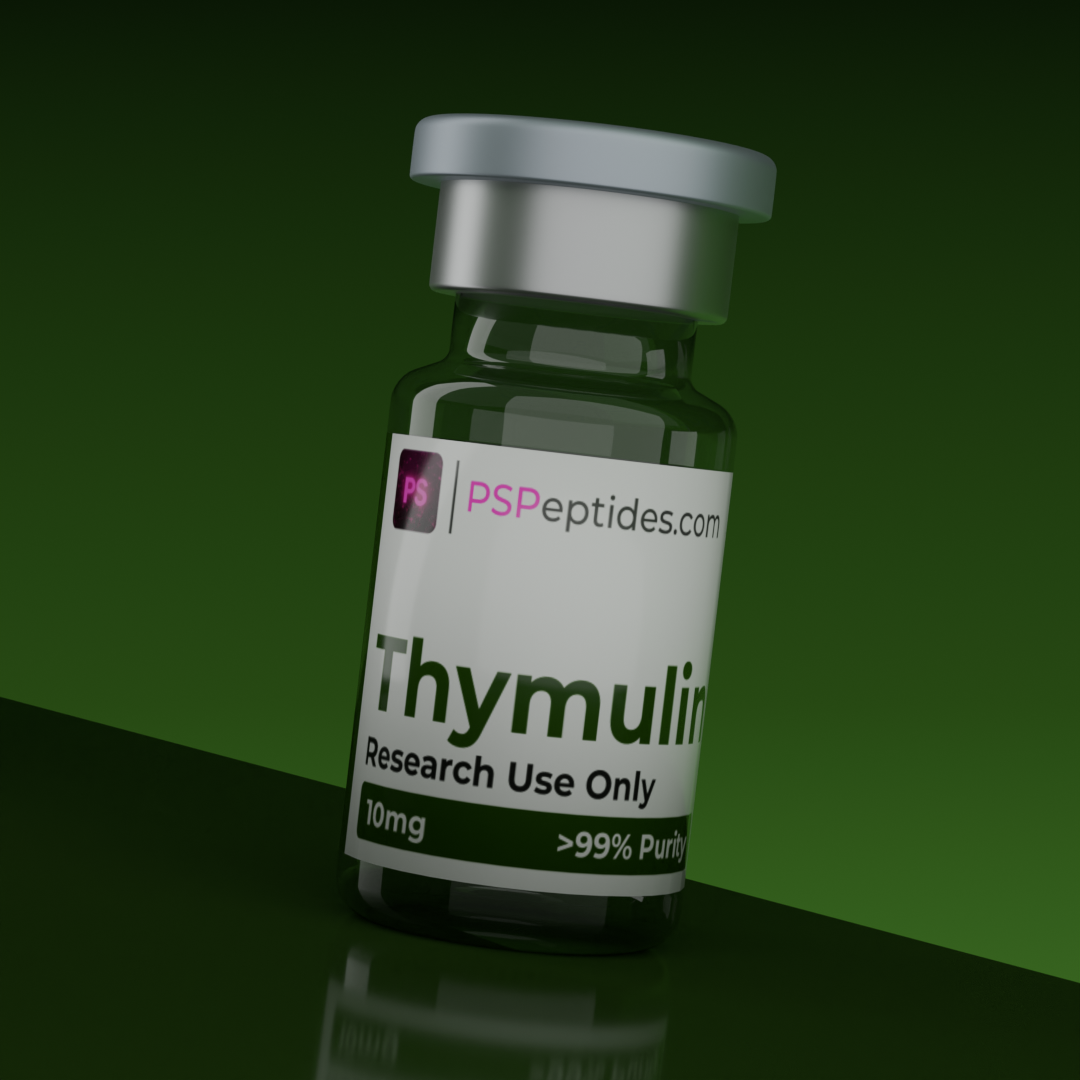
Thymulin, formerly called serum thymic factor (FTS), is a nine-amino-acid hormone (pGlu-Ala-Lys-Ser-Gln-Gly-Gly-Ser-Asn) secreted by thymic epithelial cells. Its biological activity depends on a single bound zinc ion, which locks the peptide into its active shape. Circulating thymulin falls sharply with age and zinc deficiency, which is why labs buy thymulin for immune-aging work. For background, see our guide to immune-support peptide research.
Ready to buy thymulin for your lab? Add the 10mg vial to your cart above, then read the full research description below for mechanism data, published studies, reconstitution protocols, and answers to common questions.
Why Buy Thymulin From PSPeptides?
When you buy thymulin from PSPeptides, you receive a US-manufactured peptide with cGMP-compliant synthesis in Temecula, CA, third-party purity verification, and a lot-specific certificate of analysis with every order. Orders over $150 ship free by UPS 2nd Day Air, and orders placed before 2 PM EST leave the same day.
Many suppliers list thymulin without stating purity method, counter-ion, or net peptide content. We publish all three on the COA, so when you buy thymulin here you can match the material to the assay conditions used in the literature. Our support team is available seven days a week by email, phone, or text, and checkout accepts credit cards, Afterpay, Klarna, Apple Pay, and Google Pay.
Researchers also buy thymulin from us because the vial is sized for real experiments. A 10mg vial supports dozens of rodent dosing arms or an extended series of in-vitro cytokine assays, which keeps cost per data point low. If your protocol calls for larger quantities, simply increase the quantity at checkout or message our support team with questions before you order.
Thymulin is in demand from university immunology labs, contract research organizations, longevity-focused biotech teams, and independent researchers extending the 2026 inflammaging findings. Whether you buy thymulin as a single vial for a pilot study or in quantity for a full aged-cohort trial, every vial is tested to the same batch COA standard.
Detailed Mechanism of Action
Thymulin is synthesized and secreted by thymic epithelial cells as an inactive apo-peptide. Dardenne and colleagues showed in 1982 that it must bind one Zn2+ ion, at a 1:1 ratio, to become biologically active; the zinc-free form is inactive and can even antagonize the active hormone. This zinc dependence is why researchers who buy thymulin plan their zinc chemistry alongside the peptide.
Once active, zinc-thymulin acts on T-cell precursors. It induces the expression of T-cell surface markers on prothymocytes, promotes the maturation of CD4+ helper and CD8+ cytotoxic subsets, and helps regulate interleukin-2 production and natural killer cell activity. In thymectomized and nude (athymic) animal models, thymulin replacement restores several of these T-cell functions.
Thymulin also sits inside a bidirectional thymus-pituitary loop. Growth hormone, prolactin, and thyroid hormones stimulate thymulin secretion, while thymulin in turn modulates pituitary release of growth hormone, luteinizing hormone, and ACTH. Goya’s laboratory found that the growth hormone-releasing action of thymulin on somatotropes is age dependent, which links the peptide to endocrine aging. Labs that buy thymulin for neuroendocrine studies often pair it with pituitary cell cultures.
In the nervous system, thymulin shows dose- and route-dependent effects. At systemic doses it reduced endotoxin-induced hyperalgesia and dampened IL-1β, TNF-α, IL-6, and nerve growth factor. Low intraplantar doses, by contrast, produced local hyperalgesia through IL-1β, NGF, and prostaglandin E2, so experimental design matters. The thymulin analogue PAT appears to signal partly through α7-nicotinic acetylcholine receptors, tying it to the cholinergic anti-inflammatory pathway.
Finally, thymulin is tightly coupled to zinc status at the whole-organism level. Mocchegiani and colleagues showed that the fraction of active, zinc-bound thymulin in plasma drops in aged animals and in zinc deficiency, and that zinc supplementation restores it. Active thymulin is therefore used as a functional biomarker of thymic endocrine output, which is one more reason immunology groups buy thymulin as a reference standard.
Thymulin and Immune Aging
Thymic involution begins in early adulthood, and circulating thymulin declines in parallel. As the thymus shrinks, fewer naive T cells are produced and chronic low-grade inflammation, often called inflammaging, rises. Thymulin sits at the intersection of these two processes, which makes it a compelling tool for longevity and immunosenescence research. Our overview of the best peptides for longevity and anti-aging research places thymulin alongside epithalon and other bioregulators.
The 2026 USC study crystallized this idea. Aged mice and aged human blood samples carried more pro-inflammatory, cytokine-producing myeloid cells, and thymulin suppressed those cells only in aged systems, not in young ones. That age-selective effect is unusual among immune peptides and is exactly the kind of result that drives labs to buy thymulin for heterochronic and aged-cohort designs.
Earlier human data point the same direction. Mocchegiani’s group reported that zinc supplementation in elderly subjects raised the proportion of active thymulin in plasma and improved several T-cell parameters, suggesting the thymulin-zinc axis remains responsive late in life. Together, these findings frame thymulin as a measurable, modifiable node in immune aging rather than a passive marker of thymic decline.

Published Research on Thymulin
Safieh-Garabedian and colleagues reported in 1996 that thymulin reduces hyperalgesia induced by peripheral endotoxin injection in rats and mice. The same group later showed that thymulin reverses inflammatory hyperalgesia after central (i.c.v.) endotoxin and normalizes the elevated proinflammatory cytokines that drive it.
A follow-up paper demonstrated that a thymulin analogue peptide strongly inhibits pain of neurogenic origin, and a 2013 study linked the analogue’s anti-inflammatory action to α7-nicotinic receptors. Before you buy thymulin for pain research, these papers define the effective dose ranges, routes, and time courses you will need to reproduce.
The neuroendocrine literature is anchored by Goya and co-workers, whose 2014 review of the physiology and therapeutic potential of thymulin summarizes gene-therapy studies in which a synthetic thymulin gene restored circulating thymulin in thymus-deficient mice and prevented the decline of gonadotropins. Earlier work from the same lab established thymulin’s growth hormone-releasing activity and showed how that activity changes across the lifespan.
The most significant recent result arrived in 2026, when Kanemaru, Ito, and colleagues at the Keck School of Medicine of USC published in Nature Communications that thymulin restrains age-associated myeloid inflammation and enhances cancer immunotherapy. Using heterochronic parabiosis, they identified thymulin as a circulating factor whose decline tracks rising inflammation with age.
In that study, thymulin treatment lowered pro-inflammatory cytokine-producing cells in aged mice, delayed tumor growth, and restored responsiveness to anti-PD-1/PD-L1 therapy, with little effect in young animals. Labs now buy thymulin specifically to extend this inflammaging work into new tumor models and aged cohorts.
Experimental Design Notes
Thymulin rewards careful design. Animal age is the first variable to fix, because the 2026 data show the peptide acts selectively in aged systems. Zinc status is the second: measure or control dietary zinc, and decide whether you will pre-complex the peptide with zinc chloride or rely on endogenous zinc in the medium or plasma.
Route and dose are the third consideration. Systemic intraperitoneal or subcutaneous administration produced anti-hyperalgesic and anti-inflammatory effects in the rodent literature, while very low local doses produced the opposite, pro-inflammatory response. Build a dose-response arm into your first study rather than assuming a single dose. Useful readouts include paw-withdrawal latency, von Frey thresholds, serum IL-1β, TNF-α, and IL-6 by ELISA, and flow cytometry of myeloid and T-cell subsets.
Groups that buy thymulin for in-vitro work typically use human or murine peripheral blood mononuclear cells stimulated with lipopolysaccharide, then measure cytokine suppression across a thymulin concentration series. Include a zinc-only control, because zinc alone has measurable immune effects. See our peptide stacking guide if you plan to run thymulin alongside other immune peptides.
Thymulin vs Thymosin Alpha-1 vs Thymalin
Thymulin is one of several thymic peptides in active research use. Before you buy thymulin, compare it against the two alternatives most often considered for immune and aging studies.
| Feature | Thymulin (This Product) | Thymosin Alpha-1 | Thymalin |
|---|
| Structure | 9-amino-acid nonapeptide, 858.9 Da | 28-amino-acid acetylated peptide, ~3,108 Da | Multi-peptide thymic extract (bioregulator) |
| Cofactor requirement | Requires Zn2+ for activity | None | None |
| Primary research focus | T-cell maturation, anti-inflammatory, neuroendocrine, inflammaging | Innate immune activation, TLR signaling, antiviral models | Immune restoration, geroprotection |
| Key mechanism | Zinc-dependent T-cell differentiation; cytokine suppression | Dendritic cell and TLR-9 activation; interferon signaling | Composite peptide regulation of thymic function |
| Pain and neuro data | Extensive rodent analgesia and hyperalgesia literature | Limited | Limited |
| Landmark study | Nature Communications 2026 (inflammaging, immunotherapy) | Multiple human trials (hepatitis B and C, sepsis) | Russian clinical and geroprotective studies |
| Defined composition | Single defined sequence | Single defined sequence | Variable extract |
| Learn more | This page | Thymosin Alpha-1 research guide | Bioregulator peptide research |
Thymosin alpha-1 remains the better-documented choice for antiviral and sepsis models, while thymulin’s defined sequence and zinc-regulated activity make it the cleaner tool for T-cell maturation and inflammaging experiments. Many labs buy thymulin and thymosin alpha-1 together to compare the two arms of thymic signaling directly.
Reconstitution & Handling
Reconstitute the 10mg vial with bacteriostatic water. Adding 1 mL yields 10 mg/mL, adding 2 mL yields 5 mg/mL, and adding 5 mL yields 2 mg/mL for assays that need a dilute stock. Direct the stream of diluent down the inside wall of the vial, then swirl gently until the powder dissolves. Never shake, which can shear the peptide.
Because thymulin’s activity depends on zinc, many published assays add zinc chloride to the working solution at an equimolar ratio immediately before use. Plan this step when you buy thymulin, and record the zinc source and concentration on your protocol sheet. Our peptide reconstitution guide and peptide dosage calculator walk through the volume math for any target concentration.
For in-vivo work, the rodent literature uses subcutaneous and intraperitoneal routes most often; see our comparison of subcutaneous vs intramuscular peptide administration for technique notes. Use sterile, single-use syringes and discard any reconstituted solution that turns cloudy.
Storage & Stability
Lyophilized thymulin is typically stable for 24 months or longer at −20°C when kept sealed, dry, and away from light. Brief excursions to room temperature during shipping do not compromise the powder. After reconstitution, store at 2–8°C and use within 14 to 28 days, or aliquot and freeze at −20°C to avoid repeated freeze-thaw cycles.
Keep reconstituted thymulin protected from light, and avoid metal-leaching containers that could alter the zinc balance of the solution. Our peptide storage guide and peptide degradation guide explain how to recognize a compromised vial before it costs you an experiment.
Certificate of Analysis
Every lot ships with a batch-specific certificate of analysis showing HPLC purity (99%+), mass spectrometry confirmation of the 858.9 Da target mass, and net peptide content. When you buy thymulin from PSPeptides, the COA for your batch ships with the order so you can match it to the lot number printed on your vial, and support can answer lot questions before you buy.
Learn how to interpret each line in our guide to reading a peptide certificate of analysis.
Peptide purity by HPLC is determined on a reversed-phase column with UV detection, and the purity figure reflects the area of the main peak relative to all peptide-related peaks. Mass spectrometry confirms the observed molecular weight matches the calculated 858.9 Da within instrument tolerance, which rules out truncated or mis-synthesized sequences. Net peptide content accounts for residual water and counter-ion so you can calculate exact molar concentrations.
Why Researchers Choose PSPeptides
- US Manufactured: cGMP-compliant synthesis in Temecula, CA
- Third-Party Tested: Independent HPLC and mass spectrometry on every lot
- Fast Shipping: Free UPS 2nd Day Air over $150, same-day before 2 PM EST
- Flexible Payments: Credit cards, Afterpay, Klarna, Apple Pay, Google Pay
- 7-Day Support: Email, phone, or text
Choosing where to buy thymulin comes down to verifiable purity, honest labeling, and a supplier who answers the phone. Our guide on how to choose a research peptide supplier lists the questions we encourage every customer to ask, including of us.
Frequently Asked Questions
What is thymulin used for in research?
Thymulin is used to study T-cell differentiation, anti-inflammatory and analgesic signaling, thymus-pituitary communication, and age-related immune decline. The 2026 Nature Communications study on inflammaging and cancer immunotherapy has sharply increased interest, and many groups now buy thymulin to replicate or extend that work in aged-animal models.
Why does thymulin need zinc?
Thymulin is only biologically active when bound to a single zinc ion, which stabilizes its active conformation. Zinc-free thymulin is inactive and can even block the active hormone. Published assays typically add equimolar zinc chloride to the working solution, so factor this into your protocol when you buy thymulin for cell-based or in-vivo work.
How do I reconstitute a 10mg thymulin vial?
Add 1 to 2 mL of bacteriostatic water slowly down the inside of the vial to make a 10 mg/mL or 5 mg/mL stock, then swirl gently. Store the reconstituted solution at 2–8°C and use it within two to four weeks, or aliquot and freeze. Our dosage calculator guide converts any target concentration into exact volumes.
Where can I buy thymulin online in the USA?
You can buy thymulin online directly from PSPeptides, a US manufacturer with cGMP-compliant synthesis and third-party testing. Orders ship from the United States, qualify for free UPS 2nd Day Air over $150, and leave the same day when placed before 2 PM EST. Every vial includes a batch-specific COA, so you can buy thymulin with full documentation.
Is it legal to buy thymulin?
Research peptides such as thymulin are sold legally in the United States for laboratory and in-vitro research use only, and are not approved for human or veterinary use. Our article on whether research peptides are legal in 2026 covers the current regulatory picture in detail before you buy thymulin.
How is thymulin different from thymosin alpha-1?
Both are thymic peptides, but thymulin is a nine-amino-acid, zinc-dependent hormone studied mainly for T-cell maturation, pain signaling, and inflammaging, while thymosin alpha-1 is a 28-amino-acid peptide studied for innate immune activation and antiviral models. Labs that buy thymulin for immune-aging work often run thymosin alpha-1 as a comparison arm.
What is the difference between thymulin and zinc-thymulin?
They are the same nonapeptide. “Zinc-thymulin” simply refers to the biologically active complex formed when thymulin binds one zinc ion. Our product is supplied as the lyophilized peptide, which gives you full control over zinc stoichiometry in your own buffer. Researchers who buy thymulin here can form the active complex by adding equimolar zinc chloride before use.
How long does thymulin last after I buy it?
Sealed lyophilized vials stored at −20°C typically remain within specification for 24 months or more. Once reconstituted, keep the solution at 2–8°C and use it within two to four weeks, or divide it into single-use aliquots and freeze. Avoid repeated freeze-thaw cycles, which degrade most peptides faster than time alone.
Can I buy thymulin in multi-vial quantities?
Yes. Set the quantity you need at checkout, and every vial ships with its batch-specific COA under the same shipping terms. If you have questions about a larger lab order, reach our support team by email, phone, or text seven days a week before you buy thymulin in quantity.
Related Resources
All PSPeptides products are sold exclusively for laboratory and research use. Not intended for human consumption.




 Made & Shipped