

Reviewed by
Brandon Johnson — Certified Personal Trainer, Nutrition Coach & Peptide Research Consultant
Brandon Johnson is a certified personal trainer, nutrition coach, and peptide research consultant with a background in kinesiology and over 15 years of experience in fitness and wellness. He reviews all PSPeptides educational content for scientific accuracy and practical relevance.
Knowing how to inject peptides correctly is as important as choosing the right compound. Proper subcutaneous injection technique ensures accurate dose delivery, minimizes discomfort, maintains sterility, and produces consistent research results. This guide covers how to inject peptides safely using the subcutaneous route — the standard administration method for most research peptides — with step-by-step instructions, site selection, needle specifications, common mistakes, and the safety protocols that protect both the researcher and the research data.
Before injection, peptides must be reconstituted with bacteriostatic water. If you have not reconstituted your peptide yet, start with the reconstitution guide and the free PSPeptides reconstitution calculator first, then return here for injection technique.
How to Inject Peptides: What You Need
Before learning how to inject peptides, gather these supplies: a reconstituted peptide vial (stored at 2-8°C), a U-100 insulin syringe (29-31 gauge, 1/2″ needle), alcohol swabs, and a sharps container. PSPeptides provides research-grade peptides and bacteriostatic water ($19.99); insulin syringes and swabs are available from any pharmacy. The complete peptide supplies checklist covers everything needed.
How to Inject Peptides: Step-by-Step Subcutaneous Protocol
Step 1 — Wash hands thoroughly. Clean hands with soap and water for at least 20 seconds. Dry with a clean towel. Hand hygiene is the first defense against contamination when learning how to inject peptides.
Step 2 — Clean the vial top. Swab the rubber stopper of your reconstituted peptide vial with an alcohol swab. Allow to air dry (approximately 30 seconds). Do not blow on it or wipe dry.
Step 3 — Draw the dose. Remove the syringe cap. Pull the plunger back to your target unit mark to draw air into the syringe. Insert the needle through the vial stopper, inject the air (this equalizes pressure), then invert the vial and slowly draw the calculated dose. The PSPeptides calculator provides the exact unit mark for your dose.
Step 4 — Remove air bubbles. With the needle still in the vial, tap the syringe barrel to move any air bubbles to the top. Slowly push the plunger to expel the bubbles back into the vial. Verify the dose volume is still correct.
Step 5 — Select injection site. Common subcutaneous injection sites: abdomen (at least 2 inches from the navel), front of the thigh (middle third), and back of the upper arm. Rotate sites with each injection to prevent tissue irritation.
Step 6 — Clean injection site. Swab the chosen injection site with a fresh alcohol swab. Allow to air dry completely.
Step 7 — Inject. Pinch a fold of skin between thumb and forefinger. Insert the needle at a 45-90 degree angle (45° for thin skin, 90° for more subcutaneous tissue). Push the plunger slowly and steadily to deliver the full dose. Wait 5-10 seconds before withdrawing the needle to ensure complete delivery.

Step 8 — Dispose safely. Immediately place the used syringe in the sharps container. Never recap used needles. Apply light pressure with gauze if there is any bleeding at the injection site.
How to Inject Peptides: Site Rotation Guide
| Injection Site | Location | Best For | Notes |
|---|---|---|---|
| Abdomen | Below navel, avoid 2″ radius of navel | Most peptides (largest SC tissue area) | Most commonly used; easy access |
| Thigh | Front, middle third | Self-administration | Alternate left/right |
| Upper Arm | Back, between shoulder and elbow | Alternative site | May need assistance |
How to Inject Peptides: Common Mistakes to Avoid
Mistake #1: Not cleaning the vial top. Every time you draw from the vial, swab the stopper. Every single time. Skipping this introduces contamination risk.
Mistake #2: Injecting too fast. Slow, steady plunger pressure delivers the dose evenly into the subcutaneous tissue. Rapid injection can cause discomfort and uneven distribution.
Mistake #3: Using the same injection site repeatedly. Rotate sites with every injection. Repeated injection at the same spot causes tissue irritation, lipodystrophy, and inconsistent absorption.
Mistake #4: Recapping used needles. Never recap. Place directly in the sharps container. Recapping is the primary cause of accidental needle sticks.
The subcutaneous vs intramuscular comparison covers route selection. The peptide side effects guide covers what to watch for. The storage guide covers post-reconstitution handling. PSPeptides provides every compound at 99%+ verified purity with free shipping and same-day processing including Sundays. Researchers can explore peptides at PSPeptides. PubMed indexes injection technique research.
How to Inject Peptides: Understanding Subcutaneous Tissue
Learning how to inject peptides subcutaneously requires understanding what subcutaneous tissue is and why it is the preferred route. The subcutaneous layer sits between the skin (dermis) and the muscle (fascia). It is composed primarily of adipose (fat) tissue with a rich blood supply that absorbs injected compounds gradually over time. This gradual absorption produces a sustained pharmacokinetic profile — compounds enter the bloodstream over minutes to hours rather than the rapid bolus of intravenous delivery or the depot effect of intramuscular injection.
For most research peptides, subcutaneous injection is the standard route documented in published literature. BPC-157, TB-500, GHK-Cu, Retatrutide, Tirzepatide, Sermorelin, and most other research peptides use subcutaneous protocols. The technique for how to inject peptides subcutaneously is the same regardless of the specific compound — only the dose (determined by the reconstitution calculator) changes between protocols.

How to Inject Peptides: Needle Gauge and Syringe Selection
The correct syringe for how to inject peptides subcutaneously is a U-100 insulin syringe with a 29-31 gauge needle and 1/2-inch (12.7mm) length. The gauge number refers to needle diameter — higher gauge = thinner needle. 29-31 gauge needles minimize tissue trauma and discomfort while being thin enough for the low-viscosity reconstituted peptide solution. The 1/2-inch length ensures the needle reaches the subcutaneous layer without penetrating into muscle tissue for most body compositions.
For researchers with very low body fat at the injection site, a shorter needle (5/16 inch) or a shallower 45-degree angle prevents intramuscular delivery. For researchers with more subcutaneous tissue, the standard 1/2-inch needle at 90 degrees deposits the compound reliably in the subcutaneous layer. The key principle for how to inject peptides: the needle tip must reach the subcutaneous fat layer but not the underlying muscle.
How to Inject Peptides: Pre-Injection Preparation Checklist
Before learning how to inject peptides, prepare your workspace. Gather all supplies in one clean area: reconstituted peptide vial (from refrigerator), insulin syringe (new, in sealed wrapper), two alcohol swabs (one for vial, one for injection site), and accessible sharps container. Having everything within reach before beginning prevents the need to handle non-sterile surfaces mid-procedure.
Remove the peptide vial from refrigeration and allow it to come to room temperature for 5-10 minutes before drawing. Cold solution is more viscous and harder to draw smoothly. Do NOT shake the vial — gently roll between your palms if needed to ensure uniform concentration. The PSPeptides reconstitution calculator provides the exact syringe units for your dose.
How to Inject Peptides: Timing and Frequency Considerations
When learning how to inject peptides, understanding timing is as important as technique. Many peptides have specific timing recommendations: Sermorelin is typically administered in the evening to align with the natural nocturnal GH pulse. AOD-9604 is typically administered in the morning on an empty stomach. BPC-157 can be administered 1-2 times daily. Retatrutide and Tirzepatide are weekly injections. The specific compound guide on the PSPeptides blog covers timing for each compound.
Consistency matters more than precise clock time — if your protocol calls for morning administration, morning every day at roughly the same time produces more consistent research data than varying between morning and evening. The peptide half-life chart provides compound-specific duration data that informs timing decisions.
How to Inject Peptides: After the Injection
After learning how to inject peptides and completing administration: apply light pressure with gauze if there is any bleeding (common and normal with subcutaneous injection). A small amount of bruising is normal, especially at abdominal sites. Document the injection site, dose, time, and any observations for your research records. Store the reconstituted vial upright in the refrigerator. Mark your site rotation tracker for the next injection location.
If you notice persistent redness, swelling, or warmth at the injection site that worsens over 24 hours, this may indicate a sterile technique issue — review your alcohol swabbing protocol and syringe handling procedures. The peptide side effects guide covers injection-site reactions and other safety considerations for researchers learning how to inject peptides.
How to Inject Peptides: PSPeptides Supports Your Entire Journey
PSPeptides provides everything you need for the how to inject peptides journey: 30+ research peptides at 99%+ verified purity (from $29.99), bacteriostatic water ($19.99), the free reconstitution calculator with visual syringe guide and video tutorial, the comprehensive reconstitution and storage guides, and near-24-hour support for any preparation or technique questions. Free shipping on every order. Same-day processing including Sundays. Affirm and Afterpay at zero fees. The 5-star rating from thousands of verified customers confirms that PSPeptides supports researchers from first purchase through ongoing protocol execution.
How to Inject Peptides: Sterile Technique Deep Dive
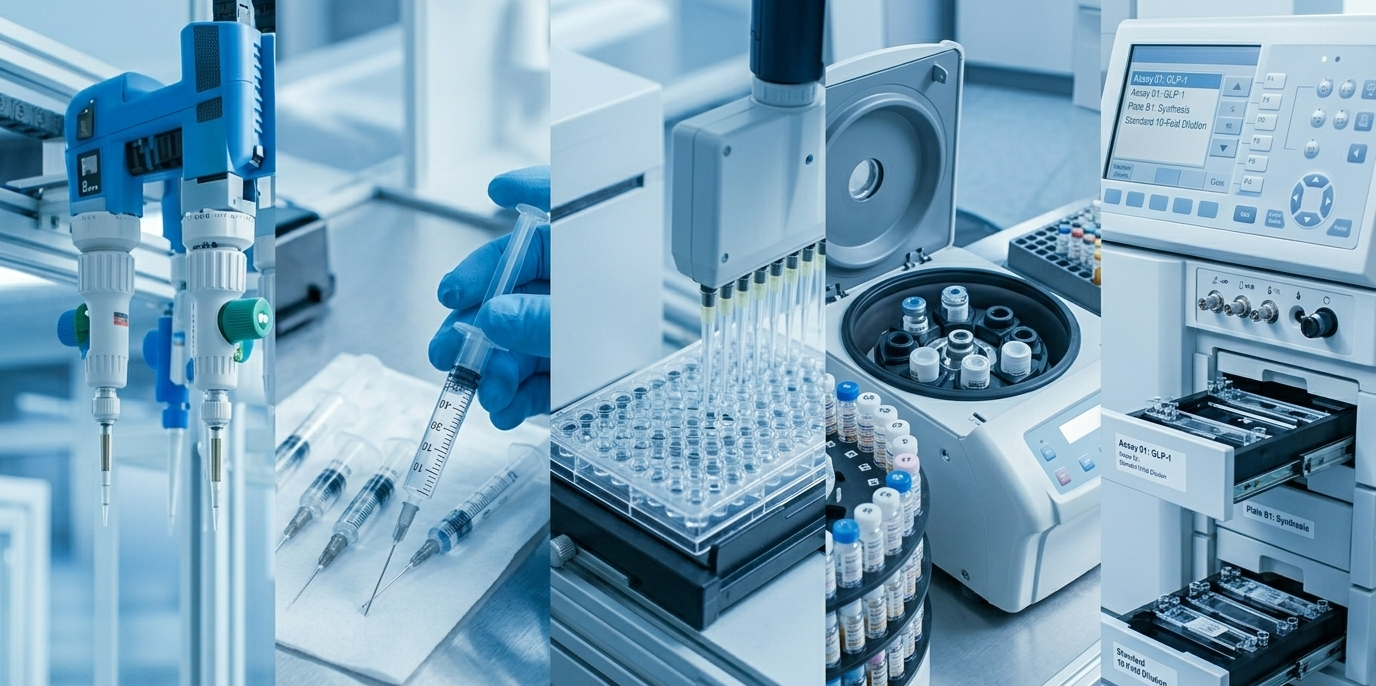
Sterile technique is the foundation of safe peptide injection and the most important aspect of learning how to inject peptides. Contamination at any point in the process — dirty hands, unswabbed vial tops, touched needle tips, unwashed injection sites — introduces bacteria into the compound or the subcutaneous tissue. The three critical sterility checkpoints when you inject peptides: (1) clean hands before handling any supply, (2) alcohol swab the vial top before every draw, and (3) alcohol swab the injection site before every injection.
Additional sterility practices for how to inject peptides safely: never touch the needle to any surface after uncapping. If the needle touches a non-sterile surface, discard and use a new syringe. Do not draw from a vial that has been reconstituted for more than 28 days (bacteriostatic preservative effectiveness diminishes). Store reconstituted vials upright in the refrigerator at 2-8°C with the cap on. These practices add seconds to each session and prevent the contamination that compromises both safety and research data quality.
How to Inject Peptides: Subcutaneous vs Intramuscular
When learning how to inject peptides, most researchers use the subcutaneous route. Subcutaneous injection delivers compounds into the fat layer beneath the skin for gradual absorption. Intramuscular injection delivers compounds deeper into muscle tissue for potentially faster absorption. For most research peptides — BPC-157, TB-500, GHK-Cu, Retatrutide, Tirzepatide, Sermorelin, Ipamorelin, CJC-1295 — subcutaneous is the standard protocol documented in published research. The subcutaneous vs intramuscular comparison guide covers route selection for specific compounds.
The practical advantages of subcutaneous injection for learning how to inject peptides: shorter, thinner needles (29-31G, 1/2″) cause less discomfort. Self-administration is easier (abdomen and thigh are accessible without assistance). The injection technique is simpler (pinch and insert vs locating muscle landmarks). For beginners learning how to inject peptides, subcutaneous is the overwhelmingly recommended starting route.
How to Inject Peptides: The PSPeptides Research Support System
PSPeptides supports the entire how to inject peptides journey through integrated tools and resources. The free reconstitution calculator provides precise dose calculations before injection. The reconstitution guide covers preparation technique. This injection guide covers administration technique. The storage guide covers post-session handling. The side effects guide covers safety monitoring. And the near-24-hour support team is available for any question at any stage.
30+ research peptides at 99%+ verified purity with batch-specific COAs. Bacteriostatic water at $19.99. Free shipping on every order. Same-day processing including Sundays. Affirm and Afterpay at zero fees. The 5-star rating from thousands of verified customers — many of whom learned how to inject peptides with PSPeptides as their vendor. The complete PSPeptides catalog and all educational resources are available at pspeptides.com.
How to Inject Peptides: Building Confidence Through Practice
Learning how to inject peptides is a skill that improves rapidly with practice. Most researchers report significant comfort improvement after just 3-4 sessions. The initial apprehension is normal — but 29-31 gauge needles are extremely thin (thinner than a standard sewing needle), and subcutaneous injection in areas with adequate fat padding produces minimal sensation. The key factors that build confidence when learning how to inject peptides: proper preparation (supplies laid out, dose calculated, site selected before uncapping the syringe), slow and steady technique (no rushing), and consistent site rotation.
PSPeptides supports confidence-building for researchers learning how to inject peptides through the complete resource system: the reconstitution calculator for dose accuracy, the video tutorial for visual demonstration, the injection guide (this article) for technique, and near-24-hour support for real-time questions. The 5-star rating from thousands of customers — many of whom started as injection beginners — confirms that PSPeptides’ support system works.
How to Inject Peptides: The Complete PSPeptides Catalog
PSPeptides carries 30+ injectable research peptides for researchers who have mastered how to inject peptides, plus non-injectable options (nasal sprays, topical serum, throat spray) for those who prefer needle-free research. All at 99%+ verified purity, free shipping, same-day processing including Sundays, and Affirm/Afterpay at zero fees. Bacteriostatic water at $19.99 completes your injection supplies. The most important skill in peptide research is knowing how to inject peptides safely — and PSPeptides provides every tool to develop that skill with confidence. Explore the complete catalog at pspeptides.com/shop.

Mastering how to inject peptides is a fundamental research skill that opens access to the full range of injectable peptide compounds — from tissue repair (BPC-157, TB-500) to metabolic research (Retatrutide, Tirzepatide) to longevity (Epitalon, MOTS-C) to growth hormone optimization (Sermorelin, CJC/Ipamorelin). The subcutaneous technique is the same across all compounds — only the dose changes. Once you know how to inject peptides safely, every compound in the PSPeptides catalog becomes accessible for your research program.
PSPeptides provides the compounds, the supplies, and the comprehensive how to inject peptides education that transforms injection anxiety into research confidence. 99%+ verified purity ensures compound quality. Bacteriostatic water ($19.99) ensures proper reconstitution. The free calculator ensures accurate dosing. This guide ensures safe technique. And the 5-star verified experience ensures that the vendor behind your how to inject peptides journey delivers consistently excellent quality and support. Learn the skill. Start the research. Begin at pspeptides.com/shop.
For researchers who prefer to start without injections while building confidence for how to inject peptides later, PSPeptides offers five non-injectable products: GHK-Cu Skin Serum ($16.99, topical), Semax Nasal Spray ($55.99), Selank Nasal Spray ($55.99), Selank+Semax Nasal Spray ($55.99), and BPC-157 Throat Spray ($59.99). These ready-to-use products require zero reconstitution and zero injection skill — providing an entry point while you build comfort with how to inject peptides through the guides and video tutorials.
The how to inject peptides skill set — sterile preparation, accurate drawing, proper site selection, smooth technique, safe disposal — is the practical foundation that every injectable peptide researcher must develop. This guide provides the complete technique. The PSPeptides calculator provides the dose math. The video tutorial provides the visual demonstration. And 99%+ verified compounds provide the quality foundation that makes proper injection technique meaningful. How to inject peptides safely is a learnable, practicable skill — and PSPeptides provides every resource you need to develop it with confidence.
Understanding how to inject peptides
Frequently Asked Questions
How to inject peptides subcutaneously?
Clean vial top, draw dose, clean injection site, pinch skin, insert needle at 45-90°, push plunger slowly, wait 5-10 seconds, withdraw, dispose in sharps container.
What needle gauge for peptide injection?
29-31 gauge, 1/2 inch needle length, U-100 insulin syringe for subcutaneous peptide injection.
Where to inject peptides?
Abdomen (2+ inches from navel), front of thigh (middle third), or back of upper arm. Rotate sites with each injection.
What supplies do I need to inject peptides?
Reconstituted peptide, U-100 insulin syringe, alcohol swabs, sharps container. PSPeptides provides peptides and BAC water.
All PSPeptides products are sold exclusively for research and laboratory use.