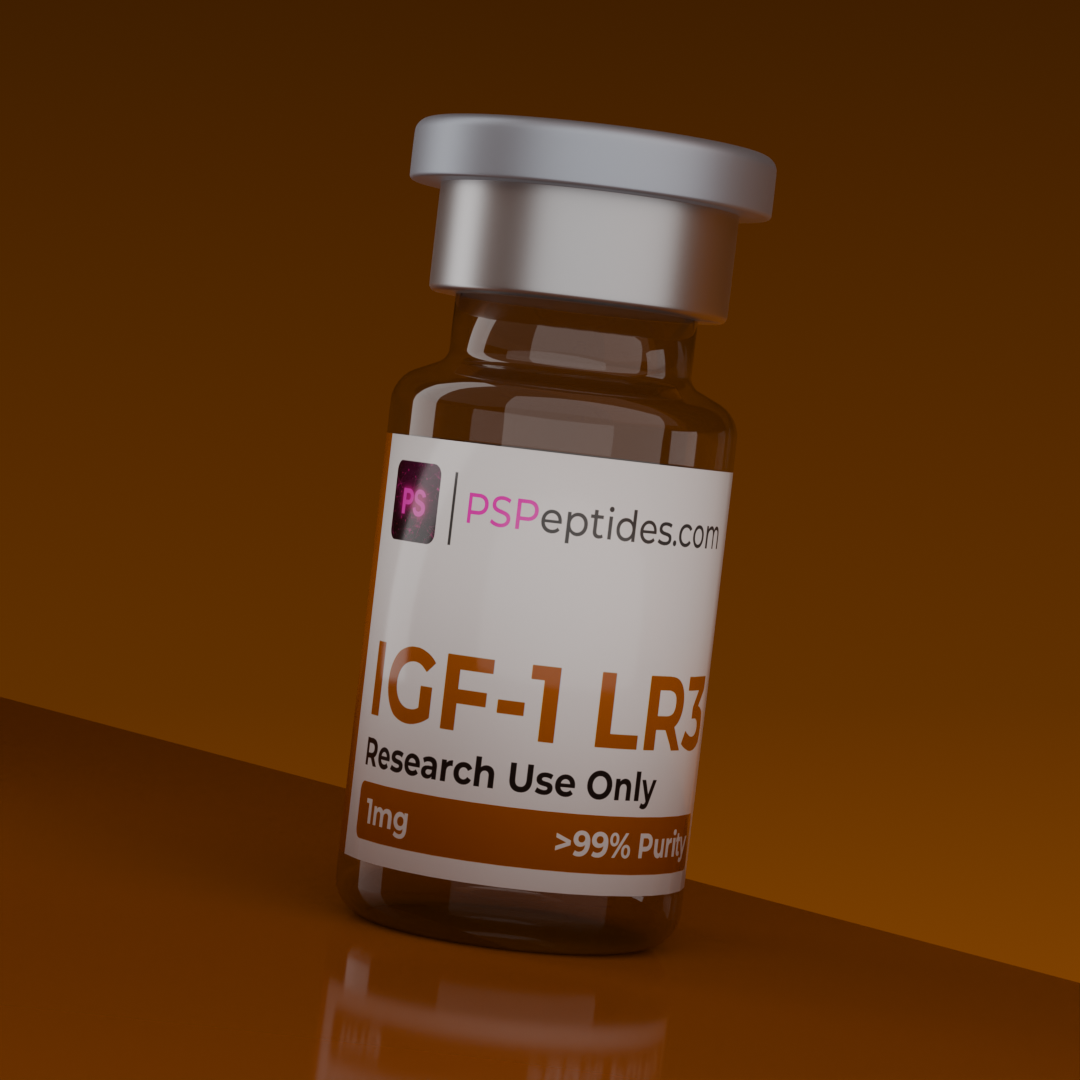
IGF-1 LR3 is a recombinant isoform of Insulin-like Growth Factor 1 that retains the full N-terminal E-peptide extension found in the LF splice variant of the IGF1 gene. Unlike truncated forms such as des(1-3)IGF-1, this variant maintains an intact propeptide domain that influences receptor engagement kinetics and local tissue signaling gradients.
Researchers who buy IGF-1 LR3 use it to probe the specific contributions of the E-peptide region to myogenic, chondrogenic, and neuroprotective signaling cascades in controlled in vitro and ex vivo models.
The full-length LF isoform has attracted significant interest in regenerative biology because the E-peptide itself may exert bioactivity independent of the mature IGF-1 domain. Studies suggest this peptide extension can influence cell proliferation and migration at nanomolar concentrations, making it a valuable research tool for dissecting growth factor biology.
Detailed Mechanism of Action
When you buy IGF-1 LR3 and apply it to cells expressing the insulin-like growth factor 1 receptor (IGF-1R), the mature IGF-1 domain binds to the extracellular alpha-subunits of the receptor, inducing conformational changes that activate the intracellular beta-subunit tyrosine kinase domains.
This autophosphorylation cascade recruits insulin receptor substrate (IRS-1/IRS-2) proteins, which act as docking platforms for the regulatory subunit of phosphoinositide 3-kinase (PI3K). Activated PI3K converts PIP2 to PIP3 at the plasma membrane, recruiting PDK1 and Akt (PKB), whose phosphorylation at Thr308 and Ser473 drives downstream pro-survival and anabolic effectors.
The PI3K/Akt pathway activated by IGF-1 LR3 treatment phosphorylates and inhibits FOXO transcription factors, blocking pro-atrophy gene programs including MAFbx/atrogin-1 and MuRF-1. Simultaneously, Akt activates mTORC1 through TSC2 phosphorylation and Rheb GTPase activation, stimulating ribosomal S6 kinase 1 (S6K1) and inhibiting 4E-BP1.
The net effect is a coordinated increase in cap-dependent mRNA translation, supporting robust protein synthesis in target tissues. This dual suppression of catabolism and stimulation of anabolism makes IGF-1 LR3 a powerful research probe for studying protein homeostasis.
Beyond the canonical PI3K/Akt/mTOR axis, IGF-1 LR3 also activates the RAS/RAF/MEK/ERK mitogen-activated protein kinase cascade through Grb2/SOS recruitment. ERK1/2 phosphorylation drives cell cycle progression from G1 to S phase by upregulating cyclin D1 and downregulating the CDK inhibitor p27Kip1.
Researchers who buy IGF-1 LR3 for cell proliferation assays can exploit this pathway to investigate how growth factor signaling integrates with cell cycle checkpoints in primary and transformed cell lines. The E-peptide domain of the LF isoform additionally interacts with extracellular matrix proteoglycans, potentially modulating local bioavailability and signaling duration in 3D culture systems.

Published Research on IGF-1 LF Isoforms
The biology of IGF-1 splice variants has been documented across numerous peer-reviewed studies. Yang and colleagues demonstrated in 2004 that the mechano-growth factor (MGF) variant of IGF-1, which shares structural features with LF isoforms, activates satellite cell proliferation independently of the mature IGF-1/IGF-1R axis, suggesting autonomous E-peptide bioactivity (Yang et al., 2004, PMID 15482527). This foundational work underpins much of the rationale for using IGF-1 LR3 as a tool to parse splice-variant-specific effects in regenerative research.
Philippou et al. (2009) reviewed the heterogeneity of IGF-1 isoforms in skeletal muscle adaptation, noting that the LF isoform is preferentially expressed in liver and plays a distinct role in systemic growth signaling compared to locally expressed muscle isoforms.
Research teams that buy it for comparative studies can use it alongside des(1-3)IGF-1 and the Ea peptide to map which structural domain drives specific downstream effects in a given cell type. Additional work from the Rotwein laboratory established the sequence-function relationships of IGF-1 propeptides, confirming that E-domain variants differentially regulate binding to IGF-binding proteins (IGFBPs) 1-6 (Rotwein, 2012, PMID 22033464).
More recent proteomic investigations have used mass spectrometry to confirm the full-length nature of recombinant IGF-1 LR3 preparations, validating that the E-peptide remains intact and non-glycosylated after lyophilization. Labs that buy the compound from PSPeptides receive a batch-specific COA that includes mass spectrometry data confirming molecular weight and purity. This traceability is critical for studies seeking to differentiate the effects of the mature IGF-1 domain versus the E-peptide extension in complex cell culture systems.
IGF-1 LR3 vs. Alternative IGF-1 Research Tools
| Feature | IGF-1 LR3 | Recombinant IGF-1 | des(1-3)IGF-1 |
|---|
| E-Peptide Present | ✅ Yes (LF domain) | ❌ No | ❌ No |
| IGF-1R Binding | High affinity | High affinity | Higher (IGFBP-independent) |
| IGFBP Interaction | Modulated by E-domain | Full interaction | Minimal binding |
| Splice Isoform Research | ✅ Yes | ❌ No | ❌ No |
| E-Peptide Autonomy | Investigable | Not applicable | Not applicable |
| Stability (lyophilized) | ≥24 months at −20°C | ≥24 months at −20°C | ≥24 months at −20°C |
| COA Included | ✅ Batch-specific | Varies by vendor | Varies by vendor |
| US Manufactured | ✅ Yes | Varies | Varies |
Reconstitution & Handling Protocol
Researchers who buy this peptide receive a lyophilized powder that must be reconstituted with sterile bacteriostatic water (BAC water) before use. For a 0.1mg vial, adding 500µL of BAC water yields a 200ng/µL (200 nM at approximately 9 kDa) working stock suitable for most cell culture applications. For the 1mg vial, reconstituting in 2mL BAC water creates a 500ng/µL stock, which can be diluted to experimental concentrations of 10–200ng/mL typically used in proliferation, differentiation, and survival assays.
Use our free peptide reconstitution calculator to determine exact volumes for your target working concentration. After reconstitution, store at 4°C and use within 28 days; for longer-term storage, aliquot into single-use volumes and freeze at −80°C, avoiding more than two freeze-thaw cycles. All pipettes, tips, and containers that contact IGF-1 LR3 solutions should be low-protein-binding grade to minimize adsorptive loss. For complete step-by-step technique guidance, see our peptide reconstitution guide.
When preparing IGF-1 LR3 working solutions, avoid vortexing vigorously — use gentle end-over-end rotation or slow roller mixing to prevent aggregation and denaturation. If a precipitate forms after reconstitution, centrifuge briefly at 10,000×g and use the clarified supernatant. Carrier proteins such as 0.1% BSA can be added to dilute solutions below 1ng/mL to reduce surface adsorption.
Storage & Stability
Lyophilized IGF-1 LR3 is stable for ≥24 months at −20°C when stored in a dry, dark environment away from freeze-thaw cycling. The product is shipped on dry ice in a sealed vial with desiccant. Once reconstituted, the working solution retains activity for up to 28 days at 4°C.
For longer storage windows, single-use aliquots in low-binding microtubes can be stored at −80°C for up to 6 months with minimal loss of biological activity when thawed gently on ice. Avoid repeated freeze-thaw cycles, which progressively degrade the E-peptide domain and reduce specific activity.
Light exposure can accelerate oxidative degradation. Keep vials wrapped in foil or stored in opaque containers. For comprehensive guidance on protecting peptide integrity, see our peptide storage and stability guide and our article on how to detect peptide degradation.
Certificate of Analysis
Every vial shipped when you buy it from PSPeptides comes with a batch-specific Certificate of Analysis generated from independent third-party laboratory testing. The COA documents HPLC-confirmed purity ≥99%, electrospray ionization mass spectrometry (ESI-MS) confirmation of the correct molecular weight, and microbial sterility testing. COAs are attached to your order confirmation and are always available on request for any prior batch. To understand how to interpret these results for your research, read our guide to reading a peptide COA.
Why Researchers Choose PSPeptides to Buy IGF-1 LR3
- US Manufactured: All peptides, including IGF-1 LR3, are synthesized in US-based cGMP-compliant facilities under rigorous quality control — never outsourced to unvetted international suppliers.
- Third-Party Tested: Independent HPLC and mass spectrometry verification on every production batch, with results published in the batch-specific COA attached to your order.
- Fast Shipping: Free UPS 2nd Day Air on orders over $200, with same-day dispatch for orders placed before 2 PM EST Monday–Friday.
- Flexible Payments: Credit cards, Afterpay, Klarna, Apple Pay, and Google Pay all accepted.
- 7-Day Support: Responsive customer service team available via email — available to answer technical reconstitution and handling questions.
- Transparent Sourcing: PSPeptides publishes vendor qualification criteria; read our comparison of the best peptide companies in 2026 to understand our standards.
Learn more about how to evaluate any supplier before you buy this peptide or any research peptide: how to choose a research peptide supplier.
Frequently Asked Questions About IGF-1 LR3
What makes IGF-1 LR3 different from standard recombinant IGF-1?
When you buy it, you receive a full-length isoform that retains the LF E-peptide domain, which is absent from standard recombinant IGF-1. This domain has been shown in multiple studies to interact with extracellular matrix components and potentially exert independent bioactivity on cell proliferation and migration. For researchers studying IGF-1 splicing biology or E-peptide function specifically, IGF-1 LR3 is the appropriate tool rather than the mature 70-amino acid IGF-1 peptide alone.
What concentration should I use in cell culture experiments?
Most in vitro proliferation and differentiation studies use IGF-1 LR3 at concentrations ranging from 10–200 ng/mL (approximately 1–22 nM), which is within the physiological range for IGF-1R half-maximal activation. Dose-response experiments starting from 1ng/mL up to 1µg/mL are recommended to establish the optimal concentration for your specific cell line and assay. Receptor expression level, serum content, and the presence of IGF-binding proteins in conditioned medium all affect the effective free concentration.
How does the E-peptide influence IGF-binding protein interactions?
The E-peptide domain of IGF-1 LR3 modulates the binding affinity of IGFBPs 1–6 compared to the mature IGF-1 domain alone. Some studies suggest the propeptide sterically restricts IGFBP binding, potentially increasing free IGF-1 bioavailability in serum-containing culture media. This makes IGF-1 LR3 a useful tool for studying how IGFBPs regulate IGF-1 signaling dynamics in tissues where IGFBP concentrations are high, such as liver and serum-exposed epithelial models.
Is IGF-1 LR3 suitable for use in 3D organoid and tissue-engineering models?
Yes — the intact E-peptide domain of IGF-1 LR3 enables interaction with ECM proteoglycans such as heparan sulfate, which may help retain the peptide within 3D matrices and extend local signaling duration. Researchers using Matrigel, collagen, or fibrin-based systems have employed IGF-1 LR3 to promote organoid growth and maintain progenitor cell identity. When used in 3D models, protein adsorption is a key concern — low-binding matrices and carrier proteins are recommended to ensure consistent bioavailability throughout the scaffold.
Related Research Resources
All PSPeptides products are sold exclusively for laboratory and research use. Not intended for human consumption. Not for use in clinical trials, veterinary applications, or food production without appropriate regulatory authorization.
IGF-1 LR3 in the Context of the Growth Hormone / IGF-1 Axis
The growth hormone (GH) / IGF-1 axis is one of the most extensively studied endocrine systems in mammalian physiology and disease. Growth hormone, secreted from somatotroph cells in the anterior pituitary in response to hypothalamic GHRH pulses, stimulates hepatic production of IGF-1 through JAK2/STAT5b signaling.
The liver exports IGF-1 — predominantly as ternary complexes with IGFBP-3 and the acid-labile subunit (ALS) — into circulation, where it exerts endocrine actions on peripheral tissues. When you buy the compound for axis modeling, you are working with the specific isoform that most closely reflects this hepatic secretion pattern, since the LF variant is the predominant mRNA transcript expressed in adult liver.
Local, autocrine/paracrine IGF-1 signaling in muscle, bone, and neural tissue is governed by different splice variants — primarily the Ea and Eb (mechano-growth factor, MGF) isoforms. Researchers who buy this peptide and use it alongside locally expressed variants can parse the respective contributions of systemic vs. local IGF-1 signaling to tissue maintenance and repair.
This distinction has clinical relevance in aging research, where reduced hepatic IGF-1 output is a hallmark of somatopause, and in sarcopenia models where local muscle IGF-1 expression is altered independently of circulating levels.
Peptide Stacking Considerations for IGF-1 LR3
In preclinical research contexts, IGF-1 LR3 is sometimes investigated alongside growth hormone secretagogues such as CJC-1295, ipamorelin, or GHRP-2 to understand how upstream GH stimulation influences local IGF-1 signaling. Read our complete CJC-1295 and Ipamorelin guide for context on GH secretagogue research. For studies examining how downstream IGF-1 signaling interacts with tissue repair cascades, our peptide stacking guide provides an overview of combination strategies used in the literature.
Some research groups co-administer IGF-1 LR3 with BPC-157 in myoblast injury models to investigate whether BPC-157-mediated VEGF upregulation potentiates IGF-1-driven satellite cell activation. Others combine IGF-1 LR3 with TB-500 (thymosin beta-4) in wound healing models to probe synergistic effects on keratinocyte and fibroblast migration. These multi-peptide experimental designs require precise quantitation and high-purity reagents — exactly the standard maintained by PSPeptides for every batch.
Dosage Considerations in Preclinical Models
Published preclinical literature using recombinant IGF-1 isoforms provides reference points for researchers who buy it for in vivo or ex vivo work. In rodent muscle injury models, local intramuscular injections of IGF-1 variants at 0.1–1µg per injection site have been used to evaluate regenerative responses over 7–28-day recovery periods. In neuronal culture, EC50 values for IGF-1-mediated survival range from 1–10ng/mL in serum-free medium, providing a starting point for receptor activation studies with IGF-1 LR3.
For chondrocyte and osteoblast research, higher concentrations (50–200ng/mL) are typically needed to achieve measurable increases in proteoglycan synthesis and alkaline phosphatase activity. Researchers should always establish cell-type-specific dose-response curves, as receptor expression levels, co-receptor crosstalk, and endogenous IGFBP secretion vary substantially between primary cells and established cell lines.
Use our peptide dosage calculator guide for assistance with concentration planning across your experimental volumes. Also review our peptide half-life chart to plan your treatment schedules appropriately for your in vitro model.




 Made & Shipped