Primary application: preclinical research on mitochondrial bioenergetics, oxidative stress, and age-related functional decline in heart, skeletal muscle, kidney, and neural tissue. Researchers who buy SS-31 from PSPeptides receive a batch-specific Certificate of Analysis with every order.
SS-31 is a synthetic Szeto-Schiller peptide with the sequence D-Arg-dimethylTyr-Lys-Phe-NH₂. Its alternating cationic and aromatic residues let it cross cell membranes and concentrate roughly 1,000-fold inside mitochondria, where it binds cardiolipin on the inner mitochondrial membrane. By protecting cardiolipin from peroxidation, SS-31 stabilizes the electron transport chain, restores ATP synthesis, and reduces reactive oxygen species at their source.
Labs that buy SS-31 are usually studying what happens when mitochondria fail: ischemia-reperfusion injury, cardiomyopathy, sarcopenia, neurodegeneration, or kidney disease. New to the field? Start with our complete guide to peptides before planning your first experiment.
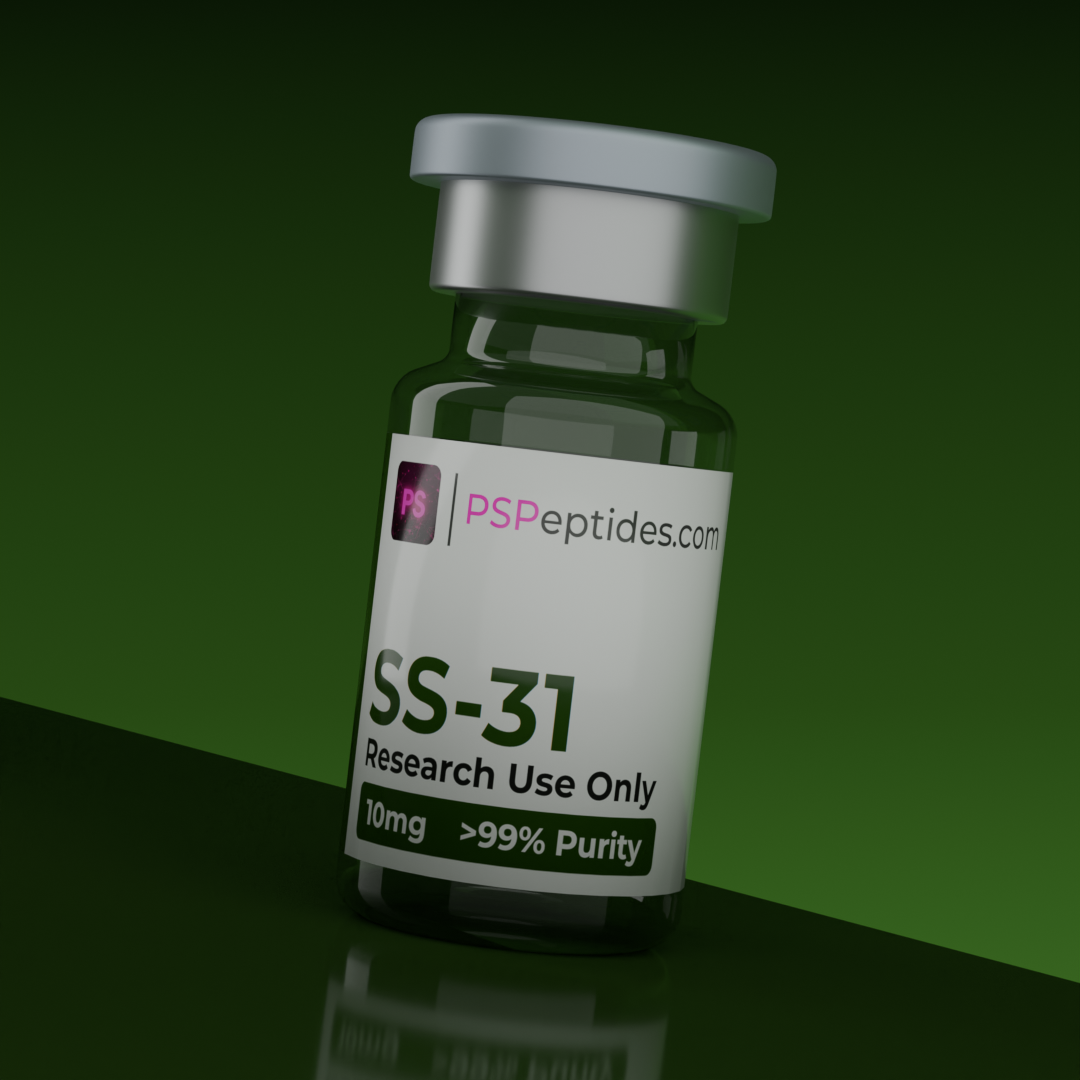
Review the specifications below before you buy SS-31 for your protocol. The 10mg vial is the standard research quantity; a 50mg vial is listed for larger programs when in stock.
Detailed Mechanism of Action
To understand why so many labs buy SS-31, start with cardiolipin. This four-chain phospholipid is found almost exclusively in the inner mitochondrial membrane, where it anchors cytochrome c, organizes respiratory complexes I, III, and IV into efficient supercomplexes, and maintains the tightly curved cristae that electron transport depends on. When cardiolipin becomes oxidized, cytochrome c detaches, electron flow becomes leaky, ROS production climbs, and the cell drifts toward apoptosis.
SS-31 binds cardiolipin through two forces. The cationic arginine and lysine side chains are drawn electrostatically to cardiolipin’s two negatively charged phosphate head groups, while the aromatic dimethyltyrosine and phenylalanine residues insert into the lipid bilayer. Because this binding is selective for cardiolipin-rich membranes, SS-31 accumulates in mitochondria rather than the plasma membrane or cytosol.
Once bound, SS-31 does three things. It shields cardiolipin from peroxidation by the cytochrome c/cardiolipin peroxidase complex. It restores the electrostatic surface properties of the inner membrane, improving electron transfer between complexes. And it reduces electron leak, which lowers superoxide generation at complexes I and III.
The net result is more ATP per unit of oxygen consumed and less oxidative damage. Researchers who buy SS-31 are therefore acquiring a tool that addresses the cause of mitochondrial dysfunction rather than scavenging ROS downstream.
SS-31 also limits opening of the mitochondrial permeability transition pore, preventing the mitochondrial swelling and cytochrome c release that trigger apoptosis during reperfusion. In the original 2004 characterization, this translated into reduced oxidative cell death in cultured cells and smaller infarcts in isolated hearts, findings that have since been reproduced across many tissue types.
Unlike lipophilic cation antioxidants such as MitoQ, SS-31 uptake does not depend on mitochondrial membrane potential. This matters when mitochondria are already depolarized, as in ischemic tissue, aged muscle, or a failing myocardium, because the peptide still reaches its target. That is one reason groups studying damaged mitochondria buy SS-31 rather than a potential-driven compound.
Proteomic mapping has also shown SS-31 engaging ATP synthase, adenine nucleotide translocase, and other inner membrane proteins, suggesting the mechanism extends beyond cardiolipin alone.

Published Research
SS-31 is among the most thoroughly characterized mitochondria-targeted peptides in the literature, with hundreds of peer-reviewed publications spanning cell culture, rodent, large-animal, and human studies. Szeto’s 2014 review in the British Journal of Pharmacology, First-in-class cardiolipin-protective compound as a therapeutic agent to restore mitochondrial bioenergetics, remains the definitive mechanistic summary and is the first paper most researchers read before they buy SS-31.
In skeletal muscle aging, Siegel and colleagues (Aging Cell, 2013) showed that a single dose of SS-31 improved mitochondrial ATP production and coupling efficiency in aged mouse muscle within one hour, alongside improved fatigue resistance and endurance; read the study on PubMed. That rapid, measurable effect prompted many aging labs to buy SS-31 for sarcopenia work.
Campbell and colleagues (Free Radical Biology and Medicine, 2019) extended this with eight weeks of daily SS-31 in aged mice, which restored a more youthful glutathione redox state in skeletal muscle, reduced protein S-glutathionylation, improved mitochondrial function, and increased treadmill exercise tolerance; see the PubMed record.
Cardiac and renal evidence is equally deep. Dai and colleagues reported that SS-31 attenuated angiotensin II-induced cardiac hypertrophy, fibrosis, and diastolic dysfunction in mice (JACC, 2011), and Birk and colleagues (JASN, 2013) showed that SS-31 re-energizes ischemic kidney mitochondria by binding cardiolipin and accelerating ATP recovery after reperfusion.
Swine studies of renovascular hypertension demonstrated restored mitochondrial cardiolipin and reduced myocardial damage. Cardiology groups buy SS-31 largely on the strength of this body of work.
Kidney and healthy-aging data continue to accumulate. Sweetwyne and colleagues (Kidney International, 2017) found that eight weeks of SS-31 improved glomerular architecture and reduced podocyte loss in mice of advanced age, and a 2022 study of long-term elamipretide treatment reported enhanced healthy-aging phenotypes, including preserved cardiac and skeletal muscle function, in aged mice.
In neurodegeneration models, SS-31 reduced amyloid-beta-induced mitochondrial fragmentation and synaptic loss in Alzheimer’s-model mice, protected dopaminergic neurons in the MPTP model of Parkinson’s disease, and in recent work exerted neuroprotective effects in spinal cord injury models.
Clinically, the pharmaceutical form, elamipretide, has been evaluated in heart failure, primary mitochondrial myopathy, Barth syndrome, and dry age-related macular degeneration, and in September 2025 the FDA granted it accelerated approval for Barth syndrome. Research-grade SS-31 sold here is not that drug product and is intended solely for laboratory use.
SS-31 vs Alternatives
Researchers comparing mitochondrial interventions often weigh SS-31 against MOTS-c and MitoQ. Our MOTS-c mitochondrial peptide guide covers the metabolic side in depth; the table below summarizes the practical differences to consider before you buy SS-31 or a complementary compound.
| Feature | SS-31 (Elamipretide) | MOTS-c | MitoQ |
|---|
| Compound class | Synthetic tetrapeptide (4 amino acids) | Mitochondrial-derived peptide (16 amino acids) | Ubiquinone-triphenylphosphonium small molecule |
| Primary target | Cardiolipin on the inner mitochondrial membrane | AMPK signaling and nuclear gene expression | Mitochondrial matrix lipids |
| Core mechanism | Stabilizes cristae, restores electron transport efficiency, reduces ROS at the source | Metabolic regulator; shifts the folate-methionine cycle, improves insulin sensitivity | Chain-breaking antioxidant; scavenges lipid peroxides |
| Uptake dependence | Independent of membrane potential | Cell-permeable; translocates to the nucleus under stress | Requires intact membrane potential |
| Typical preclinical dosing | 1–10 mg/kg SC, IP, or IV | 0.5–15 mg/kg IP (mouse studies) | 250–500 µM in drinking water (mouse) |
| Strongest evidence base | Cardiac and renal ischemia-reperfusion, aging muscle, heart failure, mitochondrial disease | Metabolic dysfunction, exercise capacity, obesity models | Oxidative stress, endothelial function, liver injury |
| Human clinical data | Multiple phase 2/3 trials; FDA accelerated approval (Barth syndrome, 2025) | Early-phase analog trial only | Several small oral-supplement trials |
| Research form | Lyophilized 10mg vial; buy SS-31 at PSPeptides | Lyophilized peptide vial | Oral tablet or mesylate powder |
Reconstitution & Handling
When you buy SS-31 from PSPeptides it arrives as a lyophilized powder that must be reconstituted before use in aqueous assay systems. The peptide is highly water-soluble because of its cationic character. Add 1 mL of bacteriostatic or sterile water slowly down the inside wall of the vial to yield a 10 mg/mL (approximately 15.6 mM) stock, or 2 mL for 5 mg/mL. Swirl gently; never shake or vortex.
For working concentrations, dilute the stock in assay buffer or sterile saline on the day of use. A 10 mg/mL stock diluted 1:10,000 gives roughly 1.56 µM, so a single vial supports an enormous number of in vitro wells. Our peptide reconstitution guide and dosage calculator walkthrough cover volumes, syringe markings, and dilution math step by step.
Use sterile technique throughout: swab the stopper, use a fresh needle for each draw, and avoid introducing air bubbles. Most researchers who buy SS-31 also order bacteriostatic water in the same cart so reconstitution is not delayed on arrival.
Storage & Stability
After you buy SS-31, keep the sealed vial at −20°C and protected from moisture and light. Lyophilized SS-31 is typically stable for 24 months or longer under these conditions, and short excursions to room temperature during shipping do not measurably affect purity. Keep the vial in its original packaging with desiccant until the day you reconstitute.
Reconstituted solution should be stored at 2–8°C and used within 28 days, or divided into single-use aliquots and frozen at −80°C to avoid repeated freeze-thaw cycles. The dimethyltyrosine residue is light-sensitive, so use amber tubes or foil for stock solutions. Our peptide storage guide covers aliquoting strategy, temperature logs, and how to recognize degradation. Researchers who buy SS-31 in multi-vial quantities should keep unused vials frozen rather than refrigerated.
On arrival, inspect the vial: the lyophilized cake should appear as a white to off-white powder or compact pellet, the crimp seal should be intact, and the label should list the lot number that matches your COA. Record the receipt date in your lab notebook so the 24-month stability window and the 28-day post-reconstitution window are tracked from the correct starting point.
Certificate of Analysis
Each time you buy SS-31 from PSPeptides, the vial is backed by a batch-specific Certificate of Analysis from an independent third-party laboratory. The COA confirms identity by mass spectrometry (observed mass versus the theoretical 639.8 g/mol), purity by reverse-phase HPLC (≥99% main peak), and appearance. Lot-to-lot purity variance is held under 0.5%, which matters for multi-experiment programs where batch variability can confound results.
Request your lot’s COA at any time by contacting support with your order number. Not sure how to interpret retention times or impurity peaks? Our guide on how to read a peptide COA walks through every section. When you buy SS-31 here, you never have to take purity on faith.
SS-31 Research Dosing Considerations
Published preclinical literature uses a wide range of administration routes and concentrations depending on the model. Researchers who buy SS-31 for in vivo work should design around the paradigm closest to their own question:
- Cardiac and renal ischemia-reperfusion (rodent): 1–10 mg/kg intravenous or intraperitoneal, given before or at the onset of reperfusion, is the most frequently cited approach in infarct-size and renal-function studies.
- Skeletal muscle aging: 3 mg/kg/day subcutaneous for 8 weeks in aged mice is the established paradigm for assessing mitochondrial morphology, redox state, and treadmill endurance.
- Neurodegeneration: Systemic (IP or IV) dosing at 1–5 mg/kg is typical; some groups explore intranasal delivery to favor central nervous system exposure.
- In vitro: 0.1 nM to 1 µM in culture medium, with sub-nanomolar extracellular concentrations often sufficient because of the peptide’s high mitochondrial accumulation ratio.
Always run preliminary dose-response experiments. If you buy SS-31 for chronic paradigms, note that its plasma half-life is short, so most long-term studies rely on once-daily injections or continuous infusion, although intermittent schedules have also been reported.
Why Researchers Buy SS-31 from PSPeptides
- US Manufactured: Synthesized in a US-based, GMP-compliant peptide facility using pharmaceutical-grade reagents, never sourced from overseas bulk suppliers.
- Third-Party Tested: Independent HPLC and mass spectrometry on every batch, with the COA available before your experiment begins. This is the main reason labs buy SS-31 here instead of from unverified sources.
- Fast Shipping: Free UPS 2nd Day Air on orders over $150, with same-day dispatch on orders placed before 2 PM EST on business days.
- Flexible Payments: Credit cards, Afterpay, Klarna, Apple Pay, and Google Pay accepted at checkout.
- 7-Day Support: Reach our team by email, phone, or text for pre-sale questions, COA requests, or multi-vial pricing.
Academic labs and companies that buy SS-31 in larger quantities for extended programs can contact us about volume pricing on the 10mg and 50mg options.
How to Order SS-31
Ordering takes under a minute. Choose the 10mg vial from the selector above, add it to your cart, and complete checkout with a credit card, Afterpay, Klarna, Apple Pay, or Google Pay. Orders placed before 2 PM EST on business days ship the same day, and tracking information is emailed as soon as the label is created.
Need bacteriostatic water or other research supplies? Add them to the same order to avoid a second shipment. Our support team is available seven days a week by email, phone, or text for pre-sale questions, COA requests, and multi-vial quotes for institutional programs.
Frequently Asked Questions
Where can I buy SS-31 online in the USA?
You can buy SS-31 directly from this page. PSPeptides ships US-manufactured, third-party-tested SS-31 to research customers throughout the United States, with free 2nd Day Air on qualifying orders. Select the 10mg vial, add it to your cart, and check out with your preferred payment method.
Is SS-31 the same as Elamipretide and MTP-131?
Yes. SS-31, Elamipretide, MTP-131, and Bendavia all refer to the same tetrapeptide, D-Arg-dimethylTyr-Lys-Phe-NH₂. “SS-31” is the Szeto-Schiller designation used in academic literature, “MTP-131” was the developer’s research code, and “Elamipretide” is the international nonproprietary name used in clinical trials. When you buy SS-31 from PSPeptides, you receive research-grade material with the identical sequence, verified by mass spectrometry.
Is it legal to buy SS-31 for research?
Research-grade SS-31 can be purchased legally in the United States for laboratory and in vitro research use. It is not an approved dietary supplement and is not for human consumption. Researchers who buy SS-31 from PSPeptides acknowledge that it is supplied strictly for research purposes.
What concentration should I use for in vitro work?
Most cell culture studies use 0.1 nM to 1 µM depending on cell type and endpoint. Because SS-31 concentrates about 1,000-fold in mitochondria, effective intracellular levels are reached at low extracellular doses. A single 10mg vial supports hundreds of experiments at these concentrations, which is why most labs buy SS-31 in the 10mg size first.
How do I verify purity before I buy SS-31?
Every lot ships with a third-party COA showing HPLC purity and mass spectrometry identity, and you can request the current lot’s COA from support before ordering. We recommend this step with any vendor; our supplier-selection guide in the resources below explains exactly what to look for.
Does SS-31 need to ship cold?
No. Lyophilized SS-31 tolerates ambient temperatures for the duration of standard 2nd Day Air shipping without measurable loss of purity. Transfer the vial to a −20°C freezer on arrival and keep it sealed until reconstitution.
Can SS-31 be studied alongside other mitochondrial peptides?
Yes. Because SS-31 acts on the inner membrane while MOTS-c acts through AMPK and nuclear signaling, the two are frequently studied together to separate structural from metabolic effects on mitochondrial function. Keep compounds in separate stock solutions and dose them independently so each variable can be controlled.
Can I buy SS-31 in bulk for a multi-year study?
Yes. Labs that buy SS-31 for long programs can choose the 50mg vial when it is in stock or request multi-vial pricing on the 10mg size. Because sealed lyophilized vials remain stable at −20°C for extended periods, ordering ahead is practical and avoids mid-study batch changes.
Related Resources
Before you buy SS-31 or any mitochondrial peptide, these guides will help you plan a reproducible protocol:
All PSPeptides products are sold exclusively for laboratory and research use. Not intended for human consumption.





 Made & Shipped