Reviewed by
Brandon Johnson — Certified Personal Trainer, Nutrition Coach & Peptide Research Consultant
Brandon Johnson is a certified personal trainer, nutrition coach, and peptide research consultant with a background in kinesiology and over 15 years of experience in fitness and wellness. He reviews all PSPeptides educational content for scientific accuracy and practical relevance.
Understanding how many units of peptides to draw on your syringe is the single most important practical skill in peptide research — and the most common source of confusion for beginners. The confusion exists because “units” on an insulin syringe are NOT milligrams (mg), NOT milliliters (mL), and NOT micrograms (mcg). They are a volume measurement specific to U-100 insulin syringes where 100 units = 1 milliliter. How many units of peptides you draw depends entirely on the concentration of your reconstituted solution — which is determined by how much bacteriostatic water you added to the vial.
The free PSPeptides Reconstitution and Dosage Calculator eliminates this confusion entirely — enter your vial size, water volume, and target dose, and it outputs the exact number of units with a visual syringe diagram. But understanding the underlying math ensures you can verify any calculation and catch potential errors. This guide explains what units actually mean, how they relate to mg and mL, and exactly how to determine how many units of peptides to draw for any dose.
How Many Units of Peptides: What Are “Units” on a Syringe?
“Units” on a U-100 insulin syringe are simply a volume measurement: 100 units = 1 milliliter (mL). The markings on the syringe barrel count from 0 to 100 (on a 1mL syringe), with each mark representing 1 unit = 0.01 mL. This is the universal standard for peptide research — every reconstitution calculator, every dosing guide, and every published protocol references U-100 syringe units.
The critical insight for understanding how many units of peptides to draw: units measure VOLUME, not mass. A vial containing 5mg of peptide reconstituted with 1mL of water has a different concentration (and therefore a different number of units per dose) than the same 5mg vial reconstituted with 2mL. The amount of peptide in the vial is the same — but how many units of peptides you draw changes because the concentration changed.
How Many Units of Peptides: The Core Formula
The formula for how many units of peptides to draw:
Units = (Desired dose in mg ÷ Total mg in vial) × Total units of water added
Where “total units of water added” = mL of bacteriostatic water × 100.
Example: 5mg vial + 2mL BAC water = 200 total units of water. For a 250mcg (0.25mg) dose: (0.25 ÷ 5) × 200 = 10 units. Draw to the “10” mark on your EasyTouch syringe.

How Many Units of Peptides: Common Dose Examples
| Compound (vial) | BAC Water | Dose | How Many Units |
|---|---|---|---|
| BPC-157 (5mg) | 2mL | 250mcg | 10 units |
| BPC-157 (5mg) | 2mL | 500mcg | 20 units |
| Retatrutide (5mg) | 2mL | 2mg | 80 units |
| TB-500 (5mg) | 2mL | 2.5mg | 100 units (full syringe) |
| Sermorelin (5mg) | 2mL | 200mcg | 8 units |
| Ipamorelin (5mg) | 2mL | 300mcg | 12 units |
| CJC-1295 No DAC (5mg) | 2mL | 100mcg | 4 units |
How Many Units of Peptides: mg vs mL vs mcg vs Units Explained
The biggest source of confusion about how many units of peptides to use is the multiple measurement systems involved:
Milligrams (mg) = mass/weight of the peptide. The vial label says “5mg” — this is how much peptide powder is in the vial before reconstitution. This number NEVER changes regardless of how much water you add.
Micrograms (mcg) = a smaller mass unit. 1mg = 1,000mcg. Peptide doses are often listed in micrograms (e.g., “250mcg BPC-157”). When calculating how many units of peptides to draw, you must convert mcg to mg: 250mcg = 0.25mg.
Milliliters (mL) = volume of liquid. This is how much bacteriostatic water you add. On a U-100 syringe, 1mL = 100 units.
Units = the markings on the syringe barrel. On U-100 syringes, 100 units = 1mL. How many units of peptides you draw is the final output — the number that tells you where to fill the syringe.
How Many Units of Peptides: Why the Calculator Changes Everything
The free PSPeptides calculator eliminates all manual math for determining how many units of peptides to draw. Enter three values: vial size (mg), water volume (mL), target dose (mg or mcg). The calculator outputs the exact syringe units AND displays a visual diagram of where on the syringe to draw. No formula needed. No unit conversions needed. No risk of mg/mcg confusion. A video tutorial on the same page demonstrates the reconstitution technique.

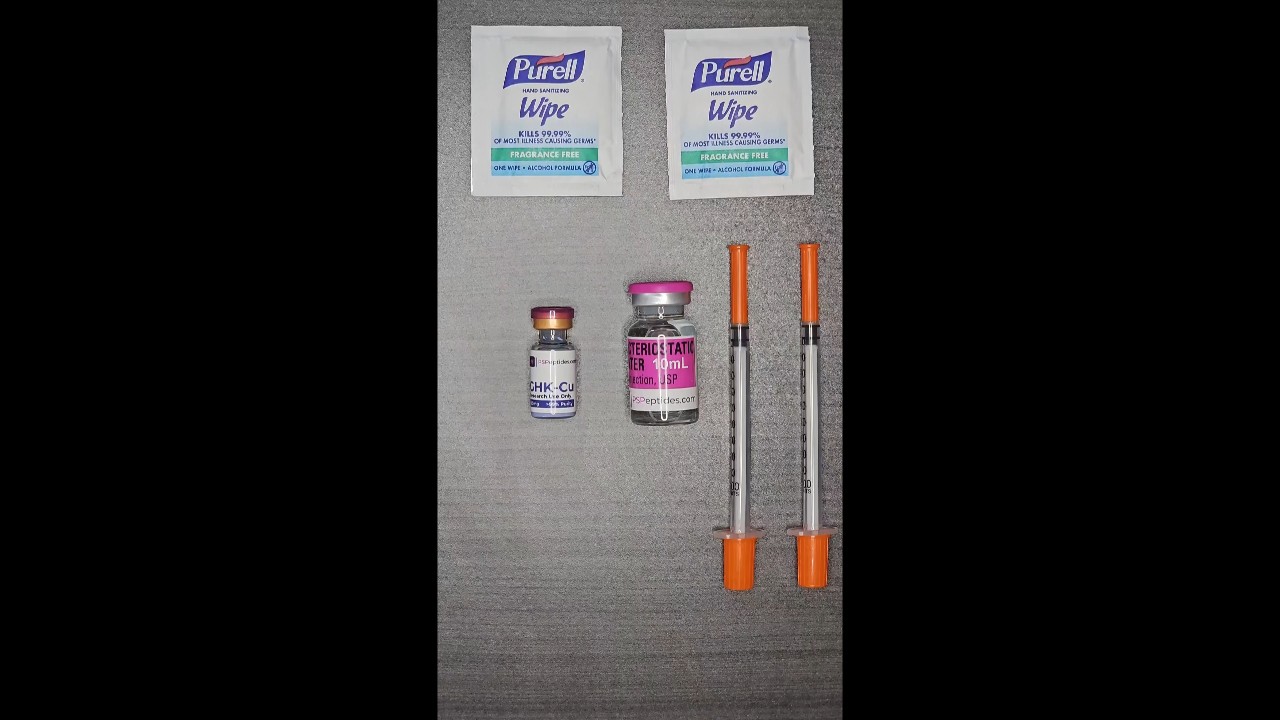
The reconstitution guide covers preparation. The calculator guide covers advanced features. The half-life chart covers timing. PSPeptides provides the compounds (30+ peptides from $29.99), the supplies (BAC water, syringes, alcohol pads), the calculator, and 24/7 support for any question about how many units of peptides to use. PubMed indexes peptide dosing research.
How Many Units of Peptides: The Water Volume Variable
The most important concept for understanding how many units of peptides to draw: the same vial reconstituted with different water volumes requires different unit draws for the same dose. A 5mg BPC-157 vial + 1mL BAC water = 5mg/mL concentration. A 250mcg dose = 5 units. The SAME vial + 2mL BAC water = 2.5mg/mL. The SAME 250mcg dose now = 10 units. Same vial. Same dose. Different water volume → different number of units. This is why how many units of peptides is not a fixed number — it depends entirely on YOUR reconstitution.
The free PSPeptides calculator handles this automatically. Enter YOUR water volume, and the calculator adjusts the unit output accordingly. But understanding WHY the units change (because concentration changes with water volume) prevents the dangerous mistake of using someone else’s unit numbers with a different reconstitution volume.
How Many Units of Peptides: The mg/mcg Conversion Trap
The most dangerous error in calculating how many units of peptides to draw: confusing milligrams (mg) and micrograms (mcg). 1mg = 1,000mcg. A “250mcg” BPC-157 dose is 0.25mg — NOT 250mg. Mistaking mcg for mg produces a 1,000x calculation error. While the physical impossibility of drawing 1,000x volume from a small vial usually catches this error, it illustrates why understanding the measurement systems that determine how many units of peptides to use is essential for safe research.
The PSPeptides calculator accepts both mg and mcg inputs and converts automatically — providing a safety layer against this confusion. When manually calculating how many units of peptides to draw, always verify: is the published dose in mg or mcg? The compound-specific guides on the PSPeptides blog specify the correct unit for each compound.
How Many Units of Peptides: The U-100 Standard
All peptide dosing — every calculator, every guide, every published protocol — uses U-100 syringe units. “U-100” means 100 units per milliliter. PSPeptides’ EasyTouch syringes are U-100. The PSPeptides calculator outputs U-100 units. Using a U-40 syringe (designed for concentrated insulin formulations) with U-100 calculations delivers 2.5x the intended dose — a dangerous error. When purchasing syringes for peptide research, always verify “U-100” on the packaging. This is the single most important syringe specification for determining how many units of peptides to draw accurately.
How Many Units of Peptides: Practical Tips for Accuracy
For maximum accuracy when drawing how many units of peptides your protocol requires: draw slowly — fast drawing creates air bubbles that reduce actual delivered volume. Hold the syringe needle-up and tap bubbles to the top before expelling them. Re-verify the unit mark after bubble removal. Draw at eye level — viewing the syringe from above or below creates parallax error. And always use a new syringe for each session — reused needles are duller, creating inconsistent draw rates and contamination risk. The EasyTouch syringes at PSPeptides are individually sealed for single-use sterility.

The PSPeptides Quality, Supplies, and Support Standard
PSPeptides provides research-grade peptides at 99%+ purity verified through third-party HPLC testing with batch-specific Certificates of Analysis. US-based manufacturing. Same-day processing seven days a week including Sundays. Free shipping on every domestic order. Free international shipping to 30+ countries on orders over $150. Zero processing fees on Affirm, Afterpay, Zelle, cards, Apple Pay, and Google Pay. Complete supplies — bacteriostatic water ($19.99), EasyTouch insulin syringes, and alcohol prep pads — alongside 30+ research peptides in a single checkout.
24/7 customer support via live chat, email at [email protected], and phone/text at (551) 284-2670. The free reconstitution and dosage calculator at pspeptides.com/peptide-calculator provides visual syringe diagrams and video tutorials. The 5-star rating from thousands of verified customers confirms consistent quality and service. PSPeptides provides the complete research peptide experience: verified compounds, essential supplies, preparation tools, educational resources, and around-the-clock human support.
Complete PSPeptides Catalog
Retatrutide $39.99-$119.99. Tirzepatide $54.99-$104.99. MOTS-C $69.99-$189.99. Epitalon $59.99-$129.99. GHK-Cu $29.99-$39.99. GHK-Cu Serum $16.99. GLOW $69.99. KLOW $89.99. Semax $42.99. Selank $32.99. BPC-157+TB-500 Wolverine $59.99. BPC-157 $49.99-$89.99. TB-500 $44.99-$79.99. KPV $35.99. PT-141 $29.99. Kisspeptin $39.99. AOD-9604 $39.99. CJC/Ipamorelin Blend $65.99. CJC-1295 No DAC $35.99. Sermorelin $44.99-$79.99. Ipamorelin $39.99. Cagrilintide. DSIP Injectable and Nasal Spray. Thymosin Alpha-1. BAC water $19.99. EasyTouch Syringes. Alcohol Prep Pads. Nasal sprays $55.99. BPC-157 Throat Spray $59.99. Free shipping, same-day processing, zero fees at pspeptides.com/shop.
How Many Units of Peptides: The Complete Reference
For researchers who want a permanent reference for how many units of peptides common protocols require (all assume 2mL BAC water reconstitution): BPC-157 5mg — 250mcg = 10 units, 500mcg = 20 units. Retatrutide 5mg — 1mg = 40 units, 2mg = 80 units. TB-500 5mg — 2mg = 80 units, 2.5mg = 100 units. Sermorelin 5mg — 200mcg = 8 units, 300mcg = 12 units. Ipamorelin 5mg — 200mcg = 8 units, 300mcg = 12 units. CJC-1295 No DAC 5mg — 100mcg = 4 units, 200mcg = 8 units. GHK-Cu 50mg — 2mg = 8 units. Tirzepatide 10mg — 2.5mg = 50 units.
CRITICAL: These how many units of peptides numbers are ONLY valid for 2mL reconstitution. If you use 1mL, double the units. If you use 3mL, multiply by 1.5. Always verify with the free PSPeptides calculator at pspeptides.com/peptide-calculator for YOUR specific reconstitution volume. The calculator eliminates all manual math and shows the visual syringe diagram for how many units of peptides to draw.
How Many Units of Peptides: The Importance of Consistency
For reproducible research data, understanding how many units of peptides to draw must be paired with dosing consistency. Use the same bacteriostatic water volume for the same compound throughout your research program — this keeps the concentration constant and ensures the same number of units always delivers the same dose. If you reconstitute BPC-157 with 2mL one time and 1.5mL the next time, the units-per-dose changes even though the vial size and dose are the same. Consistency in water volume = consistency in how many units of peptides you draw = consistency in your research data.
How Many Units of Peptides: When the Calculator Is Essential
While the formula for how many units of peptides is simple, the free PSPeptides calculator is essential in three scenarios. First, when working with multiple compounds at different vial sizes and water volumes — mental math across different concentrations increases error risk. Second, when dose escalation protocols change the target dose weekly (as in Retatrutide’s TRIUMPH-1 schedule) — the calculator adjusts instantly for each new dose. Third, when reconstituting with non-standard water volumes — the calculator handles any volume, not just the common 1mL or 2mL examples. For any scenario where how many units of peptides involves more than one simple calculation, the calculator eliminates error risk entirely.

How Many Units of Peptides: Common Calculation Mistakes to Avoid
Understanding how many units of peptides to draw is only half the battle — avoiding the most common miscalculations is equally critical for research accuracy. The single most frequent error is confusing the vial concentration with the total dose. For example, a 5mg vial reconstituted with 2mL of bacteriostatic water creates a 2.5mg/mL solution — meaning that 40 units (0.4mL) delivers 1mg of peptide, not the entire vial. Many beginners incorrectly assume one full syringe delivers the full 5mg content.
A second common mistake involves the mg-to-mcg conversion trap. Research protocols for compounds like BPC-157, Sermorelin, and Ipamorelin specify doses in micrograms (mcg), while vial sizes are listed in milligrams (mg). Forgetting this conversion means a researcher drawing for a 250mcg dose of BPC-157 might calculate based on 250mg — an error resulting in 100 times the intended draw. Always confirm whether the protocol dose is in mg or mcg before performing any unit calculation, and use a peptide dosage calculator to verify results automatically.
Air bubbles are another underappreciated source of error. A 0.1mL air pocket in a 0.2mL draw reduces the actual delivered dose by 50%. Published reconstitution guidelines consistently recommend drawing slowly, holding the syringe vertically needle-up, tapping the barrel to rise bubbles, and expelling them before confirming the final unit mark. This eliminates virtually all air-bubble dosing error in peptide syringe measurements.
Finally, many researchers change their bacteriostatic water volume between reconstitutions without updating their unit calculation. Using 1mL one time and 2mL the next doubles the concentration — and halves the units-per-dose relationship. Documenting reconstitution volume alongside the calculated units in a research log prevents this compounding error across multi-week protocols.

Reconstitution and Storage: Protecting Peptide Integrity
Proper reconstitution directly determines the unit count you will draw — and how reliable those measurements remain over the storage period. Research data demonstrates that lyophilized peptides stored correctly (sealed, at -20°C or -80°C) retain structural integrity for 12–24 months. Once reconstituted with bacteriostatic water, most peptides remain stable for 4–8 weeks when refrigerated at 2–8°C, though stability varies by compound. Bacteriostatic water (containing 0.9% benzyl alcohol as a preservative) is the correct reconstitution medium for multi-dose vials — sterile water is appropriate only for single-use preparations used immediately.
The reconstitution volume you select determines your working concentration and therefore directly affects which syringe unit count corresponds to any given dose. Researchers studying compounds with small per-dose weights (under 100mcg, such as CJC-1295 No DAC or Sermorelin) often use smaller water volumes (0.5–1mL) to keep unit counts measurable. Compounds with larger per-dose weights (1mg or above, such as Retatrutide or TB-500) are commonly reconstituted with 2mL to distribute doses across more of the syringe scale for finer measurement precision.
When reconstituting, inject bacteriostatic water slowly down the side of the vial — never directly onto the peptide cake — and allow it to dissolve without shaking or vortexing. Vigorous agitation can degrade peptide bonds and reduce potency. Once dissolved, gently swirl to ensure homogeneous mixing before drawing the first measured dose. Store reconstituted vials upright in a refrigerator, away from light, and away from the door to minimize temperature fluctuations.
For extended research programs, maintain a written log with the compound name, vial size, water volume used, resulting concentration, and the calculated units-per-dose. This documentation provides a reliable audit trail for research reproducibility and eliminates recalculation errors across sessions. The complete peptide storage guide and the reconstitution protocol guide at PSPeptides cover these procedures in detail for each compound class.
PSPeptides: Quality, Supplies, and 24/7 Support
PSPeptides provides 99%+ HPLC-verified peptides with batch-specific COAs from independent laboratories. US manufacturing. Same-day processing seven days a week including Sundays. Free shipping on every domestic order. Free international shipping to 30+ countries over $150. Zero fees on Affirm, Afterpay, Zelle, cards, Apple Pay, and Google Pay. Complete supplies: bacteriostatic water ($19.99), EasyTouch insulin syringes, and alcohol prep pads in the same checkout. Free reconstitution calculator with visual syringe diagrams and video at pspeptides.com/peptide-calculator. 24/7 support via live chat, email ([email protected]), phone/text (551) 284-2670.
The 5-star rating from thousands of verified customers confirms consistent quality. 30+ research peptides from $29.99. Retatrutide $39.99-$119.99. Tirzepatide $54.99-$104.99. BPC-157 $49.99-$89.99. GHK-Cu $29.99. GLOW $69.99. KLOW $89.99. CJC/Ipa Blend $65.99. CJC-1295 No DAC $35.99. Sermorelin $44.99. Ipamorelin $39.99. Cagrilintide. DSIP. Thymosin Alpha-1. Nasal sprays $55.99. All at pspeptides.com/shop.
Understanding how many units of peptides is essential for researchers navigating this rapidly evolving field in 2026.
Frequently Asked Questions
How many units of peptides should I take?
Units depend on your reconstitution concentration. Use the free PSPeptides calculator: enter vial size, water volume, and dose — it shows the exact units with a visual syringe diagram.
What does ‘units’ mean on an insulin syringe?
Units are a volume measurement: 100 units = 1mL on a U-100 syringe. They are NOT milligrams or micrograms — they measure how much liquid you draw.
Are mg and units the same thing?
No. Milligrams (mg) measure peptide mass. Units measure syringe volume. The number of units per mg depends on your reconstitution concentration.
Does PSPeptides have a dosage calculator?
Yes. Free at pspeptides.com/peptide-calculator with visual syringe diagrams and video tutorial. Enter vial size, water volume, and dose — get exact units instantly.
All PSPeptides products are sold exclusively for research and laboratory use.