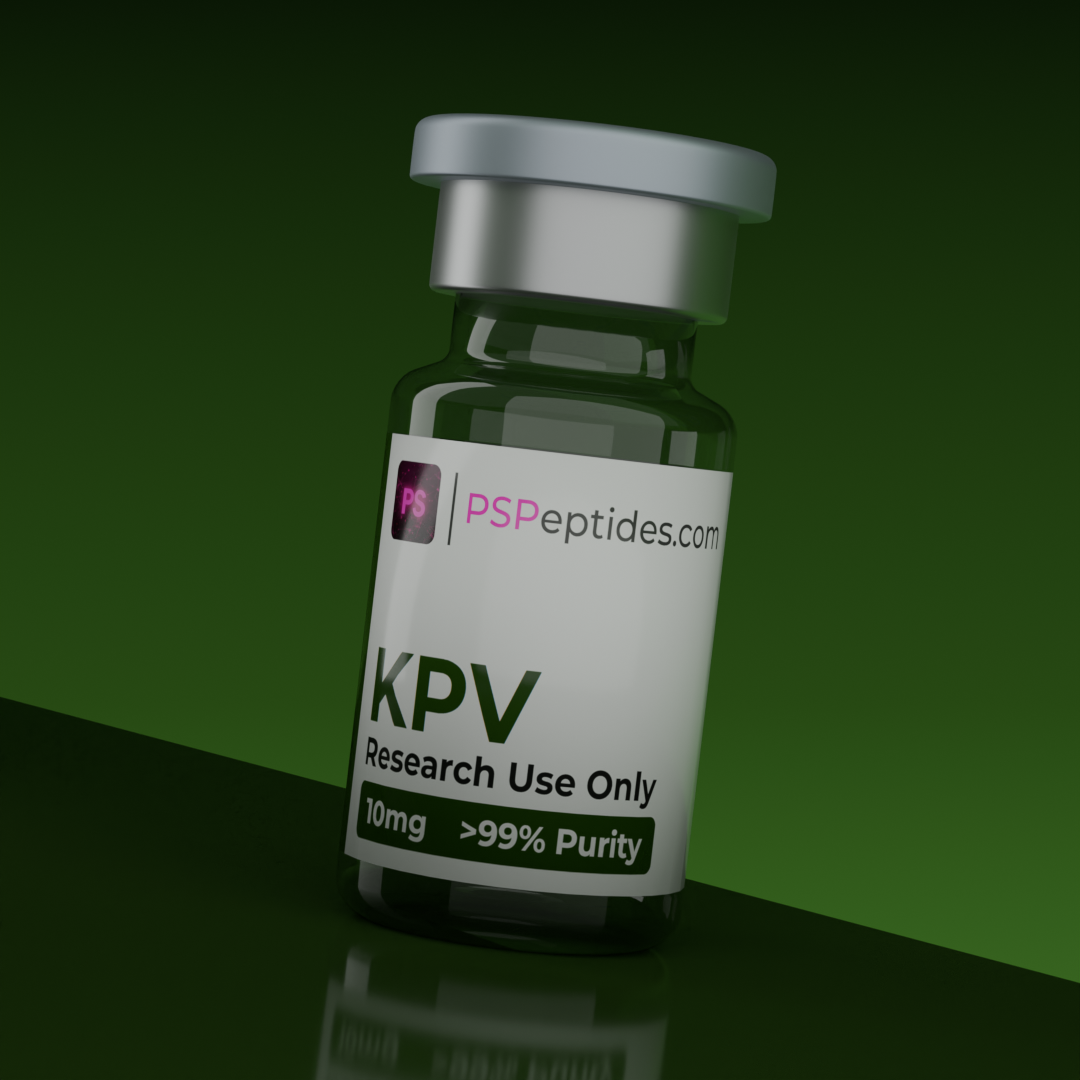
KPV (1 Vial)
$39.99
KPV (1 Vial) — buy KPV peptide 10mg, research-grade Lys-Pro-Val tripeptide. 99%+ HPLC purity, batch COA, US made. $39.99 per vial.
Vials count across your whole order — mix any peptides and sizes.
40% OFF Need 10+ vials? Build your own kit — 40% off every vialView older reports




 Made & Shipped
For laboratory and research use only. This product is not a drug, food, or cosmetic and is not for human or animal consumption. It is not intended to diagnose, treat, cure, or prevent any disease. These statements have not been evaluated by the FDA. Sold solely to qualified researchers and licensed laboratories. Certificate of Analysis available on request.
KPV protocol reference
What the published research and common laboratory protocols report for this compound, in one place. Figures are a reference for designing a study, not instructions.
Reconstitution & syringe units
Units are for a standard U-100 insulin syringe (100 units = 1 mL). Add the water slowly down the inside of the vial, swirl gently — never shake — and refrigerate.
| Vial | Add BAC water | Concentration | 200 mcg dose | 500 mcg dose |
|---|---|---|---|---|
| 10MG | 2.5 mL | 4 mg/mL | 5 units | 13 units |
Different water volume? Use the dosage calculator — it does the units for any concentration.
Alpha-MSH fragment studied for anti-inflammatory and gut-barrier effects.
For laboratory and research use only. This product is not a drug, food, cosmetic or dietary supplement and is not for human or animal consumption. The figures above summarise published studies and common research protocols; they are not medical advice or instructions for use. These statements have not been evaluated by the FDA.
Description
Buy KPV peptide from PSPeptides — a 10mg vial of research-grade KPV (Lys-Pro-Val), the C-terminal tripeptide fragment of α-melanocyte-stimulating hormone (α-MSH) widely studied for its potent anti-inflammatory and tissue-repair signaling. Every vial of KPV ships at 99%+ HPLC-verified purity with a batch-specific Certificate of Analysis. KPV is sold exclusively for laboratory and research use.
What Is KPV Peptide?
KPV is a synthetic tripeptide composed of lysine, proline, and valine — the same C-terminal sequence found at positions 11-13 of α-MSH. Despite its small three-residue size, KPV is studied for its ability to dampen NF-κB signaling and reduce pro-inflammatory cytokine release in cellular and animal models. See our complete KPV anti-inflammatory research guide for background on its mechanism and history.
Key Research Applications
- Inflammatory pathway research: The tripeptide is investigated for suppression of NF-κB nuclear translocation and downstream cytokine signaling.
- Gut barrier and IBD models: KPV has been examined in colitis and intestinal permeability studies — see our overview of peptides for gut health research.
- Skin and wound research: Researchers frequently compare KPV with GHK-Cu in dermal repair and pigmentation models.
- Mast cell and allergy models: The tripeptide is studied for its modulation of mast cell degranulation in atopic and allergic inflammation research.
Product Specifications
| Amount | 10mg per vial |
| Sequence | Lys-Pro-Val (H-Lys-Pro-Val-OH) |
| Purity | 99%+ (third-party HPLC and mass spectrometry) |
| Form | Lyophilized (freeze-dried) powder |
| Storage | Store at -20°C lyophilized, or 4°C reconstituted (use within 28 days) |
| Testing | Batch-specific COA included |
| Origin | US manufactured |
Detailed Mechanism of Action
The KPV peptide owes its biological activity to its unique structural relationship with α-melanocyte-stimulating hormone. While α-MSH binds the five melanocortin receptors (MC1R through MC5R), the KPV tripeptide lacks the receptor-binding core of the parent hormone. This allows researchers to investigate anti-inflammatory effects without engaging classical melanocortin pigmentation pathways — one reason buy KPV is increasingly used as a research probe in inflammatory biology.
At the molecular level, the KPV peptide is reported to enter cells via the PepT1 oligopeptide transporter — a mechanism that has made it of particular interest in intestinal epithelium and colonic inflammation models. PepT1 is upregulated in inflamed intestinal epithelium, which means KPV uptake can be selectively enhanced in tissues already mounting an inflammatory response, providing a built-in element of targeting.
Inside the cell, KPV interferes with inhibitor-of-kappa-B (IκB) kinase activity, blocking phosphorylation of IκBα and preventing the release of the NF-κB p65/p50 heterodimer that drives transcription of pro-inflammatory cytokines including TNF-α, IL-1β, IL-6, IL-8, MCP-1, and inducible nitric oxide synthase (iNOS). Reduction of these downstream cytokines is a hallmark observation in cellular studies of the KPV peptide.
Beyond NF-κB, the KPV peptide has been shown in cellular studies to modulate AP-1 transcription factor activity, JAK/STAT signaling components, mitogen-activated protein kinase (MAPK) cascades, and to reduce reactive oxygen species production in stimulated macrophages and dendritic cells. These overlapping pathways explain why a single small tripeptide can influence inflammation, mast cell behavior, mucosal repair, and oxidative stress in parallel — and why our KPV anti-inflammatory research guide spans so many model systems.
Researchers comparing KPV to other repair peptides also note that, unlike larger compounds such as BPC-157 or TB-500, KPV peptide is small enough to be administered in oral models thanks to PepT1-mediated absorption. This unusual property is why KPV is studied alongside oral-active peptides reviewed in our complete guide to peptides, and why it has attracted interest in formulation work involving colon-targeted nanoparticles, microspheres, and hydrogels.
From a structural biology standpoint, KPV is too short to form stable secondary structure on its own, but the L-Lys / L-Pro / L-Val arrangement is bioactive in cellular models — particularly in studies where C-terminal amidation is preserved. The Lys-Pro bond and the Pro-Val bond are also relatively resistant to common gut proteases, helping explain why oral KPV models retain measurable activity.
Published Research on the KPV Peptide
Published preclinical literature on the KPV peptide spans more than three decades, with foundational work from Luger and Brzoska at the University of Münster establishing the tripeptide’s anti-inflammatory activity in skin and immune models in the late 1990s and early 2000s. This early work demonstrated suppression of contact hypersensitivity reactions, IL-1 release from keratinocytes, and lymphocyte proliferation in vitro.
Subsequent investigations from the Merlin laboratory at Georgia State University extended this research into the gastrointestinal tract, demonstrating attenuation of colitis severity in murine DSS and TNBS models. These studies repeatedly showed reduced myeloperoxidase activity, lower colon shortening, and restoration of mucosal architecture in KPV-treated animals compared to vehicle controls.
More recent research has explored KPV peptide formulations including PLGA nanoparticles, chitosan-alginate hydrogels, and oral delivery systems. Research data suggests that targeted gastrointestinal delivery can reduce systemic exposure while maintaining local anti-inflammatory effects — an area of active formulation research. Comparative work has positioned KPV alongside other tripeptide and small-peptide modulators of innate immunity, including LL-37 fragments, defensin-derived sequences, and modified melanocortin analogs.
Mast cell research on the KPV peptide has shown reductions in degranulation following IgE-mediated activation, along with decreased histamine and tryptase release. Skin model investigations have explored topical KPV preparations in atopic dermatitis-like inflammation, with reductions in scratching behavior, lesion severity, and inflammatory cell infiltration reported in published rodent studies.
For peer-reviewed background, see this PubMed overview on KPV tripeptide and intestinal inflammation, the broader PubMed KPV tripeptide literature index, and NIH’s α-MSH and KPV combined literature collection.
KPV Peptide vs Alternatives
| Feature | KPV Peptide | BPC-157 | TB-500 |
|---|---|---|---|
| Size | Tripeptide (3 AA) | Pentadecapeptide (15 AA) | Tetradecapeptide (17 AA) |
| Primary mechanism | NF-κB inhibition | VEGFR2/NO pathway | Actin sequestration |
| Oral viability in models | Yes (PepT1 transport) | Yes (some studies) | Limited |
| Key research focus | Anti-inflammatory, IBD | Tissue repair, GI | Muscle, joint recovery |
| Half-life (approx.) | Short (minutes) | Moderate | Hours |
| Reference guide | KPV guide | BPC-157 guide | TB-500 guide |
| Origin | α-MSH C-terminus | Gastric juice protein | Thymosin β-4 |
| Common stack pairing | BPC-157, gut peptides | TB-500, KPV | BPC-157 |

Reconstitution & Handling
KPV is supplied as a lyophilized powder and requires reconstitution with bacteriostatic water before research use. A typical 10mg vial is reconstituted with 2 mL of bacteriostatic water to give a 5 mg/mL working stock, although researchers commonly use 1 mL (10 mg/mL) or 2.5 mL (4 mg/mL, the most the 3 mL vial takes) depending on the dose-volume requirements of their study design and animal model.
Add the diluent slowly down the inner wall of the vial — do not inject directly onto the lyophilized cake, as turbulence can damage the peptide. Allow the vial to sit at room temperature for 60-120 seconds, then gently swirl (do not shake) until the powder is fully dissolved. Vortexing or vigorous shaking can shear the peptide and introduce foaming that complicates accurate measurement.
For step-by-step protocols, see our complete peptide reconstitution guide and use our free peptide reconstitution calculator to determine exact volumes for your KPV concentration. Once dissolved, the solution should be clear and colorless; any cloudiness or visible particulates is a reason to discard the vial and contact our support team.
Storage & Stability
Lyophilized vials of KPV peptide are most stable at -20°C, protected from light and humidity; under these conditions they retain potency for at least 24 months from the manufacture date. Reconstituted KPV peptide should be stored at 2-8°C and used within 28 days for best stability, with aliquoting recommended for protocols requiring multiple freeze-thaw cycles. Avoid more than three freeze-thaw events, as each cycle introduces structural stress on the tripeptide.
If a refrigerator is unavailable for an extended period, the tripeptide can be aliquoted into small single-use volumes and stored long-term at -20°C or -80°C. Researchers should label each aliquot with date, concentration, and lot number to maintain experimental traceability — especially important when working across multiple cohorts or batches of KPV peptide.
For more on long-term storage, aliquoting strategy, and avoiding degradation pitfalls, see our peptide storage guide and our peptide degradation detection guide.
Certificate of Analysis
Every vial of KPV peptide from PSPeptides ships with a batch-specific Certificate of Analysis documenting purity verification via reverse-phase HPLC and identity confirmation via mass spectrometry. COAs include the analytical chromatogram, identity confirmation, water content, counter-ion data, and sterility/endotoxin results where applicable, so you can verify the KPV peptide before research use.
Learn more about how to read a peptide COA before beginning your work, and reach out to our research-support team if you need an additional copy for your institutional records or grant documentation.
Quality & Sourcing
The KPV peptide sold through PSPeptides is synthesized in US-based GMP-compliant facilities using solid-phase peptide synthesis (SPPS), then purified by preparative reverse-phase HPLC to a target of 99%+. Every lot is independently verified by a third-party analytical laboratory using orthogonal techniques — analytical HPLC for purity quantitation and mass spectrometry (typically ESI-MS) for identity confirmation. This dual-verification standard is part of why customers consistently choose PSPeptides; for more on supplier evaluation, see how to choose a research peptide supplier.
Why Researchers Buy KPV from PSPeptides
- US Manufactured: All peptides, including KPV peptide, are synthesized in US-based facilities under strict QC controls.
- Third-Party Tested: Independent HPLC and mass spectrometry verification on every batch with COAs included.
- Fast Shipping: Free UPS 2nd Day Air on orders over $200, with same-day dispatch before 2 PM EST.
- Flexible Payments: Credit cards, Afterpay, Klarna, Apple Pay, and Google Pay accepted at checkout.
- 7-Day Support: Responsive email support from our research-trained team.
- Trusted Supplier: Read our 2026 best peptide companies comparison for context on quality benchmarks.

Frequently Asked Questions
Is KPV peptide the same as α-MSH?
No. The KPV peptide is the C-terminal tripeptide fragment (positions 11-13) of α-MSH. It retains anti-inflammatory activity but lacks the melanocortin-receptor binding portion of the parent hormone, so it does not drive pigmentation effects in models.
Can KPV peptide be combined with other research compounds?
In published preclinical literature, KPV is sometimes studied alongside BPC-157 in gut-repair models or TB-500 in tissue-recovery models. See our peptide stacking guide for considerations when designing combination studies.
How should KPV peptide be stored after reconstitution?
Reconstituted KPV should be refrigerated at 2-8°C and used within 28 days. For longer-term storage, aliquot and freeze at -20°C, then thaw individual aliquots as needed to avoid repeated freeze-thaw cycles that can degrade the tripeptide.
Is KPV peptide legal to purchase in the United States?
Research-grade KPV is legal to purchase in the United States when sold for laboratory research use only — not for human consumption. See our overview of research peptide legality in 2026 for current regulatory context.
What dose of KPV peptide is used in research models?
Published research has used a wide dose range depending on model and delivery route. Researchers should rely on peer-reviewed protocols and IACUC-approved designs rather than generalized dose recommendations.
How long does the KPV peptide remain stable once reconstituted?
Reconstituted KPV peptide is generally considered usable for 28 days when kept refrigerated and protected from light. Beyond that window, purity may decline and research data may be affected.
Related Resources
- KPV Peptide Anti-Inflammatory Research Guide
- Peptides for Gut Health Research
- Peptides for Immune Support Research
- BPC-157 Research Guide
- TB-500 (Thymosin Beta-4) Research Guide
- Peptide Storage Guide
- How to Read a Peptide COA
- How to Choose a Research Peptide Supplier
Groups running mucosal inflammation models can also review the intranasal KPV spray, which ships ready to use with no reconstitution required.
Extended Research Context
Beyond its inflammatory research applications, KPV has been examined in studies of innate antimicrobial activity. Published work suggests that the tripeptide retains a portion of the antimicrobial signaling functions attributed to its parent hormone α-MSH, although the underlying mechanisms differ. In cellular models, KPV reduces fungal colonization markers and decreases bacterial adhesion to epithelial surfaces, while leaving normal commensal interactions largely undisturbed in the published preclinical work to date.
Investigators have also explored the relationship between KPV and the gut-brain axis. Because chronic gastrointestinal inflammation is increasingly linked to systemic outcomes in published rodent models — including effects on behavior, cognition, and peripheral immune tone — the anti-inflammatory profile of the tripeptide has drawn interest from research groups studying neurological-gastrointestinal crosstalk. For broader background on this domain, see our research overview of peptides for immune support research.
In dermatology research, KPV is studied not only for atopic dermatitis-like inflammation but also for its effects in models of psoriatic-type skin biology, contact hypersensitivity, and UV-stress responses in keratinocytes. Topical formulations using carriers such as liposomes, nanoemulsions, and microneedle delivery systems are an active subject of peer-reviewed investigation. Researchers comparing dermal peptides often look at KPV alongside copper-binding compounds like GHK-Cu and the Matrixyl vs GHK-Cu comparison.
Mucosal immunology investigators have studied the tripeptide in models of oral mucositis, asthma airway inflammation, and ocular surface inflammation, with each model highlighting different facets of the NF-κB suppression profile. The relatively short half-life of the molecule — frequently described in published research as on the order of minutes following bolus administration — means that formulation work, slow-release matrices, and repeated-dose protocols dominate the recent literature.
Dosing Considerations in Research Models
Researchers should consult peer-reviewed dose-response work for the specific model under study. Published intraperitoneal protocols in murine colitis have used microgram-per-kilogram dose ranges, while oral formulations sometimes use higher nominal doses to compensate for incomplete absorption. Topical formulations vary widely depending on vehicle, occlusion, and skin permeability. Researchers should always validate their handling protocol with a small pilot cohort before scaling.
For dose-volume calculation help, our peptide reconstitution calculator converts vial mass and diluent volume into easy mg/mL stocks, and our dosage calculator usage guide walks through real-world examples. Pair this with the peptide half-life chart when planning timing of administration.
Researchers comparing administration routes for small peptides should also review our overview of subcutaneous versus intramuscular peptide injection. While KPV is unusual among research peptides in that it tolerates oral administration via PepT1, comparative parenteral routes are widely used in published mechanistic studies.
Quality Control & Lot Documentation
Every lot is assigned a unique batch identifier that ties back to its synthesis date, raw-material lot, analytical chromatogram, mass-spec spectrum, and final packaging records. The Certificate of Analysis included with each vial documents these values and serves as the primary quality record for researchers. Institutional buyers requesting additional documentation for grant or regulatory reporting can request batch records through our support team.
Analytical purity is reported as area-percent by reverse-phase HPLC under standardized gradient conditions, with a 99%+ target across all production lots. Mass spectrometry confirms identity by matching the observed [M+H]+ ion mass to the theoretical molecular weight of the Lys-Pro-Val sequence within 0.5 daltons. Where applicable, lots are also screened for residual solvents and bacterial endotoxin to support downstream sterility-sensitive applications.
Inventory is held in a temperature-controlled warehouse. No cold packs are needed — lyophilized powder ships stable at ambient temperature in a durable, discreet bubble mailer. Refrigerate once received. While the dry tripeptide is robust under typical shipping conditions, customers in extremely hot climates may consider expedited shipping to minimize time in transit. Our standard shipping methods and timing are detailed in your cart and at checkout.
Comparison With Other α-MSH-Derived Peptides
The KPV peptide is one of several α-MSH-derived research molecules. Full-length α-MSH is a 13-residue peptide that binds melanocortin receptors and drives pigmentation, appetite, and inflammation-related signaling. Synthetic agonists such as Melanotan II target the same receptors with greater stability, while the KPV tripeptide is studied for its receptor-independent anti-inflammatory profile.
This receptor-independence is one of the key distinguishing features in published comparative work — researchers can investigate inflammatory pathway modulation without confounding melanocortin-receptor effects. For researchers interested in the broader melanocortin family, the published literature provides extensive cross-references to receptor-targeted analogs, while KPV remains uniquely positioned as a receptor-independent anti-inflammatory tool.
Frequently Asked Questions — Continued
How does the tripeptide enter cells?
The published mechanism involves the PepT1 oligopeptide transporter, which is upregulated in inflamed intestinal epithelium. This means uptake is selectively enhanced in tissues mounting an inflammatory response.
Does KPV affect pigmentation?
Unlike full-length α-MSH, the tripeptide lacks the melanocortin-receptor binding portion of the parent hormone, and published research models do not report pigmentation changes attributable to KPV alone.
Can the tripeptide be used in oral research models?
Yes — KPV is unusual among research peptides in that it tolerates oral administration in animal models thanks to PepT1-mediated absorption. Many published colitis studies use oral or rectal formulations.
What is the shelf life of the lyophilized product?
Stored at -20°C and protected from light and humidity, the lyophilized vial retains potency for at least 24 months from the manufacture date.
All PSPeptides products, including the KPV peptide 10mg, are sold exclusively for laboratory and research use. Not intended for human consumption, diagnosis, treatment, cure, or prevention of any disease.
Additional information
| Weight | 0.03 lbs |
|---|---|
| Dimensions | 2 × 2 × 2 in |
| MG | 10MG |
Related products
-
 Injury Recovery2 sizes
TB-500 (1 Vial)
Price range: $44.99 through $79.99 Select options This product has multiple variants. The options may be chosen on the product page -
Gut & Tissue Repair
BPC-157 Throat Spray
$59.99 Select options This product has multiple variants. The options may be chosen on the product page -
Antimicrobial
LL-37 (1 Vial)
$79.99 Select options This product has multiple variants. The options may be chosen on the product page -
Skin & Gut
KLOW (1 Vial)
$109.99 Select options This product has multiple variants. The options may be chosen on the product page