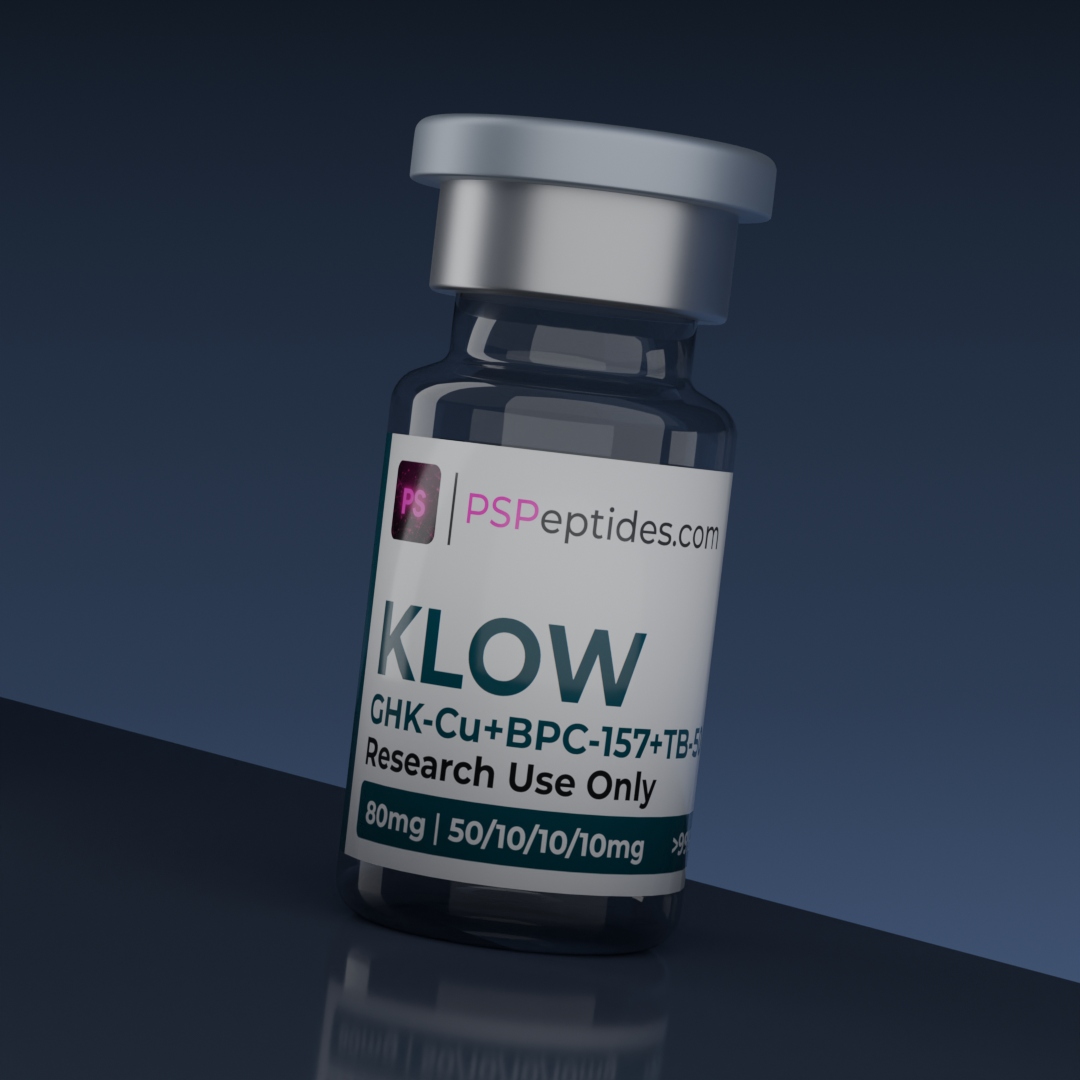
KLOW is a four-pathway research stack that combines tissue-repair, collagen-synthesis, anti-inflammatory, and immune-modulating peptides in one precisely dosed vial. It builds on the three-peptide GLOW blend (BPC-157 + GHK-Cu + TB-500) by adding KPV, the anti-inflammatory tripeptide derived from alpha-melanocyte-stimulating hormone (α-MSH).
Researchers buy KLOW blend when single-peptide or two-peptide stacks have proven insufficient for models where inflammation and tissue damage occur together. Read our GLOW vs. KLOW comparison guide to decide which formulation fits your protocol.
Labs buy KLOW blend for protocols that need several repair pathways active at once:
Ready to buy KLOW blend? Select the 80mg option above, add it to your cart, and check out with credit card, Afterpay, Klarna, Apple Pay, or Google Pay. Orders over $200 ship free via UPS 2nd Day Air, and every order includes a published COA.
Detailed Mechanism of Action: Four-Peptide Synergy
When you buy KLOW blend, you are buying a formulation designed around a four-phase model of tissue repair: inflammation resolution, cellular proliferation, matrix remodeling, and immune support. Each peptide contributes distinct, non-redundant mechanisms to each phase, which is what makes KLOW more comprehensive than any single-peptide vial or standard three-component blend.
BPC-157 (Body Protection Compound-157) is a 15-amino-acid stable gastric pentadecapeptide (CAS 137525-51-0). Its primary mechanisms include VEGFR2 activation for angiogenesis, FAK-paxillin pathway stimulation for tendon fibroblast migration, and nitric oxide system modulation for blood flow to injured tissue.
Published animal models document BPC-157 activity across gastrointestinal, tendon, ligament, muscle, bone, nerve, spinal cord, cornea, and vascular tissues — the first layer of the stack you get when you buy KLOW blend. See our BPC-157 research guide for the full literature.
GHK-Cu (Glycyl-L-Histidyl-L-Lysine copper complex, MW 403.93 Da, CAS 49557-75-7) is the highest-concentration component at 50mg per vial. Endogenous GHK-Cu declines from roughly 200 ng/mL at age 20 to around 80 ng/mL at age 60, correlating with reduced regenerative capacity.
GHK-Cu modulates over 4,000 human genes — including those governing collagen synthesis, matrix metalloproteinase regulation, anti-inflammatory signaling, and stem cell activation — and penetrates the stratum corneum in bioactive quantities. That dermal relevance is why skin-research labs often buy KLOW blend rather than a single-peptide vial. Learn more in our complete GHK-Cu guide.
TB-500 (synthetic Thymosin Beta-4 fragment, approximately 4,963 Da) is the 43-amino-acid actin-binding peptide found in virtually all nucleated mammalian cells. It sequesters G-actin monomers to drive cytoskeletal remodeling, increases keratinocyte migration 2–3-fold at picogram concentrations, stimulates cardiac progenitor cells after ischemic injury, and reduces myofibroblast-driven scarring. Read our TB-500 guide for the complete mechanism.
KPV (Lys-Pro-Val, MW 342.43 Da) is the C-terminal tripeptide of α-MSH. Despite its three amino acids, KPV retains the anti-inflammatory potency of the parent hormone without its pigmentation effects. It suppresses NF-κB, lowers TNF-α, IL-6, and IL-1β production, and inhibits S. aureus colony formation and C. albicans germ-tube formation at picomolar concentrations.
This fourth pathway is the reason researchers buy KLOW blend over the three-peptide GLOW formulation for inflammatory-context work. Our KPV research guide covers the mechanism in depth.

Published Research Behind the KLOW Blend
Each component you receive when you buy KLOW blend has an independent peer-reviewed research record spanning decades of in vitro and animal studies. Seiwerth et al. (2021, Front Pharmacol) comprehensively reviewed BPC-157 wound healing evidence across multiple tissue types.
Chang et al. (2011, J Appl Physiol) showed BPC-157 promotes tendon fibroblast outgrowth and survival under oxidative stress via the FAK-paxillin pathway, and Mikus et al. (2001) found that topical BPC-157 cream improved burn-wound healing in mice.
Pickart and Margolina (2018, Int J Mol Sci) published the definitive review of GHK-Cu’s regenerative and protective actions, documenting gene-expression effects across skin, organ, and systemic research contexts. For TB-500, Malinda et al. (1999, J Invest Dermatol) reported a 2–3-fold increase in keratinocyte migration and faster re-epithelialization in full-thickness rat wounds, while Ehrlich and Hazard (2010) documented reduced myofibroblast formation in connective tissue repair.
For KPV, Cutuli et al. (2000, J Leukoc Biol) demonstrated S. aureus and C. albicans inhibition without reducing neutrophil bactericidal capacity, and Singh and Mukhopadhyay (2014) reviewed α-MSH-derived peptides as anti-inflammatory antimicrobials. Dalmasso et al. (2008, Gastroenterology) showed KPV delivery via the PepT1 transporter with measurable anti-inflammatory effects on colonic mucosa — a key reason gut-focused labs buy KLOW blend for gut health research.
KLOW Blend vs. Alternatives
| Feature | KLOW Blend | GLOW Blend (3-Peptide) | BPC-157 Alone |
|---|
| Components | BPC-157 + GHK-Cu + TB-500 + KPV | BPC-157 + GHK-Cu + TB-500 | BPC-157 only |
| Total Content | 80mg per vial | 70mg per vial | 5–10mg per vial |
| NF-κB Suppression | ✓ (via KPV) | ✗ | ✗ |
| Antimicrobial Activity | ✓ (via KPV) | ✗ | Limited |
| Collagen Synthesis | ✓ (via GHK-Cu) | ✓ (via GHK-Cu) | Indirect only |
| Actin Remodeling | ✓ (via TB-500) | ✓ (via TB-500) | ✗ |
| Per-Component Purity | ≥99% each | ≥99% each | Varies by vendor |
| US Manufactured + Published COA | ✓ | ✓ | Varies |
| Best For | Inflammatory-context tissue repair | Collagen and skin-focused research | Single-pathway studies |
Researchers should buy KLOW blend for inflammatory-context tissue repair research, where KPV’s NF-κB suppression adds non-redundant value alongside BPC-157, GHK-Cu, and TB-500. For collagen- and skin-focused research without a significant inflammatory component, the GLOW blend may be sufficient, and for single-pathway studies an individual peptide offers more experimental control. See our BPC-157 vs. TB-500 comparison and Wolverine stack overview for the two-peptide options.
Reconstitution & Handling
KLOW follows a standard lyophilized peptide reconstitution protocol. Allow the vial to reach room temperature (15–20 minutes) before opening to prevent condensation on the lyophilized cake. Using a sterile syringe, draw the desired volume of bacteriostatic water and inject it slowly down the inside wall of the vial — not directly onto the powder. Gently swirl until dissolved; do not shake or vortex.
For the 80mg vial, the standard reconstitution is 2.5mL of bacteriostatic water (the vial holds 3mL), yielding a total blend concentration of 32mg/mL: BPC-157 at 4mg/mL, GHK-Cu at 20mg/mL, TB-500 at 4mg/mL, and KPV at 4mg/mL. A faint blue tint from GHK-Cu’s copper complex is normal and expected. Use our peptide dosage calculator and the full reconstitution guide for step-by-step handling.
Many labs that buy KLOW blend also order bacteriostatic water and sterile supplies in the same checkout to keep protocols consistent. For injection methodology across all four components, see our subcutaneous vs. intramuscular injection guide.
Storage & Stability
Lyophilized KLOW should be stored at −20°C or below and remains stable for 12 months or longer under these conditions. After reconstitution, store at 2–8°C and use within 28 days. Protect all forms from repeated freeze-thaw cycles, direct light, and ambient humidity. If you buy KLOW blend in multiples, keep unopened vials frozen until needed.
GHK-Cu is the most environmentally stable component; BPC-157 and KPV are the most sensitive to temperature fluctuation and oxidative stress. Every vial ships in protective packaging, and when you buy KLOW blend from PSPeptides it leaves our facility the same day to minimize transit time. For long-term protocols, consult our peptide storage guide and peptide half-life chart.
Certificate of Analysis
Transparency is the main reason experienced labs buy KLOW blend from PSPeptides. Every batch includes a batch-specific Certificate of Analysis documenting HPLC purity and mass-spectrometry molecular-weight confirmation for each of the four components individually. HPLC confirms ≥99% purity for BPC-157, GHK-Cu, TB-500, and KPV before blending, and mass spectrometry independently confirms the molecular weight of each peptide.
The current 80mg COA, along with heavy metals, endotoxin, sterility, and fentanyl screening reports, is published in the Lab Reports section of this page, with older lot reports archived for comparison. You can review the documentation before you buy KLOW blend, and the complete archive is available on our Certifications page. For help interpreting your batch documentation, see our guide to reading peptide COAs.
Why Researchers Buy KLOW Blend from PSPeptides
There are many places to buy KLOW blend online, but few that test every component individually and publish the results. Here is what sets PSPeptides apart:
- US Manufactured: Produced domestically under strict quality-controlled conditions — not imported and relabeled.
- Third-Party Tested: Independent HPLC and mass spectrometry verification for all four peptide components before blending, with COAs published on the product page.
- Fast Shipping: Free shipping on every order, free UPS 2nd Day Air over $200, free UPS Next Day Air over $400, and same-day dispatch on orders placed before 2 PM EST.
- Flexible Payments: Credit cards, Afterpay, Klarna, Apple Pay, and Google Pay all accepted at checkout.
- 7-Day Support: Research support team available by email, phone, or text seven days a week.
- Transparent Dosing: Exact milligram content for each of the four components is clearly labeled — no vague proprietary blend disclosures.
- Proven Track Record: More than 130,000 orders shipped, with international delivery to Canada, the EU, the UK, and Australia.
How to Order the KLOW Blend
Ordering takes under a minute. To buy KLOW blend, choose the 80mg option at the top of this page, click Add to Cart, and complete checkout with your preferred payment method. Orders placed before 2 PM EST ship the same day with full tracking, and discreet packaging is standard on every shipment.
Need more than one vial? Bulk pricing is available for labs that buy KLOW blend in quantity — contact our team for a quote. Many researchers pair KLOW with the GLOW blend or individual BPC-157 and TB-500 vials to run comparative protocols; our peptide stacking guide explains how to structure multi-peptide research designs.
Not sure which supplier to trust? Our guides on how to choose a research peptide supplier and the best peptide companies in 2026 explain exactly what to look for — published COAs, per-component testing, and domestic manufacturing — before you buy KLOW blend from anyone.
Understanding the KLOW Blend Research Rationale
The four-peptide design is not arbitrary — it reflects a deliberate attempt to cover each critical phase of tissue repair biology simultaneously. Phase one (inflammation) is addressed primarily by KPV and BPC-157, which operate through NF-κB suppression and nitric oxide pathway modulation respectively. Phase two (cellular proliferation) is driven by TB-500’s actin regulation, keratinocyte migration enhancement, and stem cell support.
Phase three (matrix remodeling) is handled by GHK-Cu’s 4,000+ gene modulations affecting collagen synthesis and matrix metalloproteinase balance. Phase four (immune support) is uniquely covered by KPV’s cytokine modulation and antimicrobial effects, a dimension absent from the three-peptide GLOW blend. Labs that buy KLOW blend get all four phases covered in one vial.
This phase-aware design suits research protocols modeling conditions where inflammation and tissue damage co-occur — connective tissue repair models, inflammatory skin pathology studies, gastrointestinal mucosal healing research, and cardiovascular remodeling contexts. No two components compete at the same receptor or rely on the same downstream pathway as their primary mode of action.
For researchers comparing the decision to buy KLOW blend against purchasing four separate vials, the blend format offers clear logistical advantages: a single reconstitution, consistent component ratios in every dose, one COA covering all four ingredients, and a lower combined cost than four individual orders. The 80mg total — including 50mg of GHK-Cu as the dominant component — provides substantial material for multi-week protocols at typical research concentrations.
Legal and Research Context
PSPeptides sells the KLOW blend exclusively as a research chemical for laboratory use by qualified researchers. It is not intended for human or veterinary use, nor for any in vivo or clinical application. Researchers should confirm the regulatory context governing research peptides in their jurisdiction before they buy KLOW blend or any other research compound.
For a comprehensive overview of the legal landscape, see our are research peptides legal in 2026? guide and our summary of FDA peptide reclassification updates. All PSPeptides products comply with applicable regulations for research chemical sales within the United States.
Frequently Asked Questions
What does the KLOW blend contain and how is it different from GLOW?
KLOW contains BPC-157 (10mg), GHK-Cu (50mg), TB-500 (10mg), and KPV (10mg) — 80mg total per vial. The defining difference from the three-peptide GLOW blend is the addition of KPV, which contributes NF-κB suppression and antimicrobial activity not covered by the other three peptides. Researchers buy KLOW blend for inflammatory or immune-mediated tissue repair contexts; our GLOW vs. KLOW guide has the full breakdown.
How do I reconstitute the KLOW vial?
Add 2.5mL of bacteriostatic water to the 80mg vial by injecting slowly along the vial wall — never directly onto the powder. Gently swirl to dissolve; a faint blue tint from GHK-Cu’s copper complex is normal. Store reconstituted vials at 2–8°C and use within 28 days. Bacteriostatic water is sold separately, so add it to your cart when you buy KLOW blend.
What are the storage requirements for the KLOW blend?
Store lyophilized vials at −20°C or below for up to 12 months. After reconstitution, refrigerate at 2–8°C and use within 28 days. Avoid repeated freeze-thaw cycles and protect from light and humidity at all times. When you buy KLOW blend, it ships lyophilized for maximum stability in transit.
Can I stack the KLOW blend with other peptides?
KLOW already functions as a comprehensive four-peptide research stack covering tissue repair, collagen synthesis, immune modulation, and anti-inflammatory signaling. Researchers who buy KLOW blend may combine it with additional targeted peptides depending on their protocol; see our joint and tendon repair peptide guide for common pairings.
What purity does each component meet?
All four components are individually tested at ≥99% purity by HPLC and confirmed by mass spectrometry before blending. A batch-specific COA documenting these results is published on this page and included every time you buy KLOW blend — a more rigorous standard than testing only the final blended product.
How fast will my order ship if I buy KLOW blend today?
Orders placed before 2 PM EST ship the same day. Shipping is free on every order, with free UPS 2nd Day Air over $200 and free UPS Next Day Air over $400. International shipping is available to Canada, the EU, the UK, and Australia.
Is there published research on using these four peptides together?
Each component has a robust independent research record. The four-peptide KLOW combination is a PSPeptides formulation grounded in the published literature for each individual peptide across tissue repair, inflammation, and immune function. Start with our complete guide to peptides for background on all four before you buy KLOW blend.
Related Resources
Before you buy KLOW blend, these guides cover each component, handling, and documentation in detail:
Order the KLOW Blend Today
PSPeptides makes it simple to buy KLOW blend with fast domestic shipping, flexible payment options, and comprehensive research support. Every order includes a batch-specific COA, same-day shipping on orders placed before 2 PM EST, and access to our full library of research guides. Select the 80mg option above and add it to your cart to get started.
Buy KLOW blend from PSPeptides and you are getting a four-peptide regenerative research formulation that is US manufactured, third-party tested to ≥99% purity per component, and backed by more than 130,000 shipped orders. If you have questions before ordering, our support team is available seven days a week by email, phone, or text.
All PSPeptides products are sold exclusively for laboratory and research use. Not intended for human consumption.




 Made & Shipped