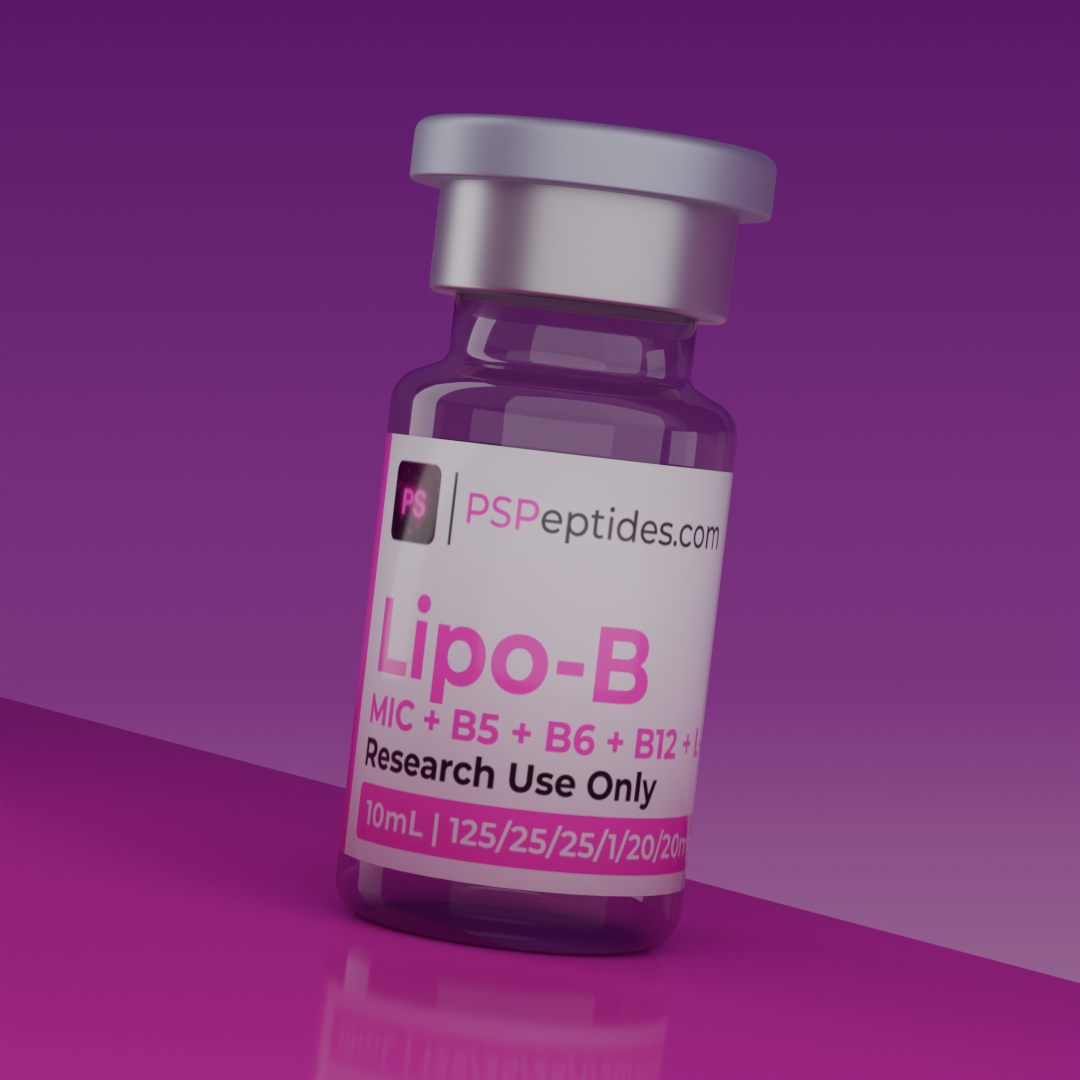
Lipo-B is a pre-mixed lipotropic injection blend. “Lipotropic” nutrients are compounds that help the liver package and export fat rather than store it, and the classic trio — methionine, inositol and choline (MIC) — has been studied for decades in models of hepatic steatosis.
The LC216 formula builds on that MIC core with three B vitamins that act as metabolic cofactors, plus L-arginine and L-carnitine for nitric oxide and mitochondrial fatty-acid transport research. Researchers who buy Lipo-B typically use it alongside metabolic and body-composition protocols. For a broader overview of the compounds in this category, see our guide to the best peptides for weight loss research and the complete guide to research peptides.
These are the four research areas most often cited by laboratories that buy Lipo-B:
Everything you need to check before you buy Lipo-B 10mL is summarized below.
Detailed Mechanism of Action
The eight components of the LC216 formula act on three connected systems: liver fat export, mitochondrial fuel transport and one-carbon (methylation) metabolism. Labs that buy Lipo-B for metabolic work are usually interested in how these systems interact rather than in any single ingredient, so it helps to walk through each pathway in turn.
Methionine is an essential amino acid and the direct precursor of S-adenosylmethionine (SAMe), the body’s principal methyl donor. In hepatocytes, SAMe drives the PEMT pathway that converts phosphatidylethanolamine into phosphatidylcholine, and it feeds the transsulfuration pathway that produces cysteine and glutathione.
Choline supplies the other route to phosphatidylcholine (the CDP-choline pathway), and phosphatidylcholine is required to assemble and secrete very-low-density lipoprotein (VLDL). When choline is scarce, triglyceride accumulates in the liver instead of being exported — the basis of the classic choline-deficiency steatosis model.
Inositol (myo-inositol) is the backbone of phosphatidylinositol and the inositol-phosphate second messengers that sit downstream of insulin and growth-factor receptors. Inositol deficiency produces fatty liver in rodent models, which is why it was grouped with methionine and choline as a “lipotropic” factor.
L-carnitine works one step further along the pathway. Carnitine palmitoyltransferase I attaches long-chain acyl-CoA to carnitine, the acylcarnitine crosses the inner mitochondrial membrane, and CPT II releases the fatty acid for beta-oxidation. Without adequate carnitine, long-chain fatty acids simply cannot enter the mitochondrial matrix to be burned.
The B vitamins are the cofactors that keep those reactions running. Vitamin B12 (cobalamin) is required by methionine synthase, which recycles homocysteine back to methionine, and by methylmalonyl-CoA mutase in odd-chain fatty-acid metabolism. Vitamin B6 (as pyridoxal 5′-phosphate) is the cofactor for the transsulfuration enzymes and for more than 100 aminotransferases.
Vitamin B5 (pantothenic acid, supplied as dexpanthenol in injectable formulas) is the precursor of coenzyme A, the carrier for every acyl group in beta-oxidation and the citric-acid cycle.
Finally, L-arginine is the substrate for nitric oxide synthase and a precursor of creatine and polyamines, adding a vascular and tissue-perfusion dimension to the blend. Having all eight actives in one fixed-ratio solution is why many metabolic labs buy Lipo-B rather than sourcing and combining each component separately.

Published Research
The individual components of Lipo-B are among the most thoroughly studied nutrients in metabolic science. Zeisel and da Costa (2009) reviewed the evidence establishing choline as an essential nutrient and documented that dietary choline restriction produces fatty liver and organ dysfunction in healthy adults, reversible when choline is restored (Nutrition Reviews, PubMed).
The methionine-choline-deficient (MCD) diet remains the standard rodent model of steatohepatitis. Rinella and Green (2004) showed that MCD-fed mice develop steatosis, inflammation and hepatocellular injury within weeks, without the insulin resistance seen in obesity-driven models (Journal of Hepatology, PubMed).
L-carnitine has the largest body of controlled-trial data. Pooyandjoo and colleagues (2016) pooled nine randomized controlled trials and reported significantly greater weight reduction in carnitine-supplemented groups than in controls, with a weighted mean difference of roughly 1.3 kg (Obesity Reviews, PubMed).
A larger 2020 meta-analysis of 37 randomized trials by Talenezhad and colleagues confirmed reductions in body weight, BMI and fat mass, with a non-linear dose–response that plateaued near 2,000 mg per day (Clinical Nutrition ESPEN, PubMed).
The B-vitamin components are covered extensively by the NIH Office of Dietary Supplements, whose vitamin B12 fact sheet details cobalamin’s role in methionine synthase activity, red-cell formation and neurological function. Most published data concern the individual nutrients; controlled studies of the complete lipotropic blend are limited, which is precisely why research groups buy Lipo-B as a standardized, fixed-ratio preparation for their own protocols.
Protocol Design for Labs That Buy Lipo-B
Because the formula touches several pathways at once, a well-designed study defines its primary endpoint before the first vial is opened. Hepatic studies typically track liver triglyceride content, serum ALT and AST, and histological steatosis scoring. Mitochondrial studies use acylcarnitine profiling, respiratory-chain assays or indirect calorimetry to quantify fatty-acid oxidation.
One-carbon studies measure plasma homocysteine, methionine, SAMe and the SAMe:SAH ratio, which respond directly to the B12, B6 and methionine content. Vascular studies quantify nitrate and nitrite, the stable breakdown products of nitric oxide, to capture the L-arginine contribution. Teams that buy Lipo-B for multi-endpoint work usually run a vehicle control, a single-component control and the full blend in parallel so that each ingredient’s contribution can be isolated.
Whatever the endpoint, record lot numbers, draw volumes and storage conditions for every vial. Those details, combined with the batch COA, are what make a Lipo-B study reproducible when it is time to publish or repeat the experiment.
Lipo-B vs Alternatives
Not every lipotropic preparation is the same. Many “MIC” products contain only the three-ingredient core, and many “B12 shots” contain cobalamin alone. The table below shows what you get when you buy Lipo-B LC216 compared with the two most common alternatives.
| Feature | Lipo-B LC216 (This Product) | Basic MIC + B12 | B12-Only Injection |
|---|
| Methionine, inositol, choline | Yes — full MIC | Yes | No |
| Vitamin B12 | Yes | Yes | Yes |
| Vitamins B5 and B6 | Yes | Rarely | No |
| L-carnitine | Yes — 20 mg/mL | Sometimes | No |
| L-arginine | Yes | No | No |
| Total active concentration | 216 mg/mL | Varies (typically 100–150 mg/mL) | 1 mg/mL |
| Research scope | Liver lipid export + mitochondrial oxidation + nitric oxide | Liver lipid export | Cobalamin status only |
| Format | 10mL multi-dose vial, ready to use | Multi-dose vial | Single-dose or multi-dose |
| Availability | Buy Lipo-B here — in stock, ships from the US | Varies by supplier | Widely available |
If your protocol focuses specifically on peptide-driven fat metabolism, our AOD-9604 product page and MOTS-c mitochondrial peptide guide cover complementary compounds, and the peptide stacking guide explains how researchers combine nutrient blends with peptides in a single study design.
Who Should Buy Lipo-B?
Metabolic and hepatology groups buy Lipo-B when they need a complete lipotropic blend for fatty-liver, lipid-export or methylation studies without compounding eight separate reagents. A single fixed-ratio vial removes a major source of batch-to-batch variability.
Body-composition and cosmetic research teams buy Lipo-B as a systemic complement to localized fat-dissolving work. Where products such as Lemon Bottle are studied for targeted adipose reduction, Lipo-B addresses the whole-body side of lipid handling: hepatic export, mitochondrial oxidation and the B-vitamin cofactors that support both.
Analytical and teaching laboratories also buy Lipo-B as a multi-component reference sample. The eight actives span amino acids, vitamins and quaternary ammonium compounds, making the LC216 solution a practical standard for HPLC method development and assay validation.
Reconstitution & Handling
Unlike lyophilized peptides, Lipo-B ships as a finished sterile solution, so there is nothing to reconstitute and no bacteriostatic water is needed. When you buy Lipo-B you receive a 10mL multi-dose vial at 216 mg/mL that is ready to draw from immediately. Before each use, inspect the solution against a light background — it should be clear and free of particulates — and swab the stopper with 70% isopropyl alcohol.
Because the solution carries a high solute load, a 20–22 gauge needle makes drawing easier than the fine-gauge needles used for peptides. Each 1 mL draw delivers 216 mg of combined actives, including 20 mg of L-carnitine, so a single vial provides ten 1 mL aliquots or twenty 0.5 mL aliquots. Our dosage calculator guide walks through converting mg to mL for any target amount.
Lipotropic blends are administered intramuscularly in most published animal models rather than subcutaneously, in part because of the volume and concentration involved. The subcutaneous vs intramuscular injection guide compares the two routes, absorption profiles and needle selection for laboratory work.
Storage & Stability
Store unopened and opened vials refrigerated at 2–8°C and protected from light at all times. Vitamin B12 and the other B vitamins are light-sensitive, and the boxed storage the vial ships in should be maintained throughout its use. Do not freeze; freezing can cause precipitation of the concentrated amino acids and alter the solution’s pH.
Once the stopper has been punctured, follow the standard multi-dose-vial convention and discard any remaining solution 28 days after first use. Discoloration (a shift from pink-red toward brown), cloudiness or visible crystals are signs the product should no longer be used. Labs that buy Lipo-B in multiples should log the receipt date and first-puncture date of each vial.
Our peptide storage guide and degradation guide cover temperature logging, light exclusion and how to document stability in your lab records.
Certificate of Analysis
Every vial is tied to a batch-specific Certificate of Analysis. The COA reports the identity and concentration of each component by HPLC, confirms the 216 mg/mL total assay against specification, and records the lot number and retest date. Independent third-party testing means the numbers are not generated in-house, which is a key reason laboratories buy Lipo-B from PSPeptides rather than from unverified sources.
If you are new to reading analytical reports, our guide on how to read a peptide COA explains chromatogram peaks, assay percentages and what a passing specification looks like. The same principles apply to multi-component blends like this one, so review the lot COA before you buy Lipo-B and again when the vial arrives.
Why Buy Lipo-B From PSPeptides?
- US Manufactured: Produced in the United States under cGMP-compliant conditions — no overseas sourcing, no unknown intermediaries.
- Third-Party Tested: Independent HPLC and mass spectrometry verification with a batch-specific COA for every lot.
- Fast Shipping: Free UPS 2nd Day Air on orders over $200, and same-day dispatch on orders placed before 2 PM EST.
- Flexible Payments: Credit cards, Afterpay, Klarna, Apple Pay and Google Pay are all accepted at checkout.
- 7-Day Support: Reach our team by email, phone or text any day of the week with questions about your order or product handling.
Choosing a supplier matters more for a multi-ingredient preparation than for a single compound, because every component has to be verified. Our article on how to choose a research peptide supplier lists the questions to ask before you buy Lipo-B or any other research product online.
How to Buy Lipo-B Online From PSPeptides
To buy Lipo-B, choose the single 10mL vial option at the top of this page, add it to your cart and complete checkout with a credit card, Afterpay, Klarna, Apple Pay or Google Pay. Orders placed before 2 PM EST ship the same business day, and every package leaves our US facility with cold-chain-appropriate packing.
Customers who buy Lipo-B online often add bacteriostatic water, syringes and other research supplies to the same order to reach the $200 free-shipping threshold. Tracking is emailed as soon as the label is created, and our support team is available seven days a week if you need help with your order.
When you buy Lipo-B online from a US supplier with a published COA, you avoid the two most common problems with imported lipotropic blends: undisclosed concentrations and vials that spent days unrefrigerated in transit. Both issues show up as degraded B12 and inconsistent assay results, and both are avoidable.
Frequently Asked Questions
Where can I buy Lipo-B online?
You can buy Lipo-B directly from this page. Select the single 10mL vial option, add it to your cart and check out with any major credit card, Afterpay, Klarna, Apple Pay or Google Pay. Orders placed before 2 PM EST ship the same business day from the US, and orders over $200 ship free via UPS 2nd Day Air.
What is in the Lipo-B LC216 formula?
LC216 is a full MIC blend — methionine, inositol and choline — combined with vitamins B5, B6 and B12, L-arginine and L-carnitine at 20 mg/mL. The combined active concentration is 216 mg/mL in a 10mL multi-dose vial, and each lot ships with a COA confirming the assay.
Does Lipo-B need to be reconstituted?
No. Lipo-B is a ready-to-use sterile solution, not a lyophilized powder, so no bacteriostatic water or mixing is required. Simply refrigerate on arrival, swab the stopper before each draw and keep the vial protected from light.
Is Lipo-B the same as Lipo-C or a MIC B12 shot?
Not quite. “Lipo-C” and basic MIC B12 preparations usually contain only the MIC core plus cobalamin, and sometimes carnitine. Lipo-B LC216 adds vitamins B5 and B6 and L-arginine on top of the MIC, B12 and L-carnitine, giving a broader eight-component profile at a higher 216 mg/mL total concentration.
Should I buy Lipo-B or Lemon Bottle for fat-metabolism research?
They answer different questions. Lemon Bottle is studied for localized, injection-site adipose reduction, while Lipo-B targets systemic lipid handling through the liver and mitochondria. Many research groups buy Lipo-B alongside a localized product so that whole-body and local effects can be compared in the same protocol.
How long does an opened vial last?
Following standard multi-dose-vial practice, an opened vial should be used within 28 days of the first puncture and kept at 2–8°C between uses. Unopened vials should be stored refrigerated and used before the retest date printed on the COA.
Is it legal to buy Lipo-B for research?
PSPeptides sells Lipo-B strictly for laboratory and research use, and the components are well-characterized nutrients rather than controlled substances. Our guide on whether research peptides are legal in 2026 explains the research-use framework that applies to every product in our catalog.
Can I buy Lipo-B in larger quantities?
This listing is for a single 10mL vial. If your laboratory needs multiple vials or recurring supply, contact our support team by email, phone or text and we can arrange volume pricing and scheduled shipments.
Related Resources
All PSPeptides products are sold exclusively for laboratory and research use. Not intended for human consumption.





 Made & Shipped