PNC-27 was developed by the research groups of Matthew R. Pincus and Josef Michl as a tool for studying HDM-2, the human homolog of the MDM2 oncoprotein. Many cancer cell lines display HDM-2 in their plasma membrane, whereas untransformed cells generally do not. In published cell-culture work, PNC-27 binds that membrane-bound HDM-2 and forms transmembrane pores, producing rapid necrotic lysis of the cancer cells while leaving normal cells intact.
Laboratories that buy PNC-27 typically use it to probe membrane HDM-2 biology, pore-forming peptide mechanisms, and the differences between necrotic and apoptotic cell death. For background on how research peptides are classified and handled, see our complete guide to peptides and our overview of research peptides vs prescription peptides.
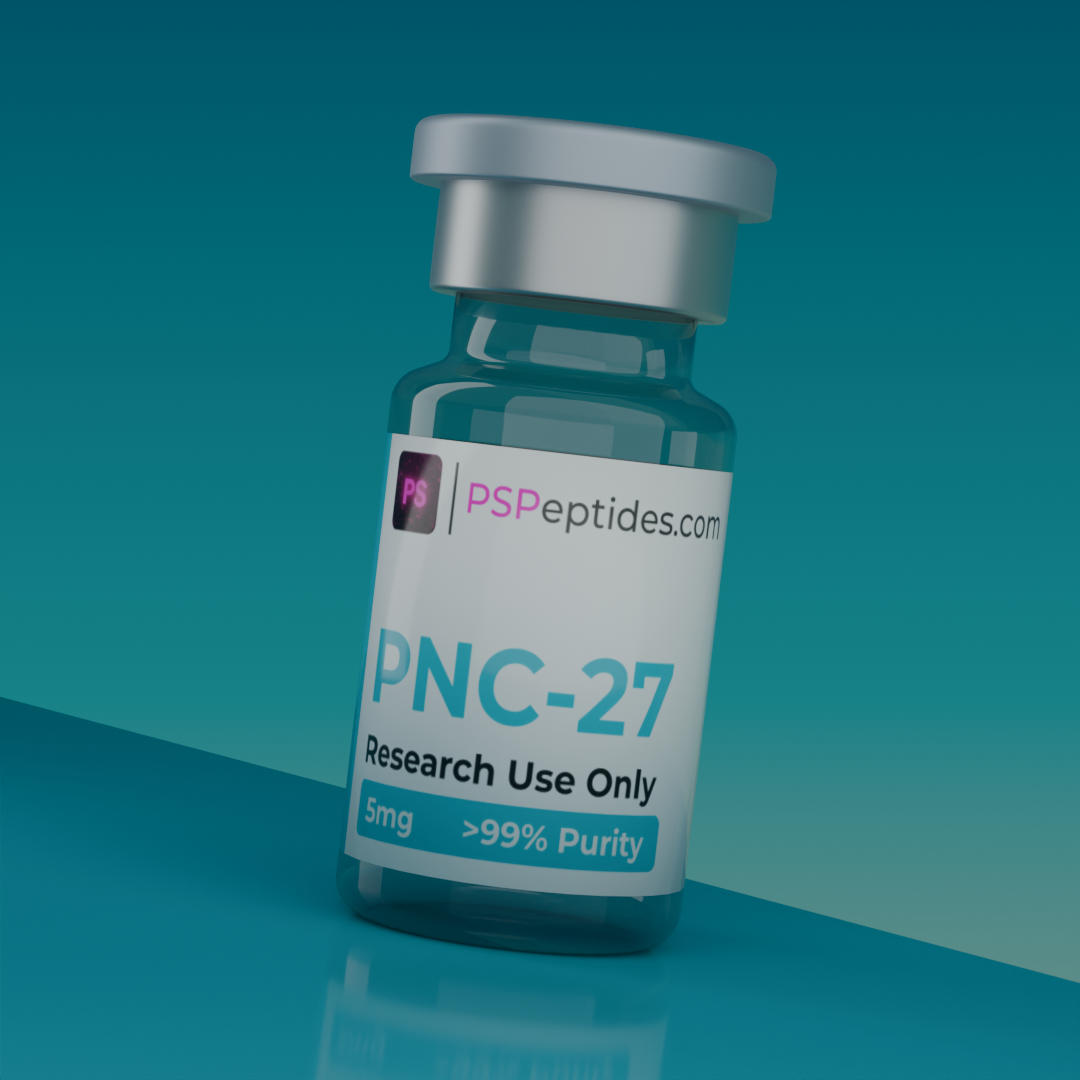
Each vial contains 5 mg of lyophilized peptide from a single lot. Each lot’s batch-specific Certificate of Analysis is published on this page.
Questions before you buy PNC-27? Each lot’s batch-specific Certificate of Analysis is published on this page. Our support team can confirm stock and advise on shipping for your facility. The full research description below covers mechanism, published studies, handling, storage, and frequently asked questions.
Detailed Mechanism of Action
Before you buy PNC-27 for a study, it helps to understand what the two halves of the molecule do. The N-terminal segment, PPLSQETFSDLWKLL, reproduces residues 12–26 of p53, the region that docks into the hydrophobic cleft of HDM-2. The C-terminal segment, KKWKMRRNQFWVKVQRG, is a cationic membrane-residence domain adapted from the Antennapedia penetratin sequence.
NMR work by Rosal and colleagues (Biochemistry, 2004) showed that the p53 segment adopts a helical conformation in a membrane-like environment. The 2010 PNAS study from Sarafraz-Yazdi and colleagues then demonstrated that PNC-27 binds HDM-2 in the plasma membrane of cancer cells and that this binding is required for its cytotoxic effect.
Once bound, PNC-27 molecules assemble with membrane HDM-2 into pore-like structures that allow ions, water, and cytosolic enzymes such as lactate dehydrogenase to leak across the membrane. The result is rapid necrosis rather than caspase-dependent apoptosis, typically measurable within hours by LDH release and trypan blue uptake. Because killing depends on surface HDM-2 rather than nuclear p53, the effect is independent of the cell’s p53 mutation status.
Cells lacking membrane HDM-2, including untransformed fibroblasts, normal epithelial cells, and normal hematopoietic cells in the published studies, were not lysed under the same conditions. A 2024 report by Krzesaj and colleagues added that PNC-27 can also interact with mitochondrial membranes in cancer cells, disrupting mitochondrial integrity as a secondary mechanism. HDM-2 knockdown or blocking antibodies are the usual controls for this specificity.

Published Research
The PNC-27 literature spans more than two decades. Kanovsky and colleagues first described the PNC series in the Proceedings of the National Academy of Sciences in 2001, showing that p53 12–26 peptides attached to a membrane-residence domain were selectively cytotoxic to transformed cells.
The defining mechanistic paper is Sarafraz-Yazdi et al., PNAS 2010, which showed that PNC-27 adopts an HDM-2-binding conformation and kills cancer cells by binding HDM-2 in their membranes. The same group published a comprehensive follow-up in Biomedicines in 2022, consolidating structural, imaging, and cell-lysis data on the chimeric p53-penetratin peptide. Both papers are open access, so the original protocols can be followed directly.
Hematologic models are well represented. Davitt and colleagues (Annals of Clinical and Laboratory Science, 2014) reported necrosis of K562 leukemia cells that depended on plasma-membrane HDM-2. Thadi et al., Anticancer Research 2020, extended this to U937, OCI-AML3, and HL-60 lines, with LDH release within four hours and no comparable effect on normal hematopoietic cells.
Solid-tumor work includes a 2020 ovarian cancer study by Thadi and colleagues showing that necrosis tracked with high membrane HDM-2 expression and a 2021 study of colon cancer cells and stem-like colonic progenitor cells. On the hematologic side, a 2020 paper in Leukemia by Wang and colleagues framed membrane HDM2 as a target in acute myeloid leukemia. Labs that buy PNC-27 for a new cell line generally begin by quantifying surface HDM-2 by flow cytometry, since expression level predicts sensitivity.
Two caveats matter for anyone evaluating this literature. All of the cited work is in vitro or in animal models, and none of it involves human subjects. The findings describe a research mechanism, not a clinical outcome, and PNC-27 remains an investigational laboratory compound.
Research Applications in Detail
Membrane HDM-2 as a marker. A recurring theme in the literature is that surface HDM-2 expression, not total HDM-2, determines whether a cell line responds. Groups that buy PNC-27 often pair it with flow cytometry on non-permeabilized cells to classify lines as high, intermediate, or negative for membrane HDM-2 before running cytotoxicity assays.
Necrosis versus apoptosis. Because PNC-27 produces membrane rupture rather than programmed cell death, it is a useful positive control for necrotic endpoints. Typical readouts include LDH release, propidium iodide or trypan blue exclusion, and the absence of caspase-3 activation or annexin V staining at early time points.
Cancer stem-like populations. The 2021 colon cancer study reported that PNC-27 bound membrane HDM-2 in colon cancer stem-like cells. Tumor-heterogeneity studies use the same comparison to test whether sorted subpopulations differ in sensitivity.
Comparisons with PNC-28. The shorter sibling peptide PNC-28 was shown by Bowne and colleagues (Annals of Surgical Oncology, 2008) to cause necrosis rather than apoptosis in human pancreatic cancer cells. PNC-27 is the more extensively characterized member of the pair in recent literature.
PNC-27 vs PNC-28 vs Nutlin-3a
Researchers choosing an HDM-2/MDM2 tool compound usually weigh three options. PNC-28 is the shorter sibling peptide from the same series, and nutlin-3a is the small-molecule MDM2 antagonist most often used as an intracellular comparator.
| Feature | PNC-27 (this product) | PNC-28 | Nutlin-3a |
|---|
| Class | Chimeric p53-penetratin peptide | Chimeric p53-penetratin peptide | Cis-imidazoline small molecule |
| p53-derived segment | Residues 12–26 (15 aa) | Residues 17–26 (10 aa) | None (fully synthetic) |
| Length / mass | 32 residues, ~4,032 Da | 27 residues, ~3,509 Da | ~581 Da |
| Target location | HDM-2 in the plasma membrane | HDM-2 in the plasma membrane | Intracellular MDM2–p53 interface |
| Reported cell-death mode | Rapid necrosis via pore formation | Rapid necrosis via pore formation | Apoptosis and cell-cycle arrest |
| Requires wild-type p53 | No | No | Yes |
| Research stage | Preclinical (cell lines, animal models) | Preclinical (cell lines, animal models) | Preclinical tool; later analogs entered clinical trials |
| Format | 5 mg lyophilized vial | Lyophilized peptide | Powder or DMSO stock |
PNC-27 and nutlin-3a can be run together: the peptide reports on membrane HDM-2 and necrotic lysis, while the small molecule reports on the intracellular MDM2–p53 axis and apoptotic signaling, giving two orthogonal readouts from the same cell panel.
Reconstitution & Handling
PNC-27 is supplied as a lyophilized powder and is reconstituted in the laboratory before use. Its highly cationic membrane-residence domain makes it readily water soluble, so bacteriostatic water or sterile water for cell-culture work is the usual solvent. Allow the sealed vial to reach room temperature before opening to avoid condensation on the powder.
Most protocols start from a concentrated stock: adding 1 mL of solvent to a 5 mg vial gives 5 mg/mL (about 1.24 mM), and 2 mL gives 2.5 mg/mL (about 0.62 mM). Introduce the solvent slowly down the inside wall of the vial and swirl gently; do not shake or vortex, since foaming can denature peptides.
Working dilutions for cell culture are then made fresh in medium immediately before an experiment. Step-by-step guidance is in our how to reconstitute peptides guide, and our peptide concentration calculator handles the molarity math for any vial size. Use sterile technique throughout and record the lot number from the COA in your lab notebook.
Experimental Design Considerations
Before you buy PNC-27 for a screen, settle the readouts and controls. Published PNC-27 time courses run from roughly thirty minutes to twenty-four hours, with most membrane-leakage endpoints appearing early. Including an untransformed control line with low or absent membrane HDM-2, a scrambled or membrane-residence-domain-only control peptide, and an HDM-2 blocking or knockdown condition allows the necrotic effect to be attributed specifically to membrane HDM-2 binding.
Serum proteins and high cell densities can reduce the apparent activity of cationic peptides, so quantitative comparisons usually standardize medium composition and seeding density across plates. Our peptide half-life chart discusses why fresh dilutions matter for short-lived peptides in culture.
Storage & Stability
Store sealed lyophilized vials at −20 °C, protected from light and moisture; under these conditions lyophilized peptides of this type are typically stable for two years or more. Short periods at 2–8 °C during shipping and receiving do not compromise the product. The two tryptophan residues and the single methionine make PNC-27 sensitive to light and oxidation, so keep vials in their original packaging.
After reconstitution, keep the solution at 2–8 °C and use it within a few days, or divide it into single-use aliquots and freeze at −20 °C or −80 °C. Avoid repeated freeze–thaw cycles. For multi-vial orders, our peptide storage guide and peptide degradation guide cover long-term handling and the signs that a solution should be discarded.
Certificate of Analysis
Each lot’s batch-specific Certificate of Analysis is published on this page. It documents identity by mass spectrometry and purity by reverse-phase HPLC. The observed mass should match the theoretical 4,031.8 Da within instrument tolerance, and the chromatogram should show a single dominant peak. Our guide to reading a peptide COA explains how to interpret each section.
Because PNC-27 contains an oxidation-prone methionine, the COA is also the place to confirm that the lot shows no significant +16 Da oxidation peak. For quantitative work, note the net peptide content on the COA, since lyophilized peptides include counter-ions and residual water that affect molarity calculations.
Why Buy PNC-27 From PSPeptides
- US Manufactured: Synthesized in a cGMP-compliant facility in Temecula, California, and shipped from our US facility.
- Third-Party Tested: Independent HPLC and mass spectrometry on every batch. Each lot’s batch-specific Certificate of Analysis is published on this page.
- Fast Shipping: Free UPS 2nd Day Air on orders over $200, and same-day dispatch on orders placed before 2 PM EST.
- Flexible Payments: Credit cards, Afterpay, Klarna, Apple Pay, and Google Pay.
- 7-Day Support: Email support seven days a week, 9 AM to 10 PM EST, with replies typically within 2–6 hours.
Lot-to-lot consistency matters for multi-month studies. Sourcing from one supplier across a project, with matching COAs, lets you document that identity and purity were constant, which reviewers increasingly expect in the methods section of a manuscript.
PSPeptides focuses on research-grade peptides for laboratory customers. If you are comparing suppliers, our articles on how to choose a research peptide supplier and the legal status of research peptides in 2026 explain what to look for and what the research-use-only designation requires.
Frequently Asked Questions
Has PNC-27 been studied in humans?
No. Every published PNC-27 study is in cultured cells or animal models. There are no human clinical trials, no approved indications, and no established safety data in people. Preclinical results do not establish that a compound is safe or effective in people, and nothing on this page should be read as medical advice. PNC-27 is sold only as a laboratory research compound and must not be used in or on humans or animals outside an approved research protocol.
Where can I buy PNC-27 online?
You can buy PNC-27 directly from PSPeptides on this page as a 5 mg lyophilized vial. Orders ship from the United States. Each lot’s batch-specific Certificate of Analysis is published on this page. We sell exclusively to laboratory and research customers.
How does PNC-27 differ from PNC-28?
Both peptides share the same membrane-residence domain and the same HDM-2-dependent, necrotic mechanism. PNC-27 carries the longer p53 segment (residues 12–26) and is the more extensively characterized of the two in recent literature; PNC-28 is the natural comparator.
Does PNC-27 act on p53-mutant cell lines?
In the published work, yes. Because the mechanism depends on HDM-2 at the cell surface rather than on functional nuclear p53, cell lines with mutant or deleted p53 were lysed as long as they expressed membrane HDM-2. Nutlin-3a, by contrast, requires wild-type p53.
What vial sizes can I buy PNC-27 in?
This listing is a single 5 mg lyophilized vial, the format used in most published cell-culture work. For larger screens or multi-month projects, contact support about multi-vial orders drawn from the same lot so that the COAs match across the entire study.
How should I reconstitute and store PNC-27?
Reconstitute with bacteriostatic or sterile water to a 2.5–5 mg/mL stock, swirling gently, then dilute fresh in medium for each experiment. Keep sealed vials at −20 °C and reconstituted stock at 2–8 °C for short-term use or in frozen aliquots for longer storage. Full details are in the handling sections above.
What controls are used with PNC-27 in cell-culture work?
Published studies pair PNC-27 with an untransformed control line, with HDM-2 knockdown or antibody-blocking conditions, and with a scrambled or membrane-domain-only control peptide. LDH release, trypan blue, and annexin V/caspase-3 assays distinguish necrosis from apoptosis. Each lot’s batch-specific Certificate of Analysis is published on this page. Use it to document peptide identity in your methods section.
Related Resources
Ready to buy PNC-27 for your laboratory? Select the 5 mg vial above and add it to your cart. Each lot’s batch-specific Certificate of Analysis is published on this page.
All PSPeptides products, including PNC-27, are sold exclusively for laboratory and research use. Not intended for human consumption or for the diagnosis, treatment, cure, or prevention of any disease.





 Made & Shipped