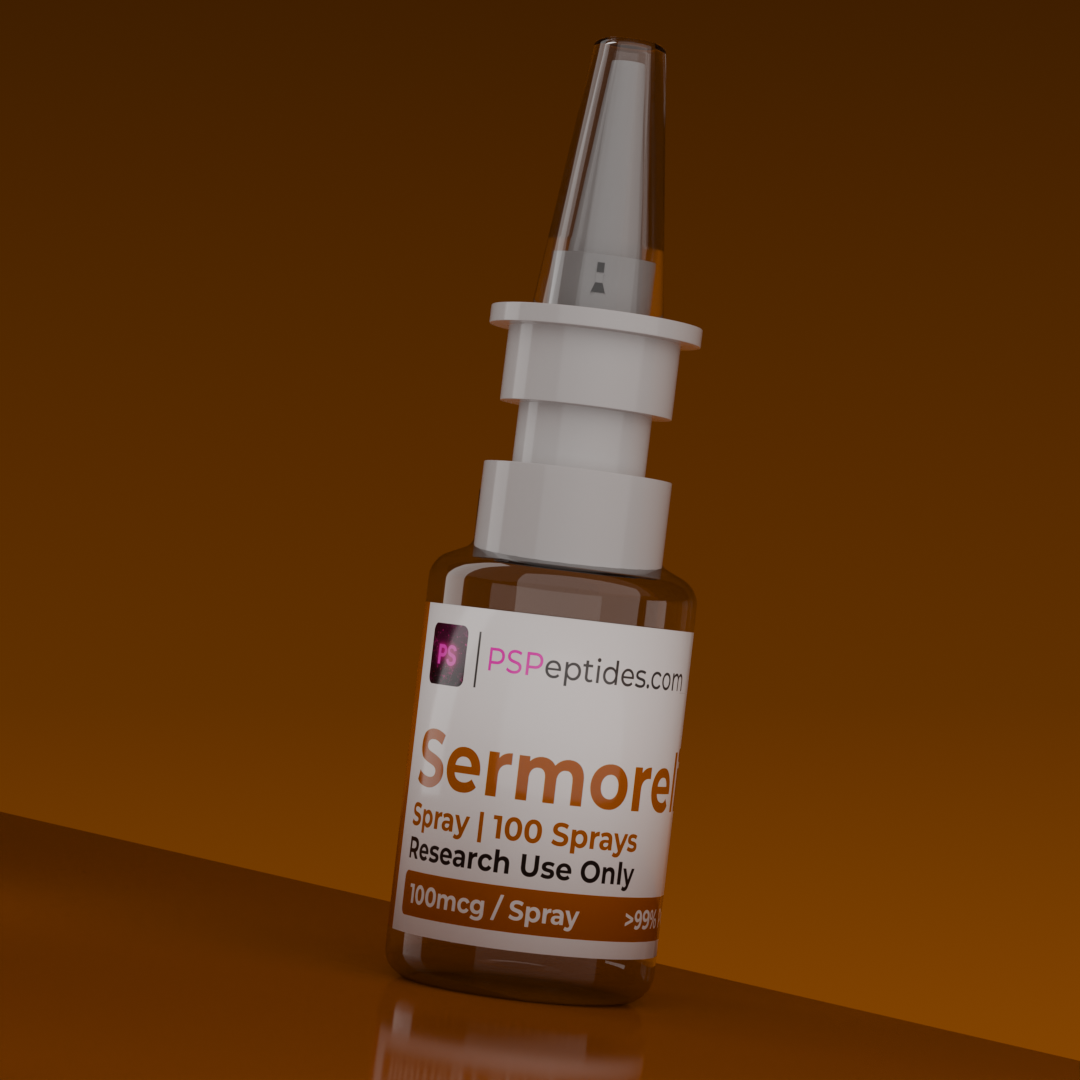
Sermorelin Spray
$59.99
Sermorelin Spray — research-use GHRH peptide, 99%+ purity, US manufactured, COA included with every batch.




 Made & Shipped
For laboratory and research use only. This product is not a drug, food, or cosmetic and is not for human or animal consumption. It is not intended to diagnose, treat, cure, or prevent any disease. These statements have not been evaluated by the FDA. Sold solely to qualified researchers and licensed laboratories. Certificate of Analysis available on request.
Description
Sermorelin Spray is a research-use formulation of Sermorelin, a growth-hormone-releasing-hormone (GHRH) analog peptide, supplied in a convenient spray format for laboratory research. Each batch is third-party tested to 99%+ purity and manufactured in the USA.
What Is Sermorelin Spray?
Sermorelin is a shortened synthetic fragment of GHRH that retains the biologically active region of the natural hormone. Researchers study GHRH analogs to better understand pituitary receptor signaling and peptide stability. This sermorelin spray is intended strictly for laboratory and in-vitro research use, not for human consumption.
Key Research Areas
- Endocrine Signaling: Referenced in studies of GHRH receptor interactions.
- Formulation Research: Studied for stability and delivery-format comparisons.
- Comparative Peptide Studies: Frequently discussed alongside other GH-axis peptides such as CJC-1295 and Ipamorelin in academic literature.
- Assay Development: Used as a reference compound in laboratory assay work.
Product Specifications
| Form | Spray |
| Purity | 99%+ (third-party HPLC and mass spectrometry) |
| Storage | Per Certificate of Analysis; keep away from heat and direct light |
| Testing | Batch-specific COA included |
| Origin | US manufactured |
| Intended Use | Laboratory research only; not for human consumption |
Formulation Overview
The spray delivery format is one of several ways researchers package peptide compounds for laboratory handling and comparative studies. As with any peptide, stability and purity depend heavily on manufacturing controls, cold-chain handling, and storage conditions after the container is first opened. PSPeptides manufactures each batch of sermorelin spray in the USA and verifies purity through independent third-party laboratory testing before the product ships.
Spray-based delivery is sometimes chosen in research settings for its ease of handling compared to lyophilized powders that require reconstitution equipment. Because a spray format changes how a peptide is exposed to air, light, and ambient temperature between uses, researchers working with sermorelin spray should pay close attention to the storage guidance printed on the product label and accompanying Certificate of Analysis. Consistent handling practices help preserve peptide integrity across the life of the container and reduce batch-to-batch variability in laboratory comparisons.
For background reading on GHRH-analog research, see the PubMed literature index for Sermorelin and the PMC collection on growth-hormone-releasing hormone.
The Growth Hormone Axis: Background for Researchers
The hypothalamic-pituitary-somatotropic axis is a well-studied endocrine pathway in which the hypothalamus releases GHRH, which in turn signals the anterior pituitary gland to synthesize and release growth hormone. This axis is regulated by feedback loops involving somatostatin, insulin-like growth factor 1 (IGF-1), and a range of other signaling molecules. GHRH analogs such as Sermorelin are of interest to researchers precisely because they interact with the same receptor pathway as the natural hormone, allowing scientists to model and compare receptor behavior under controlled laboratory conditions.
Because the GH axis touches on metabolism, tissue growth, and cellular repair pathways, it remains an active area of general endocrine research. Sermorelin spray is one of several peptide tools researchers use when studying this axis in a laboratory context, alongside other compounds referenced throughout the academic literature. Any translation of laboratory findings to clinical or therapeutic use requires formal drug development pathways, regulatory review, and licensed medical oversight — none of which apply to products sold for research use only.
Researchers interested in broader context on this peptide category may also find it useful to review our peptide glossary and our complete guide to peptides, both of which cover foundational terminology used throughout this field.
Sermorelin Spray vs Other GH-Axis Research Peptides
Researchers frequently compare Sermorelin against other GH-axis peptides referenced in the literature, such as CJC-1295 and Ipamorelin. Each of these compounds belongs to a related but distinct category, and understanding their structural and functional differences is useful context when designing comparative studies.
| Feature | Sermorelin | CJC-1295 | Ipamorelin |
|---|---|---|---|
| Peptide Class | GHRH analog fragment | GHRH analog | Growth hormone secretagogue |
| Common Research Format | Spray or lyophilized vial | Lyophilized vial | Lyophilized vial |
| Typical Study Focus | Receptor signaling | Extended receptor activity | Selective GH secretagogue activity |
| Third-Party Tested | Yes | Yes | Yes |
| US Manufactured | Yes | Yes | Yes |
Researchers comparing GH-axis peptides can review our CJC-1295 and Ipamorelin research guide for background on related compounds. Because each peptide interacts with the GH axis through a slightly different mechanism, side-by-side laboratory comparisons are common in the broader research community, and maintaining consistent sourcing and testing standards across compounds is generally considered good laboratory practice.

Quality Control & Testing Process
Every batch of sermorelin spray produced by PSPeptides passes through an independent third-party testing process before it is approved for sale. This process typically includes high-performance liquid chromatography (HPLC) to assess purity, along with mass spectrometry to help confirm the identity of the peptide. These are standard analytical methods used broadly across the peptide manufacturing industry to verify that a product matches its labeled specifications.
Results from this testing are compiled into a Certificate of Analysis (COA) that is specific to each production batch, rather than a generic document shared across the product line. Researchers are encouraged to review the COA for their specific batch prior to use, and to retain a copy for their own laboratory records where required by their institution’s documentation practices.
Handling & Storage Guidance
General peptide handling practices, including cold-chain storage and protection from light, are outlined in our peptide storage guide. Peptides are generally sensitive to heat, light, humidity, and repeated temperature fluctuations, all of which can accelerate degradation over time. Maintaining a stable, cool storage environment and minimizing the number of times a container is exposed to ambient conditions are widely recommended practices across the research peptide industry.
Researchers reconstituting or diluting peptides for laboratory use may also find our reconstitution overview and bacteriostatic water explainer useful background reading on general laboratory practices used across the peptide field. Signs of peptide degradation and general stability considerations are covered in our degradation guide, which discusses visual and olfactory indicators that a sample may no longer be suitable for use in a study. Always follow the handling instructions specific to your batch COA rather than relying on generic assumptions, since manufacturing processes and excipients can vary between suppliers.
Researchers should also be aware that peptide half-life and stability windows vary by compound class; our peptide half-life reference chart provides general comparative context for a range of commonly studied peptides.
Certificate of Analysis
Every Sermorelin Spray batch ships with a batch-specific Certificate of Analysis confirming purity via independent HPLC and mass spectrometry testing. The COA is intended to give researchers an objective, third-party-verified reference point for the material they are working with, rather than relying solely on manufacturer claims. For help interpreting your COA, including how to read purity percentages and testing methodology notes, see our guide to reading a peptide COA.
Shipping, Ordering & Support
PSPeptides ships orders using UPS, with free 2nd Day Air shipping available on orders over $200 and same-day dispatch available for orders placed before 2 PM EST on business days. Orders are packaged with attention to the temperature sensitivities common to peptide products, and tracking information is provided once an order ships.
Customers can complete checkout using major credit cards, as well as Afterpay, Klarna, Apple Pay, and Google Pay. The PSPeptides support team is available seven days a week by email for questions related to orders, COAs, or general product information.
Why Researchers Choose PSPeptides
PSPeptides has built its catalog around a small set of consistent commitments: domestic manufacturing, independent batch testing, and responsive customer support. These commitments apply to sermorelin spray as they do across the rest of the product line.
- US Manufactured
- Third-Party Tested: Independent HPLC and mass spectrometry
- Fast Shipping: Free UPS 2nd Day Air over $200, same-day before 2 PM EST
- Flexible Payments: Credit cards, Afterpay, Klarna, Apple Pay, Google Pay
- 7-Day Support: Email

Spray Format vs. Lyophilized Vials: General Considerations
Peptide products are typically supplied to researchers in one of two common formats: a lyophilized (freeze-dried) powder that requires reconstitution before use, or a pre-formulated liquid such as a spray. Each format carries different practical considerations for a laboratory. Lyophilized powders are generally considered more shelf-stable prior to reconstitution, since the absence of liquid reduces certain degradation pathways during long-term storage. A spray format such as sermorelin spray is pre-formulated, which can simplify handling in some laboratory workflows, but it also means the product should be treated according to its specific labeled storage window once opened.
Neither format is inherently superior for every use case — the appropriate choice depends on a lab’s specific protocols, storage capabilities, and the nature of the comparative study being conducted. Researchers who work with multiple peptide formats often find it useful to standardize their documentation practices across formats so that storage conditions, opening dates, and COA references are tracked consistently.
Understanding Peptide Purity Standards
Purity reporting in the peptide research industry is most commonly expressed as a percentage derived from HPLC peak-area analysis, sometimes supplemented by mass spectrometry to confirm molecular identity. A purity figure on its own does not describe every attribute of a sample — factors such as residual solvent content, moisture level, and counterion composition can also affect a peptide’s behavior in downstream applications, and these are sometimes reported separately on a more detailed COA.
Because testing methodologies and reporting conventions can vary between suppliers, researchers comparing products across vendors are encouraged to review the specific testing methodology disclosed on each COA rather than relying on a purity percentage alone. PSPeptides discloses its testing methodology for sermorelin spray and other products directly on the batch-specific COA provided with each order.
Documentation & Compliance for Research Laboratories
Many research institutions maintain internal documentation requirements for laboratory materials, including peptide products used in study protocols. Retaining the Certificate of Analysis, order confirmation, and any internal chain-of-custody notes for a given batch of sermorelin spray can help support a lab’s own compliance and record-keeping practices. Researchers working within an institutional setting should also confirm that their use of any research peptide aligns with their institution’s own biosafety and material-use policies, since these policies can vary between organizations.
PSPeptides labels all research peptide products, including sermorelin spray, clearly as being intended for laboratory research use only. This labeling reflects the product’s regulatory classification and is not a general statement about safety or efficacy for any other use.
Frequently Referenced Terminology
Researchers new to this product category sometimes encounter overlapping terminology across suppliers and academic sources. “GHRH analog” generally refers to a synthetic peptide designed to mimic part or all of the activity of naturally occurring growth-hormone-releasing hormone. “Secretagogue” refers more broadly to any compound that promotes the release of another substance — in this case, growth hormone — through a different receptor pathway than GHRH itself. Understanding these distinctions can help researchers select appropriate reference materials and avoid conflating mechanistically distinct peptide categories when designing comparative studies. Our peptide glossary collects definitions for many of these terms in one place.
Common Laboratory Techniques Used Alongside Sermorelin Research
Laboratories studying GHRH analogs such as sermorelin often pair a research peptide with standard analytical techniques, including receptor-binding assays, ELISA-based hormone quantification, and cell-culture models used to observe downstream signaling activity. These techniques are broadly used across peptide and endocrine research generally, not specific to any single compound, and the choice of method typically depends on the specific research question being investigated rather than on the peptide supplier.
Maintaining consistent experimental controls — including a well-documented reference sample of sermorelin spray from a known batch — is a standard practice recommended when running comparative or longitudinal laboratory studies.
Batch Consistency & Manufacturing Controls
Manufacturing consistency between batches is an important consideration for any laboratory relying on a research peptide over multiple studies. PSPeptides applies the same testing protocol to every production run of sermorelin spray, and each batch receives its own COA rather than relying on a single representative test result applied across multiple production runs. Researchers who require batch-to-batch consistency for longer research programs are encouraged to note the specific batch or lot number referenced on their COA when documenting their study protocols.
Research Use vs. Clinical Use: An Important Distinction
It is worth restating clearly that products such as sermorelin spray are labeled and sold for laboratory research use only. This is a regulatory and legal distinction, not merely a formality: research-use-only products have not gone through the clinical trial, manufacturing, and regulatory review processes required for any product intended for human therapeutic use. Researchers and institutions should treat this distinction as a firm boundary in how these materials are used, stored, and documented within their own facilities.
Frequently Asked Questions
Is Sermorelin Spray intended for human use?
No. Sermorelin Spray is sold strictly for laboratory and research use and is not intended for human consumption, ingestion, or any therapeutic application.
What is included with each order?
Every order includes the labeled product along with a batch-specific Certificate of Analysis documenting third-party purity testing.
How should Sermorelin Spray be stored?
Follow the storage instructions listed on your batch COA, generally keeping the product away from direct light and excess heat. See our storage guide linked above for general background on peptide stability.
What is GHRH and how does it relate to Sermorelin?
GHRH (growth-hormone-releasing hormone) is a naturally occurring hormone. Sermorelin is a synthetic peptide fragment modeled on the active region of GHRH, commonly referenced in endocrine research literature.
How is purity verified for each batch?
Each batch is evaluated using independent third-party HPLC and mass spectrometry testing, with results documented in a batch-specific COA that ships with the product.
Can Sermorelin Spray be compared with CJC-1295 or Ipamorelin in the same study?
Researchers often design comparative studies across GH-axis peptides. Because each compound has distinct structural properties, consulting the individual COA and relevant literature for each compound is recommended when designing such comparisons.
Does PSPeptides ship internationally?
Shipping availability can vary by destination. Customers should check current shipping options at checkout or contact PSPeptides support directly for the latest information.
Who can I contact with questions about this product?
PSPeptides offers support seven days a week by email for any questions about orders, COAs, or general product details.
Does a higher purity percentage always indicate a better research peptide?
Purity is one important factor, but researchers often also consider testing methodology, batch documentation, and storage handling when evaluating a research peptide’s suitability for a given study.
Is sermorelin spray the same product across every supplier?
No. Formulation, excipients, testing methodology, and manufacturing location can all vary between suppliers offering products labeled as sermorelin spray, which is why reviewing each supplier’s COA and sourcing practices is recommended.
Related Resources
- How to Read a Peptide COA
- Peptide Storage Guide
- How to Tell If a Peptide Has Degraded
- CJC-1295 & Ipamorelin Research Guide
- How to Reconstitute Peptides
- Peptide Glossary
- Are Research Peptides Legal in 2026?
- What Is Bacteriostatic Water?
- Peptide Half-Life Reference Chart
- Complete Guide to Peptides
Summary
Sermorelin spray from PSPeptides is manufactured in the USA and independently tested to confirm 99%+ purity, with a batch-specific Certificate of Analysis included with every order. Researchers evaluating GH-axis peptides for laboratory study can use the resources linked throughout this page, alongside their own institutional protocols, to guide safe handling, storage, and documentation practices.
All PSPeptides products are sold exclusively for laboratory and research use. Not intended for human consumption.
Additional information
| Weight | 0.03 lbs |
|---|---|
| Dimensions | 2 × 2 × 2 in |
| Spray Size | 10mg – 100 Sprays: 100mcg / Spray |
Related products
-
 GH & Regeneration Research Peptides
GHRP-2 (1 Vial)
$29.99 Select options This product has multiple variants. The options may be chosen on the product page -
GH & Regeneration Research Peptides
GHRP-6 (1 Vial)
$29.99 Select options This product has multiple variants. The options may be chosen on the product page -
GH & Regeneration Research Peptides
Tesamorelin Spray
$69.99 Select options This product has multiple variants. The options may be chosen on the product page -
GH & Regeneration Research Peptides
CJC No DAC + Ipamorelin Spray
$74.99 Select options This product has multiple variants. The options may be chosen on the product page