
The Powerful BPC-157 Peptide Research Guide for Tissue Healing

Reviewed by
Brandon Johnson — Certified Personal Trainer, Nutrition Coach & Peptide Research Consultant
Brandon Johnson is a certified personal trainer, nutrition coach, and peptide research consultant with a background in kinesiology and over 15 years of experience in fitness and wellness. He reviews all PSPeptides educational content for scientific accuracy and practical relevance.
BPC-157 peptide (Body Protection Compound-157) stands apart from nearly every other synthetic research peptide for one striking reason: it originates from a protein naturally found in human gastric juice, yet it demonstrates repair activity across at least nine distinct tissue systems in published preclinical studies. That combination — gastric origin, enzymatic stability, and remarkable tissue breadth — is what has driven decades of continuous preclinical research interest in this unique compound.
This guide examines what makes the BPC-157 peptide structurally and mechanistically unique, what the published literature actually shows about its activity, and how researchers approach working with it in a laboratory setting. All information is provided for research and educational purposes only.
Why the BPC-157 Peptide Is Structurally Unusual
Most synthetic research peptides are designed in a laboratory from first principles, optimized for a single target receptor or pathway. The BPC-157 peptide is different. It was isolated from a naturally occurring protective protein in human gastric mucosa — the stomach’s inner lining — which evolved over millions of years precisely to survive highly acidic, enzyme-rich environments.
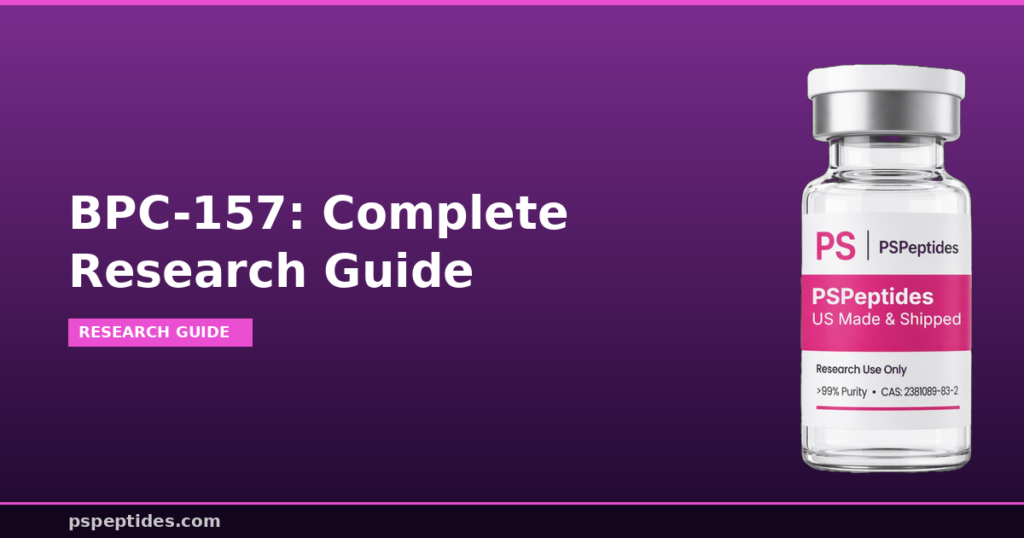
PSPeptides offers BPC-157 in 5mg and 10mg research vials.
This origin has a profound practical consequence: unlike nearly all other research peptides, the BPC-157 peptide is resistant to hydrolysis and enzymatic degradation in gastric conditions. It does not require encapsulation, a carrier molecule, or special formulation to maintain structural integrity in biological environments. Its amino acid sequence — Gly-Glu-Pro-Pro-Pro-Gly-Lys-Pro-Ala-Asp-Asp-Ala-Gly-Leu-Val — is freely soluble in water, making reconstitution straightforward for laboratory use.
Key chemical identifiers: CAS 137525-51-0 | Molecular Weight 1,419.53 Da | 15 amino acids | Freely water-soluble | No carrier required for reconstitution
The Dual Mechanism That Sets BPC-157 Peptide Research Apart
Most tissue-repair peptides studied in preclinical research operate through a single primary mechanism. The BPC-157 peptide is documented in peer-reviewed literature as acting through at least two distinct, non-redundant molecular pathways simultaneously — which may explain its unusually broad tissue-repair activity profile.
Pathway 1: VEGFR2-Mediated Angiogenesis
A pivotal 2017 study by Hsieh et al. published in the Journal of Molecular Medicine identified VEGFR2 (vascular endothelial growth factor receptor 2) activation as a central mechanism of the BPC-157 peptide’s pro-angiogenic effects. By upregulating VEGFR2 signaling, the compound promotes the formation of new blood vessels in damaged tissue — a process called angiogenesis. This is critical for tissue repair because damaged tissue frequently suffers from impaired vascular supply, and healing cannot proceed at scale without adequate blood flow. How quickly this angiogenic healing becomes measurable in research models is covered in how long BPC-157 takes to work. The Hsieh et al. VEGFR2 study remains one of the most-cited mechanistic papers on this peptide.
Pathway 2: Nitric Oxide System Modulation
Independently, the BPC-157 peptide interacts with the nitric oxide (NO) signaling system — a key regulator of vascular tone, inflammation resolution, and cellular repair signaling. Notably, researchers have documented that the peptide appears to upregulate NO production when it is deficient and downregulate it when excessive, suggesting a modulatory rather than simply stimulatory relationship. This bidirectional NO interaction gives this compound an adaptability in biological environments that single-pathway peptides lack, and may contribute to its consistency of effect across diverse tissue types and experimental conditions.
Secondary Mechanisms: FAK-Paxillin and Growth Hormone Receptor
Beyond the two primary pathways, published studies have identified additional mechanisms relevant to specific tissue types. It also activates the FAK-paxillin signaling pathway in tendon fibroblasts, promoting cytoskeletal reorganization and directed cell migration — both essential steps in connective tissue repair. Separately, research shows the peptide promotes growth hormone receptor expression in fibroblasts and myosatellite cells, supporting collagen synthesis and tissue remodeling at wound sites. These secondary mechanisms operate in addition to — not instead of — the primary VEGFR2 and NO pathways.

Nine Tissue Systems: The Breadth of BPC-157 Peptide Research
No other synthetic research peptide has published preclinical evidence across as many tissue types as this compound. The following is a summary of documented tissue systems from peer-reviewed literature:
| Tissue System | Documented Effect in Preclinical Research | Key Mechanism Involved |
|---|---|---|
| Tendon & Ligament | Accelerated fibroblast outgrowth; improved tensile strength | FAK-paxillin, angiogenesis |
| Gastrointestinal Tract | Maintained intestinal permeability; protection against NSAID damage | NO modulation, tight junction stabilization |
| Skin & Wound Sites | Improved wound closure; enhanced breaking strength | VEGFR2, growth hormone receptor |
| Muscle Tissue | Myosatellite cell activation; improved recovery in injury models | Growth hormone receptor, angiogenesis |
| Bone | Enhanced fracture healing in animal models | Angiogenesis, collagen synthesis |
| Peripheral Nerve | Promoted nerve fiber regeneration; reduced neuropathic markers | NO modulation, VEGFR2 |
| Cornea | Accelerated healing in corneal injury models | Angiogenesis, epithelial repair signals |
| Central Nervous System | Dopaminergic modulation; neuroprotective effects in injury models | NO system, dopamine receptor interaction |
| Cardiovascular | Improved vascular function; reduced adhesion in thrombosis models | NO modulation, VEGFR2 angiogenesis |
This cross-tissue activity profile is directly attributable to the fact that its primary mechanisms — VEGFR2-driven angiogenesis and NO system modulation — are not tissue-specific. They are fundamental biological processes that operate across all vascularized tissue types. Researchers have described this as the compound’s key differentiating feature in systematic reviews of the preclinical literature.
What the Human Trial Record Shows
This compound has a documented history in human clinical research that distinguishes it from the vast majority of synthetic research peptides, which have never been tested in human subjects. Two separate human clinical trials have investigated this compound:
Ulcerative Colitis Trial
Clinical investigation of this compound in patients with ulcerative colitis examined the compound’s GI-protective properties — properties that are consistent with its gastric origin and documented activity on intestinal permeability barriers in animal models. The trial proceeded without reported toxicity, and no lethal dose threshold (LD1) was ever established in subsequent safety testing — meaning researchers administering the compound could not find a dose that caused death in even 1% of test subjects across the animal model safety work that preceded and followed the human study.
Multiple Sclerosis Trial
A separate investigation explored this compound in the context of multiple sclerosis, likely motivated by the compound’s documented interactions with the dopaminergic and neuroprotective systems identified in animal research. Again, no significant adverse events were reported. This human safety record — however limited in scope — is a meaningful differentiator when researchers evaluate the preclinical-to-translational potential of synthetic peptides. The Gwyer et al. 2019 systematic review places this human trial history in context alongside the broader musculoskeletal preclinical literature.
Safety Profile Summary
A formal preclinical safety evaluation published in 2020 by Xu et al. in Regulatory Toxicology and Pharmacology confirmed the favorable safety profile of this compound across multiple evaluated parameters. The Xu et al. 2020 safety paper is considered essential reading for any researcher evaluating this compound’s translational potential. No genotoxicity, mutagenicity, or organ-specific toxicity was reported at the doses tested in the preclinical safety evaluation.
BPC-157 Peptide vs. Other Repair Peptides: Key Differences
Researchers frequently evaluate this peptide alongside TB-500 (Thymosin Beta-4) and GHK-Cu, since these three compounds share broad tissue-repair research relevance. Understanding their mechanistic distinctions is important for designing research protocols. For a full side-by-side analysis, see our BPC-157 vs TB-500 comparison guide.
Its primary distinction is its dual-pathway mechanism (VEGFR2 + NO) combined with its gastric stability — making it the only compound in this group with demonstrated activity when administered orally in animal models, not just by injection. TB-500 operates primarily through actin polymerization and cell migration signaling, without the angiogenic mechanism that defines research into this compound. GHK-Cu focuses on copper-mediated collagen synthesis and antioxidant activity — valuable for skin and wound research, but absent the vascular and neuroprotective dimensions of the compound’s profile. For a comprehensive overview of how peptides compare across tissue systems, our joint and tendon peptide research guide provides useful context.
Working With the BPC-157 Peptide in Research Settings
Researchers working with this compound should be familiar with several practical considerations that affect the quality and reproducibility of experimental results. All information below is provided for laboratory research context only.
Reconstitution and Handling
The BPC-157 peptide is supplied as a lyophilized (freeze-dried) powder. Because it is freely soluble in water, bacteriostatic water is the most commonly used reconstitution vehicle in published laboratory protocols. Unlike many other research peptides that require acidic solvents or DMSO, its water-solubility simplifies laboratory handling. Once reconstituted, peptide solutions should be stored at 2–8°C and used within the manufacturer-specified stability window. Researchers unfamiliar with standard reconstitution procedures can consult our peptide reconstitution guide for step-by-step laboratory methodology. Lyophilized powder stored at -20°C maintains stability for extended periods when properly sealed against moisture.
Purity Standards for Research Use
The peptide used in published research is consistently characterized by HPLC analysis confirming 99%+ purity. Impurities in synthetic peptides can confound experimental results, making third-party Certificate of Analysis (CoA) documentation a prerequisite for reliable research use. Researchers should understand how to read and interpret CoA data — our peptide CoA guide explains HPLC purity metrics and what to look for when sourcing research-grade compounds. PSPeptides supplies this peptide with full third-party tested CoA documentation at 99%+ purity.
Storage Best Practices
Proper storage is critical to maintaining bioactivity between research sessions. Lyophilized preparations should remain sealed and stored at -20°C away from light and moisture. Repeated freeze-thaw cycles degrade peptide integrity and should be avoided. Researchers working with larger quantities often divide reconstituted stock into single-use aliquots. For comprehensive guidance on storage conditions used in laboratory research, see our peptide storage guide.
PSPeptides supplies the BPC-157 both as a standalone research compound and as part of pre-formulated research blends:
- GLOW — BPC-157 peptide (10mg) + GHK-Cu (50mg) + TB-500 (10mg)
- KLOW — BPC-157 peptide (10mg) + GHK-Cu (50mg) + TB-500 (10mg) + KPV (10mg)
Frequently Asked Questions About the BPC-157 Peptide
What makes the BPC-157 peptide different from other research peptides?
The BPC-157 peptide has three features that distinguish it in preclinical research: its natural gastric origin (making it uniquely stable in biological environments), its dual-pathway mechanism (VEGFR2 angiogenesis and NO modulation simultaneously), and its documented activity across nine distinct tissue systems. No other synthetic research peptide currently has published preclinical evidence across this range of tissue types. Its human clinical trial history — two separate trials with no reported toxicity — further differentiates it from peptides studied only in animal models.
Is the BPC-157 peptide the same as Body Protection Compound 157?
Yes. BPC-157 peptide, Body Protection Compound-157, and BPC 157 all refer to the same 15-amino acid synthetic peptide with CAS number 137525-51-0 and molecular weight of 1,419.53 Da. The name “Body Protection Compound” reflects its origin in the protective protein fraction of human gastric juice. It is sold exclusively for laboratory research and is not FDA-approved for any clinical application.
Can the BPC-157 peptide be studied alongside other repair peptides?
Yes, and this is common practice in the preclinical literature. Because the BPC-157 peptide operates through VEGFR2 and NO pathways that are mechanistically distinct from TB-500’s actin-based signaling and GHK-Cu’s collagen synthesis mechanisms, the three compounds address complementary aspects of tissue repair without documented antagonism in animal studies. Researchers interested in combination protocols can review our peptide stacking research guide for methodological context from the literature.
What does the safety data show for the BPC-157 peptide?
The published safety profile of the BPC-157 peptide is notably favorable relative to other research peptides. The 2020 Xu et al. preclinical safety evaluation found no genotoxicity, mutagenicity, or organ toxicity at tested doses. The lethal dose threshold (LD1) was never achieved in animal safety studies — meaning researchers could not identify a dose lethal to 1% of test subjects. Two separate human clinical trials (ulcerative colitis and multiple sclerosis) proceeded without significant adverse event reporting. This safety record does not constitute approval for human use but is relevant context for researchers evaluating preclinical compounds.
What is the correct storage temperature for the BPC-157 peptide?
Lyophilized peptide powder should be stored at -20°C, protected from light and moisture, and kept sealed until use. Once reconstituted, the peptide solution should be stored at 2–8°C (standard refrigeration). Reconstituted solutions should not be repeatedly frozen and thawed, as this degrades peptide integrity. For detailed protocols matching published research standards, our peptide storage guide provides specific guidance on aliquoting, handling, and shelf-life considerations used in laboratory research.
BPC-157 Peptide in the Context of Broader Peptide Research
The BPC-157 peptide occupies a unique position in the landscape of synthetic research compounds. While most peptide research programs begin with a specific therapeutic target and build a synthetic molecule to match, this compound emerged from a fundamentally different direction: isolation and characterization of a naturally occurring protective sequence, followed by decades of systematic investigation into its biological activity profile.
This distinction matters for researchers because it means the BPC-157 peptide’s activity range was discovered through observation rather than design. The nine tissue systems now documented in the preclinical literature were not predicted by computational models or receptor-binding assays at the outset — they were identified sequentially as researchers in different laboratories independently tested the compound against different experimental injury models and consistently found meaningful effects. That convergence of independent findings across diverse research groups adds weight to the overall body of evidence in a way that designed peptides with narrower mechanistic rationales cannot replicate.
Researchers who work with the broader class of repair peptides — including TB-500, GHK-Cu, and KPV — note that the BPC-157 peptide’s documentation extends further back than most synthetic alternatives, with published mechanistic research dating to the early 1990s. This longevity of research interest is itself informative: compounds that fail to replicate across independent laboratories typically disappear from the literature within a decade. The sustained and growing body of research on this compound, spanning multiple countries, research institutions, and animal models, reflects a level of reproducibility that supports continued serious investigation. For researchers new to this space, our complete guide to research peptides provides useful foundational context for understanding where this compound fits within the broader synthetic peptide research landscape.
How to Evaluate BPC-157 Peptide Quality for Research Use
Research reproducibility depends heavily on compound quality. The BPC-157 peptide, like all synthetic research peptides, can vary significantly in purity, sequence integrity, and stability depending on the synthesis process and supplier quality controls. Researchers should apply a consistent standard when sourcing this compound for laboratory use.
Key Quality Indicators
The minimum quality standard for research-grade BPC-157 peptide is 99%+ purity as measured by HPLC (High-Performance Liquid Chromatography). HPLC analysis provides a chromatographic purity profile that identifies both the target peptide peak and any impurity peaks — their ratio determines the reported purity percentage. Suppliers who provide independent third-party HPLC certificates, rather than in-house testing only, offer a higher degree of quality assurance relevant to research integrity.
Mass spectrometry (MS) confirmation is a secondary but important quality indicator. MS analysis confirms that the synthesized peptide has the correct molecular weight — 1,419.53 Da for the BPC-157 peptide — verifying sequence integrity at the molecular level. HPLC alone can confirm purity of what is present; MS confirms that what is present is actually the target compound. Researchers sourcing the BPC-157 peptide should request both HPLC purity data and MS confirmation from their supplier’s CoA documentation. Our guide to reading peptide CoA documents explains how to interpret both types of analytical data in detail.
Synthesis and Endotoxin Considerations
Research-grade BPC-157 peptide should be synthesized using solid-phase peptide synthesis (SPPS) under controlled GMP-aligned conditions and tested for endotoxin contamination prior to release. Endotoxin contamination — a common source of confounding in peptide research — can trigger inflammatory responses in biological assays that mimic or mask the compound’s actual biological activity. Reputable suppliers include endotoxin testing in their standard quality documentation. Researchers conducting in vitro or cell-based assays in particular should confirm low endotoxin levels in any BPC-157 peptide preparation before use, as cellular assay systems are particularly sensitive to lipopolysaccharide contamination artifacts.
PSPeptides meets all of the above standards for research-grade supply: third-party HPLC purity testing at 99%+, MS confirmation of molecular weight, US-based synthesis, and same-day shipping with full CoA documentation included. Our guide to choosing a research peptide supplier outlines the full evaluation framework researchers should apply when assessing any supplier of the BPC-157 peptide or other synthetic research compounds.
References
- Hsieh MJ, et al. Therapeutic potential of pro-angiogenic BPC157 is associated with VEGFR2 activation. J Mol Med. 2017;95:323-333.
- Chang CH, et al. Pentadecapeptide BPC 157 in clinical trials and use in healing. J Physiol Pharmacol. 2011;62(6):774-780.
- Mikus D, et al. Pentadecapeptide BPC 157 cream improves burn-wound healing and suppresses delayed-type hypersensitivity reactions. Burns. 2001;27:817-827.
- Gwyer D, et al. Gastric pentadecapeptide BPC 157 and its role in accelerating musculoskeletal soft tissue healing. Cell Tissue Res. 2019;377(2):153-159.
- Park JM, et al. BPC 157 rescued NSAID-cytotoxicity via stabilizing intestinal permeability. Curr Pharm Des. 2020;26:2971-2981.
- Xu C, et al. Preclinical safety evaluation of body protective compound-157. Regul Toxicol Pharmacol. 2020;114:104665.
- Sikiric P, et al. Brain-gut Axis and Pentadecapeptide BPC 157: Theoretical and Practical Implications. Curr Neuropharmacol. 2016;14(8):857-865.
All products mentioned are intended for laboratory research use only. Not for human consumption.
All PSPeptides products are sold exclusively for research and laboratory use.