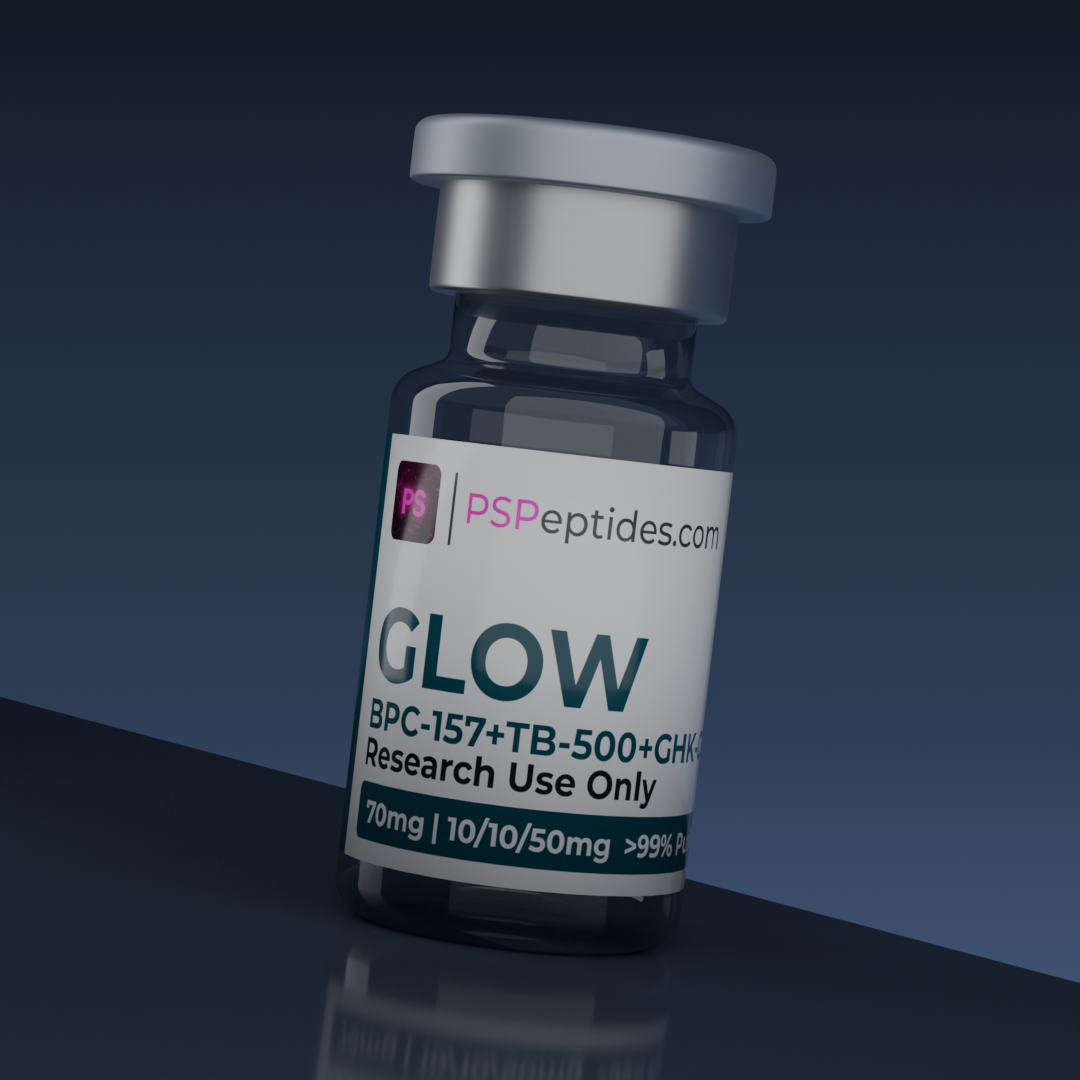
Researchers buy GLOW blend when a study calls for collagen synthesis, angiogenesis, and cell-migration signaling in one formulation. Instead of sourcing and reconstituting three separate vials, you get all three peptides pre-blended at a research-ready ratio. Add it to your cart above, or expand the full research description below for mechanisms, published data, and handling protocols.
The GLOW blend unites three of the most extensively studied tissue-repair peptides in preclinical literature. BPC-157 (Body Protection Compound-157) targets angiogenesis and connective tissue signaling. GHK-Cu (glycyl-L-histidyl-L-lysine copper complex) drives collagen synthesis and extracellular matrix remodeling. TB-500 (a Thymosin Beta-4 fragment) promotes actin polymerization and cell migration.
Together, these compounds address complementary mechanisms that single-peptide protocols may not fully engage. Labs studying multi-pathway skin regeneration, wound healing, or connective tissue repair buy GLOW blend for exactly that reason. See our GLOW vs KLOW peptide blend comparison guide for how the two PSPeptides formulations differ.
Every order to buy GLOW blend includes the batch-specific COA for the exact lot you receive, so you can verify identity and purity before opening the vial.
Ready to buy GLOW blend? Select your quantity above and add it to your cart. Want the full science first? Expand the research description below.
Detailed Mechanism of Action: How Each Component Works
Researchers who buy GLOW blend get three peptides that target distinct yet synergistic biological axes. Understanding each component’s mechanism helps you design rigorous protocols and interpret results accurately.
BPC-157 — 10mg per Vial
BPC-157 (Gly-Glu-Pro-Pro-Gly-Lys-Pro-Ala-Asp-Asp-Ala-Gly-Leu-Val; CAS 137525-51-8) is a synthetic pentadecapeptide derived from a protective gastric protein. It is among the most widely studied tissue-repair peptides in preclinical models, with reported activity across skin, tendon, ligament, muscle, bone, nerve, cornea, and gastrointestinal tissue.
Its primary mechanisms include VEGFR2 activation with downstream angiogenesis, FAK-paxillin pathway modulation driving tendon fibroblast outgrowth, nitric oxide system interaction regulating vessel tone, and rapid upregulation of growth factor gene expression at wound sites. Chang et al. (2011, J Appl Physiol) showed that BPC-157 accelerated tendon fibroblast outgrowth from explants, increased cell survival under oxidative stress, and promoted dose-dependent migration.
This component is relevant to any model requiring vascularization or fibroblast recruitment. For a full literature review, see our BPC-157 research guide.
GHK-Cu — 50mg per Vial (Primary Component)
GHK-Cu (glycyl-L-histidyl-L-lysine copper(II); molecular weight 403.93 Da; CAS 49557-75-7) is a naturally occurring tripeptide-copper complex first identified in human plasma in 1973 by Loren Pickart. It is the highest-concentration component of the GLOW blend because its mechanisms directly target the extracellular matrix remodeling and skin-quality parameters central to this blend’s design.
GHK-Cu’s primary mechanisms include collagen stimulation (Type I and III synthesis increases of up to 70% in vitro), matrix metalloproteinase regulation with TIMP-1 and TIMP-2 upregulation for controlled remodeling, wound contraction promotion, and NF-κB pathway modulation. Its copper-chaperone function supports lysyl oxidase, the enzyme essential for collagen and elastin cross-linking.
Labs that buy GLOW blend for dermal regeneration, hair follicle cycling, or anti-fibrotic work will find GHK-Cu the critical component. For deeper reading, see our GHK-Cu complete research guide.
TB-500 — 10mg per Vial
TB-500 (Thymosin Beta-4 fragment; CAS 77591-33-4) exerts its primary effects through G-actin sequestration and actin polymerization dynamics. By binding actin monomers, TB-500 lowers the ratio of filamentous to globular actin, enabling enhanced cell migration, a core requirement for tissue repair and wound re-epithelialization.
Malinda et al. (1999, J Invest Dermatol) reported keratinocyte migration increases of 2–3 fold over controls at concentrations as low as 10 picograms, and topical or intraperitoneal administration increased re-epithelialization by 42% at day 4 in wound models. Within the blend, TB-500 complements GHK-Cu’s matrix remodeling and BPC-157’s angiogenic signaling. Background is in our TB-500 Thymosin Beta-4 research guide.

Published Research Supporting the GLOW Blend Components
Before you buy GLOW blend for a study, review the primary literature on each component. All three peptides carry decades of published preclinical data across multiple tissue systems.
BPC-157: Chang et al. (2011) demonstrated that BPC-157 promotes tendon healing through tendon outgrowth, cell survival, and cell migration. Sikiric et al. (2018, Curr Pharm Des) reviewed its cytoprotective and vascular recruitment activity across gastrointestinal, musculoskeletal, and neurological models.
GHK-Cu: Pickart et al. (2015) described GHK as a natural modulator of multiple cellular pathways in skin regeneration. Pickart and Margolina (2018, Int J Mol Sci) then reviewed its regenerative and protective actions in light of gene-expression data spanning thousands of human genes.
TB-500: Malinda et al. (1999) established that Thymosin Beta-4 accelerates wound healing, and Goldstein et al. (2012, Expert Opin Biol Ther) summarized its multi-functional regenerative properties and clinical applications.
The rationale for combining these peptides rests on non-overlapping primary targets: GHK-Cu at the extracellular matrix level, BPC-157 at the vascular and fibroblast-recruitment level, and TB-500 at the actin and cell-migration level. Together they span the tissue-repair cascade from early signaling through matrix remodeling and epithelialization. See our BPC-157 vs TB-500 comparison guide for component-level context before you buy GLOW blend for a multi-pathway model.
GLOW Blend vs. Alternatives
Many customers weigh the cost and convenience of three separate vials against a single blended vial. The table below shows why researchers buy GLOW blend instead of assembling the stack themselves.
| Feature | GLOW Blend (This Product) | BPC-157 Alone | GHK-Cu Alone |
|---|
| Total peptide mass | 70mg/vial | 5–10mg/vial | 50mg/vial |
| Pathways covered | 3 (vascular, matrix, migration) | 1 primary | 1 primary |
| Angiogenesis pathway | ✓ (BPC-157) | ✓ | Indirect only |
| ECM/collagen synthesis | ✓ (GHK-Cu) | Indirect | ✓ |
| Cell migration (actin) | ✓ (TB-500) | Partial | Partial |
| Anti-inflammatory signaling | ✓ (multi-target) | ✓ (NO system) | ✓ (NF-κB) |
| Purity | 99%+ each component | Varies by vendor | Varies by vendor |
| COA included | ✓ Batch-specific | Varies | Varies |
| US manufactured | ✓ | Varies | Varies |
If your protocol targets a single pathway, a single peptide may be the better buy. If it spans vascular, matrix, and migration mechanisms, buy GLOW blend and run single-peptide controls alongside it. Our peptide stacking guide covers control-group design for multi-peptide studies.
Reconstitution & Handling Protocol
Use bacteriostatic water (BW) for reconstitution to extend post-reconstitution stability. Reconstitute the lyophilized powder using aseptic technique in a clean environment.
Steps: (1) Allow the vial to reach room temperature. (2) Add 2–2.5 mL of bacteriostatic water, injecting slowly against the glass wall rather than directly onto the peptide cake. (3) Swirl gently; do not vortex or shake. (4) Allow 2–5 minutes for complete dissolution. The solution should be clear, so discard any vial showing particulates or cloudiness.
For concentration math, use our peptide reconstitution guide and our peptide dosage calculator guide. Solvent selection is covered in our bacteriostatic water guide. Order bacteriostatic water alongside the blend so everything arrives ready for reconstitution.
Storage & Stability Guidelines
Store the lyophilized vial at −20°C (or lower) for long-term stability of 12–24 months. Refrigeration at 2–8°C is acceptable for up to 3–4 weeks before reconstitution. Once reconstituted, keep the solution at 4°C and use within 28 days; for longer storage, aliquot and freeze at −80°C.
Avoid repeated freeze-thaw cycles and keep vials away from direct light and moisture. When you buy GLOW blend from PSPeptides it ships lyophilized, the most stable form for transit and storage. Labs that buy GLOW blend in multi-vial quantities should keep unopened vials at −20°C and pull one at a time as the study progresses. Full stability data and degradation warning signs are in our peptide storage guide.
Certificate of Analysis
Every vial of GLOW blend ships with a batch-specific Certificate of Analysis generated by an independent third-party laboratory. The COA confirms identity by mass spectrometry, purity by HPLC (99%+ per component), and residual solvents within specification.
Verify the COA before beginning experimental work. If you buy GLOW blend from a vendor that cannot produce a batch-specific COA, you cannot attribute results to the compound with confidence. Our guide on how to read a peptide COA explains each field.
Ordering, Shipping & Payment
Ordering is simple: choose your quantity, add to cart, and check out with a credit card, Afterpay, Klarna, Apple Pay, or Google Pay. Orders placed before 2 PM EST ship the same day, and orders over $150 qualify for free UPS 2nd Day Air.
Need more than one vial? Increase the quantity at checkout. Many labs buy GLOW blend in multi-vial quantities to keep one lot number across an entire study, which simplifies COA tracking and reduces batch-to-batch variability.
Prefer to buy GLOW blend as part of a larger regenerative stack? Pair it with bacteriostatic water and your other research peptides in the same order to reach the free-shipping threshold faster and keep every item on one COA-tracked shipment.
Questions before you buy GLOW blend? Our support team is available by email, phone, or text seven days a week to help with product selection, COA requests, and order status.
Research Design Considerations
Multi-peptide formulations present unique design considerations compared to single-peptide studies. Because BPC-157, GHK-Cu, and TB-500 operate through distinct pathways, studies must account for potential additive, synergistic, or antagonistic interactions. Current literature does not document significant antagonism among these three compounds at research-relevant concentrations.
For in vitro work, select cell models relevant to the primary pathway of interest: primary dermal fibroblasts or keratinocytes for collagen and ECM studies, HUVECs for angiogenesis, and scratch assays for migration and wound closure. Parallel single-peptide control groups are essential for attributing observed effects to specific components.
In vivo, the route of administration, dosing interval, and wound model will significantly affect outcomes. Published BPC-157 studies have used systemic (intraperitoneal, subcutaneous) and local administration. GHK-Cu is frequently studied topically given its transdermal penetration, and TB-500 has been investigated via both systemic and topical routes.
Labs that buy GLOW blend for in vivo work should fix the route, dose, and model before the first vial is reconstituted, then hold those variables constant across cohorts. Our 2026 guide on research peptide legality addresses compliance questions to settle before you buy GLOW blend for your lab.
Administration Routes in Preclinical Research
BPC-157 shows consistent activity via subcutaneous, intraperitoneal, intragastric, and topical routes in animal models, with subcutaneous administration most common for systemic tissue-repair studies. GHK-Cu’s small size (403.93 Da) enables transdermal penetration, making it suitable for topical protocols when skin is the target tissue. TB-500 is most often administered subcutaneously or intraperitoneally, though topical formulations have shown activity in corneal and cutaneous wound models.
Researchers who buy GLOW blend for topical skin models should review the GHK-Cu transdermal literature first, since it is the component most likely to drive results by that route. For stacking context, see our Wolverine stack guide (BPC-157 + TB-500). All protocols must be approved by the relevant IACUC or equivalent ethics body before study initiation.
Why Researchers Buy GLOW Blend from PSPeptides
- US Manufactured: Every GLOW blend vial is synthesized and lyophilized in the United States under controlled conditions.
- Third-Party Tested: Independent HPLC and mass spectrometry verification on every batch, not self-reported purity claims.
- Fast Shipping: Free UPS 2nd Day Air on orders over $150, with same-day dispatch on orders placed before 2 PM EST.
- Flexible Payments: Credit cards, Afterpay, Klarna, Apple Pay, and Google Pay.
- 7-Day Support: Email, phone, or text, seven days a week.
- Research-Grade Standards: Documented, traceable quality for academic and independent researchers. See our guide to choosing a research peptide supplier.
Compare suppliers before you buy GLOW blend anywhere else. Our best peptide companies 2026 guide lays out the purity, testing, and shipping standards that separate reliable suppliers from the rest.
Frequently Asked Questions
What is the GLOW blend and why does it combine BPC-157, GHK-Cu, and TB-500?
The GLOW blend addresses three complementary axes of tissue repair simultaneously: BPC-157 for vascular and fibroblast-recruitment signaling, GHK-Cu for extracellular matrix remodeling and collagen synthesis, and TB-500 for actin dynamics and cell migration. Researchers buy GLOW blend when a model requires all three mechanisms rather than a single-peptide approach.
Where is the best place to buy GLOW blend?
The best place to buy GLOW blend is a supplier that manufactures in the US, tests every batch through an independent laboratory, and provides a batch-specific COA with each vial. PSPeptides meets all three standards and backs every order with seven-day support.
How fast will my order ship?
Orders placed before 2 PM EST ship the same business day. Orders over $150 ship free via UPS 2nd Day Air, and every package includes the batch-specific COA for your vial.
Do I need bacteriostatic water when I buy GLOW blend?
Yes. The vial ships as lyophilized powder and must be reconstituted with bacteriostatic water before use in any assay. Most researchers add bacteriostatic water to the same order so both items arrive together and the vial can be prepared on day one.
How should I store GLOW blend after receiving it?
Store the lyophilized vial at −20°C for long-term stability up to 24 months. Before reconstitution, refrigeration at 2–8°C is acceptable for up to 4 weeks. Once reconstituted with bacteriostatic water, keep at 4°C and use within 28 days. Protect from light and moisture and avoid repeated freeze-thaw cycles.
What purity level does the GLOW blend contain?
Each component, BPC-157, GHK-Cu, and TB-500, is independently verified at 99%+ purity via third-party HPLC and mass spectrometry. PSPeptides provides a batch-specific COA confirming these results for every vial shipped, which is critical for reproducible outcomes.
Is the GLOW blend intended for human use?
No. The GLOW blend, like all PSPeptides products, is sold exclusively for in vitro and preclinical laboratory research. It is not intended, labeled, or approved for human or veterinary consumption, self-administration, or therapeutic use. Buyers must comply with all applicable institutional and regulatory requirements in their jurisdiction.
How does GLOW blend compare to KLOW?
GLOW and KLOW are PSPeptides’ two flagship regenerative blends with different peptide composition ratios designed for different research applications. The GLOW blend emphasizes higher-dose GHK-Cu (50mg) for skin and ECM research, while KLOW uses a different ratio targeting other mechanisms. Full analysis is in our GLOW vs KLOW comparison guide.
Can I buy GLOW blend online in the USA?
Yes. You can buy GLOW blend online directly from PSPeptides, which ships throughout the United States from US-manufactured inventory. Select your quantity, add to cart, and check out with any accepted payment method. Same-day dispatch applies to orders placed before 2 PM EST.
Related Research Resources
More reading for researchers who buy GLOW blend:
All PSPeptides products are sold exclusively for laboratory and in vitro research use. Not intended for human consumption, self-administration, or therapeutic use.





 Made & Shipped