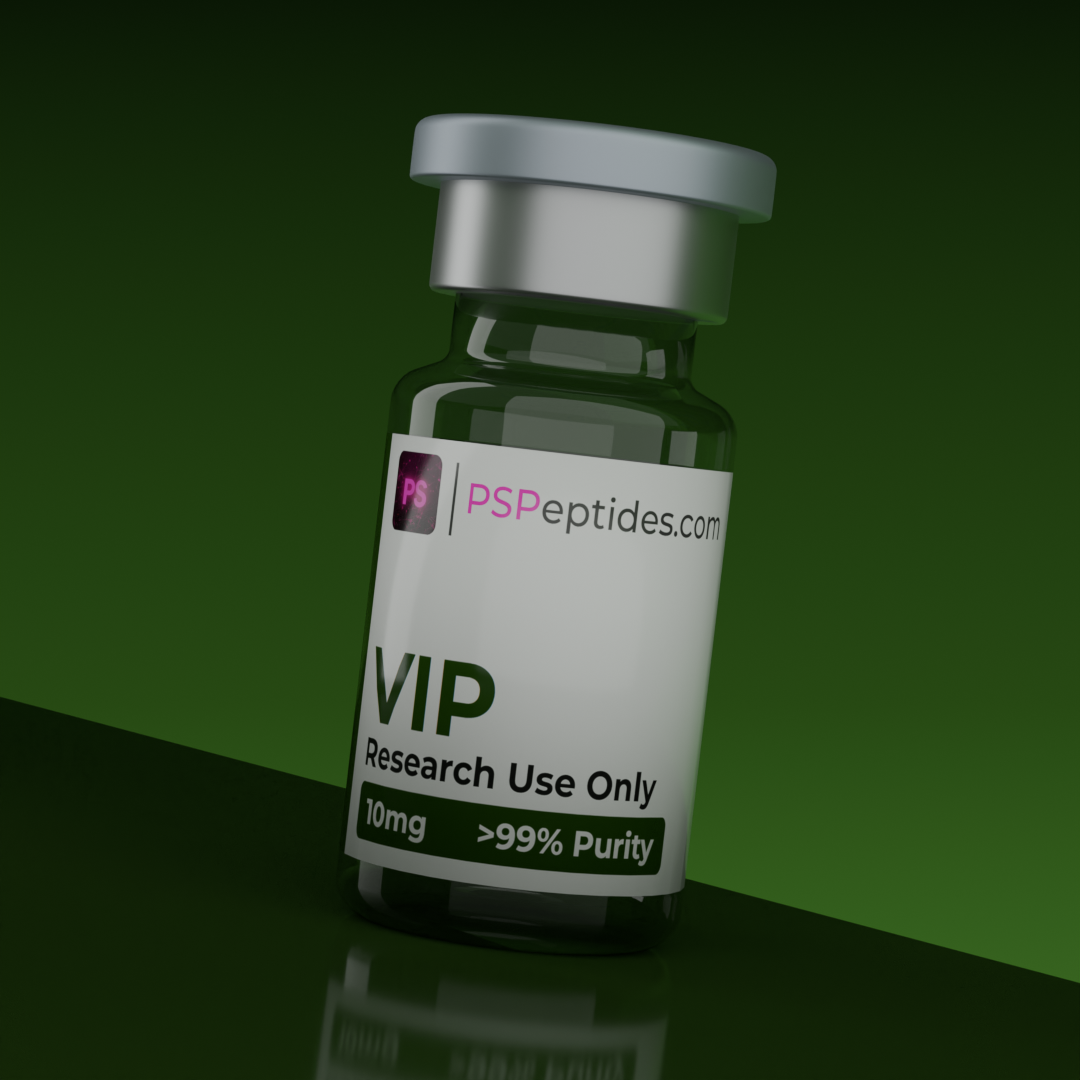
VIP (1 Vial)
$74.99
Buy VIP peptide (10MG vial) — research-grade vasoactive intestinal peptide. 99%+ purity, US manufactured, batch-specific COA included.
Vials count across your whole order — mix any peptides and sizes.
40% OFF Need 10+ vials? Build your own kit — 40% off every vial



 Made & Shipped
For laboratory and research use only. This product is not a drug, food, or cosmetic and is not for human or animal consumption. It is not intended to diagnose, treat, cure, or prevent any disease. These statements have not been evaluated by the FDA. Sold solely to qualified researchers and licensed laboratories. Certificate of Analysis available on request.
VIP (vasoactive intestinal peptide) protocol reference
What the published research and common laboratory protocols report for this compound, in one place. Figures are a reference for designing a study, not instructions.
Reconstitution & syringe units
Units are for a standard U-100 insulin syringe (100 units = 1 mL). Add the water slowly down the inside of the vial, swirl gently — never shake — and refrigerate.
| Vial | Add BAC water | Concentration | 50 mcg dose | 100 mcg dose |
|---|---|---|---|---|
| 10MG | 2.5 mL | 4 mg/mL | 1.3 units (below reliable measurement) | 2.5 units |
Under 2 units is below what a 100-unit syringe measures reliably; a 0.3 mL (30-unit) syringe has finer gradations.
Different water volume? Use the dosage calculator — it does the units for any concentration.
Very short half-life (~2 minutes in plasma); that is why dosing is frequent.
For laboratory and research use only. This product is not a drug, food, cosmetic or dietary supplement and is not for human or animal consumption. The figures above summarise published studies and common research protocols; they are not medical advice or instructions for use. These statements have not been evaluated by the FDA.
Description
Buy VIP peptide (Vasoactive Intestinal Peptide) in a 10MG lyophilized vial — a 28-amino-acid neuropeptide of the secretin-glucagon superfamily studied for its role in immune signaling, smooth muscle relaxation, circadian regulation, and gastrointestinal physiology. Every vial is US manufactured, verified at 99%+ purity by third-party HPLC and mass spectrometry, and ships with a batch-specific certificate of analysis.
What Is VIP Peptide?
Vasoactive intestinal peptide was first isolated from porcine duodenum in 1970 by Said and Mutt, who named it for the pronounced vasodilatory activity they observed in early assays. It is now recognized as one of the most widely distributed neuropeptides in mammalian tissue, expressed throughout the enteric nervous system, the central nervous system, lung, and immune compartments.
VIP signals primarily through two class B G-protein-coupled receptors, VPAC1 and VPAC2, and with lower affinity through PAC1. Receptor engagement activates adenylyl cyclase, raising intracellular cAMP and downstream protein kinase A activity — the pathway that underlies most of the effects reported in the literature. Laboratories that buy VIP peptide from us receive the native 28-residue human sequence rather than a truncated analogue. Researchers new to this peptide class often start with our complete guide to research peptides.
Key Research Applications
- Immune modulation: VIP is studied as an endogenous anti-inflammatory mediator that shifts macrophage and T-cell phenotypes in cultured immune models.
- Pulmonary and vascular physiology: Its smooth muscle relaxant activity makes it a frequent tool compound in bronchial and pulmonary vascular research.
- Circadian biology: VIP-expressing neurons of the suprachiasmatic nucleus are central to how animal models synchronize circadian output.
- Gastrointestinal signaling: As an enteric neurotransmitter, VIP is used in studies of intestinal motility, secretion, and epithelial barrier function.
Product Specifications
| Amount | 10MG per vial (1 vial) |
| Purity | 99%+ (third-party HPLC and mass spectrometry) |
| Form | Lyophilized white powder, sealed vial |
| Sequence length | 28 amino acids |
| Storage | -20°C lyophilized; 2-8°C after reconstitution |
| Testing | Batch-specific COA included |
| Origin | US manufactured |
Detailed Mechanism of Action
Laboratories that buy VIP peptide are usually working somewhere along the VPAC receptor axis. VPAC1 is expressed densely on lung epithelium, liver, and T lymphocytes, while VPAC2 predominates in smooth muscle, the suprachiasmatic nucleus, and mast cells. Because the two receptors have overlapping but non-identical distributions, selective agonist and antagonist experiments frequently use native VIP as the reference ligand.
Both receptors couple to Gs proteins. Ligand binding activates adenylyl cyclase, cAMP accumulates, and protein kinase A phosphorylates downstream targets including CREB. In smooth muscle preparations this cascade reduces intracellular calcium availability and produces the relaxation response that gave the peptide its name.
A second arm of the pathway is immunological. In cultured macrophages, cAMP elevation driven by VIP suppresses NF-kB nuclear translocation, which in turn reduces transcription of TNF-alpha, IL-6, and IL-12 while permitting IL-10 expression. Investigators who buy VIP peptide for inflammation work generally track this cytokine ratio as their primary readout, a pattern discussed further in our peptides for immune support research overview.
VIP also displays partial cross-reactivity with PACAP receptors, since VIP and PACAP share roughly 68% sequence homology. Experimental designs that need clean receptor attribution therefore pair the peptide with selective antagonists rather than relying on VIP alone, and researchers comparing related signaling molecules often consult our research peptide glossary for terminology.
Published Research
The foundational report remains Said and Mutt’s 1970 isolation paper in Science, which characterized the peptide’s vasodilatory profile and established the 28-residue sequence. Subsequent decades expanded the picture considerably, and the current literature base is indexed under vasoactive intestinal peptide on PubMed, where several thousand primary reports are catalogued.
Circadian work has been especially productive. Animal models lacking VIP or its VPAC2 receptor show markedly weakened behavioral rhythmicity and desynchronized firing among suprachiasmatic nucleus neurons, which established VIP as a principal coupling factor within the master clock rather than a peripheral modulator. Teams that buy VIP peptide for chronobiology typically use it in slice preparations to test phase-shifting and resynchronization.
Immunology represents the other large cluster. Delgado and Ganea and colleagues published an extended series describing VIP as an endogenous anti-inflammatory agent capable of promoting regulatory T-cell phenotypes in murine models, summarized across the VIP immune regulation literature at NCBI. These findings are what motivate most laboratories that buy VIP peptide online for autoimmune and mucosal inflammation models.
Respiratory research forms a third strand. Synthetic VIP has been investigated in pulmonary vascular and airway models for its relaxant activity on bronchial and pulmonary arterial smooth muscle, with the receptor pharmacology detailed in the VPAC receptor pharmacology record on PubMed. As always, published findings describe laboratory and preclinical systems and are not statements about human use.
VIP Peptide vs Alternative Research Compounds
Researchers evaluating anti-inflammatory and signaling peptides often weigh VIP against several better-known alternatives. The table below compares the practical characteristics that matter when planning a study, though each compound occupies a distinct mechanistic niche rather than substituting directly for the others.
| Feature | VIP Peptide | KPV | Thymosin Alpha-1 |
|---|---|---|---|
| Length | 28 amino acids | 3 amino acids | 28 amino acids |
| Primary target | VPAC1 / VPAC2 GPCRs | Melanocortin pathway | Toll-like receptors |
| Signaling | cAMP / PKA elevation | NF-kB suppression | T-cell maturation |
| Vasodilatory activity | Pronounced | Not characteristic | Not characteristic |
| Circadian relevance | Extensively studied | Minimal | Minimal |
| Plasma half-life | Very short (minutes) | Short | Approximately 2 hours |
| Handling difficulty | High – adsorption prone | Low | Moderate |
| Typical research field | Neuro, immune, pulmonary | Gut, dermal inflammation | Immune reconstitution |
Comparative context for the shorter anti-inflammatory tripeptide is available in our KPV anti-inflammatory research guide, and the thymic option is covered in the Thymosin Alpha-1 immune research guide. Laboratories that buy VIP peptide for comparative panels frequently run all three side by side.

Reconstitution & Handling
VIP arrives as a lyophilized powder under vacuum. Allow the sealed vial to reach room temperature before opening, since introducing solvent into a cold vial encourages condensation that can compromise the remaining powder. Bacteriostatic water is the standard diluent for multi-use preparations.
For a 10MG vial, adding 2mL of bacteriostatic water yields a 5mg/mL working stock; adding 2.5mL, the most the 3mL vial takes, yields 4mg/mL. Direct the stream against the glass wall rather than onto the powder cake, then swirl gently. Never shake a VIP preparation — the peptide is sensitive to shear and to air-liquid interface denaturation. Our step-by-step reconstitution protocol covers technique in detail, and the concentration calculator walkthrough handles the arithmetic for other volumes.
One handling note is specific to this compound. VIP adsorbs readily to glass and untreated plastic, and laboratories that buy VIP peptide for low-concentration assays commonly add a carrier protein such as 0.1% BSA to the buffer, or use low-binding tubes, to avoid silent losses that would otherwise register as poor potency. Choosing an appropriate diluent is discussed in our bacteriostatic water reference.
Storage & Stability
Store the unopened lyophilized vial at -20°C, where it remains stable for extended periods when kept dry and shielded from light. Short transit periods at ambient temperature are tolerated by the lyophilized form, which is why shipments do not require cold chain.
After reconstitution, keep the solution at 2-8°C and plan to use it within roughly two to four weeks. For longer retention, aliquot into single-use volumes and hold at -20°C or below. Repeated freeze-thaw cycling is the most common avoidable cause of activity loss, so laboratories that buy VIP peptide in the 10MG size should aliquot at the time of reconstitution rather than returning a single tube to the freezer repeatedly.
VIP is also light sensitive. Amber vials or foil wrapping are advisable for solutions held more than a few days. Our peptide storage guide covers temperature and container selection, while recognizing peptide degradation explains the visual and analytical signs that a stock has deteriorated.
Certificate of Analysis
Every order includes a batch-specific certificate of analysis. The COA reports HPLC purity chromatograms establishing the 99%+ figure, mass spectrometry confirming the expected molecular weight for the 28-residue sequence, and the lot number matching the vial label.
We recommend that anyone who intends to buy VIP peptide for publishable work retain the COA alongside experimental records, since reviewers increasingly expect documented reagent provenance. If the document is unfamiliar, our guide to reading a peptide certificate of analysis explains how to interpret each section, including what an acceptable chromatogram looks like and which impurity peaks matter.
For batch NAD-0036075 the full document set is available directly: HPLC certificate of analysis, endotoxin report, heavy metals report, and sterility report.
Why Researchers Buy VIP Peptide From PSPeptides
- US Manufactured: Synthesized and filled domestically, with full lot traceability.
- Third-Party Tested: Independent HPLC and mass spectrometry on every batch, not periodic spot checks.
- Fast Shipping: Free UPS 2nd Day Air on orders over $200, with same-day dispatch on orders placed before 2 PM EST.
- Flexible Payments: Credit cards, Afterpay, Klarna, Apple Pay, and Google Pay accepted.
- 7-Day Support: Reach our team by email seven days a week with handling questions.
Supplier selection matters more for a compound this adsorption-prone than for robust small peptides, because handling losses and synthesis impurities can look identical in a failed assay. Our comparison of how to choose a research peptide supplier outlines the questions worth asking before you buy VIP peptide online from any vendor.

Frequently Asked Questions
What purity level should I expect when I buy VIP peptide?
Every vial tests at 99%+ purity by HPLC, confirmed by mass spectrometry on the same lot. The batch-specific certificate of analysis shipped with your order documents both results against the lot number printed on the vial.
How much bacteriostatic water does a 10MG vial need?
That depends on your target concentration. Two milliliters produces a 5mg/mL stock and five milliliters produces 2mg/mL. Add solvent slowly down the vial wall and swirl rather than shake, since VIP is sensitive to mechanical stress at the air-liquid interface.
Why does VIP require carrier protein in dilute solutions?
The peptide adsorbs to glass and untreated polypropylene, so at nanomolar working concentrations a meaningful fraction can be lost to container surfaces. Adding 0.1% BSA or using low-binding labware prevents this and is standard practice in receptor binding assays.
How long does reconstituted VIP remain usable?
Refrigerated at 2-8°C, expect roughly two to four weeks. Frozen single-use aliquots at -20°C last considerably longer. The variable that degrades stocks fastest is repeated freeze-thaw cycling, not elapsed time in the freezer.
Can VIP be combined with other research peptides in a study?
Laboratories do run VIP alongside other immunomodulatory compounds in comparative panels, though co-administration introduces receptor cross-talk that complicates attribution. Our peptide combination research guide discusses experimental designs that keep effects separable.
Is this product suitable for human use?
No. This material is supplied strictly for in-vitro and laboratory research by qualified professionals. It is not a drug, not a supplement, and is not intended for human or veterinary administration under any circumstances.
Experimental Design Considerations For VIP Peptide
Because native VIP is cleared rapidly by dipeptidyl peptidase and neutral endopeptidase activity, in-vivo animal protocols and long-duration perfusion experiments must account for a functional half-life measured in minutes rather than hours. Teams that buy VIP peptide for kinetic work commonly use continuous infusion, repeated bolus scheduling, or protease inhibitor cocktails in the buffer to maintain a stable exposure window.
Cell culture designs face a different constraint. Serum-containing media introduces peptidase activity and competing binding proteins, so receptor activation studies are usually run in serum-free or low-serum conditions with a defined incubation period. A cAMP accumulation assay with a phosphodiesterase inhibitor present remains the most common functional readout for laboratories that buy VIP peptide to confirm receptor engagement before proceeding to downstream endpoints.
Dose-ranging deserves early attention. Reported EC50 values at VPAC1 and VPAC2 typically fall in the low nanomolar range, which means working stocks prepared at milligram-per-milliliter concentrations require substantial serial dilution. Each dilution step is an opportunity for adsorptive loss, so groups that buy VIP peptide online for binding studies should prepare intermediate dilutions in carrier-containing buffer rather than diluting directly from concentrated stock to final assay concentration.
Control selection is equally important. Because VIP shares appreciable homology with PACAP and engages PAC1 at higher concentrations, a well-controlled experiment includes either a VPAC-selective antagonist arm or a receptor-null comparison. Investigators who buy VIP peptide without planning this control frequently find their results difficult to attribute to a single receptor subtype during peer review.
Assay Formats And Readouts
Four formats account for most published work with this compound. Cyclic AMP accumulation assays measure proximal receptor activation directly and are the fastest way to verify that a newly reconstituted stock is active. Radioligand or fluorescent competition binding assays quantify affinity but demand the most careful attention to adsorption control.
Cytokine profiling in stimulated macrophage or dendritic cell cultures is the standard immunology readout, typically tracking TNF-alpha, IL-6, and IL-10 by ELISA or multiplex panel after lipopolysaccharide challenge. Organ bath and myography preparations remain the classical approach for the smooth muscle relaxation endpoint, and laboratories that buy VIP peptide for vascular physiology generally begin here because the response is large and reproducible.
Electrophysiological slice work rounds out the list, particularly in circadian research where VIP application to suprachiasmatic nucleus slices produces measurable phase shifts in firing rhythms. Whichever format applies, verifying stock activity in a simple cAMP assay before committing to a longer protocol saves considerable time when a preparation has degraded silently.
Quality Control And Batch Verification
Peptide quality problems fall into three categories: incorrect sequence, low purity with truncated or deletion sequences present, and correct material that has degraded in storage or transit. Mass spectrometry addresses the first, HPLC addresses the second, and neither addresses the third — which is why handling discipline after delivery matters as much as vendor testing.
Researchers who buy VIP peptide from PSPeptides receive documentation covering the first two categories on a per-lot basis. For the third, a brief functional check on arrival provides useful assurance. Comparing a fresh aliquot against a stored aliquot in the same assay run is the most informative single experiment, since it isolates storage effects from lot-to-lot variation and from day-to-day assay drift.
Record keeping closes the loop. Logging lot number, reconstitution date, diluent, storage temperature, and freeze-thaw count against each experiment makes anomalous results interpretable months later. Laboratories that buy VIP peptide across multiple lots for a long study find this practice essential when a reviewer asks whether an observed shift reflects biology or reagent variation.
Ordering And Shipping
Orders placed before 2 PM EST on business days ship the same day, and orders over $200 receive free UPS 2nd Day Air within the United States. Because the lyophilized form tolerates ambient transit, no cold chain packaging is required, though we recommend transferring vials to -20°C storage promptly on arrival rather than leaving them at room temperature.
Bulk and repeat purchasing is available for laboratories running extended protocols, and consistent-lot allocation can be requested for studies where cross-lot variability would confound results. Institutions that buy VIP peptide on purchase orders or need documentation for procurement records can contact our support team seven days a week by email.
Should I buy VIP peptide in the 10MG size or a smaller vial?
The 10MG format suits laboratories running multi-arm studies or extended protocols, since it can be aliquoted into many single-use tubes at reconstitution. Groups running a single pilot experiment often prefer a smaller vial to limit storage time, though the cost per milligram is less favourable.
Do you provide documentation for institutional procurement?
Yes. Institutions that buy VIP peptide online through purchase orders can request lot documentation, safety data, and consistent-lot allocation for multi-phase studies. Contact support seven days a week and reference the product and quantity you need.
Summary
Vasoactive intestinal peptide remains one of the more mechanistically interesting neuropeptides available to researchers, spanning immune, pulmonary, circadian, and gastrointestinal signaling through a single well-characterised receptor pair. Its short half-life and adsorption behaviour make it demanding to work with, but the breadth of validated readouts compensates.
Laboratories that buy VIP peptide at 99%+ documented purity, aliquot carefully at reconstitution, and include carrier protein in dilute working solutions generally find the compound reproducible across lots. Those who buy VIP peptide without addressing adsorption are the ones most likely to report inconsistent potency. When you buy VIP peptide from PSPeptides, the batch-specific certificate of analysis and US-manufactured supply chain remove the vendor-side variables, leaving handling technique as the factor within your control.
Related Resources
- VIP Peptide Research Guide
- Complete Guide to Research Peptides
- Peptides for Immune Support Research
- Peptides for Gut Health Research
- How to Reconstitute Peptides
- Peptide Storage Guide
- Peptide Half-Life Reference Chart
All PSPeptides products are sold exclusively for laboratory and research use. Not intended for human consumption.
Additional information
| Weight | 0.03 lbs |
|---|---|
| Dimensions | 2 × 2 × 2 in |
| MG | 10MG |
Related products
-
 Libido
PT-141 (1 Vial)
$44.99 Select options This product has multiple variants. The options may be chosen on the product page -
Skin & Gut
KLOW (1 Vial)
$109.99 Select options This product has multiple variants. The options may be chosen on the product page -
Nerve Pain
ARA-290 (1 Vial)
$59.99 Select options This product has multiple variants. The options may be chosen on the product page -
Gut & Tissue Repair
BPC-157 Throat Spray
$59.99 Select options This product has multiple variants. The options may be chosen on the product page