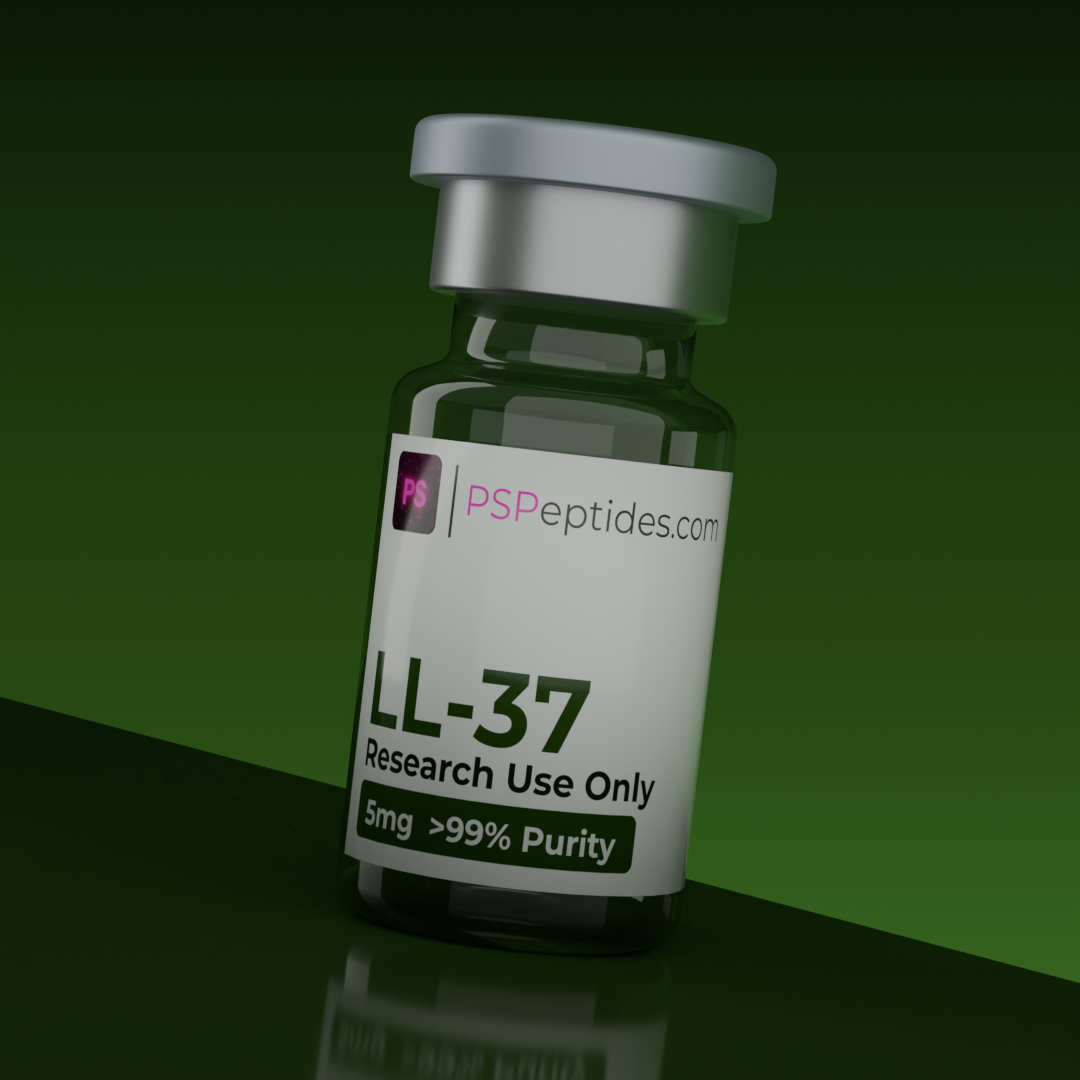
LL-37 is a 37-amino-acid peptide that begins with two leucine residues, which is where its name comes from. It is cleaved from the precursor protein hCAP18 and is the only member of the cathelicidin family expressed in humans. Researchers who buy LL-37 typically study its dual role as a direct antimicrobial agent and as a signaling molecule that shapes the innate immune response. For background on how research peptides like this one are classified, see our complete guide to peptides.
Detailed Mechanism of Action: Why Researchers Buy LL-37
LL-37 is stored in neutrophil granules and epithelial cells as the inactive precursor hCAP18. When proteinase 3 cleaves the precursor, the mature 37-residue peptide is released. In aqueous solution it is largely unstructured, but on contact with a membrane or in physiological salt it folds into an amphipathic alpha-helix. That helix places cationic residues on one face and hydrophobic residues on the other, which is the structural basis for everything the peptide does.
The first mechanism is direct membrane disruption. LL-37 carries a net charge of roughly +6, so it is electrostatically drawn to the negatively charged lipids that dominate bacterial membranes. Once bound, the peptide accumulates on the surface in a carpet-like layer and inserts to form toroidal pores. The result is loss of membrane potential, leakage of cytoplasmic contents, and rapid cell death. Because the target is the membrane itself rather than a single enzyme, resistance develops far more slowly than it does against conventional antibiotics.
The second mechanism is endotoxin neutralization. LL-37 binds lipopolysaccharide and lipoteichoic acid with high affinity, preventing those molecules from engaging Toll-like receptor 4 and triggering the cytokine storm that drives sepsis models. Researchers who buy LL-37 for inflammation work often focus on this LPS-binding property because it separates the antimicrobial activity from the anti-inflammatory activity in a measurable way.
The third mechanism is receptor-mediated signaling. LL-37 activates formyl peptide receptor-like 1 (FPRL1, also called FPR2) on neutrophils, monocytes, and T cells, producing chemotaxis toward sites of infection. It also transactivates the epidermal growth factor receptor in keratinocytes, driving migration and proliferation during wound closure. Additional signaling runs through the purinergic P2X7 receptor and through Mas-related G protein-coupled receptor X2 on mast cells. These pathways explain why LL-37 behaves as a true alarmin: it kills pathogens directly while simultaneously calling in the cellular immune response.

Published Research: What the Data Say Before You Buy LL-37
The foundational structural and functional review by Dürr, Sudheendra, and Ramamoorthy (2006) in Biochimica et Biophysica Acta established LL-37 as the only human cathelicidin and catalogued its helical structure, membrane selectivity, and broad-spectrum activity against bacteria, fungi, and enveloped viruses. The paper remains the standard citation for anyone who wants to buy LL-37 and understand its biophysics before designing experiments. Read it on PubMed (Dürr et al., 2006).
Overhage and colleagues (2008) in Infection and Immunity demonstrated that LL-37 inhibits Pseudomonas aeruginosa biofilm formation at concentrations as low as 0.5 µg/mL, far below the 64 µg/mL minimum inhibitory concentration for planktonic cells. The peptide reduced bacterial attachment, stimulated twitching motility, and down-regulated the quorum-sensing systems Las and Rhl. Those data are the reason so many biofilm laboratories buy LL-37 as a positive control. The study is available on PubMed (Overhage et al., 2008).
Vandamme and colleagues (2012) published a comprehensive summary in Cellular Immunology covering LL-37 expression, regulation by vitamin D, chemotactic activity, angiogenic effects, and its role in autoimmune conditions such as psoriasis. The review compiles data showing that LL-37 recruits immune cells at nanomolar concentrations while direct microbicidal activity occurs in the low micromolar range, an important distinction for dose-response design. See PubMed (Vandamme et al., 2012). Additional immune-focused context is available in our peptides for immune support guide.
LL-37 vs Alternatives
| Feature | LL-37 | KPV | Thymosin Alpha-1 |
|---|
| Length | 37 amino acids | 3 amino acids | 28 amino acids |
| Origin | Human cathelicidin | Alpha-MSH fragment | Thymus-derived |
| Direct antimicrobial | Yes, broad spectrum | Limited | No |
| Biofilm inhibition | Yes | No | No |
| Anti-inflammatory | Yes, via LPS binding | Yes, via NF-κB | Modulatory |
| Immune-cell recruitment | Yes, via FPR2 | No | Yes, via TLR9 |
| Wound-healing models | Strong evidence | Moderate | Limited |
| Typical research focus | Infection, biofilm, repair | Gut and skin inflammation | Immune enhancement |
Each of these peptides has its own place in an immune-research program, and they are often studied together. KPV is covered in detail in our KPV anti-inflammatory guide, and Thymosin Alpha-1 in our Thymosin Alpha-1 immune research guide. Laboratories that buy LL-37 alongside those compounds usually do so to compare a direct microbicidal peptide against purely immunomodulatory ones. For a broader look at combining compounds, see the peptide stacking guide.
Reconstitution & Handling
Each 5mg vial (the size you get when you buy LL-37 from us) should be reconstituted with bacteriostatic water. Adding 2 mL yields a 2.5 mg/mL stock; adding 5 mL yields 1 mg/mL. Inject the diluent slowly down the inside wall of the vial and allow the powder to dissolve on its own. Do not shake. Gentle swirling is sufficient, and the solution should be clear and colorless once fully dissolved.
LL-37 is cationic and highly amphipathic, so it can adsorb to plastic surfaces and precipitate in high-salt buffers. Researchers who buy LL-37 for cell-culture or microbiology assays typically prepare working dilutions fresh in low-salt buffer immediately before use and use low-binding tubes and tips. Serum proteins and physiological salt reduce measured antimicrobial activity, which should be accounted for when comparing results across assay conditions.
Step-by-step technique is covered in our how to reconstitute peptides guide, and the peptide dosage calculator guide walks through converting concentration to volume. If you are unsure which diluent to use, read what is bacteriostatic water before you buy LL-37 and set up your first run.
Storage & Stability
Lyophilized LL-37 (the form you receive when you buy LL-37 from PSPeptides) is stable for 24 months or longer at -20°C and for several weeks at room temperature during transit. Keep the vial sealed and away from light and moisture until you are ready to reconstitute. Once in solution, store aliquots at 2–8°C for up to 30 days or at -20°C for longer-term use. Avoid repeated freeze-thaw cycles, which fragment the helix and reduce activity.
Because LL-37 is susceptible to proteolytic degradation, particularly by bacterial proteases and elastase, any experiment that exposes it to biological fluids should measure activity promptly. Our peptide storage guide and peptide degradation guide explain how to recognize compromised material. Half-life data for this and other compounds is compiled in the peptide half-life chart.
Certificate of Analysis
Every batch of LL-37 sold by PSPeptides is tested by an independent laboratory using reverse-phase HPLC for purity and mass spectrometry for identity. The certificate of analysis reports the observed molecular weight against the theoretical 4493 Da for the full sequence, the purity percentage, and the lot number. When you buy LL-37 from us, the COA is linked directly on the product page so you can verify the exact lot before it ships.
If you have never interpreted one of these documents, our guide on how to read a peptide COA explains what the chromatogram peaks, retention times, and mass spectra actually mean. Reading it takes five minutes and makes it much easier to compare suppliers before you buy LL-37 anywhere.
Why Researchers Choose PSPeptides
- US Manufactured: Synthesized and packaged domestically under controlled conditions.
- Third-Party Tested: Independent HPLC and mass spectrometry on every batch.
- Fast Shipping: Free UPS 2nd Day Air over $150, same-day dispatch before 2 PM EST.
- Flexible Payments: Credit cards, Afterpay, Klarna, Apple Pay, Google Pay.
- 7-Day Support: Email, phone, or text, staffed by people who know the products.
Choosing where to buy LL-37 matters more than it does for many other peptides because the compound is long, cationic, and difficult to synthesize at high purity. Truncated or oxidized species can look like full-length peptide on a low-resolution assay. Our guide to choosing a research peptide supplier lays out the questions to ask any vendor, and our best peptide companies 2026 roundup shows how PSPeptides compares.
LL-37 in Specific Research Models
Antibiotic-resistance studies. LL-37 is routinely tested against methicillin-resistant Staphylococcus aureus, vancomycin-resistant enterococci, and multidrug-resistant Acinetobacter and Klebsiella strains. Its membrane-targeting mode of action means it retains activity against isolates that have lost susceptibility to beta-lactams, glycopeptides, and fluoroquinolones. Many groups buy LL-37 specifically to study synergy with conventional antibiotics, where sub-inhibitory peptide concentrations lower the MIC of the partner drug.
Biofilm and chronic-infection models. Beyond P. aeruginosa, LL-37 has been shown to reduce biofilm biomass in S. aureus, S. epidermidis, E. coli, and Candida albicans models. Biofilm work usually runs at 0.5 to 10 µg/mL, well below bactericidal concentrations, which keeps the peptide affordable for high-throughput crystal-violet assays. Laboratories that buy LL-37 for biofilm screening typically pair it with a scrambled control peptide to confirm sequence specificity.
Wound-healing and tissue-repair models. In scratch assays, LL-37 accelerates keratinocyte migration through EGFR transactivation, and in ex vivo skin explants it promotes re-epithelialization. In angiogenesis models it stimulates endothelial proliferation and tube formation via FPR2. These properties overlap with the repair-focused compounds described in our peptides for joint and tendon repair article, and LL-37 is often run alongside them in comparative studies.
Gut and mucosal immunity. LL-37 is expressed by colonic epithelium and is up-regulated by butyrate and vitamin D. Research models use it to study mucosal barrier function, pathogen clearance in the intestinal lumen, and the interplay between the microbiome and host antimicrobial defense. Groups working in this area can find related compounds in our peptides for gut health guide.
Autoimmunity and inflammation. Because LL-37 complexes with self-DNA and self-RNA to activate plasmacytoid dendritic cells, it is a key reagent in psoriasis, lupus, and rosacea research. This is the flip side of its beneficial immune activity, and it is one of the reasons researchers buy LL-37 to study how a protective peptide can become a driver of chronic inflammation when regulation fails.
LL-37 Fragments and Analogs
Several shorter peptides derived from the LL-37 sequence appear in the literature. KR-12 is a 12-residue core fragment that retains antibacterial activity with reduced hemolysis. LL-31 lacks the six C-terminal residues, and FK-16 is a central fragment studied for anticancer activity. These analogs are useful tools, but they do not reproduce the full receptor-signaling profile of the parent peptide. Researchers who buy LL-37 in its complete form gain access to the FPR2, EGFR, and P2X7 pathways that the truncated versions largely lose.
D-enantiomer and retro-inverso versions of LL-37 have also been synthesized to resist proteolysis. They preserve membrane-disrupting activity but generally lose receptor-mediated effects because those interactions are stereospecific. For most laboratory work, the native L-form remains the standard, which is why it is the version PSPeptides stocks.
Experimental Design Tips
A few practical points help laboratories get reproducible data after they buy LL-37. First, run a scrambled-sequence control at the same concentration to separate sequence-specific effects from nonspecific cationic charge. Second, include a hemolysis or mammalian cytotoxicity assay in parallel, because the same amphipathic helix that kills bacteria can affect host cells at higher concentrations. Third, pre-coat plasticware or use low-binding tubes, since adsorptive loss can reduce effective concentration by half or more.
For antimicrobial MIC work, the CLSI broth microdilution method with polypropylene plates is the accepted standard. For biofilm assays, seed cultures in the presence of peptide and quantify biomass after 24 hours with crystal violet. For chemotaxis, a transwell format with 10 to 100 nM peptide in the lower chamber gives clear migration of neutrophils or monocytes. Our injection route comparison and peptide cycling article are useful for in-vivo model planning.
Quality Considerations Before You Buy LL-37
LL-37 is one of the more demanding peptides to synthesize because of its length and its cluster of basic residues, which promote deletion sequences during solid-phase synthesis. A supplier that reports purity by a single UV wavelength without mass confirmation may be overstating full-length content. When you buy LL-37 from PSPeptides, the COA includes both HPLC purity and a mass spectrometry match to the theoretical molecular weight, so you can confirm the material is the intact 37-residue peptide.
Peptide content, distinct from purity, also matters. Lyophilized material contains counter-ions and residual water, so 5mg of net peptide may weigh slightly more as a powder. PSPeptides labels the net peptide amount, which keeps concentration calculations accurate. Comparisons between vendors are discussed in our Peptide Sciences alternative article for researchers deciding where to buy LL-37 and other immune peptides.
Frequently Asked Questions
What does LL-37 do in research models?
LL-37 kills bacteria, fungi, and enveloped viruses by disrupting their membranes, while also neutralizing endotoxin and recruiting immune cells to sites of infection. It additionally promotes wound closure and angiogenesis. Researchers buy LL-37 to study any of these functions individually or to explore how they interact in a single model system.
Is the LL-37 sold here the full-length human sequence?
Yes. Each vial contains the complete 37-residue human cathelicidin sequence, LLGDFFRKSKEKIGKEFKRIVQRIKDFLRNLVPRTES, confirmed by mass spectrometry against a theoretical mass of 4493 Da. Truncated fragments such as KR-12 or LL-31 are distinct molecules and are not substituted.
How should I dilute LL-37 for antimicrobial assays?
Prepare a concentrated stock in bacteriostatic water, then dilute into low-salt buffer or the assay medium immediately before use. Because physiological salt and serum reduce activity, note the exact medium composition when reporting results. Low-binding plasticware minimizes loss of the cationic peptide to tube walls.
Where can I buy LL-37 at 99%+ purity in the USA?
PSPeptides manufactures LL-37 in the United States and supplies a batch-specific COA with every vial. Orders placed before 2 PM EST ship the same day, and orders over $150 qualify for free UPS 2nd Day Air. All products are sold strictly for laboratory and research use.
Are research peptides like LL-37 legal to purchase?
Research-grade peptides may be purchased for in-vitro and laboratory use in the United States, subject to the regulatory framework covered in our are research peptides legal in 2026 article. Understanding the difference between research compounds and prescription products is explained in our research vs prescription peptides guide.
Related Resources
All PSPeptides products are sold exclusively for laboratory and research use. Not intended for human consumption. Buy LL-37 only if you are a qualified researcher or institution.





 Made & Shipped