Adipotide is a synthetic chimeric peptide built from two parts: a targeting sequence (CKGGRAKDC) that binds prohibitin and annexin A2 on the surface of blood vessels feeding white fat, and a proapoptotic domain (KLAKLAK)2 that disrupts mitochondrial membranes once internalized. Researchers who buy Adipotide are typically studying vascular-targeted fat reduction, a mechanism unlike the appetite-driven pathways of GLP-1 agonists. For broader context, see our guide to the best peptides for weight loss research.
Why Researchers Buy Adipotide: Detailed Mechanism of Action
Adipotide belongs to a class of molecules called “hunter-killer” peptides. The design pairs a homing motif with a cytotoxic payload so that the toxic portion is delivered only where the homing motif binds. In this case the homing sequence CKGGRAKDC was discovered by in vivo phage display screening in obese mice, where it localized selectively to blood vessels within white adipose tissue rather than to the fat cells themselves.
The molecular target of the homing sequence is a complex of prohibitin and annexin A2 expressed on the luminal surface of endothelial cells that line adipose vasculature. Prohibitin is normally an intracellular mitochondrial protein, but in white fat vasculature it appears on the cell surface, creating a tissue-specific address. Labs that buy Adipotide are exploiting this address to study how fat depots depend on their blood supply.
The second half of the molecule, D(KLAKLAK)2, is an amphipathic peptide made from D-amino acids for protease resistance. On its own it is harmless to intact cells because it cannot cross the plasma membrane. Once the targeting domain triggers receptor-mediated internalization, however, the KLAKLAK motif inserts into mitochondrial membranes, collapses the membrane potential, and initiates caspase-dependent apoptosis in the endothelial cell.
The downstream consequence is a loss of capillary density within white adipose tissue. Adipocytes deprived of blood flow undergo ischemia, shrink, and are resorbed. Because brown fat and other organs express little surface prohibitin, the effect in published models has been largely restricted to white fat. Researchers who buy Adipotide research peptide for metabolic work often pair it with GLP-1 or triple-agonist compounds such as those covered in our Retatrutide complete guide to compare vascular versus appetite-driven fat loss.

Published Research
The foundational paper is Kolonin et al., Nature Medicine, 2004. Using diet-induced obese mice, the authors reported that daily administration of the prohibitin-targeted proapoptotic peptide produced rapid reversal of obesity, with treated mice losing roughly 30 percent of body weight over four weeks while food intake normalized. Histology showed selective apoptosis of adipose endothelium and no detectable damage to other vascular beds.
The most cited primate study is Barnhart et al., Science Translational Medicine, 2011. Spontaneously obese rhesus monkeys received the peptide for four weeks and lost an average of 11 percent of body weight and 27 percent of abdominal fat measured by MRI. Insulin resistance improved in parallel. The authors also documented reversible, dose-related changes in renal function, which is why kidney monitoring is a standard endpoint whenever labs buy Adipotide for in vivo work.
A third key paper, Kim et al., Diabetes, 2012, demonstrated that improvements in glucose tolerance occurred within days and before meaningful weight loss, suggesting that adipose vascular targeting influences insulin signaling through a mechanism that is at least partly independent of fat mass. Together these studies define the current research rationale for labs that buy Adipotide today.
Adipotide vs Alternatives
| Feature | Adipotide | Retatrutide | AOD-9604 |
|---|
| Primary mechanism | Apoptosis of white-fat blood vessels | GLP-1/GIP/glucagon receptor agonism | Lipolysis via HGH fragment 176-191 |
| Molecular target | Prohibitin / annexin A2 | Incretin receptors | Beta-3 adrenergic pathways |
| Effect on appetite | Indirect (intake normalizes) | Strong suppression | None |
| Weight loss in primates | ~11% in 4 weeks | Human trials up to 24% | Modest |
| Glucose effects | Rapid, weight-independent | Strong, insulin-mediated | Minimal |
| Notable monitoring endpoint | Renal function | GI tolerability | None specific |
| Amino acid composition | L and D residues, 23 total | 39 residues, lipidated | 16 residues |
| Vial sizes at PSPeptides | 2mg, 5mg | Multiple | Multiple |
For a side-by-side look at the incretin class, read our Retatrutide vs Tirzepatide comparison, and for the lipolytic fragment approach see the AOD-9604 research guide. Many labs buy Adipotide specifically because it is the only compound in this table that acts on the vasculature rather than on hormone receptors.
Reconstitution & Handling
Each vial contains lyophilized powder that should be reconstituted with bacteriostatic water. For the 2mg vial, adding 1 mL yields a 2 mg/mL solution; for the 5mg vial, adding 2.5 mL yields the same 2 mg/mL concentration, or add 1 mL for 5 mg/mL. Direct the water slowly down the inside wall of the vial and swirl gently. Never shake, since mechanical stress can fragment the peptide chain. Researchers who buy Adipotide in the 5mg size often prefer the 5 mg/mL concentration to reduce injection volume.
Allow the vial to reach room temperature before opening to prevent condensation on the powder. Use sterile technique and a fresh needle for each draw. Step-by-step instructions with photos are in our reconstitution guide, and you can check volumes with the peptide dosage calculator walkthrough. If you are new to diluents, our bacteriostatic water explainer covers why benzyl alcohol matters for multi-draw vials.
Because the D-amino-acid KLAKLAK domain resists proteolysis, reconstituted solutions are somewhat more forgiving than all-L peptides. Even so, researchers who buy Adipotide online should draw only what the protocol requires and return the vial to refrigeration immediately.
Storage & Stability
Lyophilized Adipotide is stable for 24 months or longer at -20°C and for several weeks at room temperature during transit. Keep the sealed vial away from direct light and humidity. If you buy Adipotide in bulk for a long protocol, keep unopened vials frozen and thaw one at a time. After reconstitution, store at 2-8°C and use within 30 days; for longer holds, aliquot into single-use volumes and freeze at -20°C to avoid repeated freeze-thaw cycles.
The cysteine residues in the targeting sequence form a disulfide bridge that is sensitive to oxidation, so avoid leaving reconstituted solution exposed to air. Cloudiness, color change, or particulate formation are signs of degradation. Our peptide storage guide and degradation checklist walk through what to watch for.
Certificate of Analysis
Every batch sold under the buy Adipotide listing ships with a batch-specific certificate of analysis. The COA reports HPLC purity (target 99%+), mass spectrometry confirmation of molecular weight, peptide content by amino acid analysis, and water content. Independent third-party testing means the numbers are not generated by the manufacturer alone, which is a key reason institutions buy Adipotide here.
Reading a COA correctly matters: a high HPLC purity figure does not by itself confirm identity, which is why mass spectrometry is included. Learn how to interpret each line item in our guide to peptide purity and reading a COA.
Why Researchers Choose PSPeptides
- US Manufactured
- Third-Party Tested: Independent HPLC and mass spectrometry
- Fast Shipping: Free UPS 2nd Day Air over $150, same-day before 2 PM EST
- Flexible Payments: Credit cards, Afterpay, Klarna, Apple Pay, Google Pay
- 7-Day Support: Email, phone, or text
Choosing where to buy Adipotide is mostly a question of verification. Our supplier selection guide lays out the questions worth asking any vendor, and our 2026 peptide company roundup explains how PSPeptides compares on testing, transparency, and turnaround.
Experimental Design Considerations
Published protocols have used daily subcutaneous administration for 28 days in rodents and primates, with body weight, food intake, MRI fat mass, and fasting glucose as primary endpoints. Before you buy Adipotide for an in vivo study, plan the endpoints. Renal biomarkers including serum creatinine and blood urea nitrogen are typically tracked at baseline, mid-study, and washout because the primate work identified reversible changes in the proximal tubule.
Dose-ranging matters. The 2004 mouse study and the 2011 monkey study used different mg/kg levels, and the glucose effects reported in 2012 appeared at doses below those needed for maximal fat loss. Labs that buy Adipotide for a first pilot generally start with the lowest published dose and escalate only after renal markers are confirmed stable. Route comparisons are discussed in our subcutaneous vs intramuscular injection guide.
Washout design is another consideration. Because the mechanism removes vasculature rather than transiently blocking a receptor, fat-mass changes persist after dosing stops, while renal changes reverse. Building a 2-4 week post-treatment observation window into the protocol captures both effects. For peptide clearance timelines, see the peptide half-life chart.
Adipotide and the Broader Metabolic Peptide Landscape
Interest in vascular-targeted approaches has grown as the incretin class has matured. Semaglutide, tirzepatide, and retatrutide all reduce weight primarily through central appetite pathways and gastric emptying, which produces excellent efficacy but also weight regain when dosing stops. Adipotide offers an orthogonal mechanism that researchers can study alone or in combination, which is one reason searches to buy Adipotide have climbed alongside the broader interest in obesity science.
The compound also has relevance outside obesity. The same phage-display strategy that produced the adipose homing motif has been used to find vascular addresses in tumors and other organs, and prohibitin biology is an active area in cancer and aging research. Investigators working on longevity and anti-aging peptides sometimes include Adipotide in comparative panels for that reason.
Practical stacking is not well studied for this compound, and most labs run it as a monotherapy arm first. Our peptide stacking guide covers general principles for designing combination arms, and the peptide side effects overview summarizes tolerability endpoints commonly tracked across the category.
Selectivity, Off-Target Signals, and Safety Endpoints
Selectivity is the central question in any hunter-killer peptide study. In the mouse work, biodistribution imaging showed the targeting sequence accumulating in white fat pads within hours while sparing brown fat, liver, lung, and skeletal muscle. That pattern is what allowed a systemic dose to produce a local effect, and it is the reason investigators buy Adipotide rather than a generic proapoptotic peptide when the goal is depot-specific ablation.
The one consistent off-target signal is renal. The proximal tubule of the kidney expresses low levels of surface prohibitin, and at higher doses the peptide produced mild tubular changes in primates that reversed within weeks of stopping. No hepatic, cardiac, or hematologic toxicity was reported at the effective doses. Investigators should still include a full clinical chemistry panel, since long-term repeat-cycle data remain limited.
Immunogenicity has not been a reported problem, likely because the D-amino-acid payload is poorly presented by the immune system and the targeting sequence is short. Nonetheless, labs running repeated cycles sometimes screen for anti-peptide antibodies. If your protocol involves cycling, the article on whether peptides need cycling summarizes general considerations that apply here.
How to Buy Adipotide From PSPeptides
Ordering is simple. Select the 2mg or 5mg option above, add the vial to your cart, and check out with a credit card, Afterpay, Klarna, Apple Pay, or Google Pay. Orders placed before 2 PM EST ship the same business day, and orders over $150 qualify for free UPS 2nd Day Air. Vials are packed with cold-chain-aware materials appropriate for lyophilized peptides.
When you buy Adipotide online from us, the batch-specific COA is available on the product page and inside the shipment. If your institution requires documentation for purchasing or safety review, our support team can provide the COA in advance by email, phone, or text seven days a week. Bulk and repeat-order pricing for multi-vial protocols is available on request.
Researchers comparing vendors often ask what separates one source from another when the sequence is identical. The answer is verification. Read our analysis of alternatives to Peptide Sciences and the report on what happened to Amino Asylum and Paradigm Peptides to understand why third-party testing and transparent sourcing matter before you buy Adipotide anywhere.
Quality Control Behind Every Adipotide Vial
Synthesis of a chimeric peptide with both L- and D-residues and a disulfide-bridged targeting loop is more demanding than a simple linear sequence. Each batch is produced by solid-phase synthesis, cyclized under controlled oxidation, purified by preparative HPLC, and then lyophilized under vacuum to a stable powder. Only after independent HPLC and mass spectrometry confirm 99%+ purity and correct mass is the batch released for sale under the buy Adipotide listing.
Fill accuracy is verified gravimetrically so that a 2mg vial contains 2mg of net peptide, not 2mg of peptide plus counter-ion and water. Vials are sealed under nitrogen to limit oxidation of the cysteine bridge. These steps are why researchers who buy Adipotide from PSPeptides can rely on consistent potency from one batch to the next, which is critical for multi-cohort studies that span several months.
Purity, identity, and net content are the three numbers that determine whether a study is reproducible. Our explainer on research versus prescription peptides discusses why laboratory-grade material is held to these analytical standards even though it is never intended for clinical use.
Frequently Asked Questions
What does Adipotide actually target?
It binds a prohibitin and annexin A2 complex found on the surface of endothelial cells in white adipose tissue blood vessels. After binding and internalization, the proapoptotic KLAKLAK domain triggers apoptosis in those cells, reducing blood supply to the fat depot. Other tissues express little surface prohibitin, which is the basis for its selectivity in published models.
Is Adipotide the same as FTPP or Prohibitin-TP01?
Yes. FTPP stands for fat-targeted proapoptotic peptide, and Prohibitin-TP01 was the development designation used in the primate study. All three names refer to the same 23-residue chimeric sequence CKGGRAKDC-GG-D(KLAKLAK)2. When you buy Adipotide from PSPeptides you receive this exact sequence, verified by mass spectrometry.
Which vial size should a lab choose when they buy Adipotide?
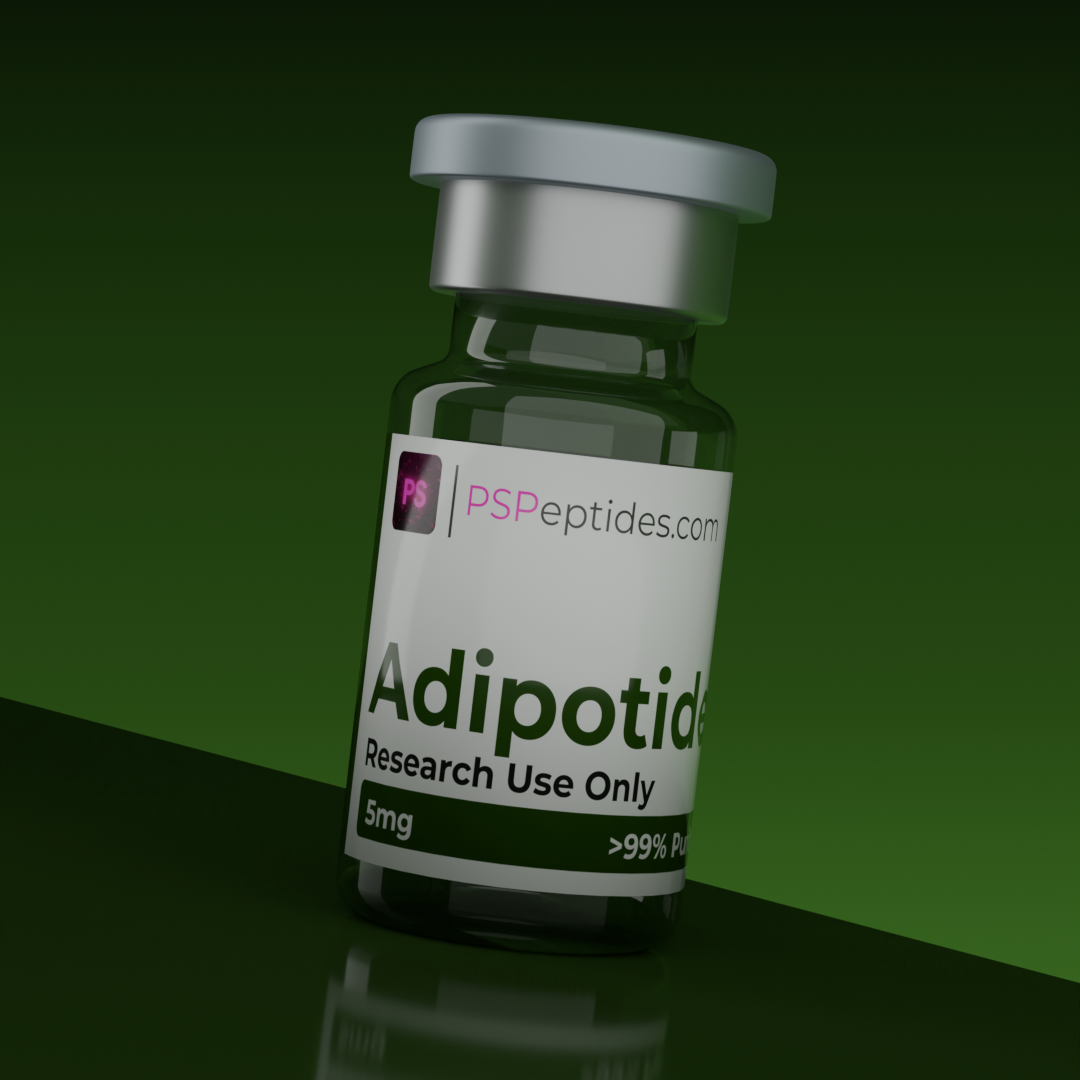
The 2mg vial suits pilot experiments and dose-finding in small rodent cohorts. The 5mg vial is more economical for multi-week protocols or larger animals. Both are lyophilized, ship with a COA, and reconstitute the same way, so the decision comes down to total protocol demand and how long the reconstituted solution will be in use.
Why is kidney monitoring emphasized in Adipotide research?
The 2011 rhesus study observed dose-dependent, reversible changes in renal proximal tubule function during treatment that resolved after washout. Because of that finding, most protocols include serum creatinine and BUN measurements at baseline and throughout dosing. It is a research endpoint, not a product defect, and it is the main reason careful dose selection matters when labs buy Adipotide for in vivo use.
Is Adipotide legal to purchase for research?
Research peptides may be sold for laboratory use in the United States, and PSPeptides sells Adipotide strictly for that purpose. It is not approved for human use by any regulatory agency. Our article on whether research peptides are legal in 2026 covers the current landscape in more detail.
Related Resources
All PSPeptides products are sold exclusively for laboratory and research use. Not intended for human consumption.





 Made & Shipped