
The Best GHK-Cu Topical Serum for Proven Skin Results

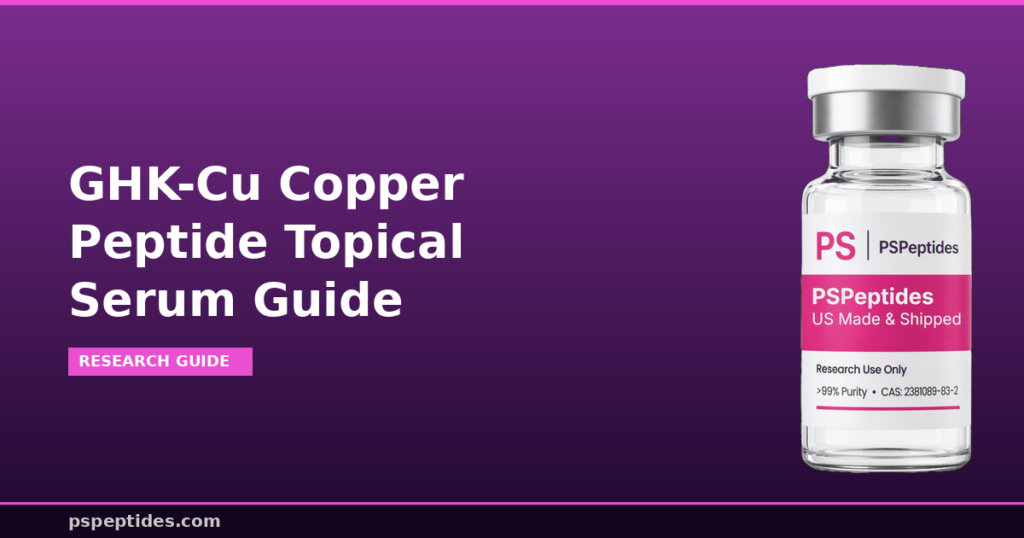
GHK-Cu topical serum is the ready-to-apply format of glycyl-L-histidyl-L-lysine copper — the same tripeptide-copper complex used in decades of published skin research, pre-formulated for direct dermal application rather than reconstitution and injection. The topical route is the format with the strongest human clinical trial evidence for skin outcomes, from the landmark 1998 Abdulghani study that outperformed both vitamin C and tretinoin to the Finkley skin-thickness data. This article covers what makes the topical delivery format distinct, why the stratum corneum penetration profile works in GHK-Cu’s favor, and how the serum compares to other cosmetic peptides.
For the underlying mechanism and full gene-expression research, see the complete GHK-Cu research guide. For the broader copper peptide research literature, see the GHK-Cu copper peptide research overview. This article focuses specifically on the topical serum format.

The Topical Delivery Format: Why It Matters for Skin Research
Most GHK-Cu research has used either subcutaneous injection or topical application. For skin-specific research, topical delivery has four practical advantages that shape research protocol design.
Direct dermal targeting. A topical copper peptide serum concentrates the active complex at the tissue where its collagen-stimulating and anti-inflammatory effects are most relevant. Injectable administration distributes systemically; topical concentrates locally.
No reconstitution required. Lyophilized peptide powders require bacteriostatic water reconstitution and sterile technique. A serum eliminates the preparation step entirely — open, apply, done. The peptide reconstitution guide covers the lyophilized workflow for researchers who also work with the injectable format.
Non-invasive protocol design. For controlled skin studies, topical application removes the confounders introduced by injection — no injection site reactions, no systemic distribution diluting local concentration, no injection technique variability across research subjects.
Direct human clinical trial evidence. Unlike many peptides that have only injectable research data, GHK-Cu has been tested in published human clinical trials specifically as a topical application — with outcomes that compared favorably against gold-standard actives.
How GHK-Cu Works in Skin at the Molecular Level
The glycyl-L-histidyl-L-lysine tripeptide forms a high-affinity complex with copper(II) ions, creating the active GHK-Cu complex that functions as a biological signal molecule rather than a structural component. The primary molecular actions relevant to skin are: modulation of TGF-β signaling (upregulating TGF-β1 for collagen I/III synthesis while suppressing TGF-β2 to prevent scarring), decorin upregulation for orderly collagen fibril assembly, MMP suppression paired with TIMP upregulation to preserve ECM integrity, and copper-dependent lysyl oxidase activation for collagen crosslinking.
The copper component also serves as a cofactor for superoxide dismutase (SOD-1 and SOD-3), providing direct antioxidant protection at the tissue level. The copper peptide research overview covers the full mechanism and the ~4,000 human genes documented as GHK-Cu-responsive in Broad Institute Connectivity Map analysis.
Skin Penetration and the Stratum Corneum Question
The practical question in topical peptide research is whether the compound can cross the stratum corneum in sufficient quantities to reach the dermal layer. GHK-Cu is unusually well-positioned here. At a molecular weight of approximately 340 Da as the free tripeptide (see the GHK-Cu compound overview), it sits below the 500 Da threshold commonly associated with good dermal penetration — a key reason GHK-Cu topical serum formulations achieve dermal absorption where many larger cosmetic peptides do not.
Published penetration studies using radiolabeled tracers have confirmed dermal absorption after topical application. The copper chelation appears to facilitate cellular uptake through copper transport proteins expressed in keratinocytes and fibroblasts. Once inside the cell, the complex interacts with intracellular copper-responsive pathways — which is what enables the downstream gene-modulation effects to translate from topical application into measurable dermal changes.
Formulation vehicle influences absorption substantially. Aqueous, low-viscosity serum formats generally deliver better penetration than cream or lotion formats — water-based vehicles allow closer contact with the stratum corneum surface. The 1% concentration range used in most published clinical trials sits at the level demonstrated to produce dermal effects while maintaining a formulation viscosity optimized for absorption.
GHK-Cu Topical Serum: Clinical Trial Evidence for Skin Outcomes
The published evidence for GHK-Cu topical serum formats is stronger than for most cosmetic peptides. Three studies define the research profile:
Abdulghani et al. (1998) — the gold-standard comparison
A 12-week randomized trial enrolled 67 women with moderate-to-severe facial aging and compared four topical formulations: a copper peptide cream, a vitamin C cream, a melatonin cream, and tretinoin. Skin biopsies and clinical photography were evaluated at weeks 4, 8, and 12. The copper peptide group showed statistically significant improvements in skin density (ultrasound), collagen content (histology), and visual wrinkle depth — outcomes that exceeded both the vitamin C and tretinoin groups by week 12. This remains the most-cited clinical comparison for topical copper peptide efficacy. PubMed indexes the broader GHK-Cu topical serum research across subsequent replication studies.
Arul et al. (2007) — wound healing acceleration
Researchers applied topical GHK-Cu formulations to full-thickness dermal wounds in an animal model over 21 days. The GHK-Cu group demonstrated 73% wound closure by day 14 versus 58% in saline controls — statistically significant (p<0.05). Histology confirmed increased angiogenesis, greater fibroblast density, and improved collagen organization. Published in Life Sciences (2007;80:1351–1355).
Finkley et al. (2007) — dermal thickness and photoaging
A double-blind, placebo-controlled study assessed topical GHK-Cu on photoaged forearm skin over 12 weeks. Ultrasound measurements showed statistically significant increases in dermal thickness in the treatment group versus placebo. Clinical photography and participant self-assessment confirmed improvements in skin roughness, laxity, and clarity — reinforcing the dermal-thickening findings from earlier studies.
Copper Peptide Serum vs Other Cosmetic Peptides
| Peptide | Primary Mechanism | Genes Influenced | Human Clinical Data? | MW (Da) |
|---|---|---|---|---|
| GHK-Cu | Collagen synthesis, ECM remodeling, antioxidant, gene modulation | ~4,000 | Yes — outperformed vitamin C and tretinoin | 340 |
| Matrixyl (Palmitoyl pentapeptide-4) | Collagen stimulation via TGF-β | Limited data | Yes — wrinkle reduction studies | 802 |
| Argireline (Acetyl hexapeptide-3) | SNARE complex inhibition (muscle relaxation) | Minimal | Limited | 889 |
| EGF (Epidermal Growth Factor) | Cell proliferation via EGFR | Moderate | Yes — wound healing | 6,045 |
| Retinol (Vitamin A) | RAR/RXR receptor activation | Broad but lower specificity | Yes — extensive, but irritation common | 286 |
The differentiator is breadth. Most cosmetic peptides operate through a single mechanism; the GHK-Cu complex operates through dozens of mechanisms simultaneously — collagen synthesis, ECM organization, MMP suppression, antioxidant defense, and gene expression modulation across ~4,000 targets. For the head-to-head against the closest comparator, see the Matrixyl vs GHK-Cu skin peptide comparison.

Storage, Formulation Vehicle, and the Blue Tint
Copper peptides are more stable than many biological peptides, but proper storage of a GHK-Cu topical serum still matters for maintaining potency. The serum should be stored at room temperature (15–25°C / 59–77°F) away from direct sunlight — light degrades the copper-peptide complex over time, which is why quality formulations use opaque or amber packaging. Refrigeration extends shelf life for long-term storage but is not required for normal use periods. Avoid freeze-thaw cycling; repeated temperature fluctuations destabilize the copper chelate.
The characteristic light blue tint of GHK-Cu formulations is not a formulation defect — it’s the visible signature of the copper-peptide complex itself. Loss of the blue color, cloudiness, or unusual viscosity changes are the primary visual indicators of degradation. Signs to watch for align with the general peptide storage guide across the peptide class.
On application, the blue tint absorbs into the skin within 2–3 minutes and does not stain. This is a quality indicator, not a formulation flaw — its presence at application confirms an intact copper-peptide complex is being delivered.
Application Protocol for Research Use
Standard application of a GHK-Cu topical serum in research settings follows a straightforward five-step protocol:
- Cleanse — wash the target area with a gentle cleanser and pat dry
- Apply — dispense a thin layer of serum onto the skin
- Absorb — allow 2–3 minutes for full absorption before applying moisturizer or sunscreen
- Frequency — apply once or twice daily for consistent research protocols
- Duration — the published clinical studies used 12-week protocols to demonstrate measurable outcomes
Researchers investigating combination approaches sometimes layer topical GHK-Cu with other cosmetic actives or research peptides. Strong acids (AHA/BHA at high concentrations) and high-concentration vitamin C can destabilize the copper chelate — separate application sessions or alternating days avoid the interaction. The peptide stacking guide covers combination protocol logic across the peptide class.
Related Research Applications
Beyond the direct skin research applications, GHK-Cu is studied in adjacent tissue-repair contexts. The GHK-Cu hair loss research guide covers the follicular application literature. The best peptides for skin research guide covers the broader dermatological peptide landscape. For researchers evaluating installment payment for larger orders including the serum plus injectable formats, the GHK-Cu Afterpay guide covers the payment options at checkout.
Sourcing GHK-Cu Cream and Serum Formats at PSPeptides
The PSPeptides GHK-Cu topical serum is a 1% concentration formula in a 3mL bottle — matching the concentration range used in published clinical research. US-manufactured with 99%+ purity verified via independent HPLC and mass spectrometry. Each GHK-Cu topical serum batch ships with a batch-specific Certificate of Analysis.
- Concentration: 1% GHK-Cu (clinically validated range)
- Volume: 3mL, approximately 60 applications
- Price: $29.99
- Format: Ready-to-use, no reconstitution
- Purity: 99%+ HPLC-verified with batch-specific COA
- Manufacturing: US-based, third-party tested
PSPeptides also carries lyophilized GHK-Cu vials for researchers requiring the injectable format, plus two multi-peptide blends that include GHK-Cu: the GLOW Blend (BPC-157 + GHK-Cu + TB-500) and the KLOW Blend (adds KPV). Both blends are covered in the GLOW vs KLOW comparison.
Frequently Asked Questions
What concentration of GHK-Cu is effective topically?
Published clinical studies have used topical GHK-Cu at concentrations of 1–4%. A 1% formulation sits within the clinically validated range. Higher concentrations are not necessarily more effective — GHK-Cu operates through receptor-mediated signaling rather than dose-dependent saturation. Concentrations above 4% have not demonstrated proportionally greater benefits in published literature.
Can I use GHK-Cu serum with other skincare products?
GHK-Cu is compatible with most skincare ingredients. Apply the serum first on clean skin, allow 2–3 minutes to absorb, then layer moisturizers or sunscreen over it. Avoid combining with strong acids (AHA/BHA at high concentrations) in the same application, as extreme pH destabilizes the copper-peptide complex. High-concentration vitamin C can compete with the copper chelate — separate application sessions are typical.
How quickly will results appear?
Published clinical data shows measurable changes in collagen density and skin firmness at 12 weeks of consistent GHK-Cu topical serum use. Some researchers report visible improvements in skin texture and hydration within 4–6 weeks. Short protocols of 4 weeks or fewer may not yield statistically meaningful results.
How does the topical copper peptide compare to retinol?
Both increase collagen production but through different mechanisms and with different tolerability profiles. Retinol activates nuclear retinoic acid receptors and drives collagen gene transcription, but frequently causes irritation, peeling, and photosensitivity at therapeutic concentrations. GHK-Cu operates through copper-mediated signaling without the retinoid irritation profile. The Abdulghani study directly compared a topical copper peptide to tretinoin and found superior tolerability with comparable or greater collagen improvements.
Is the blue tint permanent on skin?
No. The tint absorbs fully into the skin within 2–3 minutes of application. It does not stain or discolor. The characteristic blue color is a quality indicator — it confirms an intact copper-peptide complex in the formulation.
How does the serum format differ from injectable GHK-Cu?
The serum delivers the copper peptide directly to the skin surface and dermal layer — ideal for localized GHK-Cu skin research. Injectable subcutaneous administration distributes systemically through the bloodstream, reaching skin from the inside while also affecting other tissues. Both routes have published evidence. Topical concentrates effects at the skin level; injectable provides systemic effects beyond skin including potential joint, gut, and systemic anti-inflammatory research applications.
Can the serum be used on sensitive skin models?
GHK-Cu has demonstrated anti-inflammatory properties in published research, and tolerability is generally favorable compared to retinoids or high-concentration alpha hydroxy acids. Research subjects with rosacea-prone and sensitive skin have used copper peptide formulations without significant adverse events in published trials. Researchers working with sensitive skin models should begin with once-daily application and monitor for local reactions before increasing frequency.
All PSPeptides products are sold exclusively for research and laboratory use.