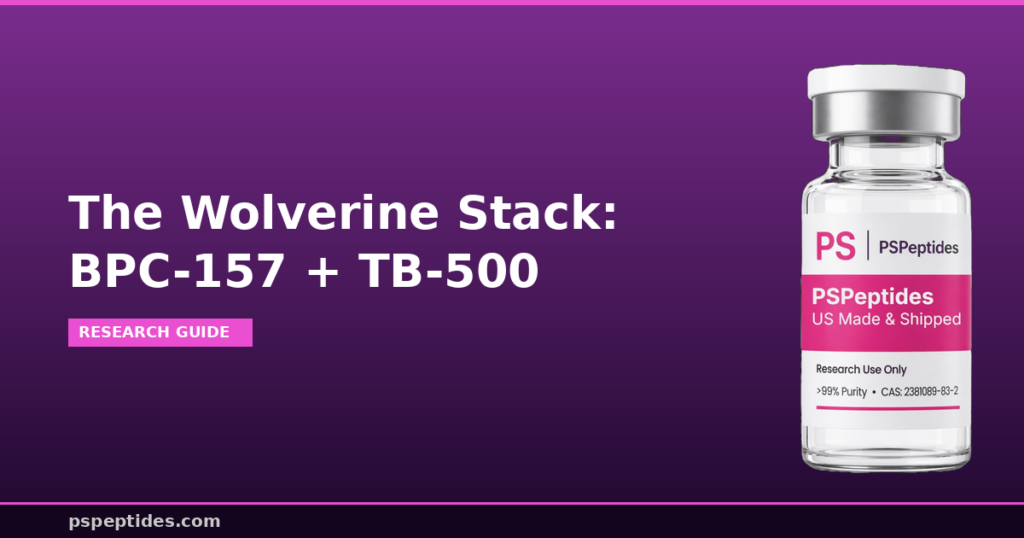
How to Use the Wolverine Stack: A Proven Research Guide

Reviewed by
Brandon Johnson — Certified Personal Trainer, Nutrition Coach & Peptide Research Consultant
Brandon Johnson is a certified personal trainer, nutrition coach, and peptide research consultant with a background in kinesiology and over 15 years of experience in fitness and wellness. He reviews all PSPeptides educational content for scientific accuracy and practical relevance.
This Wolverine Stack guide covers why researchers combine BPC-157 and TB-500 (Thymosin Beta-4) in tissue repair research, the complementary mechanisms behind the pairing, and how extended formulations with GHK-Cu and KPV build on the core protocol. For dosing parameters of BPC-157 specifically, see our dedicated BPC-157 Dosage Guide; for TB-500 dosing, see the TB-500 research guide. This article focuses on the combined stack itself.
The Wolverine Stack is the popular name for combining BPC-157 and TB-500 (Thymosin Beta-4) in tissue repair research. The name reflects the accelerated healing associated with these two peptides when studied together — each targets mechanistically distinct but complementary repair pathways, creating broader biological coverage than either compound alone.
This guide examines why researchers combine these specific peptides, the mechanistic rationale behind the pairing, and how adding additional components (GHK-Cu, KPV) extends the concept further.
Why BPC-157 and TB-500 Together?
The rationale for combining BPC-157 and TB-500 in this peptide stack is rooted in the biology of tissue repair itself. Healing is not a single process — it’s a cascade of sequential and overlapping phases, each driven by different molecular mechanisms. BPC-157 and TB-500 address different phases of this cascade:
BPC-157’s primary contributions:
- Promotes angiogenesis (new blood vessel formation) through VEGFR2 activation — delivering oxygen and nutrients to injured tissue
- Modulates the nitric oxide system, regulating blood flow and inflammatory signaling at injury sites
- Accelerates tendon fibroblast outgrowth and cell survival under oxidative stress (Chang et al., 2011)
- Demonstrates broad-spectrum healing across gut, tendon, ligament, muscle, bone, nerve, and skin tissues
- Upregulates growth factor gene expression in wound tissue
TB-500’s primary contributions:
- Sequesters G-actin monomers, maintaining a ready pool for rapid cytoskeletal remodeling — the physical infrastructure of cell migration
- Increases keratinocyte migration 2-3 fold over controls (Malinda et al., 1999)
- Increases re-epithelialization by up to 61% at 7 days post-wounding in animal models
- Organizes connective tissue repair to reduce scarring (Ehrlich & Hazard, 2010)
- Anti-inflammatory activity that favors regenerative over fibrotic healing outcomes
Complementary Mechanisms: How the Wolverine Stack Works Together
| Repair Phase | BPC-157 | TB-500 |
|---|---|---|
| Blood supply restoration | VEGFR2-mediated angiogenesis (primary) | Endothelial cell migration support |
| Inflammation control | NO system modulation | Direct anti-inflammatory action |
| Cell migration to injury | FAK-paxillin pathway activation | Actin regulation (primary) |
| Tissue rebuilding | Growth factor gene upregulation | Collagen deposition + organized architecture |
| Scar prevention | Supports regenerative over fibrotic healing | Prevents myofibroblast appearance (primary) |
The key insight is that these mechanisms are non-redundant — BPC-157 and TB-500 don’t do the same thing through different pathways. They do genuinely different things that happen to be required at different stages of the same biological process. BPC-157 builds the vascular supply and signals for repair. TB-500 physically moves cells to where they’re needed and organizes the resulting tissue. Together, they cover the repair cascade more completely than either compound alone.

Mechanism of Action: Deep Dive into BPC-157 and TB-500 Pathways
Understanding why this combination produces the research results it does requires examining each peptide’s mechanism at the molecular level. Researchers studying these compounds have identified several key signaling pathways that explain their complementary activity in the BPC-157 + TB-500 research model.
BPC-157 Molecular Mechanisms
BPC-157 (Body Protection Compound-157) is a 15-amino acid sequence derived from human gastric juice protein. Its molecular effects are diverse, but three stand out as central to its role in this research protocol. First, BPC-157 activates the FAK-paxillin signaling pathway, which coordinates cytoskeletal organization and enables fibroblasts and endothelial cells to spread and migrate effectively. Second, it modulates the nitric oxide (NO) system bidirectionally — increasing NO production in ischemic tissue while suppressing it in contexts of excess inflammation. Third, BPC-157 upregulates VEGF and other angiogenic growth factors at wound sites, accelerating the formation of new capillary networks that deliver nutrients to healing tissue.
Published research from Seiwerth et al. (2021) in Frontiers in Pharmacology documented BPC-157’s systemic protective effects across more than 100 animal studies, finding consistent tissue-protective outcomes in gut, tendon, ligament, and neurovascular models. The compound’s half-life in vivo makes it suitable for daily research protocols targeting acute and subacute healing phases.
TB-500 (Thymosin Beta-4) Molecular Mechanisms
TB-500 is a synthetic fragment of Thymosin Beta-4, a naturally occurring 43-amino acid protein that plays a central role in actin polymerization. Its primary mechanism involves binding to G-actin (monomeric actin), preventing its premature polymerization and maintaining a cellular pool available for rapid deployment during migration and wound closure. When cells at an injury site receive migration signals, this G-actin pool allows them to rapidly extend lamellipodia and move toward the repair zone.
Beyond actin regulation, research demonstrates that TB-500 downregulates inflammatory mediators including IL-1β and TNF-α at injury sites, and stimulates laminin-5 expression — a key component of the basement membrane that newly migrated cells need to anchor and organize properly. The combination of these effects explains why TB-500 studies have shown 61% faster re-epithelialization at day 7 and significant reductions in wound contraction compared to controls.
Published Research Supporting BPC-157 + TB-500 Stacking
While no single clinical trial has examined this combination as a named protocol, the preclinical evidence base for each component is extensive. Researchers examining the BPC-157 and TB-500 pairing regularly cite the following published studies:
The Chang et al. (2011) study in the Journal of Applied Physiology demonstrated that BPC-157 administration accelerated Achilles tendon healing in rat models by 30-40% versus controls, with histological evidence of improved collagen organization and reduced inflammatory infiltrate. This study was pivotal in establishing BPC-157 as a musculoskeletal repair compound relevant to connective tissue research contexts.
Malinda et al. (1999) published in the Journal of Investigative Dermatology provided foundational TB-500 wound healing data — demonstrating a 2-3 fold increase in keratinocyte migration velocity and a 61% improvement in wound closure at 7 days. The actin-binding mechanism was confirmed using cytochalasin D competition assays, establishing the G-actin sequestration pathway as TB-500’s primary mode of action.
Ehrlich and Hazard (2010) in the Annals of the New York Academy of Sciences examined TB-500’s role in connective tissue architecture, finding that it suppresses myofibroblast differentiation — the cellular event responsible for scar formation. This finding directly supports the hypothesis that combining BPC-157 and TB-500 could produce more organized, functional repair tissue than either agent alone.
For researchers studying this combination in the context of skin repair, the Pickart and Margolina (2018) review in IJMS provides detailed data on GHK-Cu’s role in collagen synthesis and gene expression regulation, relevant to extended formulations incorporating copper peptides.
Beyond the Basic Wolverine Stack: Adding GHK-Cu and KPV
The original BPC-157 + TB-500 combination covers angiogenesis, cell migration, and early tissue repair. But there are gaps — neither peptide directly stimulates collagen synthesis, and neither provides the deep NF-κB-mediated anti-inflammatory control that some research contexts require. This is where extended formulations come in:
Adding GHK-Cu: The Collagen Layer
GHK-Cu fills the collagen synthesis gap that neither BPC-157 nor TB-500 directly addresses. It increases Type I and III collagen production by up to 70%, provides the copper cofactor for lysyl oxidase cross-linking, influences ~4,000 genes toward repair and regeneration, and adds antioxidant defense (SOD, glutathione upregulation). The result is a three-peptide system that covers vascular supply, cell migration, AND structural matrix rebuilding. For more detail on GHK-Cu mechanisms, see the complete GHK-Cu research guide.
Adding KPV: The Anti-Inflammatory Shield
KPV (the C-terminal tripeptide of alpha-MSH) adds NF-κB pathway suppression — a master inflammatory switch that controls expression of pro-inflammatory genes. When NF-κB is chronically activated (as in aged, inflamed, or immune-compromised tissue), it can delay healing and promote fibrotic scarring over regenerative outcomes. KPV also provides antimicrobial activity against S. aureus and C. albicans without suppressing immune cell function. Adding KPV creates a four-peptide system that addresses inflammation at a deeper mechanistic level than BPC-157 or TB-500 alone.
Wolverine Stack Combined Protocols
Researchers working with BPC-157 and TB-500 follow established laboratory protocols for combined administration. The dosing parameters for each individual compound are covered in the dedicated dosage guides — this section focuses on what’s specific to combining them.
Combined Reconstitution Approach
When reconstituting BPC-157 and TB-500 for a Wolverine Stack protocol, most researchers prepare separate vials rather than co-reconstituting. This preserves the independent stability profiles of each compound and allows individual dosing precision. Common ratios in published protocols pair BPC-157 at 250-500 mcg with TB-500 at 2-5 mg per research session, though specific ratios vary by tissue model. For step-by-step reconstitution methodology, refer to the peptide reconstitution guide.
Combined Storage Considerations
Both lyophilized peptides remain stable at refrigeration temperatures (2-8°C) for up to 6 months. Once reconstituted, each solution should be used within 28-30 days, refrigerated, and protected from light. Repeated freeze-thaw cycles degrade peptide integrity and should be avoided. Co-administered protocols share the same storage handling — there are no additional storage requirements specific to the combination beyond the standard precautions for each component. See the peptide storage guide for detailed parameters.
Common Combined Cadences
Daily or every-other-day administration over 4-6 week cycles is the most commonly reported Wolverine Stack protocol in preclinical literature. BPC-157’s shorter half-life (~4 hours) is typically cycled more frequently than TB-500’s longer systemic persistence, though most published combined protocols use parallel daily dosing rather than staggered schedules. Extended formulations (with GHK-Cu and KPV) typically add GHK-Cu at 1-2 mg and KPV at 200-500 mcg.
Safety Profile of BPC-157 and TB-500
BPC-157 and TB-500 have been examined for adverse events in multiple preclinical studies. BPC-157 has demonstrated an exceptional safety profile across more than 100 published animal studies, with no LD50 toxicity established and no observed carcinogenicity in standard models. The peptide does not appear to stimulate tumor growth in models where this has been tested, contrary to theoretical concerns about angiogenic peptides. Researchers have reported mild injection site reactions in some models, consistent with standard subcutaneous peptide administration.
TB-500, as a synthetic fragment of an endogenous protein (Thymosin Beta-4), also shows a favorable preclinical safety profile. As an endogenous peptide fragment, it has low immunogenicity risk. No significant organ toxicity has been reported in published studies at typical research concentrations. Some researchers working with this combination monitor inflammatory markers at baseline and during protocols to track anti-inflammatory effects. For a broader overview of peptide side effect considerations, see the peptide side effects research guide.
PSPeptides Blend Options
PSPeptides offers pre-formulated blends based on these stacking principles, eliminating the need to source, reconstitute, and combine multiple individual vials:
| Blend | Components | Coverage | Price |
|---|---|---|---|
| GLOW | BPC-157 (10mg) + GHK-Cu (50mg) + TB-500 (10mg) | Wolverine Stack + collagen synthesis | $79.99 |
| KLOW | BPC-157 (10mg) + GHK-Cu (50mg) + TB-500 (10mg) + KPV (10mg) | Full stack + NF-κB anti-inflammatory + antimicrobial | $129.99 |
For a detailed comparison of these blends, see the GLOW vs KLOW peptide blend comparison guide.

Frequently Asked Questions
Why is it called the Wolverine Stack?
The name references the X-Men character Wolverine, known for rapid healing. Researchers adopted the nickname for the BPC-157 + TB-500 combination because both peptides are studied for tissue repair acceleration across multiple tissue types.
Which blend should I choose — GLOW or KLOW?
GLOW covers the core BPC-157 + TB-500 mechanisms plus GHK-Cu’s collagen synthesis. KLOW adds KPV’s NF-κB anti-inflammatory pathway and antimicrobial activity. Choose KLOW when inflammation is a primary research variable or when studying tissue repair in immune-compromised contexts.
Can BPC-157 and TB-500 be used separately instead of in a blend?
Yes. Some researchers prefer individual compounds for more controlled experimental designs. However, pre-formulated blends offer convenience, verified component ratios, and eliminate the possibility of reconstitution errors when combining multiple vials.
References
- Seiwerth S, et al. Stable gastric pentadecapeptide BPC 157 and wound healing. Front Pharmacol. 2021;12:627533.
- Chang CH, et al. The promoting effect of pentadecapeptide BPC 157 on tendon healing. J Appl Physiol. 2011;110:774-780.
- Malinda KM, et al. Thymosin beta4 accelerates wound healing. J Invest Dermatol. 1999;113(3):364-368.
- Ehrlich HP, Hazard SW. Thymosin beta4 enhances repair by organizing connective tissue. Ann N Y Acad Sci. 2010;1194:118-124.
- Pickart L, Margolina A. Regenerative and protective actions of the GHK-Cu peptide. Int J Mol Sci. 2018;19(7):1987.
- Brzoska T, et al. α-MSH related peptides: anti-inflammatory and immunomodulating drugs. Ann Rheum Dis. 2008;67(Suppl 3):iii49-iii55.
All products are intended for laboratory research use only. Not for human consumption.
PSPeptides — US Made & Shipped | Third-Party Tested | 99%+ Purity | Same-Day Shipping
What is the Wolverine Stack?
The Wolverine Stack is a research peptide combination that pairs BPC-157 and TB-500 to study their synergistic effects on tissue repair and recovery. Named for the comic book character’s regenerative abilities, the Wolverine Stack targets multiple phases of healing simultaneously—BPC-157 for angiogenesis and inflammation modulation, and TB-500 for actin regulation and cell migration. Some extended versions of the Wolverine Stack also include GHK-Cu and KPV for additional collagen synthesis and anti-inflammatory support.
What peptides are in the Wolverine Stack?
The core Wolverine Stack consists of BPC-157 (Body Protection Compound-157) and TB-500 (a fragment of Thymosin Beta-4), which are the two primary tissue repair peptides in this combination. The expanded Wolverine Stack may also include GHK-Cu copper peptide for collagen remodeling and skin regeneration, along with KPV peptide for targeted anti-inflammatory activity through NF-κB suppression. Each peptide in the Wolverine Stack addresses a different aspect of the tissue repair cascade to provide comprehensive coverage.
How does the Wolverine Stack work for recovery?
The Wolverine Stack works by targeting complementary biological pathways involved in tissue repair. BPC-157 promotes new blood vessel formation (angiogenesis), upregulates VEGF and growth factors, and provides gastrointestinal protection, while TB-500 supports cellular migration through actin sequestration and reduces inflammation at injury sites. Together, the Wolverine Stack peptides address both the vascular supply and cellular scaffolding needed for efficient tissue remodeling in research models.
What is the recommended Wolverine Stack dosing protocol?
Common Wolverine Stack research protocols use BPC-157 at 250–500 mcg and TB-500 at 2–5 mg per administration, typically administered daily or every other day for 4–6 weeks. When the expanded stack includes GHK-Cu and KPV, these are often added at their standard research ranges—GHK-Cu topically or at 1–2 mg and KPV at 200–500 mcg. The Wolverine Stack dosing schedule may be adjusted based on the specific research objectives and target tissue being studied.
Is there scientific evidence supporting the Wolverine Stack?
While there are no published clinical trials studying the Wolverine Stack as a named combination, the individual peptides have extensive preclinical research support. BPC-157 has been studied in over 100 animal models demonstrating tissue-protective effects, and TB-500 has shown 61% faster wound re-epithelialization in published studies. The Wolverine Stack’s rationale is based on the well-documented complementary mechanisms of these peptides, though direct combination studies are still an active area of investigation.
Can you buy the Wolverine Stack as a pre-mixed blend?
Some research peptide suppliers offer the Wolverine Stack as a pre-mixed BPC-157 and TB-500 blend in a single vial for convenience, while others sell the peptides separately for researchers who prefer precise individual dose control. Pre-mixed Wolverine Stack formulations simplify reconstitution and reduce the number of injections in research protocols. When purchasing a Wolverine Stack blend, researchers should verify that each peptide meets 99%+ purity standards through third-party HPLC and mass spectrometry testing.
All PSPeptides products are sold exclusively for research and laboratory use.