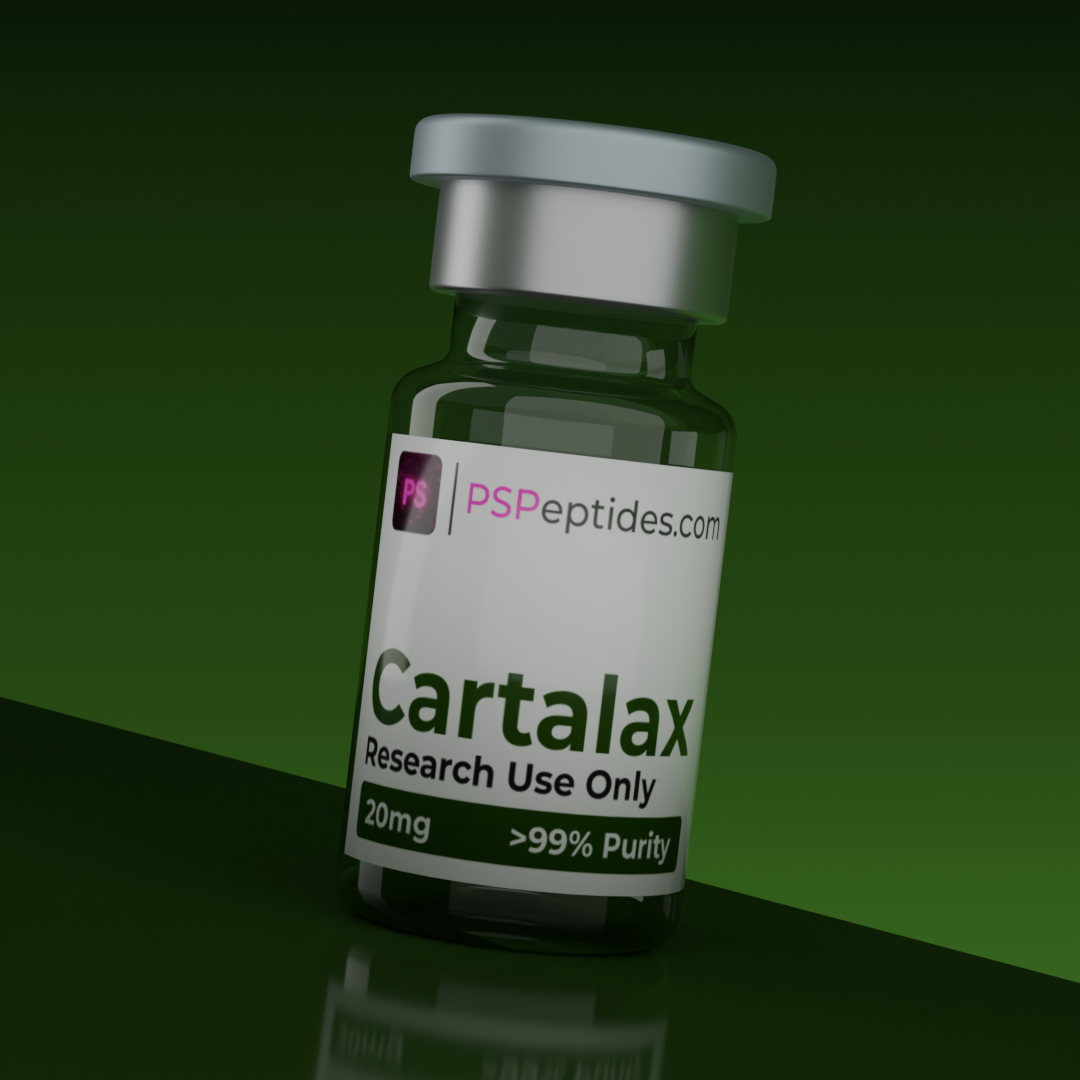
Cartalax is a synthetic tripeptide built from alanine, glutamic acid and aspartic acid (C12H19N3O8, 333.29 g/mol). Researchers at the St. Petersburg Institute of Bioregulation and Gerontology isolated the sequence from a cartilage polypeptide complex, and it is now produced synthetically.
It is studied as a short “bioregulator” peptide that may influence gene expression in connective tissue cells. Its sequence matches the first three amino acids of Epithalon, another well-known Khavinson peptide. New to the field? Start with our complete guide to peptides.
Ready to buy Cartalax for your next study? Choose your quantity above and add it to your cart. Orders placed before 2 PM EST ship the same day, shipping is free on every order, and each vial arrives with its COA. PSPeptides has shipped more than 130,000 orders, and our support team is available seven days a week.
Detailed Mechanism of Action
Cartalax belongs to a class of ultrashort peptides, two to four amino acids long, that Vladimir Khavinson’s group has studied for decades. Larger peptides usually act through receptors on the cell surface. Molecules this small are proposed to work differently, acting inside the cell itself.
The working hypothesis is epigenetic. In this model, a short peptide crosses the cell and nuclear membranes and then binds specific DNA sequences or histone proteins. That contact is thought to change how tightly chromatin is packed and how actively nearby genes are transcribed.
A 2021 systematic review in the journal Molecules by Khavinson and colleagues summarizes this proposed mechanism across the short-peptide family. The same family includes Epithalon (AEDG), Vilon (KE) and Vesugen (KED). Each sequence is associated with a different tissue and a different set of target genes.
For the AED sequence, the measurable effects in cell culture involve genes tied to matrix production and cell aging. Reported targets include sirtuin-1, sirtuin-6, collagen I, the chondrogenic transcription factor SOX9, aggrecan, type II collagen and cartilage oligomeric matrix protein (COMP). Aging-associated markers such as MMP-9 and caspase-3 moved in the opposite direction.
Read this mechanism as a research model, not a settled fact. Peptide-DNA interaction has been explored mostly through molecular modeling and physico-chemical methods, and most supporting data come from one research network. Many labs that buy Cartalax are working to test, replicate or challenge exactly these claims.

The Khavinson Peptide Family in Context
Short bioregulator peptides grew out of work on tissue extracts. Khavinson’s group first studied polypeptide complexes prepared from organs such as the thymus, the pineal gland and cartilage. Amino acid analysis of those complexes then pointed to short sequences that could be synthesized and tested individually.
The AED tripeptide is the short sequence associated with the cartilage complex. That lineage explains why most studies pair it with connective tissue cells, and why a tissue polypeptide complex often appears as a comparison arm. Researchers who buy Cartalax are working with the defined, synthetic end of that research line.
Chemical Profile
The compound is a linear tripeptide written H-Ala-Glu-Asp-OH. Its molecular formula is C12H19N3O8 and its molecular weight is 333.29 g/mol, which places it among the smallest peptides in any research catalog. Synonyms in the literature include AED peptide, T-31 and Ala-Glu-Asp.
Two of its three residues carry acidic side chains. As a result, the molecule holds a net negative charge at physiological pH and dissolves readily in water and aqueous buffers. That solubility makes stock solutions easy to prepare and dilute for cell-culture work.
Small size cuts both ways for quality control. A single missing or swapped residue produces a completely different compound, so identity testing by mass spectrometry is essential. This is one reason to buy Cartalax only with a batch-specific COA in hand.
Published Research
The published record on the AED peptide is small and almost entirely preclinical. In 2016, Lin’kova and colleagues compared the peptides KE, KED, AED and AEDG in aging skin fibroblast cultures (Bulletin of Experimental Biology and Medicine, 161:175-178). All four lowered MMP-9 and raised Ki-67 and CD98hc, while AED and AEDG also suppressed caspase-dependent apoptosis.
A 2020 comparative study in human skin fibroblasts found that AED activated the synthesis of sirtuin-1, sirtuin-6 and collagen I during replicative aging. A related paper used human dermal fibroblasts cultured to passage 25. It reported 1.9- to 3.4-fold increases in the differentiation genes ENGRAILED1, PDGFRA, SPRY4 and TWIST2 after AED was added.
The most cartilage-relevant data come from Myakisheva and colleagues (2023). In human mesenchymal stem cells undergoing replicative aging, AED at 200 ng/ml activated gene expression and protein synthesis for SOX9, aggrecan, type II collagen and COMP. A cartilage polypeptide complex produced a similar effect at a higher concentration.
For wider context, a 2023 review in the International Journal of Molecular Sciences surveys peptides that steer stem cells toward a chondrogenic fate through the WNT, ERK-p38 and Smad pathways. Earlier, Khavinson and colleagues (2014) examined the same tripeptide, labeled T-31, in aging rat kidney cell cultures. A 2019 paper by Zamorskii and colleagues extended that kidney work to aged rats.
What the literature lacks matters just as much. No controlled human clinical trials of this tripeptide appear in the PubMed-indexed literature, and long-term safety data are absent. Anyone who plans to buy Cartalax should treat it strictly as an investigational compound for in vitro and preclinical work.
Designing a Study With Cartalax
Published protocols offer a practical starting point. Working concentrations in the literature are low, from about 20 ng/ml in rat kidney cell cultures to 200 ng/ml in human mesenchymal stem cells. A single 20mg vial therefore supports a large number of culture experiments.
Most studies use replicative aging as the model, passaging cells until they show a senescent profile. One dermal fibroblast protocol cultured cells to passage 25 before analysis. Readouts typically include PCR for gene expression plus immunocytochemistry or confocal microscopy for protein synthesis.
Good design also means good controls. Published work compares AED against untreated cultures and against related sequences such as KE or AEDG. Researchers who buy Cartalax for comparative work can run it alongside Epithalon for the same reason.
Documentation completes the design. Record the batch number, reconstitution date, solvent and storage conditions for every experiment. These details make results traceable, help other labs repeat the work, and make it easier to compare outcomes across vials when a study runs long.
Cartalax vs Alternatives
Before they buy Cartalax, researchers usually weigh it against two neighbors. Epithalon is its closest structural relative, and BPC-157 is the most widely studied repair peptide. The table shows how the three differ.
| Feature | Cartalax | Epithalon | BPC-157 |
|---|
| Sequence | Ala-Glu-Asp (AED) | Ala-Glu-Asp-Gly (AEDG) | 15 amino acids (GEPPPGKPADDAGLV) |
| Size | Tripeptide, 333.29 g/mol | Tetrapeptide, 390.35 g/mol | Pentadecapeptide, about 1,419 g/mol |
| Origin | Cartilage polypeptide complex | Pineal gland extract (epithalamin) | Fragment of a gastric juice protein |
| Main research focus | Cartilage, fibroblasts and matrix genes | Telomerase and aging biology | Tendon, ligament, gut and angiogenesis |
| Proposed mechanism | Gene-expression regulation (SOX9, sirtuins, collagen) | Telomerase activation in cell models | VEGFR2-Akt-eNOS signaling and fibroblast migration |
| Evidence base | Cell culture, limited animal data | Cell culture, animal and limited human data | Extensive animal data, limited human data |
| Regulatory status | Not FDA approved; research use only | Not FDA approved; research use only | Not FDA approved; research use only |
Because Cartalax and Epithalon share their first three residues, they make a natural pair for side-by-side experiments on sequence and function. BPC-157 is a much larger molecule with a receptor-signaling profile, so it answers different questions. Our Epithalon research guide covers the related tetrapeptide in depth.
Reconstitution & Handling
When you buy Cartalax, it arrives as a dry, lyophilized powder that must be reconstituted before use in an assay. Let the sealed vial reach room temperature, wipe the stopper with an alcohol swab, and add solvent slowly down the inside wall of the glass. Swirl gently until the powder dissolves; do not shake.
Concentration is simple arithmetic. Adding 2.0 mL of bacteriostatic water to a 20mg vial gives 10 mg/mL, and 1.0 mL gives 20 mg/mL. Our step-by-step reconstitution guide and peptide calculator walkthrough cover the math for any target concentration.
Cell-culture protocols need a further dilution step. Stock solution is diluted in sterile medium or buffer to reach the ng/ml working range used in published studies. Use sterile technique throughout, label each vial with the date and concentration, and record the batch number from your COA.
Storage & Stability
Lyophilized peptide is most stable when it is kept cold, dry and dark. Store unopened vials at -20°C for long-term holding, or at 2-8°C if they will be used within a few weeks. Keep them in the original packaging, away from light and moisture.
Once reconstituted, keep the solution refrigerated at 2-8°C and plan to use it within about four weeks. Avoid repeated freeze-thaw cycles. If you need longer storage, divide the solution into single-use aliquots first.
Lyophilized peptides tolerate short periods at ambient temperature in transit, but they should move to cold storage as soon as the package arrives. Cloudiness, discoloration or visible particles after reconstitution are signs to discard the vial. If you buy Cartalax in quantity, rotate stock so the oldest batch is used first.
Certificate of Analysis
Every batch is tested by an independent laboratory before it is released for sale. HPLC confirms purity at 99% or higher, and mass spectrometry confirms that the measured mass matches the expected 333.29 g/mol for Ala-Glu-Asp. The batch-specific COA is included with your order.
When you buy Cartalax, check that the batch on the COA matches your vial and keep the document with your lab records. A complete COA lists the test method, the purity percentage, the measured mass and the testing date. Our guide to reading a peptide COA explains each line.
Documented purity protects your data. Impurities can skew results at the ng/ml concentrations used in cell culture, and an unverified vial makes any finding hard to reproduce. That is the practical reason to buy Cartalax from a supplier that publishes its testing.
Quality Checklist Before You Buy Cartalax
Not every peptide supplier documents its products the same way. Use this short checklist whenever you buy Cartalax or any other research peptide.
- Identity: Mass spectrometry data that match 333.29 g/mol.
- Purity: An HPLC result showing 99% or higher.
- Independence: Testing performed by a third-party laboratory, not only in-house.
- Traceability: A COA tied to the specific batch you receive.
- Handling: Lyophilized format, sealed vials and fast shipping.
PSPeptides meets each point on this list, so you can buy Cartalax here with confidence.
Why Researchers Buy Cartalax From PSPeptides
- US Manufactured: US production in Temecula, California.
- Third-Party Tested: Independent HPLC and mass spectrometry on every batch, with the COA included.
- Fast Shipping: Free shipping on every order, free UPS 2nd Day Air over $200, and same-day dispatch before 2 PM EST.
- Flexible Payments: Credit cards, Afterpay, Klarna, Apple Pay and Google Pay.
- 7-Day Support: Reach our team by email, phone or text.
PSPeptides has shipped more than 130,000 orders. Whether you buy Cartalax as a single vial or stock up for a longer study, every order gets the same tested product and the same fast handling.
Shipping & Delivery
When you buy Cartalax before 2 PM EST, your order ships the same day, and most orders leave within 2 to 24 hours. Shipping is free on every order. Orders over $200 qualify for free UPS 2nd Day Air, and orders over $400 qualify for free UPS Next Day Air.
PSPeptides ships across the United States and also to Canada, the EU, the UK and Australia. International researchers who buy Cartalax are responsible for confirming that the compound may be imported for research use in their country. Researchers looking for a Cartalax USA supplier get domestic manufacturing and domestic shipping from one source.
How to Order
To buy Cartalax, select the 20MG vial, set your quantity and add it to your cart. All Cartalax for sale at PSPeptides comes from tested, documented batches. Checkout accepts major credit cards along with Afterpay, Klarna, Apple Pay and Google Pay.
Labs that buy Cartalax for multi-week protocols can order several vials at once so that every replicate draws on the same material. If batch consistency matters to your design, contact our support team before ordering. We answer by email, phone or text seven days a week.
Frequently Asked Questions
Where can I buy Cartalax for laboratory research?
You can buy Cartalax directly from PSPeptides as a 20mg lyophilized vial. Each vial is 99%+ pure, third-party tested and shipped with its batch COA. Orders placed before 2 PM EST ship the same day.
What is Cartalax studied for?
Published studies examine the AED peptide in aging cell models, mainly human skin fibroblasts, mesenchymal stem cells and rat kidney cells. Researchers have measured its effect on collagen, sirtuins, SOX9 and other markers of matrix production and cell aging. The evidence is preclinical.
Is Cartalax the same as Epithalon?
No. Cartalax is the tripeptide Ala-Glu-Asp, while Epithalon is the tetrapeptide Ala-Glu-Asp-Gly. They come from the same research school and share three residues, but they are distinct compounds with separate published research.
How much peptide is in each vial?
Each vial contains 20mg of lyophilized Cartalax research peptide. Published cell-culture studies use ng/ml concentrations, so a single vial supports many experiments.
Can I buy Cartalax online with same-day shipping?
Yes. You can buy Cartalax online at PSPeptides, and orders placed before 2 PM EST ship the same day. Shipping is free on every order, with free UPS 2nd Day Air on orders over $200.
What should I check before I buy Cartalax?
Before you buy Cartalax, confirm that the supplier provides third-party HPLC and mass spectrometry results and a batch-specific COA. Check the vial size, storage instructions and shipping time as well. PSPeptides lists all of this on the product page.
How should I store my vials after I buy Cartalax?
Keep unopened vials at -20°C, or refrigerated at 2-8°C if you will use them soon. After reconstitution, store the solution at 2-8°C and avoid freeze-thaw cycles.
What solvent is used for reconstitution?
Bacteriostatic water is the most common choice for multi-use stock solutions, and this peptide dissolves readily in water. For cell-culture work, the stock is then diluted in sterile medium or buffer. Always follow your own validated protocol.
Is Cartalax approved by the FDA?
No. Cartalax is not approved by the FDA for any human or veterinary use, and no controlled human clinical trials appear in the PubMed-indexed literature. It is sold strictly as a research compound for laboratory use.
Does every vial come with a Certificate of Analysis?
Yes. Each batch is tested by an independent lab using HPLC and mass spectrometry, and the batch-specific COA is included with your order.
Related Resources
All PSPeptides products are sold exclusively for laboratory and research use. Not intended for human consumption.





 Made & Shipped