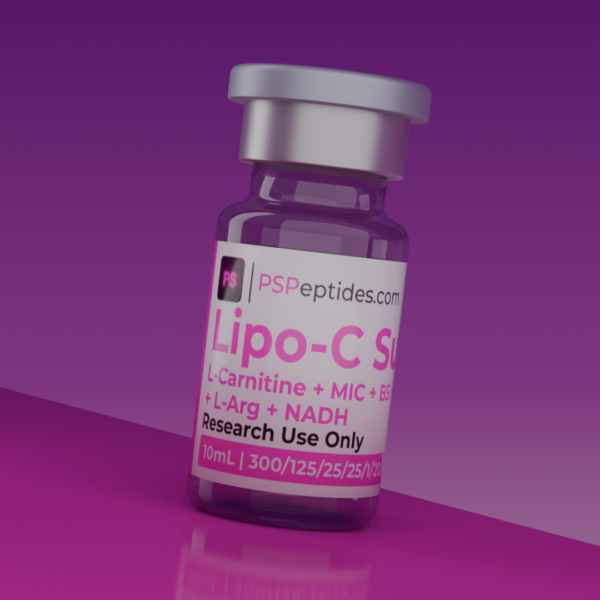
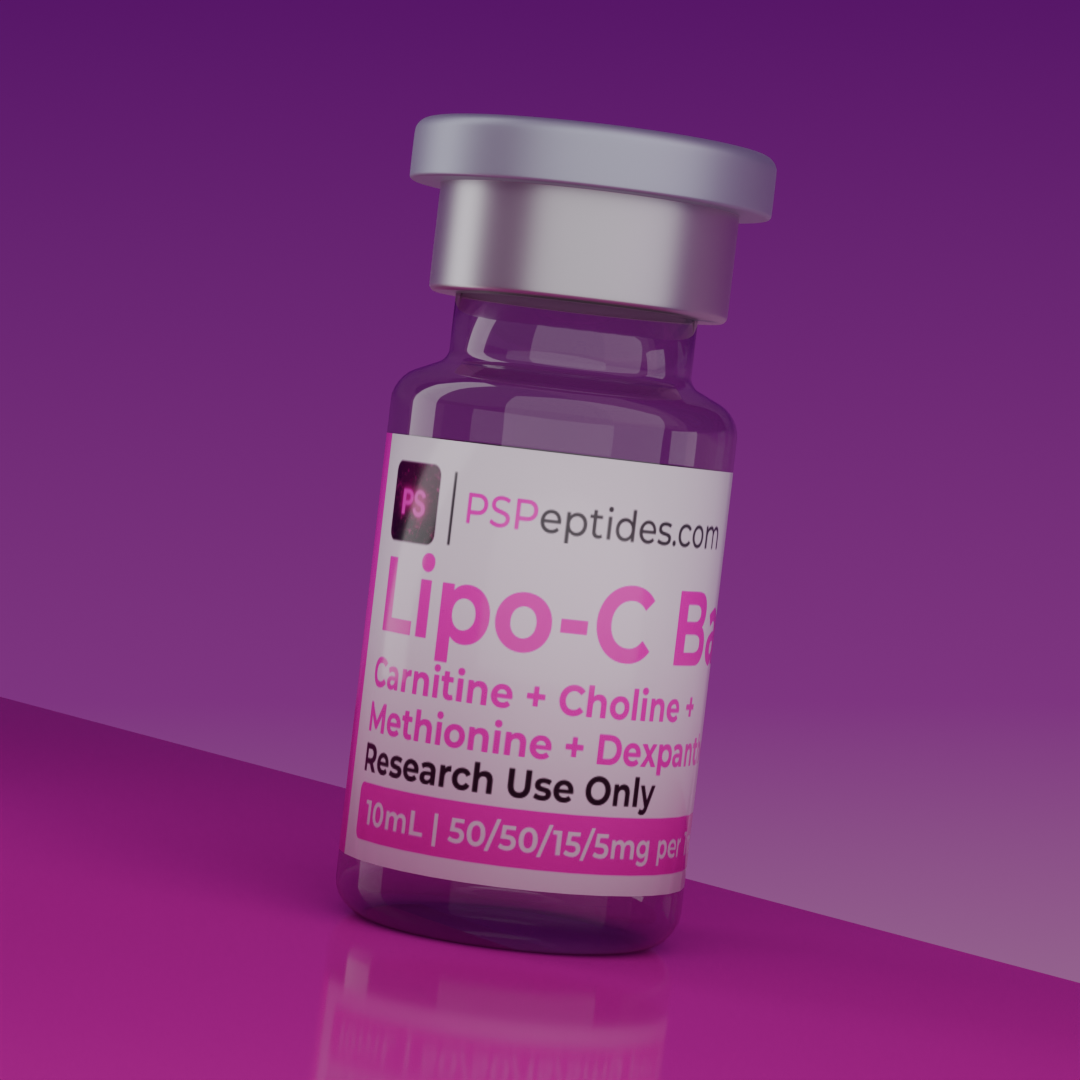
Lipo-C Basic is a four-ingredient lipotropic formula. “Lipotropic” compounds are nutrients that help the liver mobilise and export fat, while L-carnitine shuttles long-chain fatty acids into mitochondria where they are oxidised for energy. When you buy Lipo-C from PSPeptides you get all four actives pre-mixed at research-ready concentrations, so there is no weighing, no reconstitution and no sourcing of four separate raw materials.
You can buy Lipo-C Basic directly from this page: select the Single 10mL Vial option, add it to your cart and check out with a credit card, Afterpay, Klarna, Apple Pay or Google Pay. Orders placed before 2 PM EST ship the same business day from our US facility, and orders over $200 ship free via UPS 2nd Day Air.
Every vial ships with a batch-specific certificate of analysis, so you know exactly what is in the solution before it reaches your bench. Ready to buy Lipo-C? Choose your quantity above and add it to your cart.
Lipo-C Basic Formula Breakdown
When you buy Lipo-C Basic, each 10mL vial delivers 500 mg of L-carnitine, 500 mg of choline, 150 mg of methionine and 50 mg of dexpanthenol. The 50/50/15/5 ratio is printed on the label and verified on the certificate of analysis, and the “LC120” designation simply refers to the 120 mg/mL combined concentration of the four actives.
Because the solution is already at working strength, a 1 mL draw always contains the same 120 mg of actives in the same proportions. That consistency is what makes a pre-mixed formula more reproducible than four separately weighed powders, particularly across multi-week protocols where small weighing errors compound.
Detailed Mechanism of Action
L-carnitine (50 mg/mL). Long-chain fatty acids cannot cross the inner mitochondrial membrane on their own. Carnitine palmitoyltransferase I (CPT1) attaches them to carnitine to form acylcarnitines, carnitine-acylcarnitine translocase carries them across the membrane, and CPT2 releases them as fatty acyl-CoA for beta-oxidation. Carnitine availability is therefore a rate-controlling factor for fat oxidation in muscle, liver and heart tissue, and the main reason researchers buy Lipo-C formulas rather than choline-only lipotropics.
Choline (50 mg/mL). Choline is the headgroup of phosphatidylcholine, the phospholipid that coats very-low-density lipoprotein (VLDL) particles. Without adequate phosphatidylcholine the liver cannot export triglycerides, and fat accumulates inside hepatocytes. Choline is also oxidised to betaine, a methyl donor that regenerates methionine from homocysteine, tying the choline and methionine arms of the formula together.
Methionine (15 mg/mL). Methionine is activated to S-adenosylmethionine (SAMe), the universal methyl donor. SAMe methylates phosphatidylethanolamine to make additional phosphatidylcholine, supports glutathione synthesis through the transsulfuration pathway and, together with lysine, is one of the two amino-acid precursors from which the body synthesises carnitine itself.
Dexpanthenol (5 mg/mL). Dexpanthenol is the stable alcohol form of pantothenic acid (vitamin B5). Inside cells it is oxidised to pantothenic acid and incorporated into coenzyme A, which activates fatty acids for transport and oxidation and carries acetyl groups into the citric-acid cycle. Including it in a lipotropic blend keeps the cofactor pool in step with the increased fatty-acid flux the other three ingredients promote.
How the four work together. Carnitine moves fat into the mitochondria, choline and methionine move fat out of the liver, and dexpanthenol supplies the coenzyme A both processes consume. This is why labs that buy Lipo-C Basic for metabolic work generally prefer it over single-ingredient carnitine or choline solutions: the formula covers the transport, export and cofactor steps in one vial.

Published Research
The carnitine arm of the formula has the largest evidence base. A systematic review and meta-analysis published in Obesity Reviews by Pooyandjoo and colleagues (2016) pooled nine randomised controlled trials with 911 adults and found that participants receiving carnitine lost 1.33 kg more body weight and reduced BMI by 0.47 kg/m² more than controls (PubMed 27335245).
A larger 2020 dose–response meta-analysis of 37 randomised trials in Clinical Nutrition ESPEN (Talenezhad et al.) reported statistically significant reductions in body weight, BMI and fat mass with carnitine supplementation, with the greatest effect observed in overweight and obese adults (PubMed 32359762).
On the choline side, Zeisel and da Costa’s 2009 review in Nutrition Reviews summarises human depletion studies showing that choline deprivation produces fatty liver and organ dysfunction within weeks, and that restoring choline reverses the steatosis (PubMed 19906248). The NIH Office of Dietary Supplements carnitine fact sheet gives further background on carnitine’s role in energy production.
Together, the carnitine and choline literature is the reason many labs buy Lipo-C formulas that include both: the published effects on fat oxidation and hepatic lipid handling are complementary rather than overlapping. Researchers who buy Lipo-C can use these papers as a framework for designing their own protocols and selecting endpoints.
Lipo-C Basic vs Alternatives
Before you buy Lipo-C, it helps to see how the formula compares with the two most common alternatives on the research market: a classic MIC (methionine, inositol, choline) lipotropic and a single-ingredient L-carnitine solution.
| Feature | Lipo-C Basic (This Product) | MIC Lipotropic | L-Carnitine Only |
|---|
| Active ingredients | Carnitine, choline, methionine, dexpanthenol | Methionine, inositol, choline (sometimes B12) | L-carnitine |
| Total actives | 120 mg/mL | Typically 75–125 mg/mL | Typically 200–500 mg/mL |
| Mitochondrial fatty-acid transport | Yes — 50 mg/mL carnitine | No carnitine | Yes |
| Hepatic lipid export support | Yes — choline + methionine | Yes | No |
| Coenzyme A cofactor | Yes — dexpanthenol | Usually no | No |
| Format | Ready-to-use 10mL vial | Ready-to-use vial | Ready-to-use vial |
| Reconstitution needed | No | No | No |
| Best research fit | Combined fat-oxidation and liver-lipid studies | Liver-lipid studies | Isolated carnitine studies |
| Where to purchase | Buy Lipo-C Basic on this page — single 10mL vial, COA included | Varies by vendor | Varies by vendor |
Who Should Buy Lipo-C Basic?
Labs typically buy Lipo-C Basic when a protocol calls for a lipotropic component that is already in solution, already sterile and already characterised on a COA. Typical use cases include diet-induced obesity models, hepatic steatosis studies, exercise-physiology work on fat oxidation, and combination protocols where a lipotropic is run alongside a metabolic peptide.
It is also a practical choice for researchers who buy Lipo-C for pilot work: a single 10mL vial provides ten 1 mL draws or twenty 0.5 mL draws, which is enough to run a small feasibility study before committing to a larger order. Our peptide stacking guide explains how to structure combination protocols without confounding your endpoints.
What to Check Before You Buy Lipo-C Online
Before you buy Lipo-C online from any vendor, check five things.
First, that the exact mg/mL of every active is stated, not hidden behind a proprietary blend. Second, that a batch-specific COA is available rather than a generic sample certificate. Third, that the solution is sterile-filled and tested for endotoxin. Fourth, that the vendor manufactures in the United States and ships cold-chain when needed. Fifth, that checkout is protected by mainstream payment processors.
When you buy Lipo-C from PSPeptides every one of those boxes is ticked, and our guide to choosing a research peptide supplier explains why each point matters. For a wider look at the vendor landscape, see our review of the best peptide companies in 2026.
Handling & Preparation
Lipo-C Basic ships as a finished sterile solution, so unlike lyophilised peptides it does not need to be reconstituted with bacteriostatic water.
Wipe the vial stopper with an alcohol swab before each draw, use a fresh sterile syringe every time and never return unused solution to the vial. A standard 1 mL insulin syringe draws 120 mg of total actives (50 mg carnitine, 50 mg choline, 15 mg methionine, 5 mg dexpanthenol) per full millilitre.
Many researchers buy Lipo-C precisely because it skips the reconstitution step. If your protocol combines it with reconstituted peptides, follow our reconstitution guide for the peptide component and use the peptide dosage calculator to keep both solutions on a consistent mg-per-mL basis. The subcutaneous vs intramuscular article explains how route selection changes absorption kinetics in animal models.
Designing a Lipo-C Research Protocol
Because every millilitre contains a fixed 50/50/15/5 mg ratio, protocol design starts with the carnitine target and the other three actives scale automatically. Most published carnitine work in rodent models reports doses on a mg/kg basis, so convert your target dose to a volume using the 50 mg/mL carnitine concentration and confirm the resulting choline, methionine and dexpanthenol amounts are appropriate for the model.
Record lot number, draw volume and time of administration for every animal or culture, and keep the vial refrigerated between draws. Endpoints that pair well with Lipo-C Basic include body weight, fat mass by DEXA or NMR, hepatic triglyceride content, serum free carnitine and acylcarnitine profiles, and respiratory exchange ratio during indirect calorimetry.
Researchers who buy Lipo-C for longitudinal studies should order enough vials from a single lot to cover the full protocol. Our peptide half-life chart helps when timing a lipotropic alongside peptides with very different clearance rates.
Storage & Stability
Store unopened vials refrigerated at 2–8°C and protected from light. Carnitine, choline and methionine are chemically stable in aqueous solution, but dexpanthenol slowly hydrolyses at elevated temperatures, so avoid leaving vials at room temperature for extended periods. If you buy Lipo-C in multiple vials, keep unopened stock refrigerated and rotate by lot number.
Once the stopper has been punctured, use the vial within 28 days and discard any solution that becomes cloudy, discoloured or develops particulates. Our peptide storage guide and the article on how to tell if a compound has degraded cover the same principles in more depth.
Certificate of Analysis
Every batch of Lipo-C Basic is tested by an independent laboratory before release. The certificate of analysis reports identity and purity for each of the four actives by HPLC, confirms concentration against the 50/50/15/5 mg/mL label claim and includes sterility and endotoxin results for the finished solution. The COA for your specific lot ships with your order and can be requested from support at any time.
If you are new to reading analytical reports, our guide on how to read a COA walks through every line. Researchers who buy Lipo-C from vendors that cannot produce a batch-specific COA have no way to verify what they are actually dosing.
Why Researchers Buy Lipo-C From PSPeptides
- US Manufactured: Compounded and filled in the United States under controlled conditions.
- Third-Party Tested: Independent HPLC and mass spectrometry on every batch.
- Fast Shipping: Free UPS 2nd Day Air over $200, same-day dispatch on orders placed before 2 PM EST.
- Flexible Payments: Credit cards, Afterpay, Klarna, Apple Pay and Google Pay.
- 7-Day Support: Email, phone or text — real people who can answer formulation questions.
- Transparent Formula: Exact mg/mL for every active printed on the label and the COA, with no proprietary blends.
Bulk and Repeat Orders
Need to buy Lipo-C in quantity for a longer study? Simply increase the quantity in your cart; orders over $200 automatically qualify for free UPS 2nd Day Air shipping, and every vial in the shipment carries the same lot number and COA so your data stays consistent across the whole protocol. Customers who buy Lipo-C regularly can also contact support to be notified when a new batch is released.
Frequently Asked Questions
What is the difference between Lipo-C Basic and a MIC injection?
A MIC formula contains methionine, inositol and choline, and sometimes vitamin B12. Lipo-C Basic replaces inositol with L-carnitine and adds dexpanthenol, so it addresses mitochondrial fatty-acid transport and coenzyme A supply as well as hepatic lipid export. Buy Lipo-C Basic if your protocol needs the carnitine component; choose a MIC formula if you specifically need inositol.
Do I need to reconstitute Lipo-C Basic?
No. Lipo-C Basic is supplied as a sterile, ready-to-use solution at 120 mg/mL. There is no powder to dissolve and no bacteriostatic water required, which removes the most common source of concentration error in peptide research.
How many draws are in a 10mL vial?
That depends on your protocol volume. At 1 mL per draw a vial provides ten draws; at 0.5 mL it provides twenty. Each 1 mL contains 50 mg carnitine, 50 mg choline, 15 mg methionine and 5 mg dexpanthenol, so scaling to any mg target is a simple volume calculation.
Can I buy Lipo-C without a prescription?
You can buy Lipo-C Basic from PSPeptides as a research chemical for laboratory use only. It is not sold as a medication, is not intended for human consumption and is not a substitute for any prescribed product. Our article on whether research peptides are legal in 2026 covers the regulatory framework for research-use-only compounds.
Where is the best place to buy Lipo-C online?
The best place to buy Lipo-C online is a US vendor that publishes the exact formula, provides a batch-specific COA, ships quickly and offers mainstream payment protection. PSPeptides meets all four criteria and backs every order with 7-day support.
Can Lipo-C Basic be studied alongside GLP-1 peptides?
Yes. Lipotropic solutions are frequently run alongside incretin peptides in body-composition research. Researchers who buy Lipo-C to pair with retatrutide or tirzepatide protocols should read our retatrutide complete guide and the tirzepatide research guide before designing the study.
Is Lipo-C Basic the same as Lemon Bottle?
No. Lemon Bottle is a riboflavin, bromelain and lecithin lipolysis solution studied for localised fat reduction, whereas Lipo-C Basic is a systemic lipotropic formula built around carnitine, choline, methionine and dexpanthenol. The two are studied for different endpoints and are often compared side by side in body-composition research.
How quickly will my order ship?
Orders placed before 2 PM EST ship the same business day from our US facility. Orders over $200 ship free via UPS 2nd Day Air, and you will receive tracking by email as soon as the label is created.
Related Resources
Buy Lipo-C Basic today — select the Single 10mL Vial option above, add it to your cart and check out in under a minute. Same-day dispatch before 2 PM EST, batch-specific COA in every box.
All PSPeptides products are sold exclusively for laboratory and research use. Not intended for human consumption.





 Made & Shipped