Free Shipping On Any Order✦ Free UPS 2nd Day Air Shipping On Orders Over $200✦ Free UPS Next Day Air Shipping On Orders Over $400✦ Free Shipping On Any Order✦ Free UPS 2nd Day Air Shipping On Orders Over $200✦ Free UPS Next Day Air Shipping On Orders Over $400✦
Great news — we now ship to your country! | Free Shipping On Orders Over $200Dismiss
For laboratory and research use only. This product is not a drug, food, or cosmetic and is not for human or animal consumption. It is not intended to diagnose, treat, cure, or prevent any disease. These statements have not been evaluated by the FDA. Sold solely to qualified researchers and licensed laboratories. Certificate of Analysis available on request.
What the published research and common laboratory protocols report for this compound, in one place. Figures are a reference for designing a study, not instructions.
Research use only
Typical research dose20–50 mcg (≈10–25 IU)
FrequencyOnce daily or as studied
RouteIntranasal or subcutaneous
TimingStudy-dependent.
Protocol lengthShort courses; most research is single-dose
StorageRefrigerate at 2–8 °C after mixing and use within 28 days. Keep the lyophilized vial frozen (−20 °C) or refrigerated until use.
Reconstitution & syringe units
Units are for a standard U-100 insulin syringe (100 units = 1 mL). Add the water slowly down the inside of the vial, swirl gently — never shake — and refrigerate.
Vial
Add BAC water
Concentration
20 mcg dose
50 mcg dose
5MG
2 mL
2.5 mg/mL
0.8 units (below reliable measurement)
2 units
10MG
2.5 mL
4 mg/mL
0.5 units (below reliable measurement)
1.3 units (below reliable measurement)
Under 2 units is below what a 100-unit syringe measures reliably; a 0.3 mL (30-unit) syringe has finer gradations.
Different water volume? Use the dosage calculator — it does the units for any concentration.
1 mg ≈ 500 IU. Intranasal studies typically used 24 IU.
For laboratory and research use only. This product is not a drug, food, cosmetic or dietary supplement and is not for human or animal consumption. The figures above summarise published studies and common research protocols; they are not medical advice or instructions for use. These statements have not been evaluated by the FDA.
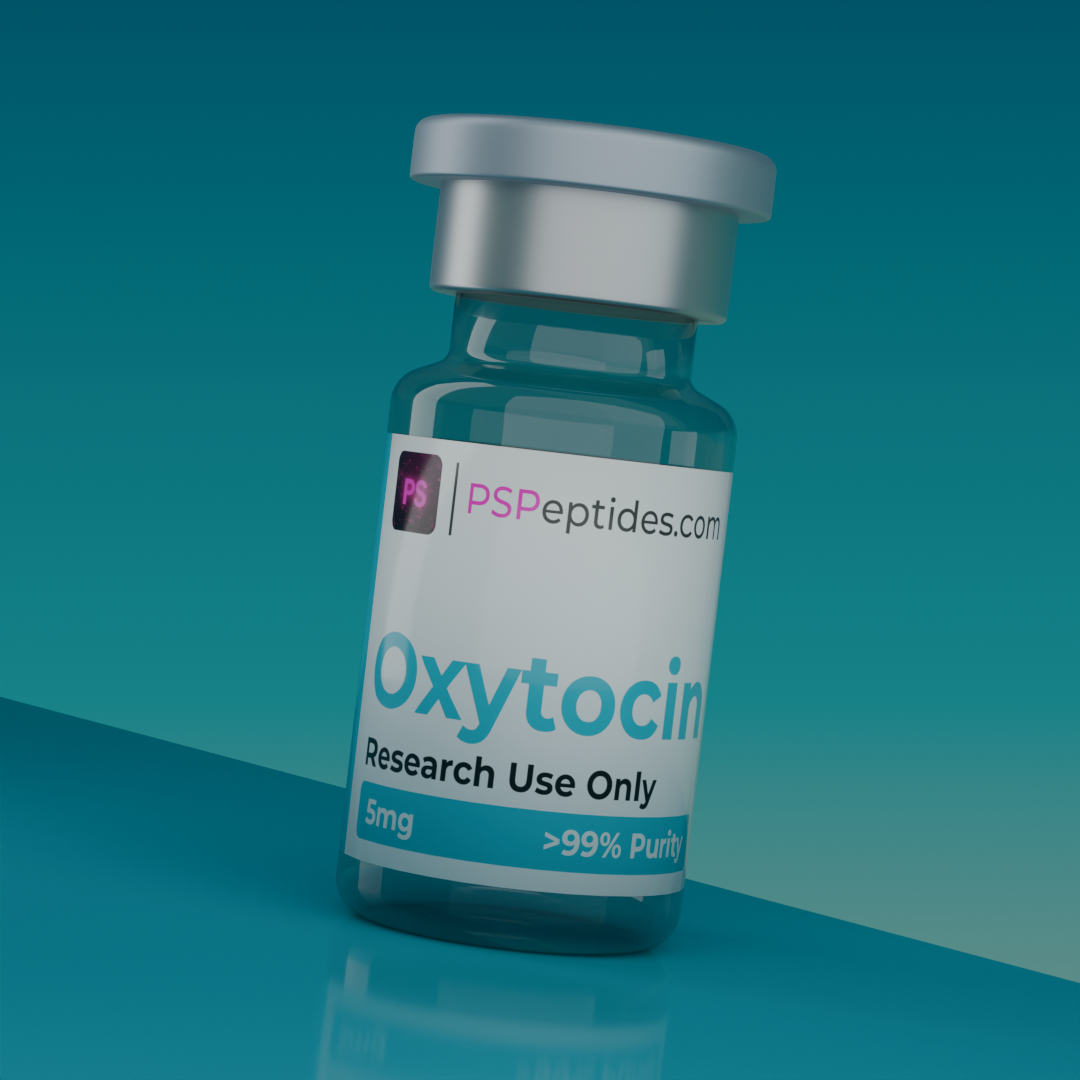
Buy Oxytocin peptide vials from PSPeptides — 5mg per vial, 99%+ purity, third-party tested, and US manufactured. Every batch ships with a certificate of analysis and is formulated exclusively for laboratory and research applications, not for human consumption.
Few neuropeptides have generated as much sustained research interest as oxytocin, and that is a major reason so many labs continue to buy oxytocin year after year for new studies. Its combination of a small, well-characterized structure and a broad receptor distribution makes it a versatile tool across neuroscience, endocrinology, and reproductive biology research.
What Is Oxytocin?
Oxytocin is a nine-amino-acid neuropeptide produced in the hypothalamus and released by the posterior pituitary gland. It is one of the most extensively studied neuropeptides in behavioral neuroscience and endocrinology, with a well-characterized role in social bonding, stress regulation, and reproductive physiology. Researchers interested in how oxytocin fits into the broader peptide landscape can start with our complete guide to peptides.
Oxytocin holds a notable place in peptide history: it was the first polypeptide hormone to be chemically synthesized, a feat accomplished by biochemist Vincent du Vigneaud in 1953, work that later contributed to his 1955 Nobel Prize in Chemistry. That milestone helped establish solid-phase and solution-phase peptide synthesis as viable research tools, and it is part of why researchers today can reliably buy oxytocin manufactured to consistent, verifiable specifications rather than relying on animal-derived extracts.
Oxytocin Structure & Receptor Biology
Structurally, oxytocin is a cyclic nonapeptide stabilized by a disulfide bridge between cysteine residues at positions 1 and 6, with a short tripeptide tail extending from the ring. This compact, constrained structure contributes to its binding specificity at the oxytocin receptor (OXTR), a member of the class A G-protein-coupled receptor family that is closely related to the vasopressin receptors.
OXTR expression has been mapped to the brain (notably the hypothalamus, amygdala, and nucleus accumbens), the uterine myometrium, the mammary gland, the kidney, and cardiovascular tissue. This wide distribution is what allows researchers to study oxytocin’s effects across such varied domains, from social neuroscience to smooth muscle physiology, using a single, well-defined peptide.
Oxytocin vs Vasopressin: A Structural Comparison
Oxytocin is often studied alongside its close structural relative, arginine vasopressin. Both are nonapeptides synthesized in the hypothalamus, and their sequences differ at only two amino acid positions.
Yet they produce distinct physiological effects and bind with different affinities to overlapping receptor families. Researchers who buy oxytocin for comparative endocrinology work frequently run it alongside vasopressin to study receptor selectivity.
The two peptides share enough homology to cross-react at certain receptor subtypes while still producing measurably different effects, which is why introductory neuroendocrinology courses often cover both together.
Common Research Methods Using Oxytocin
Quantification of oxytocin in biological samples is commonly performed using enzyme-linked immunosorbent assays (ELISA) or radioimmunoassay, both of which rely on antibody specificity to detect the peptide in plasma, saliva, or cerebrospinal fluid.
Receptor-binding studies typically use radiolabeled or fluorescently tagged ligands to characterize OXTR affinity and distribution in tissue samples.
In behavioral neuroscience, classic paradigms such as the partner-preference test in prairie voles have long been used to study oxytocin’s role in pair-bonding, and similar designs are adapted across species to examine social recognition.
Labs that buy oxytocin for these applications typically pair it with a validated assay protocol, and many maintain a standardized internal reference batch so results collected months apart remain comparable.
Key Research Applications
Before you buy oxytocin for a new study, it helps to understand where it is most commonly applied in research settings:
Social Behavior Studies: Used in models examining bonding, trust, and social recognition circuits.
Stress Axis Research: Studied for its interaction with the hypothalamic-pituitary-adrenal (HPA) axis.
Reproductive Physiology: Examined for its established role in uterine contraction and milk-ejection reflex pathways in animal models.
Receptor Signaling: Applied in oxytocin receptor (OXTR) binding and downstream signal transduction research.
Comparative Endocrinology: Used alongside related neuropeptides such as vasopressin to study receptor cross-talk and specificity.
Behavioral Pharmacology: Applied in dose-response and receptor-antagonist study designs to map behavioral outcomes.
Who Uses Research-Grade Oxytocin
Academic labs, biotechnology R&D teams, and contract research organizations are the primary groups that buy oxytocin for controlled laboratory work. University neuroscience and endocrinology departments often use it in behavioral and receptor-binding studies, while biotech teams may use it in early-stage formulation or assay-development work. Independent researchers and smaller labs buy oxytocin from suppliers like PSPeptides specifically because each batch includes third-party verification, which supports reproducibility across research groups.
Product Specifications
When you buy oxytocin from PSPeptides, each vial includes the specifications below:
Amount
5mg per vial
Purity
99%+ (third-party HPLC and mass spectrometry)
Form
Lyophilized powder
Storage
Store lyophilized vial in a freezer; consult the enclosed COA for lot-specific handling notes
Testing
Batch-specific COA included
Origin
US manufactured
How Oxytocin Works
Oxytocin exerts its effects primarily through the oxytocin receptor (OXTR), a G-protein-coupled receptor expressed in the brain, uterus, and mammary tissue. Receptor binding activates a Gq-linked signaling cascade involving phospholipase C, which in turn mobilizes intracellular calcium stores. This calcium-dependent signaling underlies oxytocin’s classical peripheral actions, including smooth muscle contraction, alongside its central effects on neural circuits involved in social cognition.
In the central nervous system, oxytocin-producing neurons project from the hypothalamus to regions including the amygdala, nucleus accumbens, and prefrontal cortex. These projections form the anatomical basis for oxytocin’s studied influence on social salience, fear processing, and reward circuitry, making it a common tool in behavioral neuroscience research.
Pharmacokinetically, oxytocin has a short plasma half-life, generally cited at just a few minutes, due to rapid degradation by circulating and tissue-bound peptidases. This short half-life is a key experimental design consideration, and it is one reason researchers who buy oxytocin for in vitro or ex vivo work pay close attention to timing between reconstitution and assay.
Manufacturing & Quality Standards
Research peptides like oxytocin are typically produced using solid-phase peptide synthesis, a method that builds the amino acid chain step by step on a solid resin before cleavage and purification. After synthesis, the crude peptide is purified using high-performance liquid chromatography (HPLC) to isolate the target sequence from synthesis by-products, and the final purity is confirmed using mass spectrometry to verify the molecular weight matches the expected structure.
PSPeptides applies this same testing framework to every batch before it ships. That means when you buy oxytocin from PSPeptides, you are receiving a product that has been verified twice: once internally, and once by an independent third-party lab. This two-step verification process is also why batch-to-batch consistency tends to be more reliable with established manufacturers than with suppliers who skip independent testing altogether, since internal-only quality control has no external check against measurement drift or contamination.
Where to Learn More
Oxytocin has an extensive peer-reviewed literature spanning endocrinology, neuroscience, and behavioral research. Researchers can search the primary literature directly through the National Library of Medicine’s PubMed oxytocin research index or browse full-text articles via the PMC oxytocin receptor collection.
Why Choose PSPeptides Oxytocin
Here is what you get every time you buy oxytocin from PSPeptides:
Feature
This Vial
Purity
99%+, third-party HPLC & mass spectrometry verified
Documentation
Batch-specific COA included with every order
Manufacturing
US-based facility
Packaging
Sealed, light-protected vial
Shipping
Fast, carefully packaged dispatch
Purity is verified twice, once in-house and once by an independent laboratory, so you can cross-check both reports before relying on a batch for published or internal work.
Every certificate of analysis is tied to a specific lot number, so the documentation you receive matches the exact vial in your hand rather than a generic reference sample.
Because the facility is US-based, turnaround times from order to shipment tend to be faster than with overseas suppliers, and customs delays are not a factor for domestic orders.
The vial itself is sealed and shielded from light at the point of packaging, which helps preserve stability during transit — one more reason researchers choose to buy oxytocin from PSPeptides.
Reconstitution & Handling (General Lab Guidance)
Like most lyophilized peptides, oxytocin is typically reconstituted with bacteriostatic or sterile water immediately before use in a research protocol, then kept refrigerated and used within the timeframe set by your lab’s standard operating procedure. Because appropriate reconstitution volumes depend on the specific research protocol, we recommend following your institution’s guidelines or reviewing our general peptide reconstitution guide and dosage calculator walkthrough for the underlying principles.
General best practice when handling any lyophilized peptide is to bring the vial to room temperature before opening, add diluent slowly down the side of the vial, and swirl gently rather than shaking, since agitation can denature the peptide chain.
Many researchers who buy oxytocin specifically choose the lyophilized form because it is far more stable in storage than a pre-reconstituted solution, giving labs flexibility in scheduling when a vial is put into use.
Storage & Stability
Store the lyophilized vial in a freezer, protected from light, until ready to use. Once reconstituted, oxytocin solutions are generally less stable at room temperature and are best kept refrigerated and used promptly.
Repeated freeze-thaw cycles should be avoided, as they can promote peptide bond fragmentation and aggregation, both of which reduce the concentration of intact peptide available for a research protocol.
This is one more reason researchers who buy oxytocin tend to reconstitute only the volume needed for a given session rather than the entire vial at once. For a broader overview, see our peptide storage guide.
Certificate of Analysis
Every vial ships with a batch-specific certificate of analysis confirming identity and purity via third-party HPLC and mass spectrometry testing, so you can verify quality before you buy oxytocin again for future studies. A typical COA includes the lot number, the measured purity percentage, the analytical method used, and confirmation that the molecular weight matches the expected sequence. If you’re new to interpreting these reports, our guide to reading a peptide COA walks through what each section means.
Why Researchers Choose PSPeptides
US Manufactured: Every peptide is produced domestically, which supports consistent quality control and faster shipping.
Third-Party Tested: Independent HPLC and mass spectrometry testing is performed on every batch before it ships.
Fast Shipping: Free UPS 2nd Day Air is available on orders over $200, with same-day dispatch before 2 PM EST.
Flexible Payments: Checkout supports credit cards, Afterpay, Klarna, Apple Pay, and Google Pay.
7-Day Support: The support team is reachable by email throughout the week.
Regulatory Considerations for Research Peptides
Research peptides, including oxytocin sold for laboratory use, occupy a distinct regulatory category separate from pharmaceutical-grade or compounded products intended for human administration.
Suppliers who sell research-use peptides are expected to clearly label products as not for human consumption and to restrict marketing claims to laboratory and research contexts.
Because regulatory frameworks around research chemicals continue to evolve, it’s worth staying current on the rules in your jurisdiction before you buy oxytocin for institutional or independent lab work.
Our guide to research peptide legality in 2026 covers the current landscape, and your institution’s environmental health and safety office is typically the best resource for compliance questions.
Peptide Research Best Practices
Regardless of which supplier you use, a few habits make research peptide work more reproducible.
Keep the certificate of analysis for every lot you receive and match the lot number on the vial label before starting a new protocol. Log reconstitution dates and storage conditions alongside your experimental notes.
When you buy oxytocin or any other research peptide, favor suppliers who provide independent third-party testing rather than relying solely on in-house verification, since cross-checked documentation is easier to defend if your work is reviewed.
Frequently Asked Questions
Common questions researchers ask before they buy oxytocin from PSPeptides:
Is this Oxytocin product intended for human use?
No. This product is sold exclusively for laboratory and research use and is not intended for human consumption, diagnostic, or therapeutic use.
What purity level does this Oxytocin vial come with?
Each vial is manufactured to 99%+ purity and independently verified using third-party HPLC and mass spectrometry testing, which is part of why many labs buy oxytocin from PSPeptides rather than unverified sources.
How is the vial shipped and stored?
The lyophilized vial ships in protective packaging and should be stored in a freezer, away from light, until you’re ready to begin your research protocol.
What documentation comes with my order?
Every order includes a batch-specific certificate of analysis so you can verify identity and purity before beginning your research.
What is the difference between research-grade and pharmaceutical oxytocin?
Research-grade oxytocin is manufactured and labeled strictly for laboratory use and is not subject to pharmaceutical-grade clinical formulation, dosing, or regulatory approval. It is intended for qualified researchers working within an institutional or private lab setting.
Do you ship internationally?
Shipping availability varies by destination. Please check current shipping options at checkout, since regulations for research peptides differ by country.
What should I do if my vial arrives damaged?
Contact PSPeptides support right away with your order number and photos of the damaged item so the team can help resolve it quickly, whether you buy oxytocin as a one-time order or as part of a recurring lab supply arrangement.
Ordering Oxytocin from PSPeptides
When you buy oxytocin from PSPeptides, the process is straightforward: select the vial, complete checkout using any supported payment method, and orders placed before 2 PM EST typically ship the same business day.
Each order is packaged to protect the lyophilized vial in transit, and tracking information is provided as soon as the package ships.
If you have questions about an order, a certificate of analysis, or general handling before you buy oxytocin again for a follow-up study, the support team is available by email.
Is PSPeptides oxytocin the same molecule used in other research contexts?
Yes. The oxytocin peptide itself is chemically identical regardless of supplier; what differs between suppliers is the manufacturing process, purity, and the rigor of testing and documentation behind each batch.
Related Resources
Explore these guides before you buy oxytocin again for your next research protocol:
Can I buy oxytocin in larger quantities for a multi-phase study?
Reach out to PSPeptides support to discuss availability for larger or recurring orders, since research needs vary widely between labs and study designs.
How do I know which lot I received?
The lot number printed on the vial label corresponds to the lot number on your certificate of analysis, allowing you to confirm both match before starting your protocol.
PSPeptides is committed to giving researchers clear documentation, consistent purity, and responsive support with every order. Whether this is your first time choosing to buy oxytocin for a new protocol or you are restocking for an ongoing study, our team is here to help along the way.
All PSPeptides products are sold exclusively for laboratory and research use. Not intended for human consumption.





 Made & Shipped


 Neurological Research Peptides