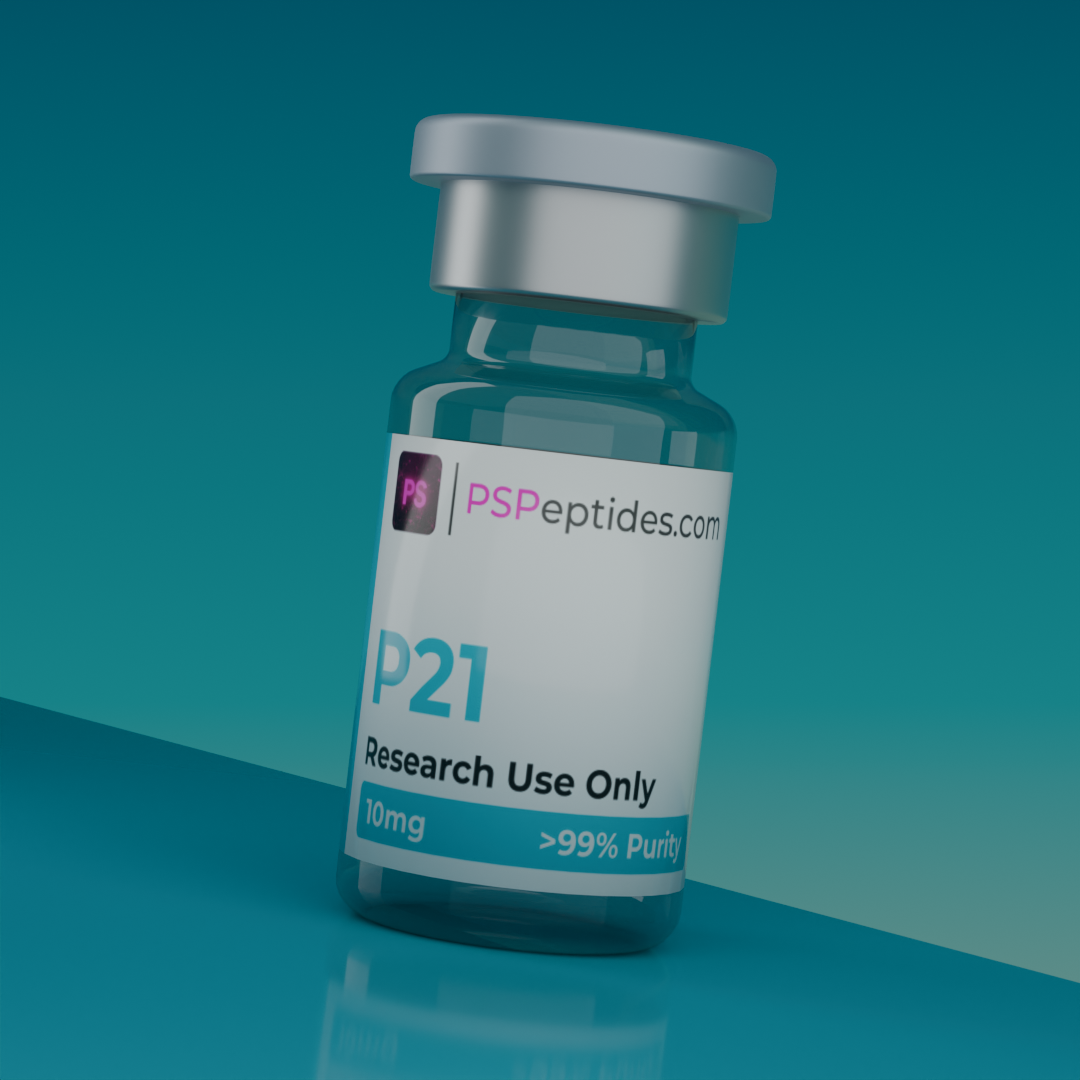
P21, published in the scientific literature as P021, is a small synthetic peptide mimetic of ciliary neurotrophic factor (CNTF). Its sequence, Ac-DGGL(A)G-NH2, pairs a four-residue core taken from CNTF with a C-terminal adamantylated glycine that improves stability and blood–brain barrier permeability.
In rodent studies the compound promoted hippocampal neurogenesis, increased BDNF expression, and reduced tau hyperphosphorylation. PSPeptides supplies P21 synthesized to that published structure. New to this class of compounds? Start with our complete guide to research peptides.
Neuroscience laboratories buy P21 peptide for four main lines of work, all of them supported by peer-reviewed rodent data:
Ready to buy P21 peptide for your lab? Add the 10 mg vial to your cart above — orders placed before 2 PM EST ship the same day, and orders over $200 ship free by UPS 2nd Day Air.
Detailed Mechanism of Action
CNTF is a cytokine of the interleukin-6 family that supports the survival of neurons and glia. It signals through a receptor complex made up of CNTFRα, gp130, and LIFRβ, activating JAK/STAT, MAPK, and PI3K/Akt cascades. The full-length protein crosses the blood–brain barrier poorly and caused significant side effects in early clinical trials, which pushed researchers toward smaller, more drug-like fragments.
P021 emerged from that work. The laboratory of Dr. Khalid Iqbal first identified an 11-residue CNTF fragment (Peptide 6) with neurogenic activity, then trimmed it to the DGGL core and capped it with an adamantylated glycine. The adamantane cage adds lipophilicity, resists proteolysis, and allows the peptide to reach the brain after peripheral or oral administration.
Mechanistically, P021 has been proposed to act as a partial CNTF mimetic that competitively inhibits leukemia inhibitory factor (LIF) signaling while raising brain-derived neurotrophic factor (BDNF) expression. Higher BDNF drives TrkB receptor activation, and downstream PI3K/Akt signaling phosphorylates GSK-3β at Ser9. That suppresses the kinase responsible for tau hyperphosphorylation and contributes to amyloid-beta generation.
The net result observed in animal models is a shift toward neuronal plasticity: more doublecortin-positive immature neurons, increased synaptic proteins such as synapsin I and PSD-95, denser dendritic arbors, and better performance on hippocampus-dependent memory tasks. Those BDNF-dependent pathways are the usual in vivo readouts for P21.

Published Research
The foundational paper is Li et al. (2010, FEBS Letters), which reported that adamantane-containing CNTF peptides, including P21, improved learning, short-term memory, and spatial reference memory in normal adult C57BL/6 mice after peripheral administration. The same study documented enhanced neurogenesis and faster maturation of newly born neurons in the dentate gyrus.
Kazim et al. (2014, Neurobiology of Disease) fed P021 to female 3xTg-AD mice for 12 months beginning at 9–10 months of age. Treated animals showed significantly less abnormal tau hyperphosphorylation at Alzheimer’s-associated sites, lower soluble amyloid-beta, and a trend toward reduced plaque load in hippocampal CA1.
The authors attributed the amyloid effect to decreased generation rather than clearance, consistent with BDNF-mediated inhibition of GSK-3β. The same 12-month protocol rescued cognitive, neurogenic, and synaptic-plasticity deficits in the transgenic animals.
Baazaoui and Iqbal (2017, Alzheimer’s Research & Therapy) began dietary P021 at 3 months of age and continued to 21 months in 3xTg-AD mice. Chronic treatment prevented dendritic and synaptic deficits, boosted neurogenesis, and reversed cognitive impairment. Related work from the same group reported rescue of cognitive aging in aged rats (Bolognin et al., 2014, Neurobiology of Aging) and reduced cerebrospinal-fluid tau in aged rats (Khatoon et al., 2015).
The record is not uniformly positive, which matters for experimental design. A 2024 study in a CDKL5 deficiency model (Mottolese et al., Journal of Neurodevelopmental Disorders) found that P021 corrected proliferation, survival, and GSK-3β pathway deficits in vitro, but chronic in vivo treatment did not raise BDNF or improve neuroanatomy in knockout mice. Disease-model studies should plan BDNF and phospho-GSK-3β readouts as primary endpoints.
Additional Models: Down Syndrome, Development, and Retina
Beyond Alzheimer’s-model mice, the Iqbal group has tested P021 in the Ts65Dn mouse model of Down syndrome, where it was reported to reverse neurogenic and neuroplastic abnormalities and cognitive deficits. A follow-up study found that neurotrophic treatment initiated during early postnatal development prevented later Alzheimer-like behavior and synaptic dysfunction, pointing to a developmental window for intervention research.
The same compound has also been examined outside the hippocampus. A study of aged rats and 3xTg-AD mice reported inhibition of age-related macular degeneration-like pathology in the retina, and a recent diffusion MRI study detected brain microstructure changes after early P021 treatment in 3xTg-AD mice. For neurotrophic studies in tissues other than the forebrain, these papers provide validated imaging and histology endpoints.
Taken together, P021 has more than a decade of published rodent work behind it, from the original 2010 study through Alzheimer’s, Down syndrome, retinal and imaging models.
P21 vs Alternatives: Semax and Selank
| Feature | P21 (P021) | Semax | Selank |
|---|
| Parent molecule | CNTF fragment (DGGL core) | ACTH(4–10) analog | Tuftsin analog |
| Structure | Tetrapeptide core + adamantylated glycine | Heptapeptide | Heptapeptide |
| Primary research focus | Neurogenesis, Alzheimer’s-model pathology, cognitive aging | Attention, cognitive performance, BDNF | Anxiety and stress models, immune markers |
| Proposed mechanism | LIF inhibition, BDNF/TrkB up-regulation, GSK-3β inhibition | Melanocortin signaling, BDNF increase | Enkephalin stabilization, GABAergic modulation |
| Brain penetration | Adamantyl group enables oral and peripheral activity | Intranasal in most studies | Intranasal in most studies |
| Evidence base | Rodent Alzheimer’s, Down syndrome, and aging models | Russian clinical literature, rodent studies | Russian clinical literature, rodent studies |
| Best suited for | Long-duration neurodegeneration and neurogenesis studies | Acute cognition and attention protocols | Anxiolytic and stress-response protocols |
| PSPeptides research vial | 10 mg vial (this product) | Available | Available |
P21 can be run alongside Semax or Selank to compare neurotrophic, melanocortin, and tuftsin pathways within the same assay. P21 is the choice when the question is structural — new neurons, dendritic spines, tau — rather than acute behavioral performance.
Designing a P21 Research Protocol
The published P021 literature offers a clear template for experimental design. Most studies used chronic administration over months rather than acute dosing, with the compound formulated into rodent chow or delivered peripherally. Researchers who buy P21 for a new program should budget for a long-duration study if neurogenesis or tau pathology is the primary endpoint.
Model selection follows the research question. The 3xTg-AD mouse carries APP, PS1, and tau mutations and develops both plaque and tangle pathology, making it the standard for disease-modification studies. Aged Fischer rats or aged C57BL/6 mice suit cognitive-aging questions, while Ts65Dn mice address developmental and Down syndrome-related neuroplasticity.
Core histological readouts include doublecortin (DCX) and BrdU labeling for neurogenesis in the dentate gyrus, synapsin I, synaptophysin, and PSD-95 for synaptic density, and Golgi staining for dendritic complexity. Biochemical endpoints typically cover BDNF by ELISA or western blot, phospho-GSK-3β (Ser9), tau phosphorylation at AT8, PHF-1, and pS396/S404 epitopes, and soluble amyloid-beta by ELISA.
Behavioral batteries in the literature include the Morris water maze for spatial reference memory, novel object recognition for short-term memory, and the elevated plus maze or open field for anxiety-related confounds. Running vehicle-treated wild-type and transgenic cohorts in parallel is essential, since P021 improved memory even in normal mice in the original 2010 study.
Finally, confirm the compound itself. Each lot’s batch-specific Certificate of Analysis is published on this page. Record its purity and mass results in the methods section alongside lot number and storage conditions. That documentation is increasingly required by journals and funding agencies for research-grade reagents.
Reconstitution & Handling
Each 10 mg vial arrives as a lyophilized powder. Allow the vial to reach room temperature before opening to prevent condensation. Add bacteriostatic water slowly down the inside wall of the vial, then swirl gently — never shake — until the powder dissolves completely.
Common laboratory concentrations: adding 1 mL yields 10 mg/mL (10,000 mcg/mL); adding 2 mL yields 5 mg/mL (5,000 mcg/mL); adding 2.5 mL, the most the 3 mL vial takes, yields 4 mg/mL (4,000 mcg/mL). Use our peptide dosage calculator guide to convert any target concentration into syringe units, and read the step-by-step reconstitution guide before preparing your first vial.
Because P021 is a small adamantylated peptide, it is comparatively robust in solution, but standard precautions still apply. Use sterile technique, label the vial with the reconstitution date and concentration, and avoid repeated freeze–thaw cycles. If you order multiple vials, reconstitute only what the current protocol requires and keep the rest lyophilized.
Storage & Stability
Lyophilized P21 should be stored at −20°C for long-term stability, where it remains stable for 24 months or longer. Short-term refrigerated storage at 2–8°C is acceptable for several weeks before reconstitution. Keep vials sealed, desiccated, and protected from light.
Reconstituted solutions should be refrigerated at 2–8°C and used within 30 days, or aliquoted and frozen at −20°C for longer studies. Our peptide storage guide explains how temperature, moisture, and light affect peptide shelf life. Stored correctly, P21 keeps consistent potency across an entire study.
Watch for signs of degradation before each use. A reconstituted solution that turns cloudy, develops visible particulates, or changes color should be discarded, and lyophilized powder that has clumped or discolored after moisture exposure should not be used. Transit at ambient temperature for a few days does not harm the lyophilized peptide, which is why the vial ships without cold packs.
Certificate of Analysis
Every lot of P21 is analyzed by an independent laboratory using reverse-phase HPLC for purity and mass spectrometry for identity confirmation. Each lot’s batch-specific Certificate of Analysis is published on this page. It reports purity percentage, observed molecular mass versus the theoretical value, and the testing date, so you can verify exactly what is in the vial before starting a study.
The HPLC method separates the peptide on a C18 column using an acetonitrile-water gradient with UV detection, and purity is calculated as the main-peak area divided by the total integrated area. Mass spectrometry then confirms that the dominant species matches the expected mass of Ac-DGGL(A)G-NH2, which rules out truncated or deletion sequences that can pass a purity check alone.
Not sure how to interpret a chromatogram? Our guide on how to read a peptide COA walks through every line of the report, from the main peak to the mass-spec identity check.
Why Researchers Buy P21 From PSPeptides
What PSPeptides provides with every P21 order:
- US Manufactured: Synthesized in a cGMP-compliant facility in Temecula, California.
- Third-Party Tested: Independent HPLC and mass spectrometry on every batch. Each lot’s batch-specific Certificate of Analysis is published on this page.
- Fast Shipping: Free UPS 2nd Day Air on orders over $200, and same-day dispatch on orders placed before 2 PM EST.
- Flexible Payments: Credit cards, Afterpay, Klarna, Apple Pay, and Google Pay at checkout.
- 7-Day Support: Email support seven days a week, 9 AM to 10 PM EST, with replies typically within 2–6 hours.
Who Should Buy P21 for Research?
Academic neuroscience laboratories typically use P21 for neurogenesis, synaptic plasticity, and neurodegeneration studies in rodent models. Contract research organizations use it as a reference neurotrophic compound when screening new candidates, and biotechnology groups studying BDNF or GSK-3β biology use it as a positive control for pathway engagement.
Comparative nootropic research is a growing second category. Teams running Semax, Selank, or growth-factor fragments side by side use P21 to anchor the neurotrophic arm of the comparison with a compound that has a published oral route and a multi-year disease-model record.
Whatever the application, the requirements are the same: a verified structure, documented purity, and stable supply across the life of the study. PSPeptides stocks P21 continuously so that follow-up vials come from the same quality system as the first order.
Frequently Asked Questions
Where can I buy P21 peptide online?
You can buy P21 directly from this page. Choose the 10 mg vial, add it to your cart, and check out with a credit card, Afterpay, Klarna, Apple Pay, or Google Pay. Orders over $200 ship free via UPS 2nd Day Air.
Is P21 the same as P021?
Yes. P021 is the designation used in the peer-reviewed literature from Dr. Iqbal’s laboratory, and P21 is the shorthand used by research suppliers. Both refer to the same CNTF-derived peptide, Ac-DGGL(A)G-NH2, so both names describe the published compound.
How is P21 different from Semax?
P21 is a CNTF mimetic that works through BDNF and GSK-3β signaling, whereas Semax is an ACTH(4–10) analog acting through melanocortin pathways. Both have been studied for cognition, but P21 has the stronger neurogenesis and Alzheimer’s-model dataset. The two can be run side by side for comparative work.
How should I reconstitute a 10 mg vial of P21?
Add 1–2.5 mL of bacteriostatic water depending on the concentration your protocol requires, swirl gently until clear, and refrigerate at 2–8°C. See the reconstitution section above for exact mg/mL values at each volume.
Do I need a prescription to buy P21?
No prescription is required to buy P21 for laboratory research, because it is sold as a research chemical rather than a drug. Orders are limited to research and in-vitro use under our research-use-only terms.
Can I buy P21 in bulk for a long-term study?
Yes. Add multiple 10 mg vials to your cart in the quantity your protocol requires — orders over $200 qualify for free UPS 2nd Day Air. For larger institutional orders, contact our support team for lot-matched vials from a single batch.
How quickly will my order ship?
Orders placed before 2 PM EST ship the same business day from our US facility. Orders over $200 ship free by UPS 2nd Day Air, and tracking is emailed as soon as the label is created. The lyophilized vial is stable at ambient temperature during transit.
What purity should I expect when I buy P21 from PSPeptides?
P21 is tested to 99%+ purity by reverse-phase HPLC, with identity confirmed by mass spectrometry. Each lot’s batch-specific Certificate of Analysis is published on this page. The exact purity value for each lot appears on that COA.
Is P21 for human use?
No. All PSPeptides products, including P21, are sold strictly for laboratory and in-vitro or animal research. They are not approved for human consumption, diagnosis, or treatment of any condition.
Related Resources
Buy P21 peptide today and bring a published CNTF mimetic into your neurogenesis or neurodegeneration program. Every vial ships from the US, and our team is available by email seven days a week if you have questions.
All PSPeptides products are sold exclusively for laboratory and research use. Not intended for human consumption.





 Made & Shipped