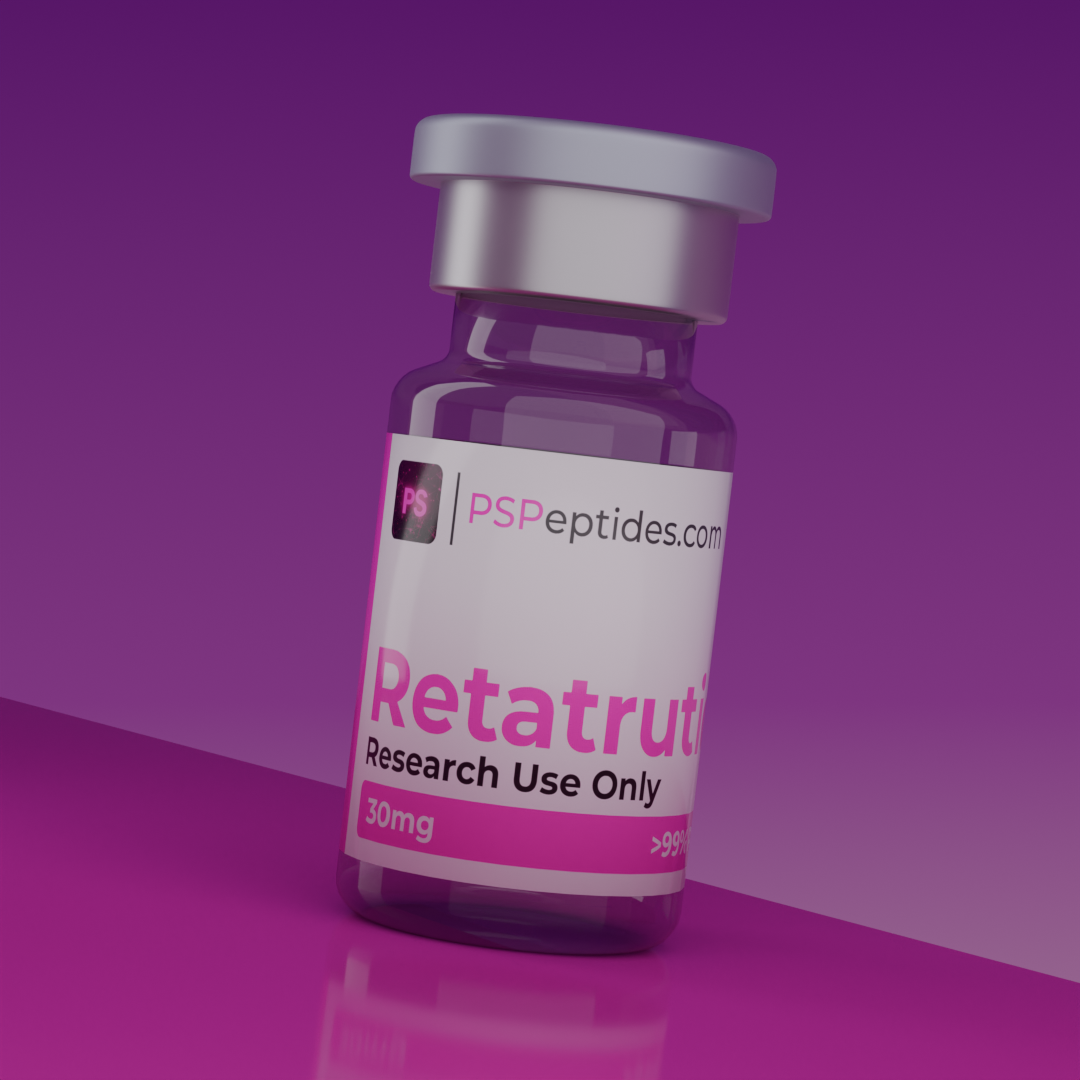
Retatrutide, developed under the code LY3437943, is a once-weekly peptide engineered to engage three incretin-family receptors at once. The GLP-1 and GIP components reduce energy intake, while the glucagon component raises energy expenditure — a combination that single and dual agonists cannot replicate. Our retatrutide triple-agonist guide explains the pharmacology in depth. Researchers who buy retatrutide from PSPeptides receive the same molecule described in the published literature.
Detailed Mechanism of Action
Retatrutide is built on a glucagon-like backbone with substitutions that balance activity across three receptors. In vitro, it activates the glucagon and GLP-1 receptors with roughly equal potency and shows even stronger activity at the GIP receptor. A C20 fatty-diacid side chain binds reversibly to serum albumin, which protects the peptide from renal clearance and gives it a half-life of about six days.
GLP-1 receptor activation slows gastric emptying, enhances glucose-dependent insulin secretion, and reduces appetite through hypothalamic and brainstem circuits. GIP receptor activation complements these effects on insulin release and appears to improve tolerability, allowing higher cumulative incretin exposure than a single agonist. Together they account for the reduction in food intake observed in preclinical models.
The glucagon component is what sets retatrutide apart. Hepatic glucagon-receptor signaling increases fatty-acid oxidation and whole-body energy expenditure, so weight loss arises from both sides of the energy-balance equation. In diet-induced obese mice, this translated into greater fat-mass loss than GLP-1 and GIP activity alone could produce. Research groups that buy retatrutide often design studies specifically around this thermogenic contribution.
Because glucagon can raise blood glucose, the receptor ratio was tuned so that incretin-driven insulin secretion offsets any hyperglycemic effect. Clinical data confirm the balance: participants showed lower, not higher, fasting glucose. When you buy retatrutide for in vitro receptor assays, this three-way balance is the property most worth characterizing.

Published Research
Coskun and colleagues (Cell Metabolism, 2022) described the discovery of LY3437943 and its first-in-human study. The peptide’s pharmacokinetics supported once-weekly dosing, and weight reduction persisted for up to 43 days after a single dose. Read the discovery paper on PubMed.
Jastreboff et al. (New England Journal of Medicine, 2023) randomized 338 adults with obesity to retatrutide or placebo for 48 weeks. Mean weight change was −8.7% at 1 mg, −17.1% at 4 mg, −22.8% at 8 mg, and −24.2% at 12 mg, versus −2.1% with placebo. These figures remain the benchmark for labs that buy retatrutide for obesity models; full details are in the Phase 2 obesity trial abstract.
Rosenstock et al. (The Lancet, 2023) studied 281 participants with type 2 diabetes over 36 weeks. The 12 mg group reduced HbA1c by about 2.0 percentage points and body weight by nearly 17%. See the type 2 diabetes Phase 2 report.
Phase 3 data from Lilly’s TRIUMPH program arrived in 2025 and 2026. TRIUMPH-1 enrolled 2,339 adults with obesity; at 80 weeks, mean weight loss reached 28.3% on 12 mg, and 62.5% of those participants lost at least a quarter of their body weight. TRIUMPH-2 (type 2 diabetes) reported 20.8% weight loss with a 1.5-point HbA1c reduction, and TRIUMPH-3 (severe obesity with cardiovascular disease) reported 22.6%.
Taken together, these readouts make retatrutide the most clinically validated triple agonist in existence. Labs that buy retatrutide today can anchor their preclinical endpoints to a large, consistent body of human data, which simplifies translational interpretation.
Research Applications in Detail
In cell-based work, retatrutide is used to quantify cAMP accumulation and β-arrestin recruitment at each of its three receptors, typically in HEK293 lines expressing a single receptor. Because potency differs across the GLP-1, GIP, and glucagon receptors, concentration-response curves should span at least five log units. Internalization and desensitization assays are also common, since biased signaling at the GIP receptor is an active research question.
In rodent models of diet-induced obesity, investigators measure food intake, body composition by NMR or DEXA, indirect calorimetry for energy expenditure, and glucose tolerance. Pair-fed control groups are essential for separating the appetite-driven component of weight loss from the glucagon-driven increase in energy expenditure. Dose scaling from the clinical range is usually done on a nanomole-per-kilogram basis.
Hepatic studies focus on liver triglyceride content, markers of lipogenesis and fatty-acid oxidation, and histological scoring in steatosis models. Retatrutide’s glucagon-receptor activity drives hepatic lipid clearance, which is why it reduced liver fat by more than 80% in a Phase 2a imaging substudy. Comparative designs that include a dual agonist help attribute the hepatic effect to the glucagon component.
Pharmacokinetic studies in rats and mice characterize albumin binding, absorption from the subcutaneous depot, and clearance. Because the C20 diacid chain gives retatrutide a long half-life, sampling schedules should extend to at least seven days after a single dose. Mass spectrometry remains the preferred quantification method in plasma.
Retatrutide vs Alternatives
Choosing between incretin peptides depends on which receptors your protocol needs to engage. Before you buy retatrutide, confirm that glucagon-receptor activity is actually part of your research question; if it is not, a dual or single agonist may be the cleaner tool. The table below compares the three most common options, and our retatrutide vs tirzepatide comparison goes deeper.
| Feature | Retatrutide | Tirzepatide | Semaglutide |
|---|
| Receptor targets | GLP-1 + GIP + glucagon | GLP-1 + GIP | GLP-1 only |
| Peptide length | 39 amino acids | 39 amino acids | 31 amino acids |
| Lipid modification | C20 fatty diacid | C20 fatty diacid | C18 fatty diacid |
| Approximate half-life | ~6 days | ~5 days | ~7 days |
| Energy-expenditure effect | Yes (glucagon receptor) | No | No |
| Peak reported weight loss | 28.3% at 80 weeks (TRIUMPH-1, 12 mg) | 20.9% at 72 weeks (SURMOUNT-1, 15 mg) | 14.9% at 68 weeks (STEP 1, 2.4 mg) |
| Development status | Phase 3, investigational | FDA approved (2022) | FDA approved (2017) |
| Dosing frequency in trials | Once weekly | Once weekly | Once weekly |
Researchers who buy retatrutide alongside tirzepatide can run head-to-head receptor-selectivity panels in the same assay system, isolating the glucagon contribution directly. That design has become a standard approach in metabolic peptide research since the TRIUMPH readouts.
Reconstitution & Handling
After you buy retatrutide, reconstitute it with bacteriostatic water rather than plain sterile water whenever the solution will be stored for more than a day. Let the vial reach room temperature before adding diluent, then direct the stream down the inside wall of the vial rather than onto the powder. Swirl gently; never shake, since agitation can shear the peptide.
Typical volumes: add 1 mL to a 5 mg vial for 5 mg/mL, 2 mL to a 10 mg vial for 5 mg/mL, or 2.5 mL to a 30 mg vial for 12 mg/mL. Every size ships in a 3 mL vial, so the larger 50 mg and 60 mg vials take at most 2.5 mL, giving 20 mg/mL and 24 mg/mL. Our step-by-step reconstitution guide walks through each stage with photos.
Use the peptide dosage calculator to convert between milligrams, millilitres, and syringe units before you buy retatrutide in a particular size. Working the numbers first prevents under- or over-diluting an expensive vial. Lyophilized retatrutide dissolves within a minute or two into a clear, colorless solution; any cloudiness indicates a handling problem.
Storage & Stability
Store unopened lyophilized vials at −20°C for long-term stability of 24 months or more, or at 2–8°C if you plan to use them within a few months. If you buy retatrutide in multiple vials, keep them in their box: retatrutide, like most peptides with aromatic residues, is light sensitive. Avoid repeated freeze-thaw cycles.
Once reconstituted, keep the solution refrigerated at 2–8°C and use it within 30 days. Do not freeze reconstituted peptide. Researchers who buy retatrutide in larger vials and need longer windows can aliquot the solution into sterile vials and freeze single-use portions at −20°C.
Signs of degradation include a yellow tint, visible particulates, or a loss of expected activity in a reference assay. Lyophilized powder that has absorbed moisture may appear clumped or glassy rather than fluffy. If any of these appear, run an HPLC check before using the material in a critical experiment.
Certificate of Analysis
Every batch ships with a certificate of analysis documenting identity and purity. HPLC quantifies purity, typically returning a single main peak at 99% or higher, while mass spectrometry confirms the molecular weight matches the expected ≈4,731 Da. Lot number, test date, and the testing laboratory appear on each document.
If you have never interpreted one before, our guide to reading a peptide COA explains each section. We encourage every customer to review it before they buy retatrutide, and to request the current lot’s COA by email at any time.
Why Researchers Buy Retatrutide from PSPeptides
- US Manufactured: Synthesized and lyophilized domestically under controlled conditions.
- Third-Party Tested: Independent HPLC and mass spectrometry on every batch.
- Fast Shipping: Free UPS 2nd Day Air over $150, same-day dispatch before 2 PM EST.
- Flexible Payments: Credit cards, Afterpay, Klarna, Apple Pay, Google Pay.
- 7-Day Support: Email, phone, or text, seven days a week.
When you buy retatrutide online, vendor transparency matters more than price. PSPeptides publishes lot-specific data, ships from the United States, and answers technical questions directly — three things many discount retatrutide for sale listings cannot offer.
Safety and Tolerability in Published Trials
Across Phase 2 and Phase 3 studies, the most common adverse events were gastrointestinal — nausea, diarrhea, constipation, and vomiting — and were dose dependent. In TRIUMPH-1, discontinuation due to adverse events ranged from 4.1% at 4 mg to 11.3% at 12 mg, compared with 4.9% on placebo.
Two findings deserve attention when planning tolerability studies. Dysesthesia (abnormal skin sensation) occurred in roughly 12% of participants at the higher doses, and heart-rate increases were observed in Phase 2. Investigators who buy retatrutide for tolerability work should factor these signals into endpoint selection. The research summarized here is for scientific context only; PSPeptides retatrutide is sold for laboratory use and not for human consumption.
Experimental Design Considerations
Prepare a fresh vehicle control that matches the reconstitution diluent, and include a positive-control incretin such as semaglutide where feasible. For in vivo work, allow a short dose-escalation period, since abrupt high doses reduce food intake sharply and can confound body-composition endpoints. Record body weight daily during the first two weeks.
Plan analytical confirmation of your working solutions. A quick HPLC check of a diluted aliquot verifies concentration after reconstitution and again at the end of a multi-week study, giving you a stability record for the exact lot you used. This step is inexpensive relative to the cost of repeating a study.
How to Choose the Right Vial Size
The 5 mg and 10 mg vials suit pilot experiments, receptor-binding assays, and method development where a small quantity is consumed per run. The 15 mg, 20 mg, and 30 mg sizes fit multi-week cell-culture or rodent protocols. Laboratories running extended in vivo studies typically buy retatrutide in 40 mg, 50 mg, or 60 mg vials to minimize per-milligram cost and lot-to-lot variability.
Because all eight sizes come from the same quality system, you can start small and scale up without changing suppliers. Many labs buy retatrutide in a single large vial per study arm so every animal or well receives peptide from one lot. Our team can advise on sizing if you share your planned concentration and run count.
Research Peptide Vendor Checklist
Before you buy retatrutide from any source, verify five things: a batch-specific COA from an independent laboratory, a US manufacturing or fulfillment location, light-protective packaging, published contact details with real support hours, and clear labeling as a research chemical. A vendor missing any of these items is a risk to your data and your budget.
Be cautious with retatrutide for sale listings that quote purity without a lot number, that cannot produce a mass-spectrometry trace, or that ship from unknown overseas facilities with no return path. Counterfeit and under-dosed peptides are an industry-wide problem; buying from a transparent domestic supplier avoids it.
Shipping & Ordering
Orders placed before 2 PM EST ship the same business day from the United States. Orders over $150 qualify for free UPS 2nd Day Air, and every package is discreetly packed with the peptide protected from light and temperature extremes. Tracking is emailed as soon as the label prints.
To buy retatrutide, select your vial size above, add it to your cart, and check out with a credit card, Afterpay, Klarna, Apple Pay, or Google Pay. Bulk and institutional pricing is available for multi-vial orders; contact our team for a quote.
Frequently Asked Questions: Buy Retatrutide
Where can I buy retatrutide for research in the USA?
PSPeptides supplies retatrutide directly from the United States in 5 mg to 60 mg vials. Each order includes a batch-specific COA and ships with same-day dispatch before 2 PM EST. We sell exclusively to researchers and laboratories for in vitro and animal research use.
Is it legal to buy retatrutide online?
Retatrutide is an investigational compound that is not approved for human use. It is sold in the United States as a research chemical for laboratory use only, and purchasers are responsible for compliance with their local regulations and institutional policies. It is never sold for personal use or consumption.
What purity should I expect when I buy retatrutide here?
Every lot is tested by HPLC and mass spectrometry and must meet a 99% purity threshold before release. The COA shipped with your order shows the exact result for your lot, typically between 99.0% and 99.8%.
Is a “buy reta” listing the same product?
“Reta” is simply shorthand for retatrutide, so a buy reta listing should describe the same 39-amino-acid molecule. The difference lies in verification: PSPeptides publishes lot-specific HPLC and mass-spectrometry data, whereas many shorthand listings offer no testing at all. Check the COA before you buy retatrutide anywhere.
Which vial size should I buy retatrutide in for a first study?
Most laboratories start with a 10 mg or 15 mg vial, which provides enough peptide for assay development plus several replicate runs. Once your protocol is fixed, the larger 30 mg to 60 mg vials reduce cost per milligram.
How long does reconstituted retatrutide last?
Refrigerated at 2–8°C, reconstituted retatrutide remains stable for about 30 days when prepared with bacteriostatic water. Lyophilized vials stored at −20°C remain stable for two years or more, which is why many labs buy retatrutide in larger sizes and reconstitute only what they need.
Does retatrutide need cold packs for shipping?
Lyophilized retatrutide tolerates normal transit temperatures for several days without measurable loss of purity, so cold packs are not needed for domestic shipping. Refrigerate or freeze the vial on arrival. During summer heat waves, choose expedited shipping to minimize time in transit.
Can I buy retatrutide in bulk?
Yes. Multi-vial and institutional orders qualify for volume pricing. Contact support by email, phone, or text with your required quantity and we will provide a quote, usually the same day.
Related Resources
All PSPeptides products are sold exclusively for laboratory and research use. Not intended for human consumption. Buy retatrutide responsibly and in accordance with your institution’s research guidelines.





 Made & Shipped