
Reviewed by
Brandon Johnson — Certified Personal Trainer, Nutrition Coach & Peptide Research Consultant
Brandon Johnson is a certified personal trainer, nutrition coach, and peptide research consultant with a background in kinesiology and over 15 years of experience in fitness and wellness. He reviews all PSPeptides educational content for scientific accuracy and practical relevance.
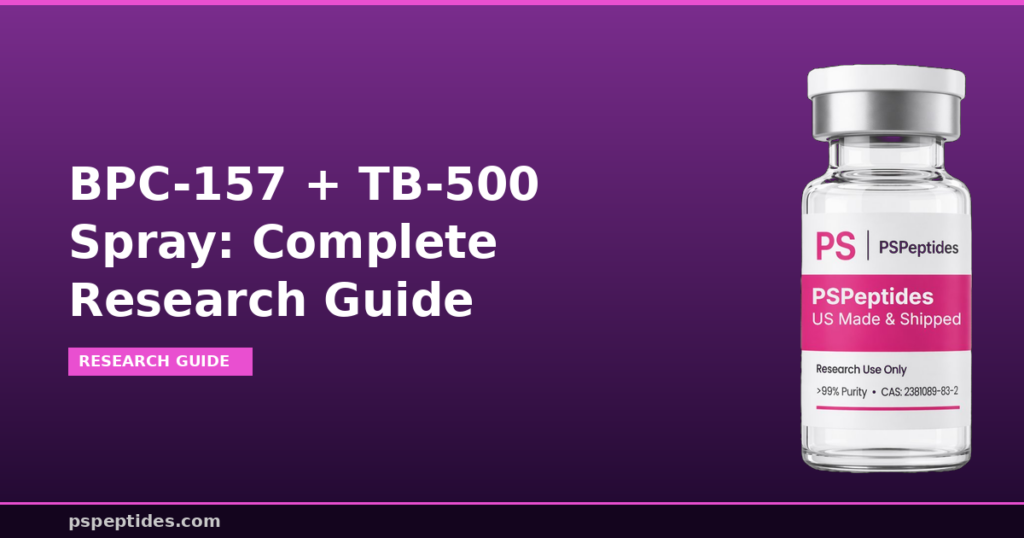
The BPC-157 + TB-500 spray combines the two most popular tissue repair peptides — the Wolverine Stack — in a single ready-to-use spray format, delivering BPC-157’s angiogenic and cytoprotective effects alongside TB-500’s actin-sequestering wound healing mechanism without the reconstitution, syringes, or sterile technique that injectable protocols require.
The BPC-157 + TB-500 spray combines the two most popular tissue repair peptides — the Wolverine Stack — in a single ready-to-use spray format, delivering BPC-157’s angiogenic and cytoprotective effects alongside TB-500’s actin-sequestering wound healing mechanism without the reconstitution, syringes, or sterile technique that injectable protocols require. This combination has been the most requested peptide pairing in the research space for years, and the spray format makes it more accessible and practical than ever for daily research protocols.
BPC-157 (Body Protection Compound-157) is a 15-amino-acid gastric pentadecapeptide that promotes angiogenesis through VEGF upregulation and protects tissue through nitric oxide system modulation. TB-500 is a 43-amino-acid fragment of Thymosin Beta-4 that promotes wound healing through actin sequestration — regulating the cytoskeletal dynamics that drive cell migration, differentiation, and tissue repair. Together, they address tissue repair from two fundamentally different biological angles. PSPeptides offers the BPC-157 + TB-500 Spray alongside the injectable blend vial. For the detailed science behind this combination, see our Wolverine Stack guide.
Why Combine BPC-157 and TB-500 in a Spray?
The Wolverine Stack combination is based on mechanistic complementarity — BPC-157 and TB-500 address different aspects of the tissue repair process, and combining them produces effects that neither compound achieves alone.
BPC-157’s contribution: Angiogenesis (new blood vessel formation) through VEGF and VEGF receptor upregulation — delivering oxygen and nutrients to damaged tissue. Cytoprotection through nitric oxide system modulation — protecting cells from further damage during the repair process. Gastric mucosal protection and intestinal barrier support — effects that are uniquely relevant to the spray delivery format, as BPC-157 has demonstrated oral stability due to its gastric origin.
TB-500’s contribution: Actin sequestration through binding to G-actin monomers — regulating the cytoskeletal rearrangements that drive cell migration into wound sites and tissue remodeling during repair. Anti-inflammatory modulation — reducing the excessive inflammation that can impair healing. Hair follicle stem cell activation — documented in published research showing TB-500 promotes hair follicle regeneration through dermal stem cell mobilization.
The spray format adds a practical dimension to this mechanistic synergy. Injectable Wolverine Stack protocols require reconstituting two peptides (or a blend vial), preparing a syringe, maintaining sterile technique, and performing daily subcutaneous injections. The BPC-157 + TB-500 Spray delivers both peptides in a single spray actuation — reducing the daily workflow from a multi-step procedure to a simple spray application.
The Science Behind the Wolverine Stack: Why BPC-157 and TB-500 Are Complementary
The name “Wolverine Stack” references the comic book character’s legendary healing ability — and while no peptide produces instantaneous tissue regeneration, the scientific rationale for combining BPC-157 and TB-500 is grounded in published preclinical research showing that their mechanisms address different bottlenecks in the tissue repair process.
Tissue repair after injury proceeds through overlapping phases: hemostasis (blood clotting to stop bleeding), inflammation (immune cells clear damaged tissue and debris), proliferation (new cells grow to fill the wound), and remodeling (new tissue matures and strengthens). Different biological processes are rate-limiting at each phase, and BPC-157 and TB-500 support different critical processes.
BPC-157’s role — vascular supply and tissue protection: Published research has documented that BPC-157 promotes angiogenesis through upregulation of the VEGF/VEGFR2 signaling pathway — creating new blood vessels that deliver oxygen, nutrients, and immune cells to the repair site. Without adequate vascular supply, tissue repair stalls regardless of cellular repair activity. BPC-157 also modulates the nitric oxide system to protect cells from further damage during the vulnerable repair period — reducing oxidative stress and preventing secondary injury that can expand the damage zone. Additionally, BPC-157 promotes the expression of growth hormone receptor in healing tissue, potentially enhancing local responsiveness to growth signals. For the full mechanism, see our BPC-157 research guide.
TB-500’s role — cellular mechanics of repair: TB-500 (Thymosin Beta-4 fragment) promotes wound healing through a fundamentally different mechanism — actin sequestration. Thymosin Beta-4 is the primary intracellular G-actin sequestering protein in mammalian cells, regulating the polymerization dynamics of the actin cytoskeleton that controls cell shape, cell migration, and cell division. During wound healing, cells at the wound edge must migrate into the defect, divide to fill the space, and differentiate into the appropriate tissue type. All of these processes require precisely regulated actin dynamics — and TB-500 ensures the actin pool is available and properly regulated for these cellular mechanics. Published research has also documented TB-500’s anti-inflammatory effects and its ability to activate hair follicle stem cells. For the full mechanism, see our TB-500 research guide.
The combination works because vascular supply (BPC-157) and cellular repair mechanics (TB-500) are both necessary for effective healing. A wound with excellent blood supply but impaired cell migration heals slowly. A wound with active cell migration but inadequate blood supply heals poorly because migrating cells lack oxygen and nutrients. Published research has shown that Thymosin Beta-4 accelerates wound closure through actin-dependent cell motility, while BPC-157’s VEGF-mediated angiogenesis ensures the vascular infrastructure supports that cellular activity. By supporting both simultaneously, the Wolverine Stack addresses the two most critical bottlenecks in tissue repair through non-overlapping mechanisms.
The preclinical evidence base for each compound independently is substantial. BPC-157 has over 100 published studies documenting tissue repair effects across gastric mucosa, tendons, ligaments, muscles, bones, and neurological tissue. TB-500 (Thymosin Beta-4) has published evidence for wound healing, cardiac tissue repair, neurological recovery, and hair follicle regeneration. While no published studies evaluate the specific BPC-157 + TB-500 combination in controlled trials, the mechanistic rationale is strong: the compounds address different molecular targets (VEGF/NO for BPC-157; actin/cytoskeleton for TB-500) in the same biological process (tissue repair), creating a theoretically synergistic combination. Our BPC-157 vs TB-500 comparison covers the mechanistic differences in detail.
Research Applications for the BPC-157 + TB-500 Spray
The spray format is suited to several specific research applications where the combination’s dual mechanism and the spray delivery route intersect.
Gut repair protocols: BPC-157’s intrinsic oral stability (derived from its gastric origin) means the throat spray delivers active peptide directly to GI tissue — making the spray format particularly relevant for gut research. TB-500’s tissue repair mechanism adds cytoskeletal support for the intestinal epithelial cell migration necessary to close mucosal defects. Combining these with a KPV spray adds NF-κB-mediated anti-inflammatory coverage — creating a three-peptide gut protocol addressing inflammation (KPV), vascular repair (BPC-157), and cellular repair mechanics (TB-500). Our gut health peptide guide covers this multi-mechanism approach.
Recovery support protocols: For researchers studying musculoskeletal tissue repair — tendons, ligaments, muscles, and connective tissue — the spray provides a convenient daily delivery format for the extended protocols that tissue healing requires. Published preclinical data on BPC-157 includes accelerated healing of Achilles tendons, quadriceps muscles, and medial collateral ligaments in animal models. TB-500 data includes improved wound healing rates, reduced fibrosis (scar formation), and enhanced tissue regeneration quality. Our joint and tendon repair guide covers the broader peptide landscape for musculoskeletal research.
Hair and skin research: Both BPC-157 (through angiogenic effects that improve follicular blood supply) and TB-500 (through hair follicle stem cell activation) have documented effects on hair biology. The spray format allows convenient scalp application for hair growth research. Combined with the GHK-Cu Spray (which modulates follicular gene expression), researchers can build a multi-peptide hair protocol using spray-only delivery.
The Anti-Fibrotic Dimension: Why the Combination Matters for Scar Quality
An underappreciated aspect of the Wolverine Stack is its potential effect on tissue repair quality — specifically, the balance between functional regeneration and fibrotic scarring. When tissue is damaged, the repair process can produce either functional tissue (regeneration) or scar tissue (fibrosis). Scar tissue, while structurally filling the wound, lacks the functional properties of the original tissue — scar tissue in tendons is weaker and less elastic, scar tissue in skin lacks normal sensation and flexibility, and scar tissue in the gut lacks normal mucosal barrier function.
Published research on TB-500 (Thymosin Beta-4) has documented anti-fibrotic effects in cardiac and skin wound models — treated tissue showed less fibrotic scarring and more functional regeneration than untreated controls. The proposed mechanism involves TB-500’s regulation of the actin cytoskeleton during the remodeling phase of wound healing, where the balance between myofibroblast contraction (which drives scar formation) and normal cell migration and differentiation (which drives regeneration) determines tissue outcome. BPC-157 contributes to repair quality through its angiogenic effects — adequate blood vessel formation in healing tissue supports the oxygen and nutrient delivery that functional regeneration requires, whereas inadequate vascularization favors the hypoxic conditions that promote fibrosis.
The combination of anti-fibrotic support (TB-500) with pro-angiogenic support (BPC-157) may shift the repair process toward regeneration rather than scarring — a qualitative improvement in healing outcomes that goes beyond simply accelerating wound closure speed. This quality-of-repair dimension is particularly relevant for researchers studying tendon healing (where scar tissue adhesions can limit range of motion), skin wound healing (where cosmetic scar quality matters), and gut mucosal healing (where functional barrier restoration is essential). For researchers studying tissue repair quality specifically, our joint and tendon repair guide covers how peptide-assisted healing affects long-term functional outcomes.
The 2026 Regulatory Context for BPC-157 and TB-500
Both BPC-157 and TB-500 have been affected by 2026 regulatory developments. The FDA’s April 2026 action removed several peptides from the Section 503A Category 2 restricted list, and BPC-157 was among those with scheduled advisory committee review in July 2026. TB-500 (Thymosin Beta-4) has its own regulatory history as a derivative of a naturally occurring human protein. For researchers tracking these developments, our FDA reclassification guide covers the full scope of the 2026 changes and their implications for peptide research. Our legal status guide provides the broader legal framework for research peptide use in the United States.
How the Wolverine Stack Spray Addresses Tissue Repair
The tissue repair process involves a coordinated sequence of biological events: inflammation (clearing damaged tissue), proliferation (new cell growth), and remodeling (tissue maturation). BPC-157 and TB-500 support different phases and mechanisms within this sequence, which is why their combination produces broader repair support than either peptide alone.

Published preclinical research on BPC-157 has demonstrated accelerated healing of tendons, ligaments, muscles, bones, and GI tissue in animal models — effects mediated through VEGF-driven angiogenesis that ensures adequate blood supply to healing tissue, and through nitric oxide modulation that protects cells during the vulnerable repair phase. Published research on TB-500 (Thymosin Beta-4) has documented wound healing through actin cytoskeleton regulation — TB-500 binds G-actin monomers, controlling the polymerization dynamics that drive cell migration, differentiation, and tissue architecture during repair.
The combination means that while BPC-157 ensures the damaged area has adequate blood vessel growth (supply side), TB-500 ensures the cells migrating into the wound site have proper cytoskeletal regulation for effective repair (cellular side). For a detailed comparison of how these two peptides differ mechanistically, see our BPC-157 vs TB-500 comparison. For researchers studying specific tissue repair applications, our joint and tendon repair guide and muscle recovery guide cover the broader peptide landscape for musculoskeletal research.
BPC-157 + TB-500 Spray vs Injectable Blend
| Feature | BPC-157 + TB-500 Spray | BPC-157 + TB-500 Injectable Blend |
|---|---|---|
| Delivery Route | Oral/pharyngeal mucosa + GI tract | Subcutaneous injection |
| Reconstitution | None — ready to use | Yes — requires BAC water |
| BPC-157 Stability | High — BPC-157 has intrinsic oral/gastric stability | High — standard SC pharmacokinetics |
| GI Direct Effects | Yes — BPC-157 contacts GI tissue directly | Indirect — systemic delivery to GI via circulation |
| Systemic Bioavailability | Moderate (mucosal + GI absorption) | Higher (direct SC absorption) |
| Best For | Gut repair, daily convenience, multi-week protocols | Musculoskeletal repair, targeted tissue healing |
The spray format is particularly well-suited for gut-focused applications (where BPC-157’s oral stability and direct GI contact are advantages) and for protocols where daily compliance over weeks is critical (where the convenience of spray vs injection is meaningful). The injectable blend remains preferred for musculoskeletal repair research where higher systemic bioavailability supports delivery to tendons, muscles, and joints. Our BPC-157 dosage guide covers protocols for both formats.
Dosing, Storage, and Combination Protocols
The PSPeptides BPC-157 + TB-500 Spray is pre-formulated with both peptides in a single ready-to-use product. Each actuation delivers a calibrated combined dose. For gut health protocols, administer on an empty stomach to maximize BPC-157’s direct mucosal contact with gastric and intestinal tissue — taking advantage of BPC-157’s unique oral stability to deliver the peptide to the GI tissue where its gastroprotective and mucosal repair effects are best documented. For general tissue repair research, timing relative to meals is less critical than consistency of daily administration.
The spray format is particularly valuable for multi-week recovery protocols where daily compliance determines outcomes. Tissue repair — whether in tendons, gut mucosa, or skin — is a gradual process that requires sustained peptide support over weeks rather than days. Published preclinical studies evaluating BPC-157 and TB-500 typically use treatment periods of 14-28 days or longer to observe measurable healing endpoints. The convenience difference between spray and injection compounds over these extended timeframes: a 28-day spray protocol requires only 28 spray administrations (taking seconds each), while the equivalent injectable protocol requires 28 reconstitution-preparation-injection cycles (taking 5-10 minutes each). This practical difference directly impacts the consistency of research data quality.
The Wolverine Stack spray can be combined with other PSPeptides sprays for multi-mechanism protocols. Adding KPV spray targets NF-κB-mediated inflammation alongside the repair mechanisms — particularly relevant for inflammatory gut conditions where both inflammation control and tissue repair are needed simultaneously. For comprehensive recovery protocols, the Ipamorelin Spray adds growth hormone stimulation that supports tissue anabolism and recovery. Our stacking guide covers principles for combining peptides from different classes.
Storage at 2-8°C per standard peptide protocols. See our storage guide for detailed handling instructions. For researchers who prefer injectable format, the blend vial with our reconstitution guide and dosage calculator covers preparation.
Further Reading
For additional peer-reviewed research, see: PubMed research on BPC-157 wound healing and angiogenesis.
Understanding bpc-157 + tb-500 spray is essential for researchers navigating this rapidly evolving field in 2026.
Frequently Asked Questions
What is the BPC-157 + TB-500 spray and how does it work?
It combines two tissue repair peptides in one spray: BPC-157 promotes healing through angiogenesis (VEGF-driven blood vessel formation) and cytoprotection (nitric oxide modulation), while TB-500 promotes healing through actin sequestration that regulates cell migration and tissue remodeling. Together they address repair from both the vascular supply side and the cellular mechanics side.
Is this the same as the Wolverine Stack?
Yes. The BPC-157 + TB-500 combination is widely known as the Wolverine Stack. The spray format delivers the same two peptides as the injectable blend vial but without requiring reconstitution, syringes, or injection procedures.
Can the spray work for gut health?
Yes — this is where the spray format has a specific advantage. BPC-157 has intrinsic oral stability (it was discovered in gastric juice) and contacts GI tissue directly when delivered as a spray. Combined with TB-500’s tissue repair support, the spray provides a dual-mechanism approach to gut healing research that leverages BPC-157’s unique oral bioavailability.
Should I use the spray or the injectable blend?
The spray is better for gut-focused research, daily convenience, and multi-week protocols where compliance matters. The injectable blend provides higher systemic bioavailability for musculoskeletal repair — tendons, muscles, joints — where the peptides need to reach specific tissue sites via circulation.
All PSPeptides products are sold exclusively for research and laboratory use.