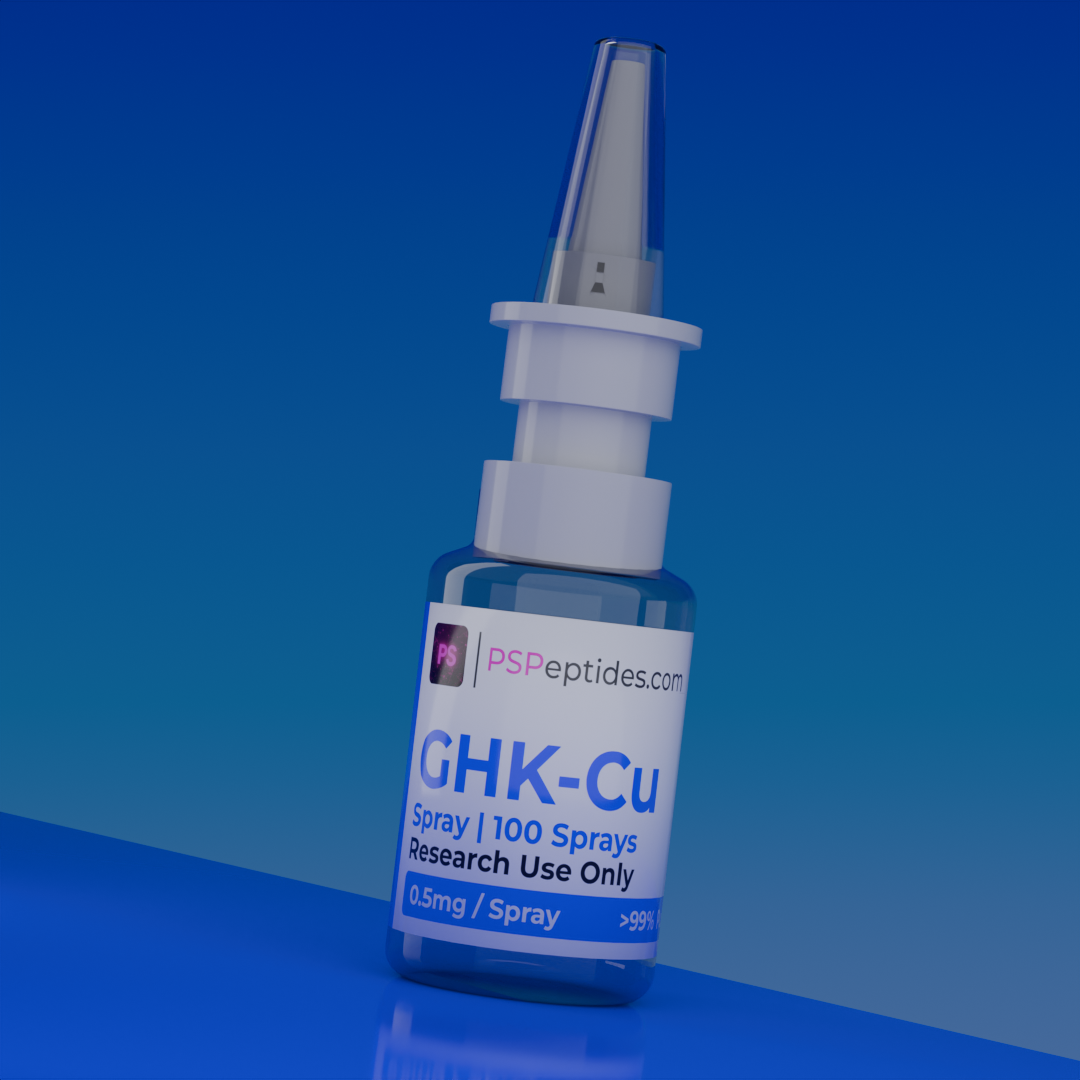
GHK-Cu Spray
$49.99
GHK-Cu Spray — topical copper-peptide research formula, 99%+ purity, US manufactured, COA included.




 Made & Shipped
For laboratory and research use only. This product is not a drug, food, or cosmetic and is not for human or animal consumption. It is not intended to diagnose, treat, cure, or prevent any disease. These statements have not been evaluated by the FDA. Sold solely to qualified researchers and licensed laboratories. Certificate of Analysis available on request.
Description
GHK-Cu spray is PSPeptides’ topical research formulation of the copper tripeptide GHK-Cu (Glycyl-L-Histidyl-L-Lysine copper complex), built for laboratory investigation of skin remodeling, wound-repair signaling, and hair follicle biology. This GHK-Cu spray is manufactured in the USA at 99%+ purity and verified by independent third-party testing. Every GHK-Cu spray batch is sold strictly for laboratory research use, and each order ships with documentation researchers can file alongside their study records.
What Is GHK-Cu Spray?
GHK-Cu spray delivers the naturally occurring human copper-binding peptide GHK in a ready-to-use topical carrier, so researchers can apply a measured dose without any reconstitution step. Investigators working with GHK-Cu spray are typically studying copper-peptide signaling pathways tied to collagen synthesis, antioxidant defense, and tissue remodeling. Because it arrives pre-formulated, GHK-Cu spray is a convenient format for topical application protocols in laboratory settings. For background on the parent molecule, see our complete GHK-Cu guide. Because it is supplied as a finished liquid rather than a lyophilized powder, this format also simplifies inventory management for labs running multiple concurrent studies, since there is no calculation step to convert milligrams into a working concentration before each session.
Key Research Applications
- Skin Remodeling Studies: GHK-Cu spray is used in models examining collagen and elastin turnover in dermal fibroblasts, often alongside markers for decorin and matrix metalloproteinase activity.
- Hair Follicle Research: Some laboratories apply GHK-Cu spray in follicle-size and hair-cycle observation models, tracking anagen-phase duration across treated groups.
- Wound-Healing Models: GHK-Cu spray supports research into chemoattraction of repair cells and tissue-remodeling cascades, including angiogenesis-related endpoints.
- Antioxidant Pathway Studies: Researchers use GHK-Cu spray to explore free-radical scavenging and superoxide dismutase activity relative to untreated control tissue.
Product Specifications
| Amount | 50mg (100 sprays, 500mcg/spray) |
| Purity | 99%+ (third-party HPLC and mass spectrometry) |
| Form | Topical spray solution, ready to use |
| Storage | Refrigerate 2-8°C, protect from light |
| Testing | Batch-specific COA included |
| Origin | US manufactured |
Detailed Mechanism of Action
GHK is a naturally occurring tripeptide found in human plasma, saliva, and urine, present at higher concentrations in youth and declining steadily with age. This decline is the basis for much of the research interest in GHK-Cu spray, since restoring exogenous copper-peptide complex is thought to reactivate signaling pathways that quiet down over time. Researchers using GHK-Cu spray are generally interested in whether topical re-introduction of the peptide can influence local tissue behavior.
The tripeptide has a strong natural affinity for copper (II) ions, similar to the copper-transport site on human albumin, and readily forms the stable GHK-Cu complex. This copper-bound state is believed to be the biologically active form studied in most published GHK-Cu literature, which is why GHK-Cu spray is formulated as the complexed peptide rather than the bare tripeptide.
In cell and tissue models, GHK-Cu has been associated with upregulation of genes tied to collagen types I and III, elastin, decorin, several matrix metalloproteinases and their inhibitors, and pro-angiogenic factors such as VEGF and FGF2. GHK-Cu spray protocols are frequently designed around these downstream markers to quantify remodeling activity in treated versus untreated samples.
Separately, GHK-Cu has documented antioxidant and anti-inflammatory activity in the literature, including suppression of certain free-radical species and modulation of inflammatory chemoattraction of macrophages and mast cells. This dual remodeling-plus-antioxidant profile is a large part of why GHK-Cu spray remains a frequently requested research format at PSPeptides.
Copper is an essential trace element that participates in numerous enzymatic reactions, from mitochondrial energy production to connective-tissue crosslinking via lysyl oxidase. When bound within the tripeptide, copper appears to be delivered and released in a controlled, chelated form rather than as free ionic copper, which is one reason researchers are interested in receptor-mediated versus simple ionic copper-delivery models. Comparative protocols sometimes pair a copper-peptide arm against a free copper-salt arm to separate peptide-specific signaling from generic trace-mineral effects.
Microarray-style gene expression work referenced in the literature reported shifts across several hundred genes following copper-peptide exposure, spanning categories tied to protein synthesis, cell signaling, and antioxidant defense. Because so many pathways are implicated at once, most research protocols isolate a small panel of markers, such as collagen I/III ratios or a single antioxidant enzyme, rather than tracking every reported change simultaneously.
Because peptide bonds are subject to enzymatic breakdown once applied, turnover time is an important variable in any protocol design. Researchers often reference general peptide stability literature alongside product-specific COA data when estimating how frequently a topical application needs to be repeated to maintain steady local exposure.

Published Research
Loren Pickart’s 2008 review in the Journal of Biomaterials Science, Polymer Edition described how the GHK-Cu complex chemoattracts repair cells, suppresses several inflammatory markers, and increases synthesis of collagen, elastin, and related growth factors, while also reporting increases in hair follicle size in treated tissue models (Pickart, 2008, PMID 18644225).
A 2012 paper by Pickart, Vasquez-Soltero, and Margolina published in Oxidative Medicine and Cellular Longevity examined the tripeptide’s role in limiting oxidative stress associated with aging tissue, proposing mechanisms relevant to degenerative processes beyond skin alone (PMID 22666519).
More recently, a 2018 review by Pickart and Margolina in the International Journal of Molecular Sciences synthesized newer gene-expression data, reinforcing earlier remodeling findings with updated molecular pathway detail (PMID 29986520). Researchers designing a GHK-Cu spray protocol often cite these three papers as foundational background reading. All three are indexed on PubMed for full-text review.
Beyond these three papers, review articles referencing the human peptide’s discovery in the 1970s continue to shape how researchers frame new hypotheses, particularly around why plasma concentration declines with age and what that means for tissue-repair capacity over time.
GHK-Cu Spray vs Alternatives
Choosing between formats usually comes down to protocol convenience versus flexibility. The comparison below outlines how this ready-to-use spray stacks up against a vial that requires reconstitution and against a non-copper alternative sometimes used in a parallel comparison arm.
| Feature | GHK-Cu Spray | GHK-Cu Vial | Matrixyl |
|---|---|---|---|
| Preparation | Ready to use, no mixing | Requires reconstitution | Ready to use |
| Application | Topical spray | Injection or topical mix | Topical only |
| Active Complex | Copper-bound GHK | Copper-bound GHK | Synthetic peptide, no copper |
| Purity Testing | 99%+ HPLC/MS, COA included | 99%+ HPLC/MS, COA included | Varies by supplier |
| Convenience | High | Moderate | High |
| Shelf Stability | Refrigerated, months | Lyophilized, longer unmixed | Room temp, months |
| Typical Research Use | Skin/hair topical models | Systemic + topical models | Cosmetic comparison arm |

Who Uses This Research Formulation
Academic dermatology labs, contract research organizations, and independent research groups investigating topical delivery systems make up the bulk of interest in this product line. Many are comparing copper-peptide signaling against other remodeling agents already in their pipeline, choosing a spray format because it simplifies blinding and dose standardization across a treatment group.
Some cosmetic-science programs also incorporate this formulation into ingredient-comparison studies, evaluating it alongside retinoid analogs or other peptide actives on reconstructed skin models. Because the pump delivers a fixed microgram amount per actuation, dose-response curves can be built without a compounding step, which shortens protocol setup time considerably.
Application & Handling Protocol
Because GHK-Cu spray is pre-formulated, no mixing or reconstitution is required before use in a research setting. Each depression of the pump dispenses a fixed microgram amount, which makes it straightforward to standardize a per-application dose across replicate samples. Researchers should record the number of sprays used per session so total peptide exposure can be calculated consistently.
Between uses, keep the GHK-Cu spray nozzle clean and avoid touching it to skin, fur, or any surface to reduce contamination risk. Our dosage calculator guide can help convert sprays into a total microgram figure for lab notebooks.
When designing a dosing schedule, many protocols standardize application to a fixed anatomical area or plate size so that surface-area exposure stays consistent across replicates. Recording ambient temperature and time since the bottle was removed from refrigeration can also help control for any activity drift during a multi-day study.
If a protocol calls for diluting the stock solution further, use a sterile, preservative-free diluent and prepare fresh working solutions rather than storing diluted aliquots for extended periods, since dilution can shorten the practical stability window.
Storage & Stability
GHK-Cu spray should be refrigerated at 2-8°C and kept away from direct light, which helps preserve peptide integrity between research sessions. Once opened, use within the timeframe noted on the batch label and avoid repeated exposure to temperature swings. For a broader look at handling peptide products, see our peptide storage guide.
Avoid freezing the liquid formulation, as freeze-thaw cycling can affect the copper-peptide complex. If you notice discoloration or cloudiness in a GHK-Cu spray bottle, discontinue use of that batch and consult the COA for reference values.
Stability data for copper-peptide formulations generally favor consistent refrigeration over intermittent room-temperature storage, since repeated warm-cool cycling accelerates degradation of sensitive peptide bonds. Labeling each bottle with the date first opened makes it easier to track remaining shelf life against your internal QC cutoff.
Certificate of Analysis
Every batch of GHK-Cu spray ships with a batch-specific Certificate of Analysis generated from independent third-party HPLC and mass spectrometry testing. The COA documents measured purity and confirms the identity of the copper-peptide complex in that specific lot.
If you are new to interpreting these documents, our COA reading guide walks through each section so you can confirm a GHK-Cu spray batch meets your research standards before use.
In addition to purity percentage, a complete COA typically reports the testing method, lot number, and date of analysis, allowing you to trace a specific bottle back to its original quality-control record. Keeping these documents on file alongside your lab notebook entries supports reproducibility if a study is later audited or repeated.
Why Researchers Buy GHK-Cu Spray from PSPeptides
- US Manufactured
- Third-Party Tested: Independent HPLC and mass spectrometry on every GHK-Cu spray batch
- Fast Shipping: Free UPS 2nd Day Air over $200, same-day before 2 PM EST
- Flexible Payments: Credit cards, Afterpay, Klarna, Apple Pay, Google Pay
- 7-Day Support: Email

Quality & Manufacturing Standards
PSPeptides formulates this product in the United States under process controls designed to minimize batch-to-batch variability. Raw peptide is sourced, complexed with copper, and filled under conditions intended to protect the finished spray from contamination and premature degradation before it reaches your lab.
Independent laboratories, not PSPeptides itself, perform the HPLC and mass spectrometry analysis behind every Certificate of Analysis, which keeps purity verification separate from manufacturing. This separation is part of why many repeat research customers cite consistency as a reason they continue sourcing this spray format from PSPeptides.
Raw material sourcing is reviewed on an ongoing basis, and any deviation identified during incoming quality checks results in that lot being held back rather than shipped, which is part of the broader process controls behind every batch released to customers.
Documenting Results
Consistent record-keeping matters as much as the formulation itself. Most labs log application date, number of sprays, storage conditions, and any observed changes in a structured lab notebook or electronic data-capture system, which makes it far easier to compare results across a multi-week study or reproduce findings in a follow-up experiment.
Photographic or imaging documentation, where applicable, should be captured under consistent lighting and distance settings so that remodeling-related changes can be measured objectively rather than judged subjectively between sessions.
Sharing methodology details, including exact spray counts and timing, alongside any published or internal results makes it far easier for other researchers to attempt replication, which remains a valuable step for any topical peptide protocol.
Limitations & Considerations
Much of the published literature on this copper-peptide complex comes from in-vitro and animal-model work rather than large randomized trials, so effect sizes reported in one system do not automatically transfer to another. Researchers designing new protocols should treat earlier findings as hypothesis-generating rather than conclusive.
Because copper itself has a narrow physiological range, protocols involving repeated or high-frequency application in animal models often include copper-load monitoring alongside the primary remodeling endpoints, to rule out confounding from excess trace-mineral exposure rather than peptide-specific signaling.
As with any research compound, batch-to-batch consistency should be confirmed against the included Certificate of Analysis before drawing comparisons across studies conducted at different times. Where possible, running a small internal reference sample alongside each new lot adds an additional layer of confidence beyond the supplied documentation.
Frequently Asked Questions
What is GHK-Cu spray used for in research?
GHK-Cu spray is used by laboratories studying copper-peptide signaling in skin remodeling, hair follicle biology, and antioxidant pathways. It is intended strictly for research use, not human application.
How is GHK-Cu spray different from GHK-Cu vials?
GHK-Cu spray is a ready-to-use liquid that requires no reconstitution, while vials typically contain lyophilized peptide that must be mixed before use. Both formats deliver the same copper-bound GHK complex.
How should GHK-Cu spray be stored?
Keep GHK-Cu spray refrigerated between 2-8°C, protected from light, and avoid freezing. Use opened bottles within the window noted on your batch label.
Is GHK-Cu spray third-party tested?
Yes. Every GHK-Cu spray batch is verified by independent HPLC and mass spectrometry testing, with a batch-specific COA included.
Can GHK-Cu spray be diluted for lower-dose protocols?
Some researchers dilute the stock solution with a sterile, preservative-free carrier to reach lower target concentrations, though fresh working solutions are recommended rather than long-term storage of diluted aliquots.
Comparing Delivery Formats in Practice
Topical delivery is not the only way researchers work with copper-peptide complexes, but it is one of the more accessible starting points for a new protocol. A spray format avoids the pipetting and mixing steps associated with powders, which can matter when a study involves a large number of replicate applications spread across many sessions.
That said, some study designs still call for a lyophilized vial, particularly when a protocol requires a specific solvent system or a concentration outside the standard spray range. Labs frequently keep both formats on hand so the delivery method can be matched to the specific research question rather than the other way around. Some teams even run a small pilot comparing both formats before committing a full study budget to one delivery method.
Research Considerations Before Ordering
Before starting a new protocol, confirm that your institution’s research-use-only policies align with how you intend to apply this formulation, and make sure any animal or cell-culture work has appropriate oversight in place. Reviewing the batch COA against your own acceptance criteria before the study begins can prevent having to discard early data points later. Setting these criteria in writing ahead of time, rather than deciding case by case, also makes it easier to justify protocol decisions during peer review or internal audit.
It is also worth deciding in advance how many bottles a study will require, since ordering enough of a single lot for the full study reduces the chance of introducing batch-to-batch variability partway through a multi-week protocol. If a second lot does become necessary, running a brief side-by-side comparison against remaining stock from the original lot can help confirm the two behave equivalently before pooling any results.
Related Resources
- Complete GHK-Cu Guide
- GHK-Cu Copper Peptide Research
- GHK-Cu for Hair Loss Research
- GHK-Cu Topical Serum Guide
- Matrixyl vs GHK-Cu Comparison
- How to Read a Peptide COA
- Peptides for Hair Growth
- Best Peptides for Skin Research
All PSPeptides products, including GHK-Cu spray, are sold exclusively for laboratory and research use. Not intended for human consumption.
Additional information
| Weight | 0.03 lbs |
|---|---|
| Dimensions | 2 × 2 × 2 in |
| Spray Size | 50mg – 100 Sprays: 500mcg / Spray |
Related products
-
 Cellular Energy Research Peptides
NAD+ Spray
Price range: $89.99 through $139.99 Select options This product has multiple variants. The options may be chosen on the product page -
Cellular Energy Research Peptides
Epitalon Spray
Price range: $54.99 through $99.99 Select options This product has multiple variants. The options may be chosen on the product page