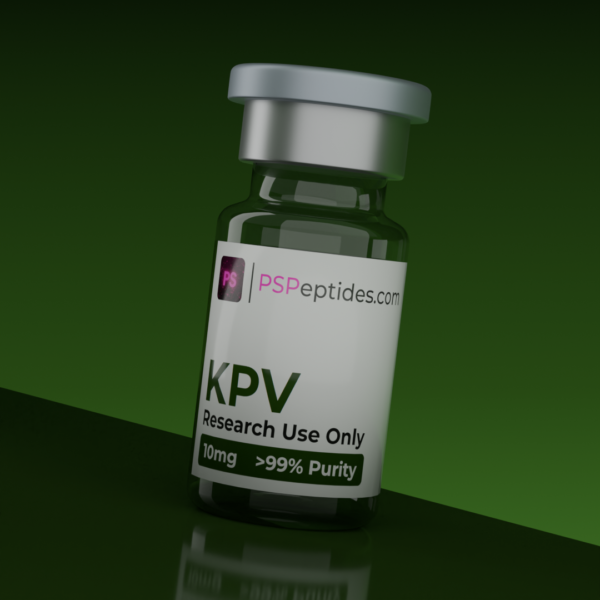
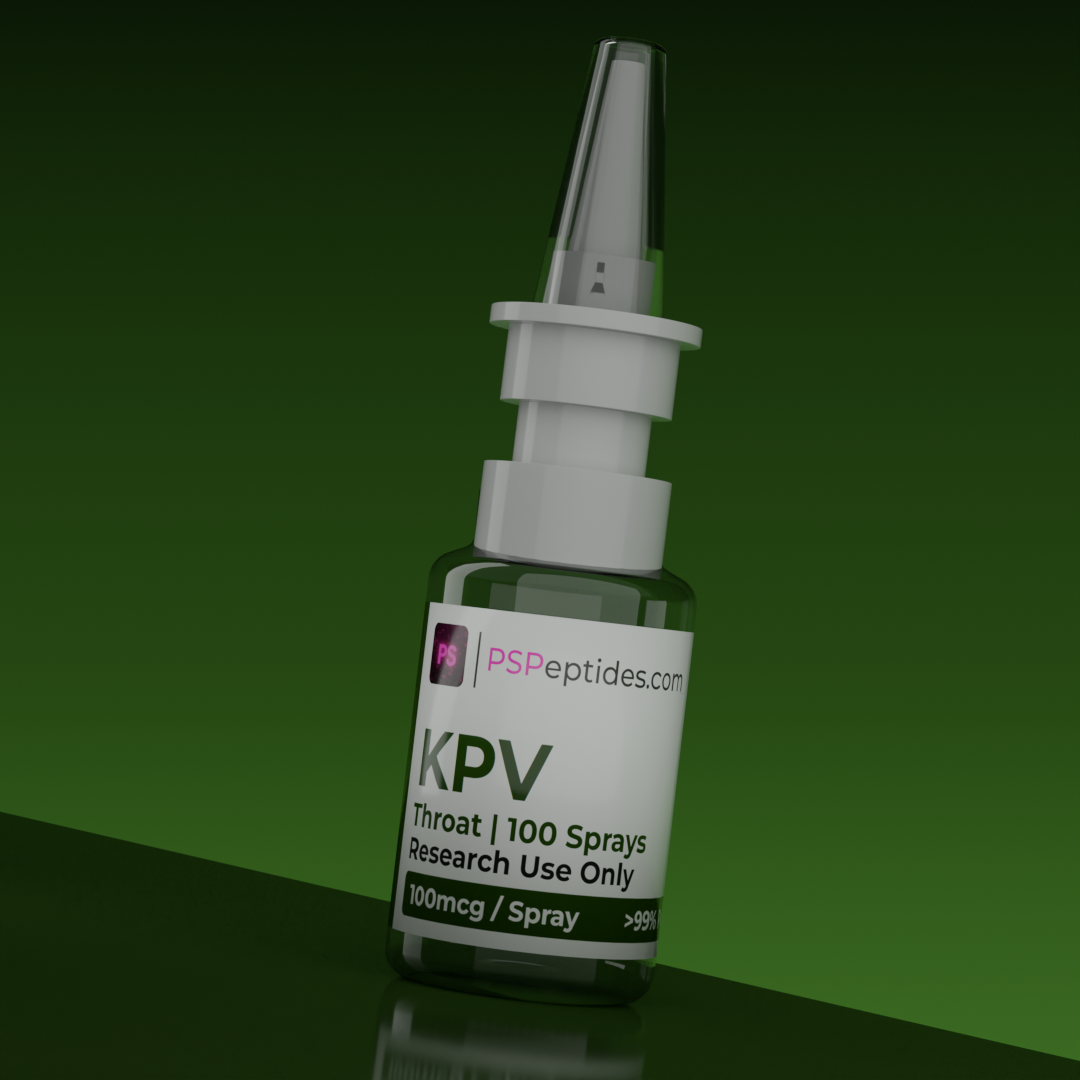
KPV Spray
$59.99
Buy KPV Spray — research-grade anti-inflammatory tripeptide (Lys-Pro-Val). 99%+ purity, US manufactured, third-party HPLC tested, COA included.




 Made & Shipped
For laboratory and research use only. This product is not a drug, food, or cosmetic and is not for human or animal consumption. It is not intended to diagnose, treat, cure, or prevent any disease. These statements have not been evaluated by the FDA. Sold solely to qualified researchers and licensed laboratories. Certificate of Analysis available on request.
Description
Buy KPV research peptide spray from PSPeptides — a research-grade anti-inflammatory tripeptide (Lys-Pro-Val) delivered in a convenient spray format. When you buy KPV from PSPeptides you receive material verified at 99%+ purity by third-party HPLC and mass spectrometry. The primary application is investigation of mucosal and systemic inflammation pathways.
What Is KPV Spray?
KPV is the C-terminal tripeptide fragment of alpha-melanocyte-stimulating hormone (α-MSH), composed of lysine, proline and valine. Researchers who buy KPV study its ability to modulate inflammatory signaling without the pigmentary effects of the parent hormone. For background, see our KPV anti-inflammatory research guide and the broader complete guide to peptides.
Key Research Applications
- Mucosal inflammation: Investigated in models of gut and intestinal barrier inflammation.
- Immune modulation: Studied for downregulation of pro-inflammatory cytokine cascades.
- Skin and wound research: Examined in topical models of dermal irritation and repair.
- Systemic anti-inflammatory pathways: Explored via NF-κB signaling modulation in cell cultures.
Product Specifications
| Amount | See variant options above |
| Purity | 99%+ (third-party HPLC and mass spectrometry) |
| Form | Reconstituted spray solution |
| Storage | Refrigerated 2–8°C, protect from light |
| Testing | Batch-specific COA included |
| Origin | US manufactured |
Detailed Mechanism of Action
KPV exerts its anti-inflammatory activity largely through intracellular pathways. Researchers who buy KPV report interest in its interaction with the melanocortin system and downstream signaling that suppresses nuclear factor kappa B (NF-κB) activation. Because the tripeptide is small, it can be taken up by cells via the PepT1 transporter, which is upregulated in inflamed tissue.
Once internalized, KPV appears to interfere with the phosphorylation and degradation of IκB, thereby limiting NF-κB translocation to the nucleus. This reduces transcription of pro-inflammatory mediators such as TNF-α, IL-6 and IL-8 in cultured cells. Teams that buy KPV frequently pair these assays with cytokine ELISA readouts.
Unlike the full α-MSH sequence, the KPV fragment does not engage melanocortin receptors strongly enough to drive melanogenesis, which is why researchers who buy KPV value it as a targeted anti-inflammatory probe. Its stability profile and small size make it attractive for both mucosal and topical model systems.
Additional investigation focuses on KPV effects on epithelial tight-junction proteins, where it may support barrier integrity in models of colitis. This dual action — cytokine suppression plus barrier support — is a recurring theme in the literature reviewed by groups who buy KPV.
The melanocortin system to which KPV is related comprises five receptor subtypes and a family of endogenous ligands derived from proopiomelanocortin. While the parent α-MSH molecule signals through MC1R and other subtypes, the isolated Lys-Pro-Val motif retains anti-inflammatory activity through receptor-independent, largely intracellular mechanisms. This distinction is central to why the tripeptide is investigated as a clean pharmacological probe rather than a pigmentation agent.
In epithelial and immune cell cultures, the peptide has been observed to reduce the nuclear accumulation of the p65 subunit of NF-κB. Because NF-κB governs the transcription of a broad set of inflammatory genes, even modest suppression can translate into measurable reductions in secreted cytokines. Investigators typically quantify these effects with reporter assays, Western blots for phosphorylated IκBα, and multiplex cytokine panels.
The PepT1 di- and tri-peptide transporter is of particular interest because its expression rises in inflamed intestinal epithelium. This means the peptide may be preferentially delivered to precisely the tissue where inflammation is highest, an elegant targeting feature that appears repeatedly in the colitis literature. Researchers frequently design uptake experiments using labeled analogs to confirm transporter-mediated entry.

Understanding the KPV Tripeptide Structure
The three amino acids that make up this molecule each contribute distinct chemistry. Lysine provides a positively charged side chain that influences solubility and cellular interaction, proline introduces a rigid ring that constrains the peptide backbone, and valine adds a compact hydrophobic residue. Together they form a short, stable sequence that resists rapid enzymatic breakdown better than many longer peptides. Teams that buy KPV appreciate this stability because it simplifies handling in extended experiments.
This structural compactness is also why the tripeptide crosses membranes and engages transporters that larger peptides cannot use. The absence of the aromatic and receptor-binding residues found in full-length α-MSH is precisely what removes the pigmentation activity while preserving the anti-inflammatory signature. For researchers, this makes it a well-defined tool with a narrow and interpretable range of biological effects.
Published Research
Early foundational work by Luger and colleagues characterized α-MSH-derived peptides and their anti-inflammatory potential across the 1990s and 2000s. Subsequent studies by Dalmasso et al. (2008) demonstrated KPV uptake through PepT1 and reduction of intestinal inflammation in murine colitis models, a frequently cited reference for those who buy KPV for gut research.
Kannengiesser and colleagues (2008) reported that KPV attenuated experimental colitis with efficacy at low micromolar concentrations, supporting its use as an economical research tool. Data points from these studies inform the reconstitution ranges chosen by many labs that buy KPV.
For primary literature, researchers can consult indexed studies via PubMed and the NIH PubMed Central archive. These databases catalog peer-reviewed studies on the KPV tripeptide and related melanocortin fragments.
Beyond the intestinal models, additional groups have examined KPV in dermatological and ocular inflammation contexts, reporting reductions in neutrophil infiltration and edema in several experimental systems. Because the tripeptide is inexpensive to synthesize and highly soluble, it has become a convenient positive control in comparative anti-inflammatory screens. The reproducibility of its effects across independent laboratories strengthens its value as a reference compound.
Reviews of melanocortin-derived peptides consistently highlight the favorable therapeutic-window characteristics observed in preclinical work, while emphasizing that all such findings remain confined to laboratory and animal research. The peptide’s mechanism, spanning both cytokine suppression and epithelial barrier support, gives it a broad footprint in inflammation research that continues to attract new investigation each year.
KPV Spray vs Alternatives
| Feature | KPV Spray | BPC-157 | TB-500 |
|---|---|---|---|
| Peptide class | Tripeptide (α-MSH fragment) | Pentadecapeptide | Peptide fragment |
| Primary focus | Anti-inflammatory | Tissue repair | Recovery/mobility |
| Key pathway | NF-κB suppression | Angiogenesis | Actin regulation |
| Common model | Gut/mucosal | GI/tendon | Muscle/tendon |
| Molecular size | Very small | Medium | Medium |
| Format offered | Spray | Lyophilized vial | Lyophilized vial |
| Purity | 99%+ | 99%+ | 99%+ |
| COA | Included | Included | Included |
Researchers comparing options often review our BPC-157 vs TB-500 comparison and the peptides for gut health overview before they buy KPV for a specific model.

Comparing Delivery Formats
Peptides reach experimental systems through several formats, and format influences both convenience and reproducibility. A pre-formulated spray offers metered actuations that are easy to standardize across sessions, which is one reason mucosal and topical models favor it. Lyophilized vials, by contrast, give researchers full control over final concentration but require careful reconstitution. Laboratories that buy KPV spray often value the reduced preparation burden and the consistency of dose per actuation.
Whichever format is selected, documentation remains the backbone of reproducible work. Recording the lot number, concentration, storage conditions and handling history for each container allows results to be traced and compared. When several team members buy KPV for parallel studies, a shared logging convention prevents mix-ups and supports clean cross-experiment analysis.
Reconstitution & Handling
KPV spray products from PSPeptides arrive ready-formulated, but researchers working with lyophilized fragments should follow standard aseptic technique. A typical protocol reconstitutes lyophilized peptide with bacteriostatic water at 1–3 mL per vial, then gently swirls without shaking. See our reconstitution guide and dosage calculator walkthrough for exact volumes.
Because concentration determines the delivered amount per actuation, labs that buy KPV should record lot, volume and date on each container. Bacteriostatic water selection matters; review what bacteriostatic water is before preparation.
Precision in handling matters because the tripeptide, while relatively stable, is still a biological molecule susceptible to degradation from heat, agitation and microbial contamination. Best practice is to work in a clean environment, wipe vial stoppers with alcohol, and draw solvent slowly down the vial wall rather than directly onto the peptide cake. Vigorous shaking introduces shear forces and foaming that can denature sensitive material.
After reconstitution, gentle inversion for several seconds is usually sufficient to dissolve the peptide fully. If any cloudiness or particulate remains after a few minutes, the solution should not be used. Labels should capture concentration, solvent, preparation date and initials so that downstream results can be traced back to a specific preparation.
Storage & Stability
Store reconstituted KPV solution refrigerated at 2–8°C and protect it from light and repeated freeze-thaw cycles. Lyophilized material is more stable and can be kept frozen for longer intervals. Groups that buy KPV in bulk often aliquot to minimize thaw cycles. Our peptide storage guide and degradation checklist detail stability windows.
Temperature control is the single most important factor in preserving peptide integrity over time. Lyophilized powder stored at -20°C in a frost-free freezer retains activity for extended periods, whereas reconstituted solutions have a shorter usable window measured in weeks. Light exposure accelerates oxidation of susceptible residues, so amber vials or foil wrapping are recommended for longer-term storage of solutions.
Freeze-thaw cycling is a common and avoidable source of variability. Each cycle can nucleate aggregation and reduce effective concentration, so aliquoting into single-use volumes at the time of first reconstitution is strongly advised. Documenting the number of cycles a given aliquot has undergone helps explain unexpected assay drift and supports reproducible experimental design.
Certificate of Analysis
Every order includes a batch-specific COA reporting HPLC purity and mass spectrometry identity confirmation. Reviewing a COA before you buy KPV — or immediately on receipt — is best practice. Learn to interpret these documents with our how to read a COA guide.
Quality Control and Verification
Quality assurance begins at synthesis and continues through independent verification. High-performance liquid chromatography separates the target peptide from truncated sequences and process impurities, producing the purity percentage reported on the certificate of analysis. Mass spectrometry then confirms that the measured molecular weight matches the expected value for the Lys-Pro-Val sequence, ruling out mis-synthesis.
Third-party testing adds an important layer of objectivity because the analyzing laboratory has no stake in the result. Independent confirmation of both identity and purity gives research teams confidence that experimental outcomes reflect the compound under study rather than contaminants. This is why documented, batch-specific analysis accompanies every order rather than a generic specification sheet.
Experimental Design Considerations
Sound experimental design maximizes the information gained from each preparation. Dose-response ranges spanning several orders of magnitude help locate the active concentration window, while vehicle-only and untreated controls isolate the peptide’s specific contribution. Time-course sampling captures both acute signaling changes and slower transcriptional responses that unfold over hours.
Because inflammation assays are inherently variable, adequate replication and appropriate statistical analysis are essential. Many investigators pair cytokine measurements with orthogonal readouts such as barrier-function assays or histological scoring to build a coherent mechanistic picture. Pre-registering endpoints and analysis plans further strengthens the rigor and reproducibility of the resulting data.
Why Researchers Buy KPV Spray from PSPeptides
- US Manufactured
- Third-Party Tested: Independent HPLC and mass spectrometry
- Fast Shipping: Free UPS 2nd Day Air over $200, same-day before 2 PM EST
- Flexible Payments: Credit cards, Afterpay, Klarna, Apple Pay, Google Pay
- 7-Day Support: Email

Handling Safety in the Laboratory
Even though this material is intended solely for laboratory research, standard chemical-handling precautions apply. Personnel should wear gloves and eye protection, work in a clean area, and avoid generating aerosols during preparation. Spills should be cleaned promptly according to institutional protocols, and unused solution disposed of following local biohazard and chemical waste guidelines rather than poured down a drain.
Good record-keeping is itself a safety practice. Clearly labeled containers reduce the risk of accidental misuse, and a maintained inventory helps ensure that older, potentially degraded material is retired on schedule. These habits protect both the integrity of the research and the people conducting it, and they align with the documentation discipline emphasized throughout responsible peptide work.
Shipping, Sourcing and What to Expect
Orders are prepared and dispatched with cold-chain considerations appropriate to peptide stability, and tracking information is provided so shipments can be monitored in transit. Because the material is US manufactured and third-party verified, buyers receive documentation that matches the exact lot delivered. This traceability from synthesis to doorstep is a defining feature of sourcing from an established supplier.
When evaluating any vendor, researchers should look for transparent purity reporting, batch-specific certificates, and responsive support. These signals distinguish reputable suppliers from unreliable ones and directly affect the quality of downstream data. The combination of verified purity, clear documentation and dependable logistics is what makes a source trustworthy for demanding experimental work.
Summary
KPV spray is a research-grade anti-inflammatory tripeptide verified at 99%+ purity, US manufactured, and shipped with a batch-specific certificate of analysis. Its small size, membrane permeability and NF-κB-suppressing activity make it a versatile probe across mucosal, immune and dermal inflammation models. Researchers who buy KPV from PSPeptides gain a well-characterized tool backed by independent testing, clear documentation and responsive support for laboratory research use only.
Frequently Asked Questions
What is KPV used for in research?
KPV is studied as an anti-inflammatory tripeptide in mucosal, immune and dermal models. Researchers buy KPV to probe NF-κB suppression and cytokine downregulation in cell culture and animal systems.
Is KPV spray third-party tested?
Yes. Every batch is verified at 99%+ purity by independent HPLC and mass spectrometry, and a batch-specific COA ships with each order so you know exactly what you buy. KPV material is US manufactured.
How should KPV spray be stored?
Keep reconstituted solution refrigerated at 2–8°C, away from light, and avoid repeated freeze-thaw. Lyophilized material can be frozen for extended storage. Aliquoting is recommended when you buy KPV in larger quantities.
Is KPV legal to purchase?
KPV is sold strictly for laboratory and research use, not for human consumption. Verify current regulations in your jurisdiction; our research peptide legality guide covers 2026 status before you buy KPV.
What format does PSPeptides KPV come in?
This listing is a spray format designed for straightforward, metered handling in research settings. Labs that buy KPV in this format benefit from consistent actuation and reduced reconstitution steps, though lyophilized options are available elsewhere in the catalog.
How does KPV differ from full-length alpha-MSH?
KPV is the C-terminal tripeptide of α-MSH and retains anti-inflammatory activity without strongly engaging melanocortin receptors that drive pigmentation. This selectivity is a key reason researchers buy KPV as a focused inflammation probe rather than the parent hormone.
Frequently Studied Research Models
Across the literature, several model systems recur when investigators buy KPV for inflammation studies. Intestinal epithelial cell lines are used to probe barrier function and cytokine secretion, while primary immune cells reveal effects on macrophage and neutrophil activation. Dermal and ocular models extend the picture into topical and surface tissues, and murine colitis remains a benchmark for in vivo anti-inflammatory evaluation.
Selecting the right model depends on the specific question being asked. Teams that buy KPV for mechanistic work often begin in cell culture to establish concentration ranges before moving to more complex systems. This staged approach conserves material, sharpens hypotheses, and produces cleaner, more interpretable data as experiments scale from dish to animal model.
Related Resources
- KPV Peptide Anti-Inflammatory Guide
- Peptides for Immune Support
- Peptides for Gut Health
- Peptide Glossary
- Research Peptide Safety Overview
- How to Choose a Research Peptide Supplier
All PSPeptides products are sold exclusively for laboratory and research use. Not intended for human consumption.
Additional information
| Weight | 0.03 lbs |
|---|---|
| Dimensions | 2 × 2 × 2 in |
| Spray Size | 10mg – 100 Sprays: 100mcg / Spray |
Related products
-
 Repair & Renew Research Peptides
KPV (1 Vial)
$39.99 Select options This product has multiple variants. The options may be chosen on the product page -
Cosmetic Research Peptides
GHK-CU (1 Vial)
Price range: $34.99 through $39.99 Select options This product has multiple variants. The options may be chosen on the product page -
Cosmetic Research Peptides
GLOW (1 Vial)
$94.99 Select options This product has multiple variants. The options may be chosen on the product page -
Repair & Renew Research Peptides
VIP (1 Vial)
$74.99 Select options This product has multiple variants. The options may be chosen on the product page