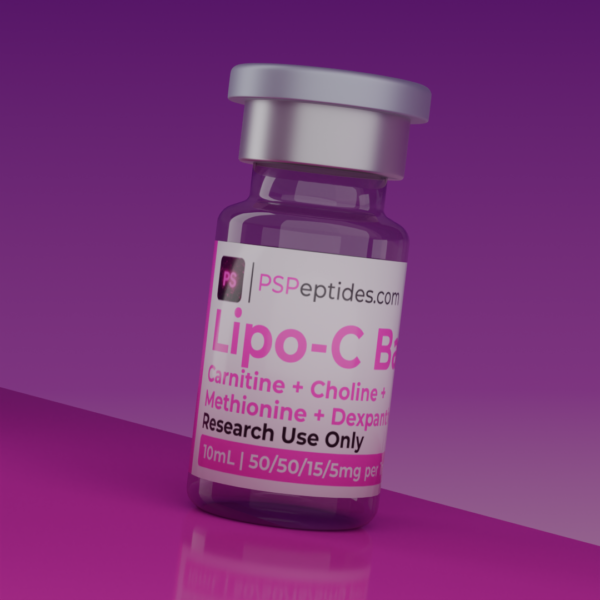
Lipo-C is a lipotropic injectable research formulation: a blend of compounds involved in mobilizing, transporting and oxidizing fat in laboratory models. The standard LC120 formula pairs L-carnitine, choline, methionine and dexpanthenol (provitamin B5) at 120 mg/mL total.
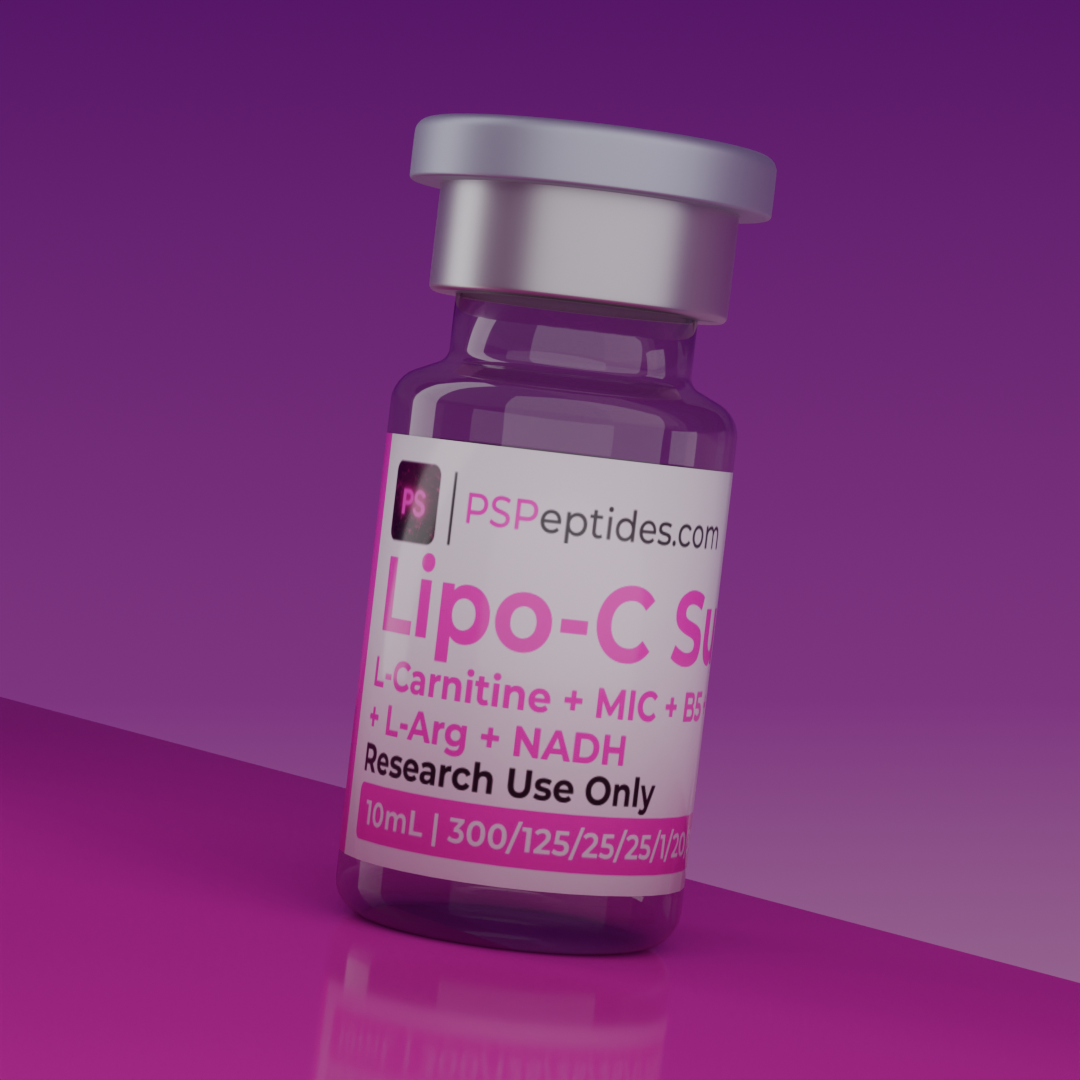
This upgraded LC526 version keeps that foundation, adds a 300 mg/mL L-carnitine fraction, and introduces NADH, the reduced form of nicotinamide adenine dinucleotide that feeds electrons into the mitochondrial electron transport chain. If you want to buy Lipo-C at its most complete, this is the vial.
Researchers who buy Lipo-C + L-Carnitine 300 + NADH get one pre-mixed solution covering fatty-acid transport, hepatic lipid processing and cellular energy production. New to this category? Start with our complete guide to research peptides and the best peptides for weight loss research overview.
Why Buy Lipo-C + L-Carnitine 300 + NADH From PSPeptides?
Most labs that buy Lipo-C online are choosing between a basic 120 mg/mL lipotropic and a premium formula. The LC526 vial delivers more than four times the total active concentration of the basic blend, so every 1 mL draw carries 526 mg of actives instead of 120 mg. For protocols that need higher carnitine exposure or an NADH cofactor, that concentration is the difference between one vial and several.
When you buy Lipo-C + L-Carnitine 300 + NADH from PSPeptides, the vial arrives ready to use, backed by a batch-specific certificate of analysis and shipped from the United States. Orders placed before 2 PM EST ship the same day, and orders over $200 ship free by UPS 2nd Day Air. You can also split payments with Afterpay or Klarna at checkout.
Prefer a lower-concentration starting point? Our Lipo-C Basic (LC120) vial covers the same four-ingredient foundation, and our NAD+ (1 Vial) is the pick for NAD-only protocols. Many researchers buy Lipo-C and NAD+ together to compare the reduced and oxidized cofactors side by side.
Detailed Mechanism of Action
L-carnitine and the carnitine shuttle. Long-chain fatty acids cannot cross the inner mitochondrial membrane on their own. Carnitine palmitoyltransferase I (CPT1) on the outer membrane converts fatty acyl-CoA into acylcarnitine, carnitine-acylcarnitine translocase (CACT) exchanges it across the inner membrane, and CPT2 regenerates acyl-CoA inside the matrix for β-oxidation. Roughly 95% of the body’s carnitine pool sits in skeletal muscle, where uptake depends on the OCTN2 transporter.
The dedicated 300 mg/mL L-carnitine fraction in this formula is what sets it apart from a standard lipotropic. Researchers who buy Lipo-C + L-Carnitine 300 + NADH typically do so to study carnitine-dependent fuel selection, acylcarnitine profiles, and the balance between fat and carbohydrate oxidation in metabolic models.
Choline and methionine: the lipotropic pair. Choline is converted through the CDP-choline (Kennedy) pathway into phosphatidylcholine, the phospholipid the liver needs to assemble and secrete very-low-density lipoprotein. Without enough phosphatidylcholine, triglycerides accumulate in hepatocytes, which is why choline deficiency produces fatty liver in both animal and human studies.
Methionine supports the same output from a second direction. It is the precursor of S-adenosylmethionine (SAM), the methyl donor that the PEMT enzyme uses to convert phosphatidylethanolamine into phosphatidylcholine. Methionine also feeds cysteine and glutathione synthesis, which is why labs studying oxidative stress often buy Lipo-C alongside a glutathione vial.
Dexpanthenol and coenzyme A. Dexpanthenol is converted to pantothenic acid, the building block of coenzyme A. Fatty acids must be activated to acyl-CoA before the carnitine shuttle can move them, and acetyl-CoA is the entry point to the citric acid cycle. Including provitamin B5 supports the activation step upstream of everything L-carnitine does.
NADH and the electron transport chain. NADH is the reduced form of nicotinamide adenine dinucleotide. It delivers electrons to Complex I, driving the proton gradient that ATP synthase uses to make ATP. β-oxidation itself generates NADH and FADH2, and the NAD+/NADH ratio acts as a metabolic signal through sirtuins (SIRT1 and SIRT3) and PGC-1α, regulators of mitochondrial biogenesis.
Pairing NADH with carnitine lets a single vial address both substrate delivery and the cofactor pool. That is the main reason researchers buy Lipo-C in this configuration rather than sourcing each component separately. For a mitochondria-focused peptide comparison, see our MOTS-c mitochondrial peptide guide.

Published Research
The carnitine literature is the deepest of the five components. Pooyandjoo and colleagues (2016) pooled nine randomized controlled trials with 911 adults and found that carnitine recipients lost significantly more weight than controls, a mean difference of −1.33 kg (95% CI −2.09 to −0.57), with BMI falling by −0.47 kg/m².
The authors noted the effect weakened over longer study durations. Read the abstract on PubMed (Pooyandjoo et al., Obesity Reviews 2016). This body-weight evidence is the most common reason metabolic labs buy Lipo-C formulas with a high carnitine fraction.
Wall and colleagues (2011) showed what carnitine loading does inside muscle. Fourteen healthy men took 2 g L-carnitine L-tartrate with 80 g carbohydrate twice daily for 24 weeks. Muscle total carnitine rose 21%, muscle glycogen use during exercise at 50% VO2max was 55% lower, and muscle lactate at 80% VO2max was 44% lower.
Work output increased 11% in the carnitine group. Body mass rose about 2.4 kg in the carbohydrate-only control group but did not change in the carnitine group. Full study: Wall et al., Journal of Physiology 2011.
For NADH, Forsyth and colleagues (1999) ran a randomized, double-blind, placebo-controlled crossover pilot in 26 patients with chronic fatigue syndrome. Four weeks of 10 mg stabilized oral NADH produced a favorable response in 31% of patients (8 of 26) versus 8% (2 of 26) on placebo, with no severe adverse effects; the authors called for larger trials. Abstract: Forsyth et al., Annals of Allergy, Asthma & Immunology 1999.
Choline’s status as an essential nutrient, and the link between choline deficiency and hepatic fat accumulation, is summarized in Zeisel and da Costa’s 2009 review in Nutrition Reviews. These are oral and clinical studies of individual components. They inform the research rationale for the blend but do not describe results from the injectable solution itself, which is supplied strictly for laboratory investigation.
Who Should Buy Lipo-C + L-Carnitine 300 + NADH?
This formula is built for labs that have outgrown a basic lipotropic. Metabolic research groups buy Lipo-C + L-Carnitine 300 + NADH to study carnitine-dependent fat oxidation at concentrations a 120 mg/mL vial cannot deliver without large injection volumes. Exercise physiology labs use it to model muscle carnitine loading and fuel selection, following the Wall protocol described above.
Mitochondrial and aging researchers buy Lipo-C with NADH because it lets them pair substrate delivery with the reduced cofactor in one solution, then compare against a separate NAD+ vial. Formulation and stability groups order it to characterize multi-component injectables, since the 526 mg/mL concentration makes it a demanding test article for solubility and degradation studies.
If your work only needs the four-ingredient foundation, the Lipo-C Basic vial is the better value. If you need carnitine dose, the NAD cofactor, or both, buy Lipo-C + L-Carnitine 300 + NADH and skip the extra vials.
Concentration Math for Research Protocols
Because this is a 526 mg/mL solution, protocol planning is a volume calculation rather than a reconstitution calculation. A 0.1 mL draw contains 52.6 mg of total actives, 0.5 mL contains 263 mg, and a full 1 mL contains 526 mg. The 10mL vial therefore holds 5,260 mg of combined actives, enough for one hundred 0.1 mL aliquots.
For cell-culture or small-animal work that requires lower concentrations, dilute a measured aliquot into sterile bacteriostatic water in a separate labeled vial and calculate the new mg/mL from the dilution factor. Keep the stock vial undiluted so the remaining contents stay at labeled strength. Labs that buy Lipo-C in the 5-pack usually dedicate one vial per study arm to avoid cross-contamination between protocols.
Lipo-C + L-Carnitine 300 + NADH vs Alternatives
| Feature | Lipo-C + L-Carnitine 300 + NADH (this product) | Lipo-C Basic (LC120) | NAD+ (1 Vial) |
|---|
| Total actives | 526 mg/mL | 120 mg/mL | NAD+ only (lyophilized) |
| L-carnitine | Base carnitine + dedicated 300 mg/mL fraction | 50 mg/mL | None |
| Choline / methionine / dexpanthenol | Included (Lipo-C base) | 50 / 15 / 5 mg/mL | None |
| NAD cofactor | NADH (reduced form) | None | NAD+ (oxidized form) |
| Form | Ready-to-use solution | Ready-to-use solution | Lyophilized powder |
| Reconstitution | Not required | Not required | Bacteriostatic water required |
| Research focus | Fat metabolism + mitochondrial energy in one vial | Baseline lipotropic studies | NAD+ metabolism only |
| Best for | Labs that want the highest concentration and the most complete formula | Entry-level or budget protocols | NAD-specific protocols |
In short: buy Lipo-C Basic when you need a simple four-ingredient lipotropic, buy NAD+ when the cofactor is the only variable you are testing, and buy Lipo-C + L-Carnitine 300 + NADH when you want both pathways covered at the highest concentration we offer. For stacking logic across products, our peptide stacking guide walks through how researchers pair metabolic compounds such as AOD-9604 and 5-Amino-1MQ.
Handling & Preparation
This is a pre-mixed liquid, so there is nothing to reconstitute, which is one reason busy labs buy Lipo-C rather than assembling the components themselves. Each 1 mL draw contains 526 mg of total actives; a 10mL vial therefore provides ten 1 mL aliquots or twenty 0.5 mL aliquots. Let the vial reach room temperature for a few minutes before drawing, swab the stopper with 70% alcohol, and use a fresh sterile syringe for every draw.
If a protocol calls for a lower concentration, dilute an aliquot with bacteriostatic water in a separate sterile vial rather than adding water to the stock vial. Our peptide dosage calculator guide explains how to work out volumes, and the reconstitution guide covers aseptic technique that applies to any multi-dose vial. Researchers comparing administration routes in animal models can read our subcutaneous vs intramuscular injection article.
Storage & Stability
Store the sealed vial refrigerated at 2–8°C and keep it in its carton. NADH is sensitive to light and oxidation, and several B-group compounds degrade faster when exposed to heat, so the refrigerator, not the benchtop, is the right home for this solution. Do not freeze; freezing can cause precipitation that does not fully redissolve. Plan refrigerator space before you buy Lipo-C in quantity.
Once the stopper has been punctured, follow the in-use window on the label, which for multi-dose research vials is typically 28 days, and discard the vial if you see discoloration, cloudiness or particulates. Our peptide storage guide and how to tell if a peptide has degraded article cover the signs to watch for.
Certificate of Analysis
Every batch ships with a certificate of analysis. The COA documents identity and purity of the raw materials by HPLC and mass spectrometry, plus the batch number and test date so you can match the paperwork to the vial on your bench. Before you buy Lipo-C from any vendor, ask for exactly this document.
If you have not read a COA before, our guide on how to read a peptide COA explains what the chromatogram and purity percentage mean. Labs that buy Lipo-C from us regularly can request the COA for any batch by email, phone or text.
Why Researchers Choose PSPeptides
- US Manufactured: Formulated and filled in the United States, never drop-shipped from overseas.
- Third-Party Tested: Independent HPLC and mass spectrometry with a batch-specific COA.
- Fast Shipping: Free UPS 2nd Day Air over $200, same-day dispatch before 2 PM EST.
- Flexible Payments: Credit cards, Afterpay, Klarna, Apple Pay and Google Pay.
- 7-Day Support: Email, phone or text, seven days a week.
Choosing a supplier matters as much as choosing a compound. Our article on how to choose a research peptide supplier lists the questions to ask any vendor before you buy Lipo-C or any other research product.
How to Buy Lipo-C + L-Carnitine + NADH Online
Ordering takes about a minute. Select the single 10mL vial (or the 5-pack when you need to stock a longer study), add it to your cart, and check out with a credit card, Apple Pay, Google Pay, or a split-payment plan through Afterpay or Klarna. Orders placed before 2 PM EST ship the same business day from the US, and orders over $200 qualify for free UPS 2nd Day Air.
There is no minimum order and no account required to buy Lipo-C online from PSPeptides, although creating one lets you reorder in two clicks and track every shipment. International researchers should check local import rules before ordering; our support team can advise on documentation.
Add a vial of NAD+, MOTS-c or glutathione to the same order to build out a mitochondrial research panel, or explore the Shred Express bundle for a pre-assembled metabolic stack. Every product ships with a COA, and our support team answers questions seven days a week.
Frequently Asked Questions
What is the difference between Lipo-C Basic and Lipo-C + L-Carnitine 300 + NADH?
Lipo-C Basic (LC120) contains carnitine 50, choline 50, methionine 15 and dexpanthenol 5 mg/mL for a total of 120 mg/mL. The LC526 formula keeps that base and adds a 300 mg/mL L-carnitine fraction plus NADH, reaching 526 mg/mL of total actives. Buy Lipo-C Basic for a simple lipotropic and buy Lipo-C + L-Carnitine 300 + NADH when carnitine dose and the NAD cofactor matter to your protocol.
Does this vial need to be reconstituted?
No. It is a ready-to-use liquid solution. Draw the volume your protocol requires with a sterile syringe and return the vial to the refrigerator. If you need a lower concentration, dilute an aliquot with bacteriostatic water in a separate vial.
Is NADH the same as NAD+?
They are two forms of the same coenzyme. NAD+ is the oxidized form and NADH is the reduced form carrying the electrons that enter Complex I of the electron transport chain. Researchers studying redox balance often buy Lipo-C with NADH and a separate NAD+ vial so both forms can be compared under the same conditions.
How should I store Lipo-C + L-Carnitine 300 + NADH?
Refrigerate at 2–8°C, protect from light, and do not freeze. After the first puncture, follow the label’s in-use window and discard the vial if the solution changes color or develops particulates.
Is it legal to buy Lipo-C for research?
PSPeptides sells research compounds to laboratories and qualified researchers for in-vitro and animal studies. They are not approved for human use and are not sold for that purpose. Our article on whether research peptides are legal in 2026 explains the regulatory landscape in detail.
Can I buy Lipo-C in bulk?
Yes. Choose the 5-pack option on this page for multi-vial pricing, or contact support for larger institutional quantities. Orders over $200 ship free by UPS 2nd Day Air.
How quickly will my order ship?
Orders placed before 2 PM EST ship the same business day from our US facility. Vials ship cold-chain protected, and tracking is emailed as soon as the label is created.
Can I see the COA before I buy Lipo-C + L-Carnitine 300 + NADH?
Yes. Email, call or text our support team with the product name and we will send the current batch COA. Every shipment also includes the certificate for the exact lot you receive.
What is the shelf life of an unopened vial?
Unopened vials stored refrigerated and protected from light are good through the expiration date printed on the label. Once punctured, follow the in-use window on the label and the storage guidance above. Labs that buy Lipo-C in multi-vial packs should keep spare vials sealed until needed.
Related Research Products
Related Resources
All PSPeptides products are sold exclusively for laboratory and research use. Not intended for human consumption.





 Made & Shipped