MGF is the 24-amino-acid C-terminal E-domain peptide derived from IGF-1Ec, a splice variant of the insulin-like growth factor 1 gene that is upregulated in skeletal muscle after mechanical loading or damage. Unlike systemic IGF-1 produced by the liver, this isoform acts locally at the site of stress.
Researchers who buy MGF are typically studying the first phase of the muscle repair cascade: the expansion of the satellite (stem) cell pool that precedes differentiation and fusion. For broader background on growth factor peptides, see our complete guide to research peptides.
Detailed Mechanism of Action: Why Researchers Buy MGF
The IGF-1 gene contains six exons that can be alternatively spliced into several transcripts. In human skeletal muscle, a 49-base-pair insert in exon 5 shifts the reading frame and produces IGF-1Ec, the transcript commonly called mechano growth factor. Cleavage of the pro-peptide releases two distinct products: the familiar 70-amino-acid mature IGF-1, and the unique C-terminal E-domain that gives MGF its name.
That E-domain is the molecule in this vial. The central hypothesis in the field is that it acts independently of the IGF-1 receptor, signaling instead through a separate, still incompletely mapped pathway. This proposed receptor independence is a major reason laboratories buy MGF rather than relying on mature IGF-1 alone in proliferation assays.
In the two-signal model advanced by the Goldspink group, the E-domain peptide arrives first. It recruits quiescent satellite cells into the cell cycle, expanding the mononucleated myoblast pool while holding terminal differentiation in check. Mature IGF-1 then drives those expanded progenitors to fuse into myotubes and upregulate protein synthesis. Teams that buy MGF are usually probing the first half of that sequence.
Expression is mechanosensitive, which is the origin of the name. Transcript levels rise sharply after stretch, electrical stimulation combined with loading, or frank muscle damage, then fall as splicing shifts toward IGF-1Ea. Reported downstream effects include PKC-dependent signaling, Nrf2 translocation, and heme oxygenase-1 induction, alongside pro-migratory activity on human myogenic precursor cells. Related mechanisms are discussed in our peptides for muscle growth and recovery guide.

Published Research on MGF
The foundational mechanistic paper is Yang and Goldspink (2002, FEBS Letters 522:156-160), which compared the IGF-1 Ec peptide against mature IGF-1 in C2C12 myoblast culture. The authors reported that the E-domain increased myoblast proliferation while inhibiting terminal differentiation — the opposite profile to mature IGF-1. The full abstract is available on PubMed, and this remains the single most-cited reference for groups that buy MGF.
Kandalla and colleagues (2011, Mechanisms of Ageing and Development; PMID 21354439) extended the work into human primary cells, reporting that synthetic MGF-E peptide activated human muscle progenitor cells and increased fusion potential, with a diminished response in cells from older donors. Ates et al. (2007, FEBS Letters) reported increased progenitor cell numbers in cultures from healthy, dystrophic, and ALS muscle.
The literature is genuinely contested, and serious laboratories should know that before they buy MGF. The 2010 Endocrinology minireview by Matheny, Nindl and Adamo argued that evidence for an endogenous MGF peptide product of the Igf1 gene in vivo is inadequate. Fornaro and colleagues (2014, Am J Physiol Endocrinol Metab; PMID 24253050) reported that concentrations up to 500 ng/ml produced no proliferative response in C2C12 or primary human myoblasts, while mature IGF-1 and full-length IGF-1Eb did. That disagreement is precisely why reproducible, high-purity material matters.
MGF vs Alternatives
| Feature | MGF | IGF-1 LR3 | CJC-1295 / Ipamorelin |
|---|
| Molecule class | IGF-1Ec C-terminal E-domain | Modified full-length IGF-1 analog | GHRH analog + ghrelin mimetic |
| Primary studied action | Satellite cell activation, proliferation | IGF-1 receptor signaling, differentiation | Upstream GH pulse induction |
| Receptor dependence | Proposed IGF-1R independent | IGF-1R dependent | GHRH-R and GHS-R dependent |
| Site of action in models | Local, mechanically stressed tissue | Systemic and local | Systemic (pituitary axis) |
| Reported plasma stability | Short; native E-peptide degrades rapidly | Extended vs native IGF-1 | Extended (CJC-1295) |
| Differentiation effect | Reported to delay or inhibit | Reported to promote | Indirect |
| Typical research pairing | Proliferation-phase studies | Fusion-phase studies | Endocrine axis studies |
| Vial format here | 2mg lyophilized, COA included | Varies by listing | Varies by listing |
Comparative selection criteria across suppliers and molecules are covered in our CJC-1295 and Ipamorelin research guide.
Reconstitution & Handling of MGF
MGF arrives as a lyophilized powder under vacuum. Allow the vial to reach room temperature before opening, then introduce bacteriostatic water slowly down the inner wall of the vial rather than directly onto the powder cake. Do not shake. Swirl gently until the solution is clear.
A common laboratory working concentration is reached by adding 2ml of bacteriostatic water to the 2mg vial, giving 1000mcg per ml. Adding 1ml instead gives 2000mcg per ml for protocols that call for smaller withdrawal volumes. Our peptide dosage calculator guide walks through the arithmetic for any target concentration.
Step-by-step technique, including vial venting and sterile transfer, is covered in our how to reconstitute peptides guide. If you are unfamiliar with the diluent itself, see what is bacteriostatic water. Laboratories that buy MGF should order diluent in the same transaction so reconstitution is not delayed on arrival.
Storage & Stability
Store the sealed lyophilized vial at -20°C, protected from light. In this state the peptide is stable for extended periods and tolerates brief ambient shipping transit without meaningful loss, which is why vials ship without cold chain.
Once reconstituted, store at 2-8°C and protect from light. Short peptides in solution are considerably less stable than lyophilized material, and repeated freeze-thaw cycling should be avoided entirely. Aliquot if the protocol requires many withdrawals over time.
The native E-domain peptide is reported to have a short plasma half-life, a point raised repeatedly in the literature and in patent filings on stabilized analogs. Comparative half-life data across research peptides is collected in our peptide half-life chart, and degradation indicators are described in our guide to spotting degraded peptides. General handling rules are in the peptide storage guide.
Certificate of Analysis
Every vial ships with a batch-specific certificate of analysis. The COA reports identity by mass spectrometry and purity by HPLC, with the chromatogram and the measured purity figure for the exact lot in your hands — not a representative document from an earlier batch.
Given the published disagreement over MGF activity in cell culture, lot-level verification is not a formality. A null result obtained with unverified material tells you nothing about the molecule. Researchers who buy MGF for replication work should file the COA alongside their experimental records.
If you are new to reading chromatograms, our guide to peptide purity and reading a COA explains what the peaks, retention times, and percentage figures actually mean.
Why Researchers Choose PSPeptides When They Buy MGF
- US Manufactured: Synthesized domestically, not drop-shipped from overseas resellers.
- Third-Party Tested: Independent HPLC and mass spectrometry on every batch, 99%+ purity.
- Fast Shipping: Free UPS 2nd Day Air over $150, same-day dispatch on orders before 2 PM EST.
- Flexible Payments: Credit cards, Afterpay, Klarna, Apple Pay, and Google Pay.
- 7-Day Support: Email, phone, or text, including reconstitution and storage questions.
- Batch COA Included: Lot-specific documentation with every vial, no request needed.
Supplier evaluation criteria are laid out in our guide to choosing a research peptide supplier and our best peptide companies of 2026 comparison.
MGF in the Muscle Repair Timeline
Mechanical loading does not trigger a single growth signal. It triggers a sequence, and the value of the E-domain peptide to a research program is that it isolates the opening move of that sequence rather than the whole cascade.
In the model drawn from stretch and stimulation experiments in rabbit and rodent muscle, the IGF-1Ec transcript rises within hours of damage and persists for roughly a day. Splicing then shifts toward IGF-1Ea, which supplies the mature IGF-1 that sustains protein synthesis through the longer repair window.
That ordering is the practical argument for the molecule. A laboratory that wants to manipulate progenitor pool size before differentiation begins has few clean tools, which is a large part of why groups buy MGF rather than loading cultures with IGF-1 and trying to separate the effects afterward.
Age changes the picture. Reduced transcript expression in older muscle has been proposed as one contributor to the declining repair capacity seen in sarcopenia models, and Kandalla and colleagues reported a blunted response in progenitor cells from older donors. Investigators who buy MGF for ageing work generally build donor age directly into the design rather than treating it as a nuisance variable.
Synthesis and Quality Control
This peptide is produced by solid-phase synthesis in the United States, then purified and assayed before release. Identity is confirmed by mass spectrometry against the expected molecular weight, and purity is quantified by reverse-phase HPLC.
Release criteria are fixed at 99%+ purity. Lots that do not meet that threshold are not sold. The reason for holding a hard line is specific to this molecule: when published results conflict, impurity or misidentified material becomes an obvious confound, and a cheap vial that fails to replicate is far more expensive than the price difference.
Short E-domain peptides are also prone to degradation in solution, so lyophilization conditions and vial sealing are part of the quality picture rather than packaging details. Laboratories that buy MGF repeatedly tend to care more about lot-to-lot consistency than about headline purity alone, and batch documentation is what makes that consistency auditable.
Ordering, Shipping and Support
Orders placed before 2 PM EST on business days ship the same day. Domestic orders over $150 ship free via UPS 2nd Day Air, and tracking is issued automatically when the label is created.
Checkout accepts major credit cards, Afterpay, Klarna, Apple Pay, and Google Pay, so research groups working against a purchase order or a split budget have options. Customers who buy MGF alongside bacteriostatic water and other supplies consolidate into a single shipment.
Support runs seven days a week by email, phone, or text, and covers reconstitution volumes, storage questions, COA interpretation, and order status. If a vial arrives damaged, contact support with photographs and we will replace it.
Compliance and Intended Use
Everything on this page describes laboratory research. This product is not a drug, not a supplement, and not approved by any regulatory agency for human use. It is sold to researchers, institutions, and laboratories only.
MGF is prohibited in sport under WADA category S2 as a growth factor, and analytical methods for detecting biotechnologically produced material in doping control have been published. Anyone who intends to buy MGF should be clear that the legitimate use case is in vitro and preclinical work. Current regulatory background is summarized in our guide to research peptide legality in 2026.
By completing a purchase you confirm that you are at least 21 years of age and that the material will be used strictly for research purposes.
Buy MGF Online: What to Check Before You Order
Not all listings are equivalent, and the differences are not cosmetic. Before you buy MGF from any vendor, confirm four things: the stated amount per vial, the purity figure, whether a lot-specific COA is included, and where the material was synthesized.
Amount per vial is the most common source of confusion, because listings are quoted in milligrams while protocols are written in micrograms. This vial contains 2mg, or 2000mcg. Laboratories that buy MGF for the first time should run the dilution arithmetic before ordering so the vial count matches the planned concentration series.
Purity claims mean little without a chromatogram attached to your lot number. A generic certificate posted on a product page is not lot verification. When you buy MGF here, the COA travels with the vial.
Origin matters for consistency. Domestic synthesis with release testing produces tighter lot-to-lot behavior than repackaged bulk material of unclear provenance. For the underlying biology behind these comparisons, Kandalla and colleagues’ human muscle progenitor cell study on PubMed is a useful starting point. Researchers who buy MGF for replication work should hold suppliers to all four criteria.
Research Context and Study Design Notes
Because the field contains both positive and null findings, study design matters more here than with better-settled molecules. Investigators who buy MGF for proliferation assays typically run mature IGF-1 as a positive control in parallel, so that a flat response can be distinguished from an inactive assay.
Concentration range is the second common variable. Published work spans a wide range, and at least one null report tested up to 500 ng/ml without a proliferative effect. Documenting the exact concentration series, cell line, passage number, and serum conditions is what makes a result comparable to the existing literature.
Timing is the third. The endogenous transcript appears as a short pulse after mechanical damage and then subsides as splicing shifts toward IGF-1Ea. Protocols that model that pulse rather than continuous exposure are closer to the physiology the hypothesis describes.
Finally, consider the comparator molecule. Pairing with an IGF-1 analog separates receptor-dependent from proposed receptor-independent effects, which is the central claim under test whenever laboratories buy MGF for mechanistic work.
Frequently Asked Questions
What exactly am I getting when I buy MGF from PSPeptides?
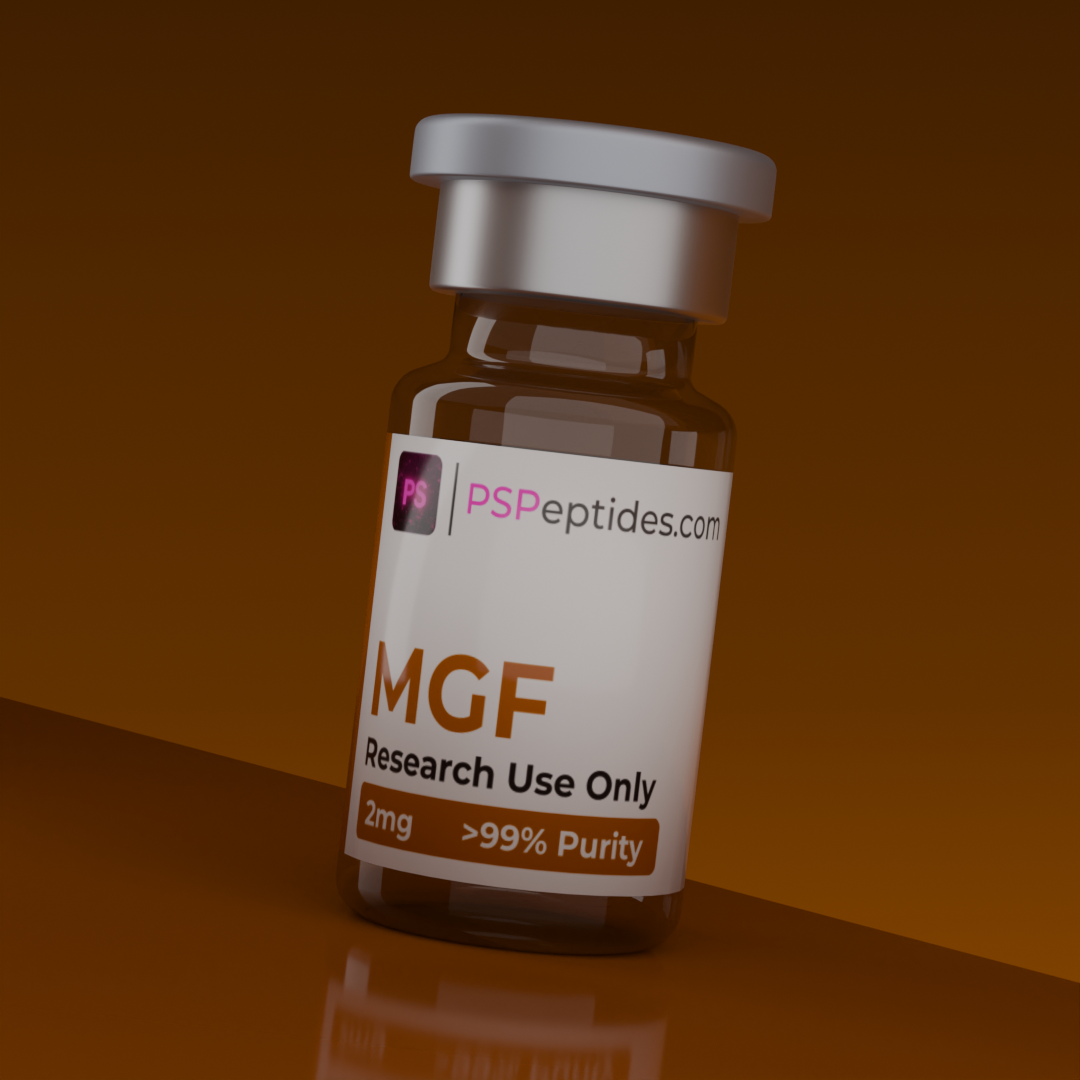
You receive one sealed vial containing 2mg of lyophilized MGF peptide at 99%+ purity, plus the batch-specific certificate of analysis for that lot. Bacteriostatic water is sold separately and is required for reconstitution.
How is MGF different from IGF-1?
MGF is the C-terminal E-domain fragment of the IGF-1Ec splice variant, not full-length IGF-1. Mature IGF-1 signals through the IGF-1 receptor to drive differentiation, while the E-domain peptide is studied for proliferative and satellite-cell-activating effects proposed to be receptor independent.
Does MGF need to be refrigerated during shipping?
No. Lyophilized peptide is stable through standard ambient transit, which is why vials ship without cold packs. Move the vial to -20°C storage on arrival, and keep reconstituted solution at 2-8°C.
Is the research on MGF settled?
No, and we would rather say so plainly. Positive findings from the Goldspink group and others are counterbalanced by a 2010 Endocrinology minireview questioning the in vivo evidence and a later null result in myoblast culture. Both sides of that literature are linked above.
Can I buy MGF for personal or human use?
No. All PSPeptides products are sold exclusively for laboratory and research use and are not intended for human or veterinary consumption. MGF is also prohibited in sport under WADA category S2.
What else should I order alongside MGF?
Most laboratories that buy MGF also need bacteriostatic water for reconstitution and appropriate sterile transfer supplies. Many pair it with an IGF-1 analog for comparative proliferation and differentiation work.
Related Resources
All PSPeptides products are sold exclusively for laboratory and research use. Not intended for human consumption.





 Made & Shipped