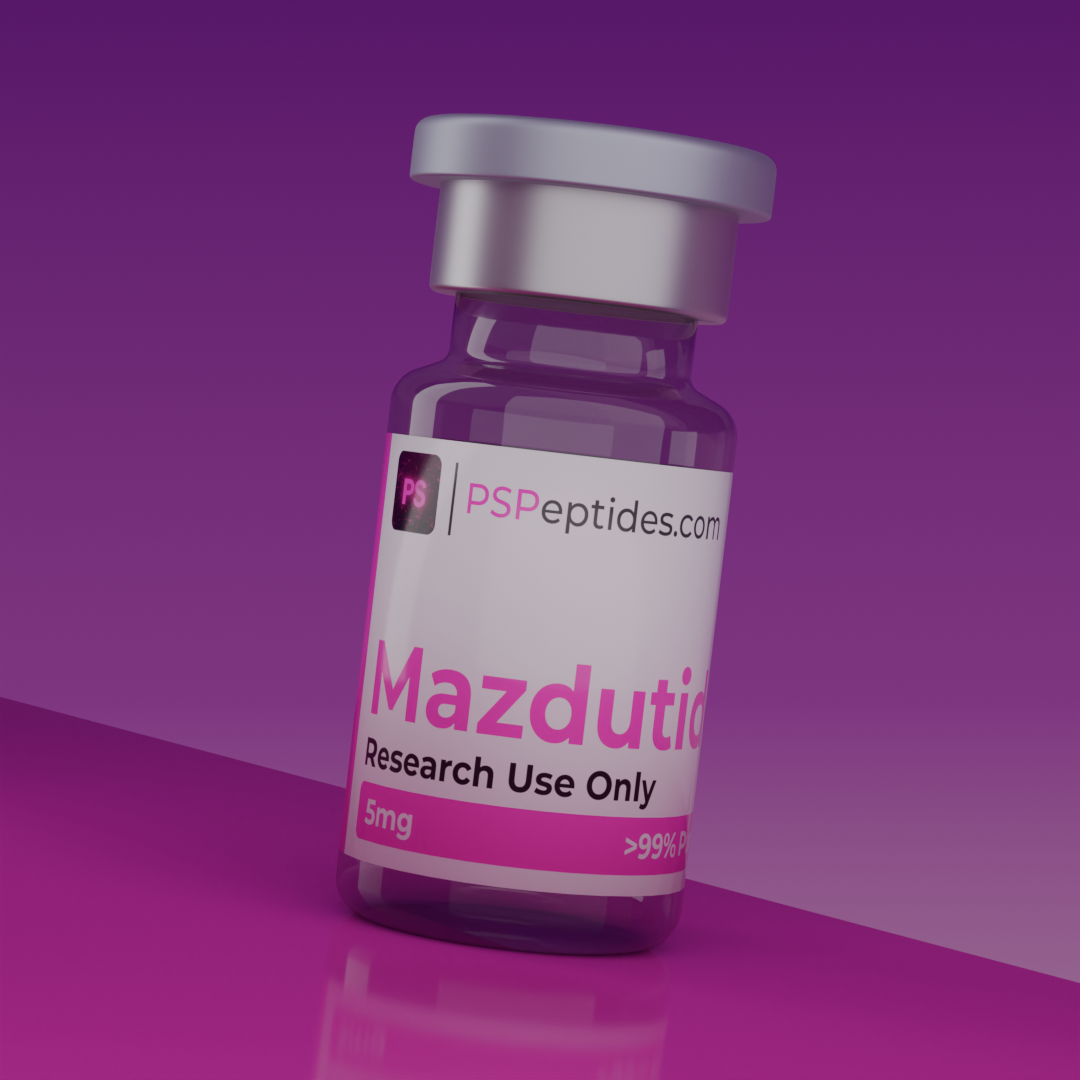
Mazdutide (1 Vial)
$54.99
Mazdutide (1 Vial) — buy Mazdutide, a dual GLP-1/glucagon receptor agonist research peptide from PSPeptides, available in a 5mg vial.
- Purity: 99%+ verified via third-party HPLC
- Form: Lyophilized powder
- Testing: Batch-specific COA included
- Shipping: Free UPS 2nd Day Air on orders over $200
For laboratory and research use only.
Vials count across your whole order — mix any peptides and sizes.
40% OFF Need 10+ vials? Build your own kit — 40% off every vialView older reports




 Made & Shipped
For laboratory and research use only. This product is not a drug, food, or cosmetic and is not for human or animal consumption. It is not intended to diagnose, treat, cure, or prevent any disease. These statements have not been evaluated by the FDA. Sold solely to qualified researchers and licensed laboratories. Certificate of Analysis available on request.
Mazdutide protocol reference
What the published research and common laboratory protocols report for this compound, in one place. Figures are a reference for designing a study, not instructions.
Reconstitution & syringe units
Units are for a standard U-100 insulin syringe (100 units = 1 mL). Add the water slowly down the inside of the vial, swirl gently — never shake — and refrigerate.
| Vial | Add BAC water | Concentration | 2 mg dose | 4 mg dose |
|---|---|---|---|---|
| 5MG | 2 mL | 2.5 mg/mL | 80 units | 160 units (2 draws) |
Over 100 units is more than one full 1 mL (100-unit) syringe — split the dose across the number of draws shown.
Different water volume? Use the dosage calculator — it does the units for any concentration.
GLORY-1 used 4 mg and 6 mg maintenance; 9 mg was studied in later phase work.
For laboratory and research use only. This product is not a drug, food, cosmetic or dietary supplement and is not for human or animal consumption. The figures above summarise published studies and common research protocols; they are not medical advice or instructions for use. These statements have not been evaluated by the FDA.
Description
Buy Mazdutide — a dual GLP-1/glucagon receptor agonist research peptide, available from PSPeptides in a 5mg vial. Every batch is manufactured in the US and verified to 99%+ purity through independent third-party testing. Researchers buy Mazdutide primarily to study body weight regulation, appetite signaling, and glucose metabolism, making it one of the most closely watched dual-agonist peptides in current incretin research, and a compound many labs now buy Mazdutide specifically to add to their comparative research pipeline.
What Is Mazdutide?
Mazdutide, also known by its development code IBI362, is a synthetic peptide engineered to activate both the glucagon-like peptide-1 receptor (GLP-1R) and the glucagon receptor (GCGR). This dual-agonist mechanism sets Mazdutide apart from single-target incretin peptides and places it alongside other emerging dual and triple agonists in current metabolic research.
In published trials, Mazdutide has been administered on a once-weekly subcutaneous schedule, a dosing pattern common among GLP-1-class research peptides. Researchers frequently compare Mazdutide against other GLP-1-based compounds such as semaglutide, tirzepatide, and retatrutide. For more background on how these peptides differ, see our comparison of leading GLP-1 research peptides.
Mechanism of Action: How Mazdutide Works
Mazdutide’s dual-receptor design is what distinguishes it in the research literature. By activating GLP-1R, Mazdutide engages the same pathway used by semaglutide and liraglutide, which is associated with slowed gastric emptying, increased satiety signaling, and glucose-dependent insulin secretion in preclinical models.
The second target, GCGR, is the receptor normally activated by glucagon. Concurrent activation of this receptor alongside GLP-1R is theorized to increase energy expenditure and hepatic glucose output regulation, a combination researchers believe may distinguish Mazdutide’s metabolic profile from single-target GLP-1 agonists. This dual mechanism is why many labs buy Mazdutide specifically for comparative receptor-pathway studies rather than as a straightforward GLP-1 substitute.
Mazdutide Research and Development Timeline
Mazdutide was developed by Innovent Biologics under the development code IBI362. Early-phase trials in China evaluated its safety and tolerability profile, followed by phase 2 studies in adults with type 2 diabetes and in adults with obesity or overweight. Later-phase trials expanded the dataset on glycemic and body-weight endpoints, cementing Mazdutide’s place among the current generation of dual and multi-agonist incretin peptides under active investigation.
Researchers who buy Mazdutide for comparative work often reference this development history to contextualize study design, since the compound’s clinical trial footprint is still smaller than more established GLP-1 agonists like semaglutide.
Key Research Applications of Mazdutide
- Body Weight Regulation: Mazdutide is studied for its effect on appetite signaling pathways and reduction of fat mass in research models.
- Glycemic Control: Clinical research has examined Mazdutide’s influence on insulin secretion and glucose homeostasis in models of type 2 diabetes.
- Energy Expenditure: The glucagon receptor component of Mazdutide is of interest for its role in hepatic glucose output and lipid metabolism.
- Neurometabolic Research: Preclinical work has begun exploring how dual GLP-1R/GCGR agonism may relate to diabetes-associated cognitive changes, an emerging area of peptide research.
- Lipid Metabolism: Researchers have examined how dual-receptor agonism affects lipid handling and hepatic fat accumulation in metabolic disease models.
- Comparative Incretin Research: Mazdutide is commonly used in comparative studies alongside other peptides researched for weight management.
Comparing Mazdutide to Other GLP-1 Research Peptides
Unlike single-target GLP-1 agonists, Mazdutide’s dual GLP-1R/GCGR activity differs from the GIP/GLP-1 approach used by tirzepatide and from the triple-agonist design of retatrutide. Researchers typically choose between these compounds based on which receptor pathways are relevant to their study design. Our comparison of retatrutide and tirzepatide research peptides outlines these mechanistic differences in more detail.
| Peptide | Receptor Targets | Class | Reported Dosing Frequency |
| Mazdutide | GLP-1R / GCGR | Dual agonist | Once weekly |
| Semaglutide | GLP-1R | Single agonist | Once weekly |
| Tirzepatide | GIP / GLP-1R | Dual agonist | Once weekly |
| Retatrutide | GIP / GLP-1R / GCGR | Triple agonist | Once weekly |
This side-by-side view is one reason many researchers buy Mazdutide alongside other incretin peptides — it allows direct comparative study of dual- versus single- versus triple-receptor agonism within the same lab.
Who Uses Mazdutide in Research Settings
Laboratories that buy Mazdutide range from academic metabolic research groups to contract research organizations running comparative incretin studies. Because Mazdutide’s dual-receptor profile is still less thoroughly characterized than semaglutide’s, it is frequently selected for studies specifically designed to isolate the contribution of glucagon receptor activation within a broader GLP-1 research program.
Mazdutide Product Specifications
| Amount | 5mg per vial |
| Purity | 99%+ (verified via third-party HPLC and mass spectrometry) |
| Form | Lyophilized (freeze-dried) powder |
| Storage | Store at -20°C (lyophilized) or 4°C (reconstituted, use within 28 days) |
| Testing | Batch-specific Certificate of Analysis (COA) included |
| Origin | US manufactured |
Note: PSPeptides offers Mazdutide in a single 5mg vial size.
Quality Assurance and Testing at PSPeptides
Every time a researcher chooses to buy Mazdutide from PSPeptides, that vial has passed through a multi-step verification process. Incoming raw peptide is tested for identity and purity, and finished vials undergo an additional round of batch-specific testing before they are released for sale.
This two-stage approach is designed to catch degradation, contamination, or synthesis errors before product reaches a research lab. Combined with US-based manufacturing, this process is central to why researchers consistently buy this peptide and other peptides from PSPeptides rather than unverified suppliers.
Certificate of Analysis
Every vial of Mazdutide from PSPeptides ships with a batch-specific Certificate of Analysis documenting purity verification via HPLC and identity confirmation via mass spectrometry. COAs are available for download on the product page or upon request. Learn more about how to read a peptide COA.
Reconstitution & Handling
Mazdutide is supplied as a lyophilized powder and requires reconstitution with bacteriostatic water before use. For step-by-step instructions, see our complete peptide reconstitution guide. Use our free peptide reconstitution calculator to determine exact volumes for your research concentration.
Handling and Storage Best Practices
Proper storage extends the usable life of lyophilized Mazdutide. Unopened vials should be kept frozen at -20°C and protected from light. Once reconstituted, store the solution refrigerated at 4°C and use within 28 days for best stability.
Avoid repeated freeze-thaw cycles, which can degrade peptide integrity over time, and avoid excessive agitation when reconstituting. For a full overview of best practices, see our peptide storage guide.
Dosing Considerations Reported in Published Research
Published trials of Mazdutide have evaluated a range of doses, generally administered once weekly by subcutaneous injection, with dose escalation protocols used to improve tolerability. Reported research doses have varied across phase 2 and phase 3 studies depending on the endpoint under investigation, whether glycemic control or body weight change.
These figures are provided strictly as a summary of what has appeared in the peer-reviewed literature and are not usage instructions. Anyone who chooses to buy it for laboratory research should design their own protocol in line with their institution’s research and safety standards.
Published Mazdutide Research
Peer-reviewed trials have evaluated Mazdutide in both glycemic and weight-management contexts. A randomized, placebo-controlled phase 2 trial reported HbA1c reductions among adults with type 2 diabetes (Zhang et al., Diabetes Care, 2024), while a separate trial reported body weight reductions in Chinese adults with obesity or overweight (once-weekly Mazdutide obesity trial). These findings continue to inform how researchers design comparative incretin studies and remain a key reference point for anyone deciding to buy the compound for their own work.
Ordering, Shipping, and Support
PSPeptides ships Mazdutide and other research peptides via UPS, with free 2nd Day Air on orders over $200 and same-day dispatch on orders placed before 2 PM EST. Every order that includes Mazdutide is packaged with temperature-conscious handling to help preserve peptide integrity during transit.
Customer support is available seven days a week by email for researchers who have questions before or after they buy this peptide, including help locating a batch-specific COA.
Why Buy Mazdutide From PSPeptides
- US Manufactured: All peptides are synthesized in US-based facilities
- Third-Party Tested: Independent HPLC and mass spectrometry verification on every batch
- Fast Shipping: Free UPS 2nd Day Air on orders over $200, same-day dispatch before 2 PM EST
- Flexible Payments: Credit cards, Afterpay, Klarna, Apple Pay, Google Pay
- Responsive Support: 7-day customer service via email
Researchers who buy the compound from PSPeptides can expect consistent batch quality every time. For a broader overview of how Mazdutide fits into current research peptide options, see our complete guide to research peptides or learn how to choose a research peptide supplier.
Understanding GLP-1/GCGR Dual Agonism
To understand why researchers buy this peptide, it helps to understand incretin biology more broadly. GLP-1 is a naturally occurring hormone released from the gut in response to food intake, and it plays a central role in glucose-stimulated insulin secretion. Peptides that activate GLP-1R, including semaglutide and liraglutide, are designed to mimic or prolong this natural signal.
Glucagon, acting through GCGR, has traditionally been associated with raising blood glucose by stimulating hepatic glucose output. Pairing GLP-1R activation with GCGR activation, as Mazdutide does, is a comparatively newer research strategy intended to add glucagon’s effects on energy expenditure without losing the glucose-lowering benefit of GLP-1R activation. This balance is precisely what makes Mazdutide such a frequently discussed molecule in dual-agonist literature.
Because this area of pharmacology is still evolving, many labs buy it specifically to generate their own head-to-head data rather than relying solely on published trials. This is one of the most common reasons cited by research groups when explaining why they buy the compound alongside single-target GLP-1 compounds already in their inventory.
Common Research Protocols Involving Mazdutide
Laboratories that buy this peptide typically incorporate it into existing metabolic research protocols already used for other incretin peptides, including body composition tracking, glucose tolerance testing, and biomarker panels for lipid metabolism. Because Mazdutide is administered on a weekly schedule in published research, many labs align their sampling and observation windows accordingly.
Some research groups also use Mazdutide in dose-ranging studies to characterize its effects at different concentrations, drawing on the phase 2 and phase 3 trial designs published in the literature as a starting framework. As with any research peptide, protocol design should always be guided by institutional review standards rather than by marketing material.
Safety and Handling Precautions for Laboratory Use
As with all lyophilized research peptides, Mazdutide should be handled using standard laboratory safety practices: gloves, a clean work surface, and sterile technique when reconstituting with bacteriostatic water. Vials should be inspected before use, and any vial showing discoloration, clouding, or particulate matter should not be used.
Researchers who buy it should also maintain a simple chain-of-custody log noting reconstitution date, storage temperature, and COA batch number, which makes it easier to trace results back to a specific vial if questions arise during data review.
Peptide Purity and Why It Matters for Mazdutide Research
Purity is one of the most important variables in any peptide research protocol, and it is a major reason researchers specifically buy the compound from suppliers that publish third-party COAs rather than relying on synthesis claims alone. Impurities or degraded peptide can introduce confounding variables into a study, making results difficult to reproduce.
PSPeptides verifies Mazdutide purity using HPLC (high-performance liquid chromatography), which measures how much of the vial’s content is the intended peptide versus synthesis byproducts, and mass spectrometry, which confirms the molecule’s identity by measuring its mass. Together, these two methods give researchers a documented, batch-specific purity and identity profile before they even open the vial.
Choosing a Research Peptide Supplier
Because the research peptide market includes suppliers with widely varying quality control standards, many researchers evaluate several factors before deciding where to buy this peptide: third-party testing practices, country of manufacture, batch traceability, and transparency around COA availability. Our guide on how to choose a research peptide supplier covers these evaluation criteria in more depth.
PSPeptides publishes batch-specific documentation for every peptide sold, including Mazdutide, so researchers do not have to take purity claims on faith.
Glossary of Key Terms
GLP-1R: Glucagon-like peptide-1 receptor, a target involved in insulin secretion and appetite regulation.
GCGR: Glucagon receptor, involved in hepatic glucose output and energy expenditure.
Lyophilized: Freeze-dried into a stable powder form for extended shelf life prior to reconstitution.
HPLC: High-performance liquid chromatography, a method used to verify peptide purity.
COA: Certificate of Analysis, a document confirming a specific batch’s purity and identity test results.
Frequently Asked Questions
Is Mazdutide the same as semaglutide or tirzepatide? No. Mazdutide is a distinct dual GLP-1R/GCGR agonist, while semaglutide is a single-target GLP-1 agonist and tirzepatide targets both GIP and GLP-1 receptors.
What vial size does Mazdutide come in? PSPeptides offers Mazdutide in a 5mg lyophilized vial.
Does every Mazdutide order include a Certificate of Analysis? Yes — each batch ships with a COA verifying purity and identity via HPLC and mass spectrometry.
Who developed Mazdutide? Mazdutide was developed by Innovent Biologics under the development code IBI362, and it has since been studied in multiple published clinical trials.
Why do researchers buy it instead of a single-target GLP-1 peptide? Researchers often Mazdutide specifically to study the added effects of glucagon receptor activation alongside GLP-1 receptor activation, which cannot be studied using single-target compounds.
How should Mazdutide be stored before use? Store unopened, lyophilized Mazdutide at -20°C, and once reconstituted, keep it refrigerated at 4°C and use within 28 days.
Can Mazdutide be used interchangeably with tirzepatide in a study? No. Mazdutide and tirzepatide activate different receptor combinations (GLP-1R/GCGR versus GIP/GLP-1R), so they are not considered interchangeable for research purposes even though both are weekly dual agonists.
Does PSPeptides ship Mazdutide internationally? Shipping availability can vary by destination; researchers should check current shipping options at checkout before placing an order.
What payment methods can I use to buy the compound? PSPeptides accepts major credit cards along with Afterpay, Klarna, Apple Pay, and Google Pay.
The Growing Role of Multi-Agonist Peptides in Metabolic Research
Mazdutide belongs to a broader wave of multi-agonist incretin peptides that have reshaped metabolic research over the past several years. Where earlier research relied heavily on single-target GLP-1 agonists, newer compounds like Mazdutide, tirzepatide, and retatrutide reflect an effort to model combined receptor activity that may better approximate the body’s natural hormonal signaling network.
This shift matters for anyone deciding to buy this peptide for a research program, since study design increasingly needs to account for multiple receptor pathways rather than a single mechanism. Comparative studies that buy it alongside single- and triple-agonist peptides are becoming more common as researchers try to map out where each compound’s effects diverge.
PSPeptides tracks this evolving research landscape closely, which is why we carry Mazdutide alongside a broad catalog of other GLP-1-class peptides, giving research teams a single, consistently tested source for comparative work.
Whether you are running a single-arm pilot study or a full comparative panel across multiple incretin peptides, the decision to buy the compound from a supplier with transparent, batch-specific testing can materially affect the reliability of your results. PSPeptides designs its entire fulfillment process, from manufacturing through shipping, around that principle.
Related Research Peptides
Researchers who buy this peptide often also study related incretin and metabolic peptides. Explore our full peptide research guide, review peptides studied for weight management, or compare leading GLP-1 class peptides side by side before placing an order.
PSPeptides is committed to giving research teams a dependable place to buy it and other incretin-class peptides, backed by documented testing and responsive support at every step of the ordering process.
All PSPeptides products are sold exclusively for laboratory and research use. Not intended for human consumption.
Additional information
| Weight | 0.03 lbs |
|---|---|
| Dimensions | 2 × 2 × 2 in |
| MG | 5MG |
Related products
-
 Weight Loss2 sizes
CagriSema (1 Vial)
Price range: $54.99 through $89.99 Select options This product has multiple variants. The options may be chosen on the product page -
Weight Loss
GLP-1 Semaglutide (1 Vial)
$64.99 Select options This product has multiple variants. The options may be chosen on the product page -
Weight Loss
Survodutide (1 Vial)
$54.99 Select options This product has multiple variants. The options may be chosen on the product page -
Appetite Control2 sizes
Cagrilintide (1 Vial)
Price range: $89.99 through $125.99 Select options This product has multiple variants. The options may be chosen on the product page