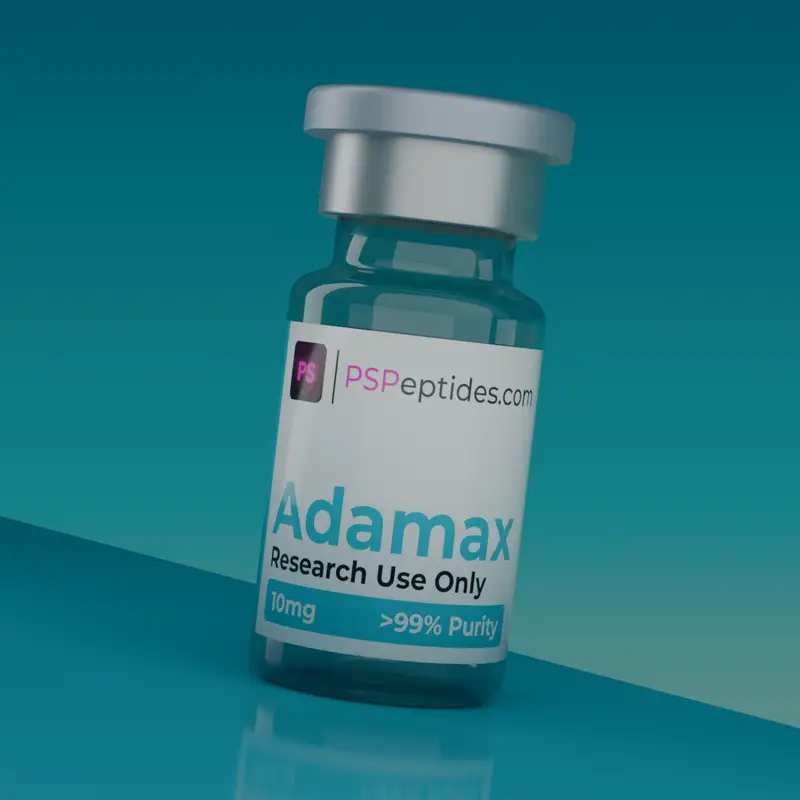
Adamax (1 Vial)
$65.99
Adamax research peptide — 99%+ purity, third-party tested. For laboratory research use only.
View older reports



 Made & Shipped
For laboratory and research use only. This product is not a drug, food, or cosmetic and is not for human or animal consumption. It is not intended to diagnose, treat, cure, or prevent any disease. These statements have not been evaluated by the FDA. Sold solely to qualified researchers and licensed laboratories. Certificate of Analysis available on request.
Description
Buy Adamax research-grade peptide from PSPeptides for laboratory studies investigating the MC4R/BDNF/TrkB signaling axis, cognitive research protocols, and modified peptide pharmacology. Adamax is a chemically modified Semax analog — specifically N-Acetyl Semax Amidate (Ac-MEHFPGPAG-NH2), a 9-amino-acid Semax derivative carrying an N-terminal acetyl cap and a C-terminal amide cap — engineered to extend plasma half-life while preserving the parent compound’s receptor binding profile. Every vial is US-manufactured, third-party HPLC tested at 99%+ purity, and shipped with a batch-specific certificate of analysis.
A critical point of clarification for researchers evaluating this product: Adamax is a single peptide compound, not a blend. It is chemically distinct from the Selank+Semax Blend product, which is a two-peptide combination of Selank and Semax co-formulated in a single research vial. Adamax delivers a single modified molecule; the Blend delivers two separate peptides simultaneously. Both have their research applications, but the mechanistic and pharmacokinetic profiles differ substantially.
Buy Adamax: Detailed Mechanism of Action
Adamax binds and modulates the melanocortin-4 receptor (MC4R) — a G-protein-coupled receptor expressed throughout central nervous system tissues, particularly in hypothalamic and cortical regions. MC4R signaling is central to research investigating cognitive function, energy homeostasis, stress response, and neuroprotective mechanisms. The parent Semax molecule was originally derived from ACTH(4-10), the biologically active core sequence of adrenocorticotropic hormone, and this heritage explains its documented effects on the hypothalamic-pituitary axis in published research.
Beyond direct MC4R binding, Adamax exerts significant effects through BDNF (brain-derived neurotrophic factor) upregulation and downstream TrkB receptor signaling. Published research has documented that Semax and its analogs increase BDNF expression in hippocampal and cortical regions within hours of administration, with downstream effects on synaptic plasticity, dendritic spine formation, and long-term potentiation markers. The BDNF/TrkB pathway is central to research investigating cognitive enhancement, neuroplasticity, and neuroprotection.
The defining structural feature of Adamax is the pair of terminal caps. Adamax is N-Acetyl Semax Amidate (Ac-MEHFPGPAG-NH2) — a 9-amino-acid Semax derivative carrying an N-terminal acetyl cap and a C-terminal amide cap. Both termini are where exopeptidases begin degrading an unprotected peptide, so capping them removes the primary route of enzymatic breakdown: aminopeptidases cannot engage the acetylated N-terminus, and carboxypeptidases cannot engage the amidated C-terminus. Base Semax has a plasma half-life measured in minutes; terminally capped analogs resist that degradation substantially longer, enabling research protocols that would otherwise require impractical dosing frequencies.
For researchers investigating parallel neuropeptide pathways, our Semax vs. Selank comparison guide covers a related but mechanistically distinct compound (Selank) that operates through GABAergic modulation and immune-cytokine effects rather than the MC4R/BDNF axis. This mechanistic distinction is why the Selank+Semax Blend product exists as a separate research offering — combining two different pathways in one vial.
Compound Details and Structural Chemistry
Adamax is supplied as a lyophilized powder in single research vials, US-manufactured, third-party tested, and shipped with batch-specific certificate of analysis documentation. Purity certifications document 99%+ HPLC purity with retention time verification against reference standards. The compound is a modified peptide (single molecule, not a co-formulation) — the Semax backbone extended with a C-terminal Ala-Gly and capped with an N-terminal acetyl group and a C-terminal amide.
Storage form is lyophilized powder for shelf stability. The terminal cap modifications also confer useful thermodynamic stability properties — Adamax is somewhat more resistant to freeze-thaw degradation than base Semax, though standard peptide handling protocols remain the safest research practice. All PSPeptides Adamax vials are shipped with insulated packaging and appropriate cold chain preservation regardless of destination climate.
For researchers evaluating quality documentation, our guide to reading a peptide certificate of analysis covers how to interpret HPLC purity measurements, retention time verification, mass spectrometry molecular weight confirmation, and endotoxin testing results — all of which are documented on the batch-specific COA that ships with each Adamax vial.
Published Research Base for the Semax and Adamax Family
The Semax family of peptides has an extensive Russian-language research literature dating back to the 1980s, with the compound originally developed at the M.M. Shemyakin Institute of Bioorganic Chemistry. English-language published research is available through the Semax PubMed database, with mechanistic studies covering MC4R binding kinetics, BDNF/TrkB signaling downstream effects, and neuroprotective mechanisms in cerebral ischemia research models.
Adamax-specific research is thinner than the base Semax literature — this is expected for a modified analog developed more recently. However, the research base for Semax as the parent scaffold provides strong mechanistic grounding for interpreting Adamax’s likely effects. Published research on Semax has documented: increased BDNF expression in hippocampal and prefrontal cortical tissue, improved performance in animal cognitive tests, neuroprotective effects in stroke and ischemia models, and modulation of stress response markers through the hypothalamic-pituitary-adrenal axis.
For researchers seeking broader context on cognitive-enhancing peptides in the published literature, the NIH National Institute of Mental Health provides authoritative resources on cognitive neuroscience research, including the BDNF/TrkB signaling pathways that Semax family compounds modulate.
Researchers should note that Semax and its analogs remain investigational in most Western regulatory frameworks. Published research has been conducted primarily in Russian institutional contexts and increasingly in international laboratory research settings. Adamax is offered for laboratory research use only.
Research Applications
Primary research applications for Adamax center on the extended-duration modulation of the MC4R/BDNF axis compared to base Semax. Where base Semax requires frequent administration due to short plasma half-life, Adamax’s terminal cap modifications enable research protocols with reduced dosing frequency while maintaining sustained receptor engagement.
Cognitive research applications include studies examining Adamax’s effects on: working memory performance in animal models, attention and executive function markers, neuroprotection in cerebral ischemia research protocols, and BDNF-dependent synaptic plasticity measurements. The extended half-life of Adamax compared to base Semax is particularly relevant for research protocols investigating chronic administration effects, where dosing frequency directly affects protocol feasibility.
Anxiolytic and stress-response research represents a secondary application area. The MC4R/HPA axis modulation documented in Semax research suggests Adamax may exhibit similar effects with extended duration, though direct Adamax-specific research on anxiety endpoints remains thinner than the Semax literature. For researchers investigating anxiolytic peptides through complementary mechanisms, our Selank research guide covers a GABAergic anxiolytic compound with distinct mechanism, and the Selank+Semax Blend product combines both mechanisms in a single vial for dual-pathway research.
Neuroprotective research applications derive from Semax family literature documenting reduced infarct volume and improved neurological outcomes in cerebral ischemia models. Adamax’s extended half-life is potentially relevant for research protocols investigating pre-conditioning or sustained neuroprotection effects. Our longevity peptides research guide covers the broader landscape of neuroprotective research peptides.
Adamax vs. Base Semax vs. Selank+Semax Blend
Understanding where Adamax fits in the Semax family landscape is essential for researchers selecting appropriate compounds for specific investigation objectives. The three primary comparisons are: Adamax (modified single peptide), base Semax (unmodified single peptide, typically nasal spray delivery), and the Selank+Semax Blend (two distinct peptides co-formulated).

Adamax vs. base Semax: Both compounds engage the same MC4R/BDNF pathway. The key difference is pharmacokinetic — Adamax’s terminal acetyl and amide caps provide substantially extended plasma half-life compared to base Semax. Base Semax requires frequent administration due to short duration; Adamax enables research protocols with reduced dosing frequency. Base Semax has the more extensive published research base as the parent compound; Adamax is the modified analog with less direct research documentation but strong mechanistic grounding through the shared pathway.
Adamax vs. Selank+Semax Blend: This is the most frequently confused comparison because both products contain a Semax component. The critical distinction: Adamax is a SINGLE modified peptide (Semax with terminal acetyl and amide caps). The Selank+Semax Blend is a combination of TWO separate peptides (Selank + Semax) co-formulated in one vial. Mechanistically, Adamax operates purely through the MC4R/BDNF axis (base Semax pathway with extended kinetics). The Blend operates through TWO pathways simultaneously — MC4R/BDNF (Semax) AND GABAergic/immune-cytokine (Selank). Choose Adamax for extended-duration research on the Semax pathway alone; choose the Blend for dual-pathway research combining cognitive and anxiolytic mechanisms.
Adamax vs. other nootropic research peptides: The MC4R/BDNF pathway that Adamax modulates is distinct from other nootropic research categories. Racetam-class compounds operate through cholinergic and glutamatergic mechanisms; Selank operates through GABAergic and immune-cytokine pathways; MK-677 operates through the ghrelin receptor. Adamax’s mechanism has no direct parallel outside the Semax family, making it a distinct research tool for MC4R/BDNF-specific investigations. Our best nootropic research peptides guide covers the broader landscape.
Buy Adamax: Vial Format and Pricing
Researchers can buy Adamax from PSPeptides in a single vial format optimized for research protocol scales:
- Adamax — $65.99, single research vial containing lyophilized Adamax peptide. Suitable for standard research protocols investigating MC4R/BDNF pathway effects with the extended kinetics that the terminal cap modifications provide.
The vial is US-manufactured, tested to 99%+ HPLC purity, and shipped with a batch-specific certificate of analysis. Reconstitution requires bacteriostatic water, available separately as research-grade bacteriostatic water in 30mL vials.
Researchers evaluating budget considerations may also want to compare Adamax against the Selank+Semax Blend ($54.99) which delivers two peptides in one vial, though the mechanistic and duration profiles differ substantially as discussed in the comparison section above. The choice between them depends on research objective (single-pathway extended duration vs. dual-pathway combination), not price alone.
Reconstitution and Storage
Adamax is supplied as a lyophilized powder requiring reconstitution before use in research protocols. Standard reconstitution uses 1-2mL of bacteriostatic water per vial, gently swirled (never shaken) until the powder is fully dissolved. Bacteriostatic water is preferred over sterile water for multi-dose research vials because the 0.9% benzyl alcohol content provides bacteriostatic activity across the typical use window.
Lyophilized Adamax should be stored at 2-8°C for short-term stability or -20°C for extended storage. The terminal cap modifications confer modestly better freeze-thaw stability than base Semax, but standard peptide handling protocols apply. Once reconstituted, Adamax solutions should be stored at 2-8°C and used within 14 days for optimal peptide integrity. Reconstituted peptide should never be frozen, as freeze-thaw cycles can produce aggregation and reduce bioactivity.
Signs of Adamax degradation include visible cloudiness in reconstituted solution, particulate matter, color changes, or unusual precipitation. Any of these observations indicate the batch should be discarded rather than used in research protocols. Our peptide degradation identification guide provides visual and analytical references for detecting compromised research materials, and our peptide reconstitution guide covers detailed handling protocols.
Why Researchers Choose PSPeptides for Adamax

Batch-Verified Purity
Every Adamax vial ships with batch-specific HPLC purity documentation confirming 99%+ purity. Retention time verification against reference standards confirms compound identity. Mass spectrometry molecular weight verification confirms the terminally capped structure. Endotoxin testing appropriate for research applications is documented on the same certificate. These are batch-level measurements, not compound-level assumptions — the COA that ships with your specific vial documents the actual measurements for that batch.
Cold Chain Handling
All PSPeptides research peptides ship with insulated packaging and gel packs regardless of destination climate. Cold chain preservation is maintained through transit to preserve peptide stability. Modified peptides like Adamax benefit particularly from proper cold chain handling because degradation products can be difficult to detect visually until concentrations become significant.
Verifiable Company Records
PSPeptides operates as a documented US business with transparent company information, US-based operations, and payment method acceptance that requires legitimate business documentation (standard credit cards, installment services). Vendors that operate exclusively on cryptocurrency or peer-to-peer payment services often signal challenges with payment processor compliance verification. Our supplier selection guide covers the specific criteria researchers should evaluate when comparing vendors.
Sourcing Considerations for Modified Peptide Research
Researchers who want to buy Adamax for laboratory research should evaluate specific sourcing considerations beyond standard peptide research. The terminal cap modifications require specialized synthesis techniques that not all peptide manufacturers implement correctly. Researchers should evaluate: batch-specific COA documentation confirming the modified structure (not just generic Semax), HPLC purity measurement with retention time verification (modified analogs have shifted retention times from base compound), and mass spectrometry molecular weight confirmation (the Ala-Gly extension and terminal caps add a specific mass signature to base Semax).
Adamax’s molecular weight is documented on the batch COA and can be verified against theoretical values calculated from the Ac-MEHFPGPAG-NH2 structure. If a supplied Adamax vial has HPLC retention time or mass spec values matching base Semax rather than the modified analog, the product is not Adamax — this is a critical verification step for modified peptide research reproducibility.
US-based synthesis and manufacturing provides additional sourcing benefits: shorter cold chain transit times, more consistent regulatory framework for facility standards, and easier verification of company records. Our US-made research peptides guide covers the specific advantages of domestic peptide manufacturing for research reproducibility, and the peptide storage guide covers post-arrival handling protocols across all peptide categories.
Common Questions About Adamax
What is Adamax?
Adamax is a chemically modified Semax analog — specifically N-Acetyl Semax Amidate (Ac-MEHFPGPAG-NH2), a 9-amino-acid Semax derivative with an N-terminal acetyl cap and a C-terminal amide cap that extend plasma half-life. It is a single modified peptide compound, not a blend of multiple peptides. These terminal modifications protect the peptide from enzymatic degradation, providing extended duration compared to base Semax while preserving the parent compound’s MC4R/BDNF signaling profile.
Is Adamax a blend of Semax and Selank?
No. Adamax is a single peptide — specifically, Semax with terminal acetyl and amide cap modifications (Ac-MEHFPGPAG-NH2). It is chemically distinct from the Selank+Semax Blend product, which is a two-peptide combination of separate Selank and Semax peptides co-formulated in one vial. Adamax delivers one modified molecule engaging the MC4R/BDNF pathway with extended duration; the Blend delivers two separate peptides engaging both MC4R/BDNF (Semax) AND GABAergic/immune-cytokine (Selank) pathways simultaneously. Choose based on research objective: Adamax for extended single-pathway research; the Blend for dual-pathway research protocols.
How does Adamax differ from base Semax?
Both compounds engage the same MC4R and BDNF/TrkB signaling pathways — they share the Semax molecular backbone. The critical difference is pharmacokinetic: Adamax’s terminal acetyl and amide caps provide substantially extended plasma half-life compared to base Semax. Base Semax has a plasma half-life measured in minutes; Adamax’s capped termini block exopeptidase degradation, extending duration multiple fold. Base Semax has the more extensive published research base as the parent compound; Adamax has thinner direct research documentation but strong mechanistic grounding through the shared pathway.
What research applications does Adamax have?
Primary research applications include cognitive research protocols (working memory, attention, executive function markers), neuroprotection studies (cerebral ischemia research, BDNF-dependent synaptic plasticity), and anxiolytic/stress-response research (MC4R/HPA axis modulation). The extended half-life makes Adamax particularly relevant for chronic administration research protocols where dosing frequency directly affects feasibility. Adamax is offered for laboratory research use only.
What documentation ships with PSPeptides Adamax?
Every Adamax vial ships with a batch-specific certificate of analysis documenting HPLC purity measurement, retention time verification confirming modified structure identity, mass spectrometry molecular weight confirmation, and endotoxin testing results. Researchers can include this documentation in their own research records, protocols, or publication supplementary materials. This batch-level documentation is essential for modified peptide research where structural verification affects reproducibility.
All PSPeptides products are sold exclusively for research and laboratory use.
Additional information
| Weight | 0.03 lbs |
|---|---|
| Dimensions | 2 × 2 × 2 in |
| MG | 10MG |
Related products
-
 Neurological Research Peptides
Semax Nasal Spray
$55.99 Select options This product has multiple variants. The options may be chosen on the product page -
Neurological Research Peptides
Melanotan I Spray
$49.99 Select options This product has multiple variants. The options may be chosen on the product page -
Neurological Research Peptides
Selank+Semax Nasal Spray
$55.99 Select options This product has multiple variants. The options may be chosen on the product page -
Neurological Research Peptides
Semax (1 Vial)
$42.99 Select options This product has multiple variants. The options may be chosen on the product page