Every vial includes a batch-specific Certificate of Analysis, free shipping on every order, and support seven days a week. If you need to buy glutathione for oxidative-stress, immune, liver, or mitochondrial research, this is the fastest way to get verified, documented material into your lab.
Glutathione (γ-L-glutamyl-L-cysteinyl-glycine) is a tripeptide built from glutamate, cysteine, and glycine. It is the most abundant non-protein thiol in mammalian cells, where it neutralizes reactive oxygen species, recycles vitamins C and E, and conjugates toxins for export. Researchers studying redox biology, immune function, detoxification, and aging rely on it as a core experimental reagent.
Before you buy glutathione for the first time, it helps to understand how peptides are handled, dosed, and stored in a research setting. Our Complete Guide to Peptides is the best place to start.
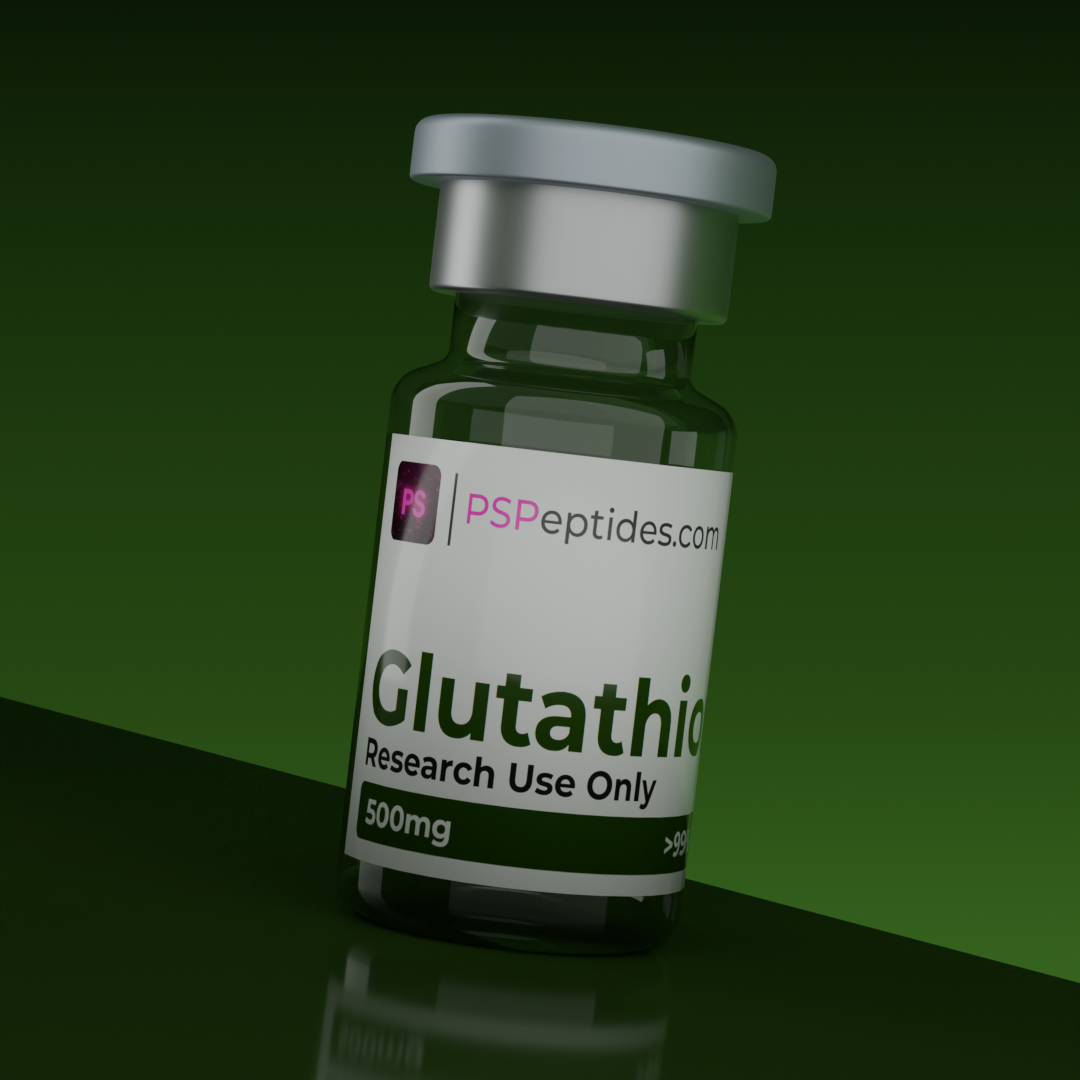
Both sizes are in stock and ship from our California facility, so you can buy glutathione today and have it on the bench within days. Select your size, add to cart, and check out with a credit card, Afterpay, Klarna, Apple Pay, or Google Pay.
Detailed Mechanism of Action
When researchers buy glutathione for in vitro or in vivo work, they are working with a molecule whose activity centers on the free thiol (–SH) group of its cysteine residue. That sulfhydryl donates electrons to oxidized proteins, lipids, and DNA bases, neutralizing reactive oxygen species before they cause irreversible damage. Two GSH molecules are oxidized to one molecule of glutathione disulfide (GSSG) in the process.
Glutathione reductase then regenerates GSH from GSSG using NADPH as a cofactor. The resulting GSH:GSSG ratio — typically well above 100:1 in healthy cytosol — is one of the most widely used biomarkers of cellular redox status. A shift toward GSSG is an early, measurable signal of oxidative stress, and it is the readout most labs that buy glutathione as a reagent are ultimately tracking.
GSH also serves as the obligate cofactor for the glutathione peroxidase family (GPx1–8), selenoenzymes that reduce hydrogen peroxide and lipid hydroperoxides to water and alcohols. In glutathione S-transferase (GST) reactions, GSH is conjugated to electrophilic xenobiotics and drug metabolites, tagging them for export through multidrug-resistance transporters and completing Phase II detoxification.
A distinct mitochondrial pool (mGSH) protects the inner mitochondrial membrane from lipid peroxidation and preserves membrane potential. Depletion of mGSH sensitizes cells to apoptosis, which is why labs that buy glutathione for mitochondrial studies need high-purity, properly handled material.
Forman and colleagues provide a comprehensive overview of these protective roles, measurement methods, and biosynthesis in Molecular Aspects of Medicine, a reference worth reading before designing any redox assay.

Published Research on Glutathione
Dröge and Breitkreutz (2000) established in the Proceedings of the Nutrition Society that intracellular glutathione levels govern T-cell proliferation and cytokine signaling, with GSH depletion linked to immune dysfunction in aging and chronic disease. Their framework still shapes how immunology groups that buy glutathione design GSH-repletion experiments today.
Richie et al. (2015) ran a six-month randomized, double-blind, placebo-controlled trial of oral glutathione at 250 mg or 1,000 mg per day in 54 healthy adults. Published in the European Journal of Nutrition, the study reported significant, dose-dependent increases in erythrocyte, plasma, and lymphocyte GSH.
The same trial recorded a more than two-fold rise in natural killer cell cytotoxicity at three months in the high-dose group. Those numbers are a common reference point for researchers who buy glutathione to plan systemic dosing protocols in translational models.
Sinha et al. (2018) followed with a four-week liposomal glutathione study (500 mg or 1,000 mg per day) in the European Journal of Clinical Nutrition, documenting elevated GSH stores, lower oxidative-stress markers, and enhanced NK-cell cytotoxicity and lymphocyte proliferation.
In dermatology, Weschawalit et al. (2017) reported in Clinical, Cosmetic and Investigational Dermatology that 250 mg per day of glutathione over 12 weeks lowered melanin index and improved skin elasticity and wrinkle scores versus placebo. Dermatology groups that buy glutathione for pigmentation models can explore related work in our Best Peptides for Skin Research guide.
Glutathione vs. Alternatives
Researchers comparing options often ask whether to buy glutathione directly or work with a precursor such as N-acetyl cysteine. The table below summarizes the practical differences, with GHK-Cu included because the two are so often run side by side in skin and anti-aging panels.
| Feature | Glutathione (GSH) | N-Acetyl Cysteine (NAC) | GHK-Cu |
|---|
| Primary role | Master intracellular antioxidant and detoxification cofactor | Cysteine donor (GSH precursor), mucolytic | Copper-binding remodeling peptide for skin and tissue |
| Mechanism | Direct ROS scavenging, GPx cofactor, GST conjugation | Indirect — raises GSH only after enzymatic synthesis | Copper delivery, collagen and elastin gene signaling |
| Onset in models | Immediate — preformed GSH | Delayed — rate-limited by glutamate-cysteine ligase | Hours to days (gene expression) |
| Research applications | Oxidative stress, immune, liver, mitochondria, skin pigmentation | Respiratory, toxicology, precursor studies | Dermatology, hair, wound healing |
| Cellular location | Cytosol, mitochondria, nucleus | Extracellular until deacetylated | Extracellular matrix, receptors |
| Molecular weight | 307.3 Da | 163.2 Da | 340.4 Da (peptide) + Cu |
| Lyophilized stability | 24 months at −20°C | 24 months at room temperature | 24 months at −20°C |
| PSPeptides purity | 99%+ | N/A | 99%+ |
NAC is a precursor, not a substitute: it raises GSH only after cells convert it, so labs studying GSH-dependent pathways directly buy glutathione to remove that confounder. GHK-Cu targets an entirely different biology — see our GHK-Cu Complete Guide for the comparison in depth.
Reconstitution & Handling
Reconstitute lyophilized glutathione with sterile bacteriostatic water (BAC water) or sterile saline. Inject the diluent slowly down the inside wall of the vial rather than onto the powder, then swirl gently until the solution is clear. Never shake or vortex — mechanical shear and air entrainment accelerate oxidation of the thiol group.
Common working stocks: add 2.5 mL to the 500 mg vial for 200 mg/mL, or 5 mL for 100 mg/mL. For the 1,500 mg vial, add 7.5 mL for 200 mg/mL or 10 mL for 150 mg/mL. Dilute further in PBS (pH 7.0–7.4) or culture medium to your working concentration — typically 0.1–10 mM for cell-culture assays — and pass through a 0.22 µm syringe filter before use.
Our reconstitution guide and peptide dosage calculator guide walk through the math step by step, so anyone who decides to buy glutathione for the first time can prepare an accurate stock on day one.
Because GSH oxidizes readily in solution, prepare single-use aliquots at the time of reconstitution and, where equipment allows, purge headspace with nitrogen or argon. Researchers who buy glutathione for sensitive assays should add medical-grade bacteriostatic water and sterile syringes to the same order so the vial can be reconstituted the day it arrives.
Storage & Stability
Lyophilized glutathione is stable for up to 24 months at −20°C in its sealed, light-protected vial, and it tolerates several weeks at 2–8°C or at room temperature in transit — no cold pack is required for shipping. Keep the vial sealed until use; moisture and oxygen are the two main drivers of degradation in the dry state.
After reconstitution, store at 2–8°C and use within 7–14 days, or freeze aliquots at −80°C for longer studies. Avoid repeated freeze–thaw cycles, each of which promotes conversion of GSH to GSSG. Labs that buy glutathione in the 1,500 mg size and reconstitute in stages get the longest usable life from a single vial.
For a full breakdown of best practices, see our Peptide Storage Guide and our guide to spotting peptide degradation before it compromises a result.
Certificate of Analysis
Every lot of glutathione sold by PSPeptides ships with a batch-specific Certificate of Analysis generated by an independent third-party laboratory. The COA reports HPLC purity as an area-under-curve percentage, confirms molecular identity by mass spectrometry (expected mass 307.3 Da), and documents endotoxin screening so immune and cytokine assays reflect glutathione biology rather than contamination artifacts.
The COA for your batch is published online and can be reviewed before you buy glutathione, not just after it arrives. To interpret every figure on the report, read our guide on how to read a peptide COA.
Understanding Glutathione Purity Standards
When you buy glutathione for research, impurities fall into four categories: related substances from synthesis intermediates, residual solvents such as acetonitrile, inorganic salts from counter-ion exchange, and endotoxins introduced by contaminated reagents. Each one skews a different class of assay, which is why a single purity number is never the whole story.
PSPeptides addresses each category in turn. HPLC purity of 99%+ rules out related substances, mass spectrometry verifies identity, and endotoxin screening protects cytokine and immune readouts. Researchers who buy glutathione and need to defend assay validity in a manuscript or audit will find this documentation framework among the most rigorous available from a US domestic supplier.
Why Researchers Choose PSPeptides to Buy Glutathione
- US Manufactured: Produced in a cGMP-compliant facility in Temecula, California — no overseas drop-shipping, full lot traceability.
- Third-Party Tested: Independent HPLC and mass spectrometry on every batch, with the COA published for you to verify before you buy glutathione.
- Fast Shipping: Free shipping on every order, free UPS 2nd Day Air over $200, free UPS Next Day Air over $400, and same-day dispatch on orders placed before 2 PM EST.
- Flexible Payments: Credit cards, Apple Pay, and Google Pay at checkout, or split the cost when you buy glutathione with Afterpay or Klarna.
- 7-Day Support: Reach our team by email, phone, or text seven days a week, with order tracking on every shipment.
- Proven Track Record: More than 130,000 orders shipped to research customers in the US, Canada, the EU, the UK, and Australia.
- Discreet Packaging: Every vial arrives in a plain, padded mailer with full tracking.
Complete Your Glutathione Research Kit
Most labs that buy glutathione add a few essentials to the same order so the vial is ready to use on arrival. Combining items also moves your cart past the free UPS 2nd Day Air threshold.
Designing a multi-reagent protocol? Our Peptide Stacking Guide covers vehicle controls, timing, and dose spacing when glutathione is combined with other research peptides.
Glutathione Half-Life and Pharmacokinetics in Research Models
Free glutathione administered intravenously has a plasma half-life of only a few minutes in rodent models, reflecting rapid uptake by hepatocytes and erythrocytes and hydrolysis by gamma-glutamyl transpeptidase on cell surfaces. Intracellular GSH, by contrast, turns over on a scale of hours to days depending on tissue type.
Researchers who buy glutathione for systemic studies should build these kinetics into their sampling schedule, and groups running cell-culture experiments should note that uptake from medium is limited unless specific transporters are engaged. Our Peptide Half-Life Chart provides comparative data for planning dosing intervals.
Glutathione in Immune, Longevity, and Skin Research
Immune cells are among the most GSH-sensitive populations in the body. GSH-depleted T-cell lines show impaired IL-2 secretion and blunted proliferative responses to mitogens, and both phenotypes reverse on repletion — which is why immunology labs buy glutathione as an essential positive control in T-cell assays. Our overview of Peptides for Immune Support places glutathione alongside other redox-active research peptides.
In aging research, total GSH and the GSH:GSSG ratio decline progressively across tissues from brain cortex to skeletal muscle, tracking hallmarks such as protein carbonylation, lipid peroxidation, and mitochondrial dysfunction. Investigators who buy glutathione for longevity models typically test whether restoring youthful GSH levels slows these markers; see our Best Peptides for Longevity & Anti-Aging guide for the wider landscape.
In skin biology, GSH inhibits tyrosinase — the rate-limiting enzyme of melanin synthesis — both by reducing the dopaquinone intermediate and by chelating the copper cofactor in the enzyme’s active site. Liposomal, nanoparticle, and penetration-enhancer vehicles are all active areas of topical-delivery research, and every one of them starts from a verified lyophilized baseline like the vials sold here.
Ordering, Shipping, and Research Compliance
When you buy glutathione from PSPeptides, your order is packed in our US facility and, if placed before 2 PM EST on a business day, leaves the same day. Standard shipping is free on every order, orders over $200 upgrade to free UPS 2nd Day Air, and orders over $400 ship free by UPS Next Day Air. Tracking is emailed automatically, and the lyophilized vial needs no cold chain.
Research-grade glutathione is sold as a laboratory reagent for in vitro and preclinical in vivo work and is not a controlled substance in the United States. Researchers outside the US who buy glutathione online should confirm local import rules before ordering; our Are Research Peptides Legal in 2026? guide summarizes the current landscape.
Not sure which supplier to trust? Our supplier selection guide lays out the criteria — domestic manufacturing, batch-specific testing, published documentation, and responsive support — that PSPeptides was built to meet.
Frequently Asked Questions
Which glutathione vial should I buy — 500 mg or 1,500 mg?
Choose the 500 mg vial for pilot experiments, cell-culture work, or validating a new assay. Choose the 1,500 mg vial for in vivo protocols running several weeks, multi-arm studies, or any lab that will buy glutathione again within the quarter — it delivers three times the material at a lower cost per milligram. Both sizes carry the same 99%+ purity standard.
How quickly will my glutathione order ship?
Orders placed before 2 PM EST on business days ship the same day from Temecula, California, with tracking emailed automatically. Standard shipping is free on every order; orders over $200 upgrade to free UPS 2nd Day Air and orders over $400 to free UPS Next Day Air. Lyophilized glutathione is stable in transit, so no cold pack is needed.
Is glutathione the same as N-acetyl cysteine (NAC)?
No. NAC is a prodrug that donates cysteine to the glutathione synthesis pathway, raising GSH only after enzymatic conversion. Direct glutathione provides preformed GSH that cells can use immediately, so labs that buy glutathione can study GSH-dependent pathways without the confounding kinetics of cysteine metabolism.
How should I store glutathione after reconstitution?
Keep reconstituted solution at 2–8°C in a light-protected vial and use it within 7–14 days. For longer studies, aliquot into single-use volumes and freeze at −80°C. Avoid repeated freeze–thaw cycles and minimize air exposure, since oxygen converts the active reduced form to GSSG.
Can I see the Certificate of Analysis before I buy glutathione?
Yes. Batch-specific COAs are published online, so you can confirm HPLC purity, mass-spectrometry identity, and endotoxin results before ordering. A printed copy ships with every vial as well.
Does PSPeptides ship glutathione internationally?
Yes. In addition to all 50 US states, we ship to Canada, the EU, the UK, and Australia. International researchers should confirm local import rules for research chemicals before they buy glutathione, and our support team can answer shipping questions seven days a week by email, phone, or text.
Related Resources
All PSPeptides products are sold exclusively for laboratory and research use. Not intended for human consumption.





 Made & Shipped