AHK-Cu belongs to the copper peptide family first characterized by biochemist Loren Pickart, the same research lineage that produced GHK-Cu. Structurally, AHK-Cu pairs a short tripeptide carrier with a bound copper ion, a combination researchers use to study copper transport, extracellular matrix signaling, and follicle-focused cell behavior.
Because AHK-Cu and GHK-Cu share a copper-binding backbone but differ in amino acid sequence, many labs use AHK-Cu as a comparison compound when mapping which effects are copper-driven versus sequence-specific. For broader background on this peptide family, see our GHK-Cu complete guide and copper peptide research overview.
Labs that buy AHK-Cu typically use it across a handful of recurring research applications:
Copper peptides entered scientific literature in the late 1970s and early 1980s, when researchers first isolated a naturally occurring copper-binding tripeptide from human plasma and began studying its role in wound healing. That original discovery became the foundation for GHK-Cu, which has since accumulated decades of published research spanning wound care, skin remodeling, and anti-inflammatory pathways.
AHK-Cu emerged later as researchers explored variations on the original copper-binding tripeptide structure, swapping the glycine residue for alanine to see how the change affected biological activity. Patent filings and cosmetic-industry research over the following years pointed toward follicle-related applications as an area where AHK-Cu showed a distinct profile from its better-known relative.
Today, most people who buy AHK-Cu do so as part of this ongoing effort to map out exactly where its effects overlap with GHK-Cu and where they diverge. That distinction is still being actively refined, which is part of what makes it an interesting subject for independent research. It is also why documentation and careful sourcing matter so much when you buy AHK-Cu for a new study.
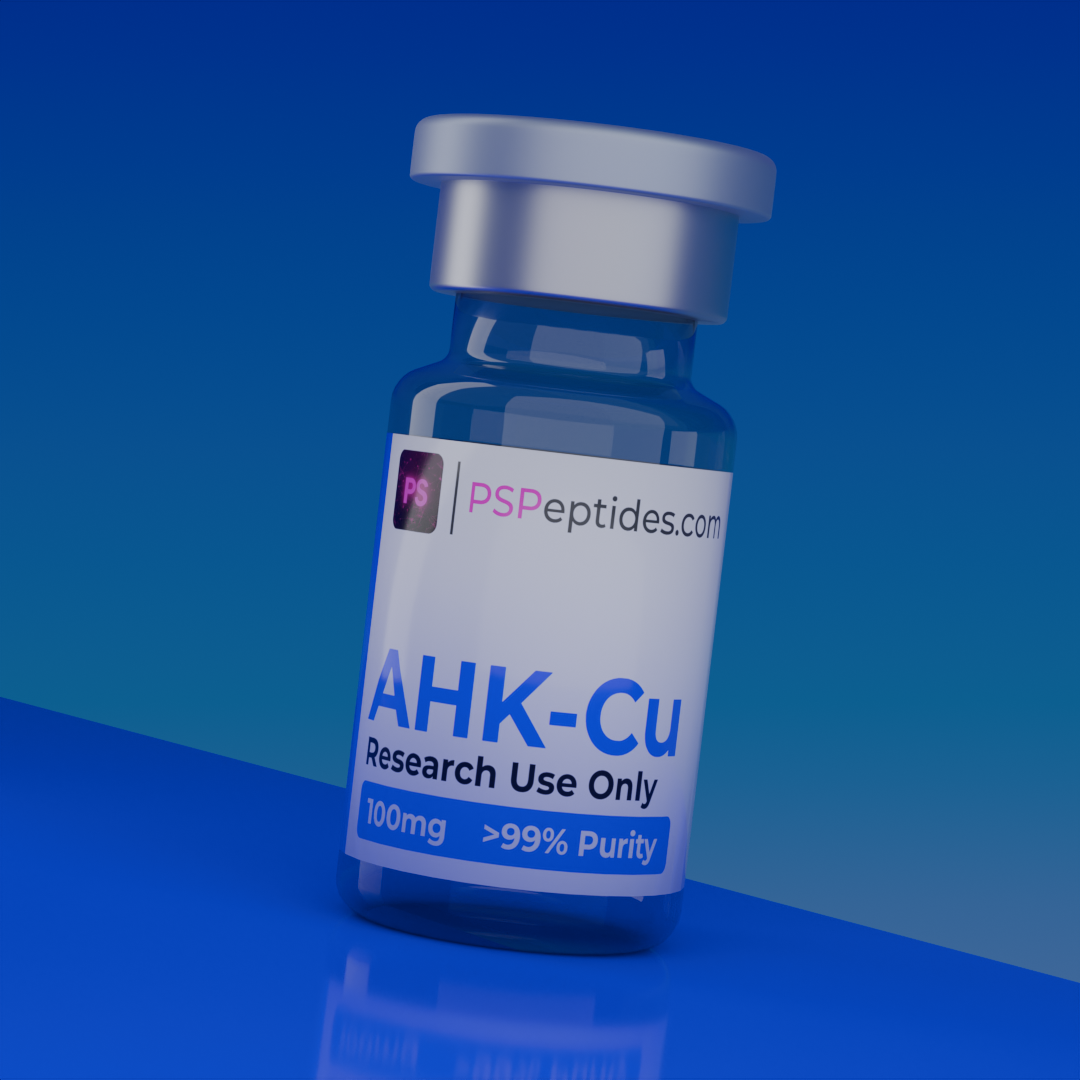
PSPeptides offers AHK-Cu in two vial sizes so researchers can match supply to project scope. A 50mg vial is often a practical starting point for smaller pilot studies, initial dose-response testing, or first-time researchers who want to confirm handling and reconstitution before scaling up.
A 100mg vial suits longer studies, larger sample sizes, or labs that want to avoid reordering mid-protocol. Buying AHK-Cu in the larger size can also reduce the number of times a lab needs to reconstitute from a fresh vial, which some researchers prefer for consistency across a study.
Whichever size you choose, both are drawn from the same manufacturing and testing pipeline, so purity and documentation standards do not change based on vial size. Whether you buy AHK-Cu in the 50mg or 100mg size, the per-mg testing standard is identical.
Detailed Mechanism of Action
Copper peptide complexes such as AHK-Cu are of research interest largely because of copper’s role as a cofactor in enzymes involved in tissue remodeling, including lysyl oxidase and superoxide dismutase. By chelating copper within a small peptide carrier, researchers can study more controlled, targeted copper delivery to cells compared to free copper salts.
In dermal and follicle research models, copper peptides are examined for their influence on fibroblast activity, extracellular matrix turnover, and signaling pathways associated with tissue repair. AHK-Cu in particular has drawn attention in hair-follicle-focused research programs, where investigators compare its effects on dermal papilla cells against GHK-Cu and other copper peptide variants.
It is important to note that AHK-Cu has a smaller published research base than GHK-Cu, which has decades of peer-reviewed literature behind it. Much of what is documented on AHK-Cu specifically comes from peptide chemistry and patent literature associated with Loren Pickart’s copper peptide research program, so researchers should treat AHK-Cu findings as an active, evolving area rather than settled science. Most labs that buy AHK-Cu do so specifically to contribute new data to this growing body of work.
At the cellular level, copper is a required cofactor for several enzymes implicated in tissue remodeling, and researchers who buy AHK-Cu often do so to study how a peptide-bound copper source behaves differently than free copper ions in culture. Free copper can be pro-oxidant at higher concentrations, while peptide-chelated copper is thought to allow more gradual, regulated release, which is part of why copper peptide complexes are of interest as research tools rather than simple copper supplements.
In follicle-focused work, investigators are generally interested in how copper peptides influence dermal papilla cell signaling, local blood vessel formation around the follicle, and the balance between growth and resting phases of the hair cycle. AHK-Cu is used in these models specifically because its sequence differs from GHK-Cu, allowing side-by-side comparison of copper delivery effects versus effects tied to the surrounding amino acids. Labs that buy AHK-Cu for this purpose typically run it in parallel with GHK-Cu and a copper-free control peptide to separate these variables.

Published Research
Researchers evaluating AHK-Cu should start with the broader copper peptide literature to understand the biochemical context, then look specifically for AHK-Cu or “copper tripeptide” studies where available. PubMed is the most reliable starting point for primary sources: search copper peptide and skin regeneration research for background on the peptide family, or AHK-Cu and copper tripeptide hair follicle studies for literature specific to this compound.
Because published data on AHK-Cu is still limited relative to GHK-Cu, we encourage researchers to read primary sources directly rather than relying on secondary summaries, and to document their own findings carefully when designing new studies. This is one reason researchers buy AHK-Cu directly from a source that discloses batch-level testing.
Research Design Considerations
Because AHK-Cu’s published literature is thinner than GHK-Cu’s, researchers who buy AHK-Cu for new studies are encouraged to build in appropriate controls rather than relying on assumptions carried over from GHK-Cu data. A copper-free tripeptide control and a GHK-Cu comparison arm are common design choices in follicle and dermal models.
Typical in vitro work involving copper peptides uses dermal papilla cell cultures or follicle organ culture models, with outcome measures such as cell viability, proliferation markers, and gene expression changes. When designing a protocol, researchers should also account for copper peptide stability in culture media over time, since oxidation and degradation rates can vary with temperature, pH, and light exposure.
Documentation matters here: because this is an evolving research area, keeping detailed records of vial lot numbers, reconstitution dates, and storage conditions helps ensure that results can be traced back to a specific batch if questions arise later. Every vial you buy AHK-Cu from PSPeptides includes lot-specific information for exactly this reason.
AHK-Cu vs Alternatives
Before you buy AHK-Cu, it helps to see how it stacks up against related copper peptides used in the same research space.
| Feature | AHK-Cu | GHK-Cu | Topical Copper Tripeptide Serum |
|---|
| Peptide sequence | Ala-His-Lys-Cu | Gly-His-Lys-Cu | Varies by formulation |
| Primary research focus | Hair follicle biology | Skin and wound remodeling | Cosmetic skin appearance |
| Form supplied | Lyophilized powder | Lyophilized powder | Pre-mixed liquid/cream |
| Published research volume | Limited, growing | Extensive | Product-dependent |
| Reconstitution required | Yes | Yes | No |
| Typical purity documentation | COA per batch | COA per batch | Rarely disclosed |
| Suited for lab handling | Yes | Yes | Not typically |
Many researchers who buy AHK-Cu for the first time have questions about handling lyophilized copper peptides safely — the section below covers reconstitution basics.
AHK-Cu in Hair Follicle Research
Hair follicle biology is one of the more active areas where researchers buy AHK-Cu for dedicated study. The follicle cycles through growth, regression, and resting phases, and copper peptides are examined for their potential influence on the signaling that governs the transition between these phases.
Dermal papilla cells sit at the base of the follicle and are thought to coordinate much of this signaling. In culture, researchers studying AHK-Cu often look at how these cells respond in terms of proliferation and expression of growth-factor-related genes, comparing treated wells against untreated controls and against GHK-Cu-treated wells.
It’s worth repeating that this remains an active, developing research area. Anyone who plans to buy AHK-Cu for follicle-focused work should expect to be contributing to a smaller but growing body of data, rather than confirming a large existing consensus the way one might with better-studied compounds.
Reconstitution & Handling
AHK-Cu ships as a lyophilized powder and must be reconstituted before use in solution-based research. Bacteriostatic water is the standard diluent used across our peptide catalog; see our bacteriostatic water guide if you are unfamiliar with it.
For step-by-step reconstitution volumes and mixing technique, follow our peptide reconstitution guide. If you need help calculating concentration per your intended dilution, our dosage calculator guide walks through the math.
Always reconstitute slowly along the vial wall rather than injecting diluent directly onto the powder, and gently swirl rather than shake, to protect peptide structure during mixing.
Consistent storage matters more for research validity than it might first appear: a peptide that has partially degraded before use can produce misleading results that look like a biological effect but are really an artifact of handling. This is one more reason researchers who buy AHK-Cu take storage guidance seriously rather than treating it as an afterthought.
Storage & Stability
Store unreconstituted AHK-Cu lyophilized powder in a freezer at approximately -20°C, where it is generally most stable for extended periods. Once reconstituted, keep the vial refrigerated at 2-8°C and shield from prolonged light exposure to help preserve peptide integrity. Anyone who plans to buy AHK-Cu for multi-week studies should plan storage accordingly.
Reconstituted copper peptide solutions are typically best used within a few weeks; for detailed stability windows and handling tips across our catalog, see our peptide storage guide.
Certificate of Analysis
Every AHK-Cu batch we sell includes a batch-specific Certificate of Analysis generated through independent third-party HPLC and mass spectrometry testing, confirming purity and identity. If you’re new to reading these reports, our COA reading guide explains what each section means. It is good practice to buy AHK-Cu only from suppliers willing to share this documentation upfront.
When you buy AHK-Cu from PSPeptides, every vial ships with the documentation researchers expect for reproducible work.
Quality Control Process
Every batch of AHK-Cu we sell moves through the same quality pipeline as the rest of our catalog. Raw material is sourced, synthesized, and lyophilized, then an independent third-party lab runs HPLC analysis to confirm purity and mass spectrometry to confirm peptide identity.
We also rely on the same lab to flag any batch that falls outside our purity threshold before it is ever listed for sale, so what you buy AHK-Cu as is the same standard we apply across GHK-Cu, BPC-157, and every other peptide we carry. The Certificate of Analysis for each batch is made available so you can verify these results yourself rather than taking our word for it.
Why Researchers Choose PSPeptides
- US Manufactured
- Third-Party Tested: Independent HPLC and mass spectrometry on every batch
- Fast Shipping: Free UPS 2nd Day Air over $200, same-day before 2 PM EST
- Flexible Payments: Credit cards, Afterpay, Klarna, Apple Pay, Google Pay
- 7-Day Support: Email
What to Expect When Your Order Arrives
Orders are packed with temperature-sensitive handling in mind. Lyophilized AHK-Cu is stable at room temperature for short shipping windows, but we still recommend moving vials to a freezer promptly after delivery rather than leaving them on a counter for an extended period.
Each shipment includes the paperwork researchers typically ask for when they buy AHK-Cu from us: a packing slip, batch identification matching the vial label, and a link to download the Certificate of Analysis for that specific lot. If anything looks off on arrival, our support team can help before you begin reconstitution.
Frequently Asked Questions
What is AHK-Cu used for in research?
AHK-Cu is primarily used in laboratory studies of hair follicle biology and copper peptide signaling. It is also used as a comparison compound alongside GHK-Cu to help researchers separate copper-driven effects from sequence-specific ones. Most researchers buy AHK-Cu specifically for this kind of comparative work.
How should AHK-Cu be reconstituted?
Reconstitute with bacteriostatic water, adding diluent slowly down the side of the vial and swirling gently. See our reconstitution guide above for exact volume guidance based on your desired concentration.
How is AHK-Cu different from GHK-Cu?
Both are copper-binding tripeptides from the same research lineage, but they differ by one amino acid (alanine versus glycine). AHK-Cu is studied more narrowly around hair follicle behavior, while GHK-Cu has a much larger published research base covering broader skin and wound remodeling.
Is AHK-Cu tested for purity?
Yes. Every batch sold by PSPeptides is verified at 99%+ purity through independent third-party HPLC and mass spectrometry, with a Certificate of Analysis provided for each batch.
Whether you buy AHK-Cu for hair follicle work or broader copper peptide comparisons, these related guides provide useful background.
Can AHK-Cu be used alongside other peptides in research?
Some labs that buy AHK-Cu combine it with other peptides in stacking-style protocols to study combined effects, though this adds complexity to interpreting results. If you’re new to this concept, our peptide stacking guide covers general considerations for designing multi-peptide protocols.
How long does a vial of AHK-Cu remain viable once opened?
Once reconstituted, copper peptide solutions are generally most reliable within a few weeks when refrigerated and protected from light. Signs of degradation to watch for are covered in our peptide degradation guide.
Does PSPeptides offer bulk pricing for labs that buy AHK-Cu regularly?
Researchers with recurring needs can reach out to our support team directly to discuss ongoing supply. Every order, regardless of size, ships with the same batch-specific COA and third-party testing documentation.
Is AHK-Cu legal to purchase for research?
PSPeptides sells AHK-Cu strictly as a research chemical for laboratory use, not as a supplement or drug. Regulations around research peptides can vary and evolve, so researchers should confirm current requirements in their own jurisdiction and institution before purchasing or using any research peptide.
Related Resources
All PSPeptides products are sold exclusively for laboratory and research use. Not intended for human consumption.





 Made & Shipped