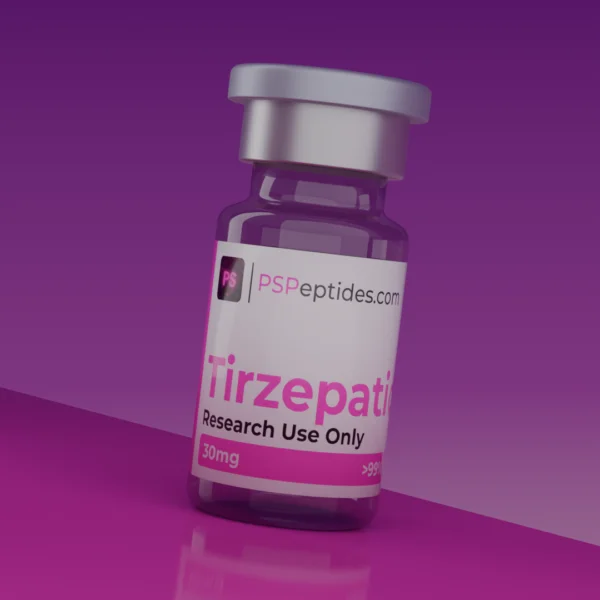
Survodutide (BI 456906) is an investigational acylated peptide that activates both the glucagon receptor (GCGR) and the GLP-1 receptor (GLP-1R). Its design follows the concept of oxyntomodulin, a natural gut hormone with the same dual activity, and it carries a C18 fatty acid that extends its half-life.
Labs that buy survodutide typically use it to study what glucagon signaling adds on top of GLP-1 effects. New to this field? Start with our complete guide to peptides.
Survodutide is being developed by Boehringer Ingelheim under license from Zealand Pharma and has reached phase 3 clinical studies. It is not an approved medicine. PSPeptides supplies it strictly as a research reagent for qualified laboratories.
Ready to buy survodutide for your lab? Choose your vial size above. Orders over $200 ship free by UPS 2nd Day Air, and every order includes a batch-specific Certificate of Analysis.
Detailed Mechanism of Action
Survodutide is a single glucagon-derived peptide engineered to activate two class B G protein-coupled receptors: GCGR and GLP-1R. Both receptors couple to Gs proteins and raise intracellular cAMP when activated. Researchers who buy survodutide for receptor studies often measure cAMP accumulation in cell lines expressing each human receptor.
The two receptors sit in different tissues. GLP-1 receptors are found in pancreatic beta cells, the gut and brain regions that regulate appetite. Glucagon receptors are concentrated in the liver, with lower levels in the kidney and adipose tissue.
On the GLP-1 side, receptor engagement has been demonstrated in mice through improved glucose tolerance, reduced food intake and slower gastric emptying. These are the classic readouts of GLP-1 pharmacology. They account for much of the appetite-related signal seen in preclinical models.
On the glucagon side, the main target tissue is the liver. Glucagon receptor activation increases energy expenditure, hepatic fat oxidation and amino acid catabolism. In preclinical work, GCGR engagement was tracked through liver Nnmt gene expression, lower circulating amino acids and higher FGF-21.
The two arms are designed to balance each other. Glucagon alone can raise blood glucose, while GLP-1 receptor activity supports glucose-dependent insulin secretion. Any lab planning to buy survodutide for metabolic work should plan assays that capture both receptors, not just one.
The C18 fatty acid side chain binds albumin, which slows clearance and supported once-weekly administration in clinical studies. At the bench, acylation also matters for handling. Acylated peptides can adsorb to some plastics at very low concentrations, so many labs prefer low-bind tubes and tips.
This combination is why survodutide is often described as an oxyntomodulin-inspired compound. Natural oxyntomodulin is a weak agonist at both receptors and is cleared quickly. Survodutide was optimized for potency at both targets and for a much longer duration of action.

Published Research
The discovery paper by Zimmermann and colleagues (2022) in Molecular Metabolism describes the preclinical pharmacology of BI 456906. The team characterized the peptide in CHO-K1 cells expressing human GLP-1R and GCGR and in primary hepatocytes. In mice, it produced greater bodyweight reductions than maximally effective doses of semaglutide.
The authors attributed that difference to two effects working together: increased energy expenditure and decreased food intake. They also used GLP-1R knockout mice to support the peptide’s dual activity. This paper remains the starting reference for most labs that buy survodutide for mechanistic studies.
Two phase I studies of BI 456906 followed, published in Diabetes, Obesity and Metabolism. A single-rising-dose study enrolled 24 males, and a multiple-rising-dose study enrolled 125 adults with a BMI of 27–40. Placebo-corrected bodyweight fell by up to 13.8% at week 16, and lower plasma amino acids indicated glucagon receptor engagement.
In a phase 2 trial, le Roux and colleagues (2024, The Lancet Diabetes & Endocrinology) treated 386 adults with a BMI of 27 or higher and no diabetes for 46 weeks. Mean bodyweight change ranged from −6.2% to −14.9% across doses, versus −2.8% with placebo. Gastrointestinal adverse events were reported by 75% of survodutide recipients and 42% of placebo recipients.
In the analysis based on the dose actually received, participants who reached and stayed on the highest dose showed a mean bodyweight change of −18.7% at week 46. The trial ran at 43 centres in 12 countries. It used a 20-week dose-escalation phase followed by 26 weeks of maintenance.
Sanyal and colleagues (2024) reported a phase 2 trial in MASH and fibrosis in the New England Journal of Medicine. Among 293 adults with biopsy-confirmed MASH, improvement without worsening of fibrosis occurred in 43% to 62% of survodutide groups versus 14% with placebo. Nausea was reported by 66% of recipients versus 23% on placebo.
Liver fat content fell by at least 30% in 57% to 67% of survodutide groups, compared with 14% on placebo. Fibrosis improved by at least one stage in 34% to 36% of treated participants versus 22%. Serious adverse events occurred in 8% of survodutide and 7% of placebo recipients.
Blüher and colleagues (2024, Diabetologia) also ran a 16-week phase 2 study in type 2 diabetes that compared survodutide with placebo and open-label semaglutide. Phase 3 programs in obesity (SYNCHRONIZE) and MASH (LIVERAGE) followed. Survodutide remains investigational and is not approved by the FDA or any other regulator.
These results come from controlled clinical trials of the pharmaceutical candidate and are summarized here for scientific context only. Researchers who buy survodutide from PSPeptides receive research-grade material for laboratory use, not a medicine.
Survodutide vs Alternatives
Before you buy survodutide, it helps to see where it sits among incretin-based research peptides. The table below compares it with retatrutide and tirzepatide. For more background on the GIP/GLP-1 class, see our tirzepatide research guide.
| Feature | Survodutide | Retatrutide | Tirzepatide |
|---|
| Receptor targets | GCGR + GLP-1R | GIPR + GLP-1R + GCGR | GIPR + GLP-1R |
| Agonist class | Dual agonist | Triple agonist | Dual agonist |
| Glucagon receptor activity | Yes | Yes | No |
| GIP receptor activity | No | Yes | Yes |
| Half-life extension | C18 fatty acid acylation | C20 fatty diacid acylation | C20 fatty diacid acylation |
| Originator | Boehringer Ingelheim / Zealand Pharma | Eli Lilly | Eli Lilly |
| Regulatory status | Investigational (phase 3) | Investigational (phase 3) | Approved as a prescription drug product |
| Main research focus | Obesity, MASH and liver fat | Obesity and type 2 diabetes | Type 2 diabetes and obesity |
The practical difference is a glucagon arm without a GIP arm. Teams that buy survodutide alongside a GIP/GLP-1 compound can separate glucagon-driven effects, such as hepatic fat oxidation, from GIP-driven ones. Adding retatrutide to the panel shows what happens when all three receptors are engaged.
Survodutide also has substantial published liver-focused data, thanks to the MASH trial above. That makes it a common choice for hepatocyte and steatosis models. Labs focused purely on GLP-1 biology may prefer a selective comparator, while those studying liver fat often buy survodutide first.
Designing Studies With a Dual Agonist
Dual agonists raise a design question that single-target peptides do not: which receptor produced the effect? A common approach is to run survodutide next to a selective GLP-1 receptor agonist at matched GLP-1 activity. Any additional effect can then be attributed to the glucagon arm.
Receptor antagonists and knockout models offer a second route. The original preclinical program used GLP-1R knockout mice for exactly this purpose. Cell-based work can use lines expressing only one of the two receptors to build separate concentration–response curves.
Readout selection matters as well. Food intake and gastric emptying mainly reflect GLP-1 receptor activity, while amino acid levels and FGF-21 track the glucagon arm. Groups that buy survodutide for liver research usually add lipid content and gene-expression readouts in hepatocytes.
Finally, plan the comparator set early. Decide whether the study needs a GIP/GLP-1 dual agonist, a triple agonist, or both, and source every compound with a COA. Consistent documentation across comparators makes the final dataset easier to defend.
Reconstitution & Handling
If you buy survodutide from PSPeptides, it arrives as a lyophilized powder that must be reconstituted before bench use. Let the vial reach room temperature, wipe the stopper with an alcohol swab, and add the solvent slowly down the glass wall. Swirl gently until the powder dissolves. Do not shake.
Volumes are simple to plan. Adding 1.0 mL of bacteriostatic water to a 5mg vial gives 5 mg/mL, and 2.0 mL gives 2.5 mg/mL. For the 10mg vial, 2.0 mL gives 5 mg/mL. Choose the volume that matches the working concentration your assay needs.
Our step-by-step reconstitution guide covers technique in detail. The peptide calculator guide walks through the concentration math. Labs that buy survodutide in both sizes should label each vial with its concentration and reconstitution date.
Work with clean technique throughout. Use a fresh sterile syringe for each vial, and aliquot into low-bind tubes if the material will be used across several experiments. Aliquoting limits repeated stopper punctures and temperature swings.
Storage & Stability
Store lyophilized survodutide at −20°C for long-term storage. Refrigeration at 2–8°C is suitable for shorter periods. Keep vials sealed, dry and protected from light, because moisture and UV exposure both speed up peptide degradation.
Once reconstituted, keep the solution at 2–8°C. As general guidance for peptides in bacteriostatic water, plan to use the solution within about four weeks. Avoid repeated freeze–thaw cycles, which can cause aggregation and loss of activity.
Lyophilized peptides tolerate standard shipping times at ambient temperature. After you buy survodutide, move the vials to cold storage as soon as the package arrives. Discard any solution that turns cloudy, changes color or shows visible particles.
Label every vial and aliquot with the batch number, concentration and date. Good labeling prevents mix-ups when several incretin peptides share the same refrigerator, and it ties each experiment back to a specific COA.
Certificate of Analysis
Every PSPeptides order includes a batch-specific Certificate of Analysis. The COA reports purity by HPLC and confirms identity by mass spectrometry. The batch number printed on the vial label should match the batch number on the document.
When you buy survodutide, check the HPLC chromatogram for a single dominant peak and compare the mass spectrometry result with the expected molecular mass. Our guide on how to read a peptide COA explains each section.
Keep the COA with your lab records. Research groups that buy survodutide repeatedly for long studies can compare COAs across batches to document consistency. That record is useful when results need to be reproduced or audited later.
Why Researchers Choose PSPeptides
There are many places to buy survodutide online. Here is why research teams choose PSPeptides.
- US Manufactured: Produced in the United States under strict quality protocols.
- Third-Party Tested: Independent HPLC and mass spectrometry on every batch.
- Fast Shipping: Free UPS 2nd Day Air over $200, same-day shipping on orders placed before 2 PM EST.
- Flexible Payments: Credit cards, Afterpay, Klarna, Apple Pay, Google Pay.
- 7-Day Support: Email, phone, or text.
Consistency is the main reason labs come back. When you buy survodutide from the same supplier for every phase of a project, you remove one variable from your data. Batch documentation makes that easy to show.
How to Buy Survodutide From PSPeptides
Ordering takes a few minutes. Select the 5mg or 10mg vial at the top of this page, choose your quantity and add it to your cart. You can buy survodutide on its own or combine it with other research peptides to reach the free shipping threshold.
Orders over $200 ship free by UPS 2nd Day Air. Orders placed before 2 PM EST ship the same day. Checkout accepts major credit cards, Apple Pay and Google Pay, with Afterpay and Klarna available for split payments.
If you buy survodutide for the first time, remember bacteriostatic water and sterile syringes so reconstitution can begin on delivery day. Questions about an order? The support team answers email, phone and text seven days a week.
Not sure which size to order? The 5mg vial suits pilot experiments and assay development, while the 10mg vial reduces the number of vials to track in longer studies.
Research Use and Compliance
Survodutide from PSPeptides is sold strictly as a research chemical for in-vitro and laboratory use. It is not a drug, a supplement or a compounded medication, and it is not for human or animal consumption. By choosing to buy survodutide here, purchasers confirm they are qualified to handle research materials.
Researchers are responsible for following their institution’s rules on storage, handling, documentation and disposal. Survodutide should be handled only by trained personnel using appropriate protective equipment. Nothing on this page is medical advice or a suggestion for personal use.
Clinical trial results are cited on this page to describe the published science. They do not describe outcomes anyone should expect from research-grade material. Outside of registered clinical trials, survodutide is not available as a treatment.
Frequently Asked Questions
Where can I buy survodutide for research?
You can buy survodutide directly on this page in 5mg or 10mg vials. Each vial is lyophilized, 99%+ pure and ships with a batch-specific COA. Orders over $200 qualify for free UPS 2nd Day Air.
Is survodutide approved by the FDA?
No. Survodutide is an investigational compound in phase 3 clinical development and has not been approved by the FDA or any other regulator. The material sold here is for laboratory research only.
How is survodutide different from retatrutide and tirzepatide?
Survodutide activates the glucagon and GLP-1 receptors. Tirzepatide activates the GIP and GLP-1 receptors, and retatrutide activates all three. Labs often buy survodutide to isolate the glucagon contribution in comparative studies.
How should survodutide be stored after delivery?
Keep lyophilized vials at −20°C for long-term storage, or at 2–8°C for shorter periods. After reconstitution, refrigerate the solution and avoid freeze–thaw cycles. Protect vials from light and moisture at every stage.
What purity is the survodutide, and how is it verified?
Every batch is 99%+ pure. Purity is measured by HPLC and identity is confirmed by mass spectrometry at an independent laboratory. The results appear on the COA included when you buy survodutide from PSPeptides.
What vial sizes are available?
Survodutide is available in 5mg and 10mg lyophilized vials. Both sizes come from tested batches and include a COA. Choose the size that matches the amount of material your protocol needs.
What is BI 456906?
BI 456906 is the development code Boehringer Ingelheim used for survodutide before the compound received its generic name. Earlier papers generally use the code, so search for both terms when reviewing the literature.
How quickly will my order ship?
Orders placed before 2 PM EST ship the same day. Orders over $200 ship free by UPS 2nd Day Air. Support is available seven days a week by email, phone or text if you have questions after you buy survodutide.
Related Resources
Ready to order? Scroll up to select your vial size and buy survodutide today.
All PSPeptides products are sold exclusively for laboratory and research use. Not intended for human consumption.






 Made & Shipped