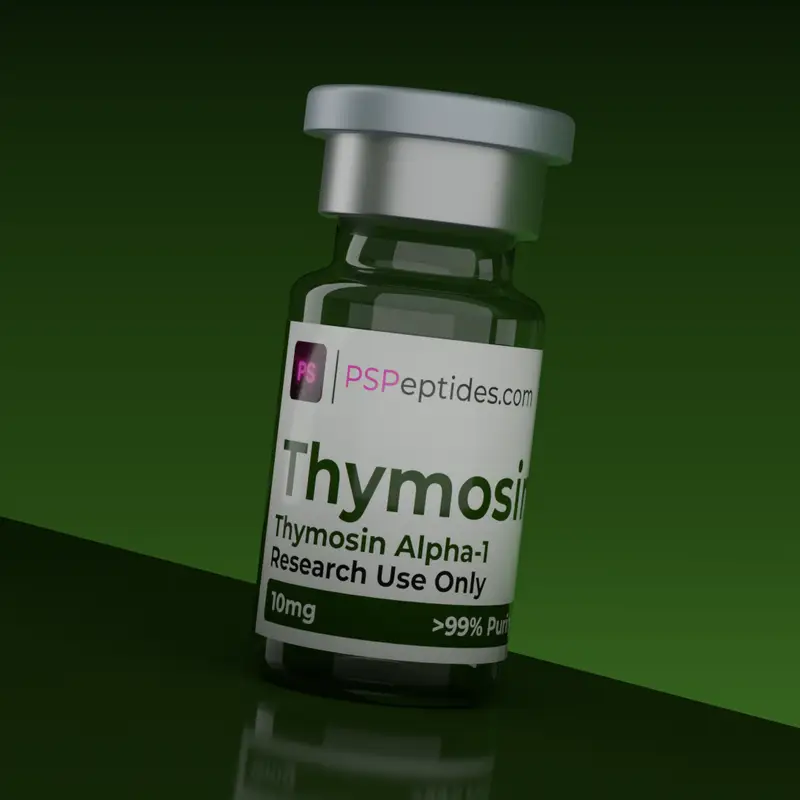
Thymosin Alpha-1 is a peptide first isolated from thymic tissue by Dr. Allan Goldstein at George Washington University in the 1970s. The thymus gland produces it endogenously as a primary regulator of T-cell maturation, differentiation, and activation. When researchers buy thymosin alpha-1 in its synthetic lyophilized form, they receive a compound sequence-identical to the 28-amino acid endogenous peptide, enabling highly accurate immunological research. Read more in our comprehensive Thymosin Alpha-1 immune research guide.
The peptide operates through several well-characterized molecular pathways including toll-like receptor (TLR) activation, upregulation of MHC class I surface expression, and modulation of the Th1/Th2 cytokine axis. These mechanisms make it a subject of sustained interest across immunology, oncology, virology, and longevity research contexts.
Detailed Mechanism of Action
When researchers buy thymosin alpha-1 for immunological studies, they are working with a peptide that acts through several distinct but interconnected molecular pathways. The primary mechanism involves activation of toll-like receptors TLR2 and TLR9 expressed on dendritic cells and macrophages. TLR9 activation by Tα1 triggers MyD88-dependent signaling cascades that increase production of pro-inflammatory cytokines including IL-12 and IFN-α, while simultaneously modulating regulatory T-cell activity to prevent excessive immune activation.
A second major mechanism involves upregulation of MHC class I molecules on the surface of target cells. By increasing MHC-I expression, Tα1 enhances the presentation of intracellular peptide antigens to cytotoxic CD8+ T-lymphocytes, improving immune surveillance efficacy. This pathway is of particular interest in oncology research, where reduced MHC-I expression is a common tumor immune evasion mechanism.
Tα1 also demonstrates documented effects on the Th1/Th2 cytokine balance. In research models of immune dysregulation, Tα1 administration shifts the response toward a Th1-dominant profile, increasing IFN-γ and IL-2 while reducing IL-4 and IL-10 output. This Th1 polarization effect is thought to underlie much of its immunostimulatory activity in preclinical models. Researchers who buy thymosin alpha-1 for cytokine profiling studies benefit from this well-characterized immunological signature.
Beyond T-cell regulation, Tα1 activates natural killer (NK) cells, increasing their cytotoxic activity against target cells. Published studies have documented NK cell activation following Tα1 exposure in multiple model systems, with measurable increases in NK cell proliferation, granule exocytosis, and target cell killing efficacy. This NK-activating property positions thymosin alpha-1 as a key tool in innate immune research.

Published Research on Thymosin Alpha-1
The clinical research foundation supporting thymosin alpha-1 as a research compound is substantial. A pivotal investigation published in International Immunopharmacology (Garaci et al., 2012) examined Tα1 in subjects with compromised immune function, documenting measurable increases in CD4+ T-cell counts, NK cell cytotoxicity, and circulating IL-2 levels following Tα1 administration. The study population showed a statistically significant restoration of T-cell function compared to control groups. This research is indexed via the PubMed Thymosin Alpha-1 immunological research database.
A comprehensive review published in the Annals of the New York Academy of Sciences (Goldstein & Garaci, 2007) synthesized data from over 20 years of Tα1 research, noting consistent immunostimulatory effects across diverse model systems including hepatitis B, hepatitis C, and tumor-bearing animal models. The review specifically highlighted Tα1’s safety profile across extended research periods and its synergistic potential with interferon-α therapy. Researchers who buy it for combination immunotherapy studies can reference this foundation directly.
Additional published data from Cancer Immunology and Immunotherapy documented Tα1-mediated upregulation of IL-2 receptors on T-lymphocytes. This receptor sensitization amplifies T-cell responsiveness to IL-2 stimulation and is considered mechanistically important for understanding how Tα1 potentiates adaptive immune responses. The NIH PubMed literature on thymosin alpha-1 mechanisms provides a comprehensive index of this research base for investigators designing studies around thymosin alpha-1 protocols.
Thymosin Alpha-1 vs. Comparable Immunomodulatory Research Compounds
| Feature | Thymosin Alpha-1 | Thymosin Beta-4 (TB-500) | BPC-157 |
|---|
| Primary Research Focus | Immune regulation, T-cell maturation | Tissue repair, actin regulation | GI healing, systemic repair |
| Molecular Target | TLR2, TLR9, MHC-I, cytokine axis | Actin-beta4, VEGF receptors | FAK-paxillin pathway, VEGFR2 |
| Amino Acid Length | 28 amino acids | 43 amino acids | 15 amino acids |
| Research Applications | Immunology, oncology, antiviral | Musculoskeletal, wound healing | GI, neuroprotection, repair |
| Half-Life | ~2 hours (plasma) | ~4-6 hours | ~4 hours (estimated) |
| Cytokine Effects | Strong Th1 bias (IL-2, IFN-γ ↑) | Anti-inflammatory (IL-4, IL-10 ↓) | Balanced (IGF-1, VEGF modulation) |
| Literature Volume | Extensive (50+ clinical studies) | Moderate (20+ preclinical studies) | Extensive (100+ preclinical) |
| PSPeptides Availability | 10mg vial, 99%+ purity | Available — TB-500 guide | Available — BPC-157 guide |
Reconstitution and Handling Protocol
Researchers who buy the compound from PSPeptides receive the peptide as a lyophilized white powder requiring reconstitution with bacteriostatic water prior to use. The recommended reconstitution approach is to add sterile bacteriostatic water slowly along the inner wall of the vial rather than directly onto the powder, which minimizes mechanical disruption of the peptide structure. For detailed step-by-step guidance, consult our complete peptide reconstitution guide.
For a 10mg vial, adding 2mL of bacteriostatic water yields a concentration of 5mg/mL (5,000mcg/mL). Adding 1mL yields 10mg/mL. Use our free peptide reconstitution calculator to compute exact volumes based on your target research concentration. All reconstitution should be performed in a clean environment using sterile technique. Never vortex the solution — mix gently by rolling the vial between your palms.
Storage and Stability Guidelines
Lyophilized thymosin alpha-1 is stable at −20°C for up to 24 months when protected from humidity and light. For short-term storage (1-4 weeks), the lyophilized powder may be kept at 4°C without significant degradation, though −20°C is preferred for maximum longevity. Once reconstituted, solutions should be stored at 4°C and used within 28 days. Avoid repeated freeze-thaw cycles of reconstituted solutions, as this accelerates degradation. Store in amber vials or foil-wrapped containers to protect from light exposure. For comprehensive peptide storage protocols, see our peptide storage guide and our reference on how to identify peptide degradation.
Certificate of Analysis
Every vial of thymosin alpha-1 from PSPeptides ships with a batch-specific Certificate of Analysis documenting purity verification by independent HPLC chromatography and identity confirmation by electrospray mass spectrometry. COA values are directly linked to the specific production batch rather than a blanket certificate. Learn how to interpret these documents in our guide to reading a peptide COA. COAs are available for download directly on this product page or by emailing the PSPeptides team with your order number.
Why Researchers Buy Thymosin Alpha-1 from PSPeptides
- US Manufactured: All thymosin alpha-1 vials are produced in US-based peptide synthesis facilities under rigorous quality control protocols.
- Third-Party Tested: Independent HPLC and mass spectrometry verification on every production batch — no self-reported purity figures.
- Fast Shipping: Free UPS 2nd Day Air on orders over $200, with same-day dispatch for orders placed before 2 PM EST on business days.
- Flexible Payments: Credit cards, Afterpay, Klarna, Apple Pay, and Google Pay all accepted at checkout.
- 7-Day Customer Support: Research support team available via email seven days a week for questions about thymosin alpha-1 reconstitution, storage, and handling.
Frequently Asked Questions About Thymosin Alpha-1
What is the difference between Thymosin Alpha-1 and Thymosin Beta-4?
Thymosin Alpha-1 and Thymosin Beta-4 are two distinct peptides from the thymosin peptide family, but they have different primary functions. When researchers buy this peptide, they are working with a 28-amino acid immune regulator that acts primarily on T-cell maturation and cytokine modulation. Thymosin Beta-4 (TB-500) is a 43-amino acid peptide focused primarily on actin regulation, wound healing, and tissue repair. The two compounds operate through largely non-overlapping mechanisms and are often studied independently for different research objectives. Learn more in our TB-500 Thymosin Beta-4 research guide.
How should researchers select a concentration when reconstituting thymosin alpha-1?
Concentration selection depends on the specific research protocol and the volumes required per experiment. Common reconstitution approaches for thymosin alpha-1 research involve adding 1-2mL of bacteriostatic water to a 10mg vial, yielding concentrations of 5-10mg/mL. Researchers requiring precise micro-dosing may prefer higher dilution ratios. PSPeptides’ free peptide calculator provides exact volume calculations based on desired concentration and dose. Always verify your target concentration against published research protocols relevant to your specific study design.
Is thymosin alpha-1 the same compound as Zadaxin?
Zadaxin is the branded pharmaceutical formulation of synthetic thymosin alpha-1, approved in several countries for specific clinical indications. When researchers buy it from PSPeptides, they receive the same amino acid sequence (CAS 62304-98-7) as the active ingredient in Zadaxin. The PSPeptides formulation is a research-grade lyophilized powder intended exclusively for laboratory use, not a pharmaceutical product. Researchers should note this distinction and consult relevant regulatory guidelines when designing research protocols. Our guide to research peptides vs prescription peptides explores this distinction in detail.
Can thymosin alpha-1 be stacked with other immunomodulatory research peptides?
Research into peptide combination protocols is an active area of investigation. Some researchers studying immune system function have examined thymosin alpha-1 alongside other compounds including BPC-157 and Epithalon in longevity and immune support research models. Any combination research protocol should be grounded in published literature and appropriate study design. PSPeptides offers a comprehensive peptide stacking research guide and our guide to peptides for immune support research covers relevant combination considerations.
Related Research Resources
All PSPeptides products are sold exclusively for laboratory and research use. Not intended for human consumption.
Research Context: Thymosin Alpha-1 in Modern Immunology
The scientific interest in thymosin peptides has grown substantially since the initial characterization of the thymic hormone system in the 1960s and 1970s. Researchers today study thymosin alpha-1 within a broader framework of immune checkpoint modulation, where understanding how regulatory signals control T-cell activation has become central to both oncology and infectious disease research programs. The peptide’s ability to enhance immune surveillance without inducing excessive inflammatory responses makes it a subject of particular interest for investigators studying immune tolerance and autoimmune mechanisms.
Modern peptide immunology research has increasingly moved toward understanding how small signaling molecules coordinate complex immune networks. Thymosin Alpha-1 exemplifies this paradigm — a 28-amino acid peptide capable of orchestrating T-cell maturation, NK cell activation, cytokine balance, and antigen presentation through a set of discrete but interconnected molecular interactions. Investigators who buy the compound for mechanistic studies benefit from this well-characterized research foundation extending back over four decades of peer-reviewed science.
The peptide’s research legacy includes its investigation in immune deficiency states, chronic viral infections, and tumor-bearing models across multiple species. Cross-species comparability of Tα1 effects — documented in murine, primate, and human research systems — provides investigators with a robust translational framework. For researchers interested in comparative immunology study designs, this cross-species consistency is a significant methodological advantage when designing protocols around thymosin alpha-1 as a research tool.
Regulatory Context for Research Use
Research peptides occupy a distinct regulatory space from pharmaceutical compounds. When investigators buy this peptide from PSPeptides, they are purchasing a compound for laboratory research use, not a pharmaceutical product approved for human therapeutic use in all jurisdictions. In some countries including Italy and China, thymosin alpha-1 formulations hold regulatory approval for specific clinical indications, while in the United States and European Union it remains a research compound. Researchers should consult our overview of research peptide legal status in 2026 and the FDA peptide reclassification 2026 update for current regulatory context relevant to their research jurisdiction.
Laboratory investigators designing studies with thymosin alpha-1 should maintain appropriate documentation of research purpose, establish institutional review board or ethics committee consultation as appropriate for their institution, and ensure that all handling and disposal follows applicable laboratory safety regulations. PSPeptides is committed to supplying research compounds exclusively to verified research contexts, and our team is available to assist investigators with questions about research documentation and best practices.
Sourcing Quality: How to Verify Peptide Research Grade
For investigators deciding where to buy it, sourcing quality should be the primary consideration. The peptide research market includes suppliers of highly variable quality, making independent verification methods essential. PSPeptides maintains strict quality standards: every batch is tested by an independent third-party laboratory using HPLC chromatography for purity assessment and electrospray ionization mass spectrometry for molecular identity confirmation. These are the two gold-standard analytical methods for peptide characterization.
When evaluating any supplier offering thymosin alpha-1, investigators should request batch-specific COAs rather than blanket certificates, verify that HPLC traces show a single dominant peak with area percentage above 99%, and confirm that mass spectrometry results match the expected molecular weight of 3108.4 Da for the 28-amino acid Tα1 sequence. Our guide to how to read a peptide COA explains each of these verification steps in detail. Additional context on evaluating suppliers is available in our research peptide supplier evaluation guide and our best peptide companies 2026 comparison.
Peptide Handling Safety for Laboratory Researchers
Standard laboratory precautions apply to all peptide research compounds including thymosin alpha-1. Researchers should handle lyophilized peptide powders with appropriate care to avoid inhalation, using a fume hood or biosafety cabinet for weighing or reconstitution steps when possible. Nitrile gloves and protective eyewear are recommended for all handling steps. Reconstituted solutions should be treated as biologically active research reagents and stored and disposed of in accordance with institutional safety protocols.
From a chemical safety standpoint, thymosin alpha-1 at research concentrations poses no known acute toxicity risks based on the published literature, and safety data sheets indicate it is not classified as a hazardous substance under standard laboratory safety frameworks. However, all research compounds should be handled with appropriate caution, and investigators new to peptide research should consult our peptide side effects research guide for a comprehensive review of preclinical safety data across commonly studied peptides. Proper subcutaneous injection technique guidance for research applications is covered in our subcutaneous vs intramuscular peptide injection guide.





 Made & Shipped