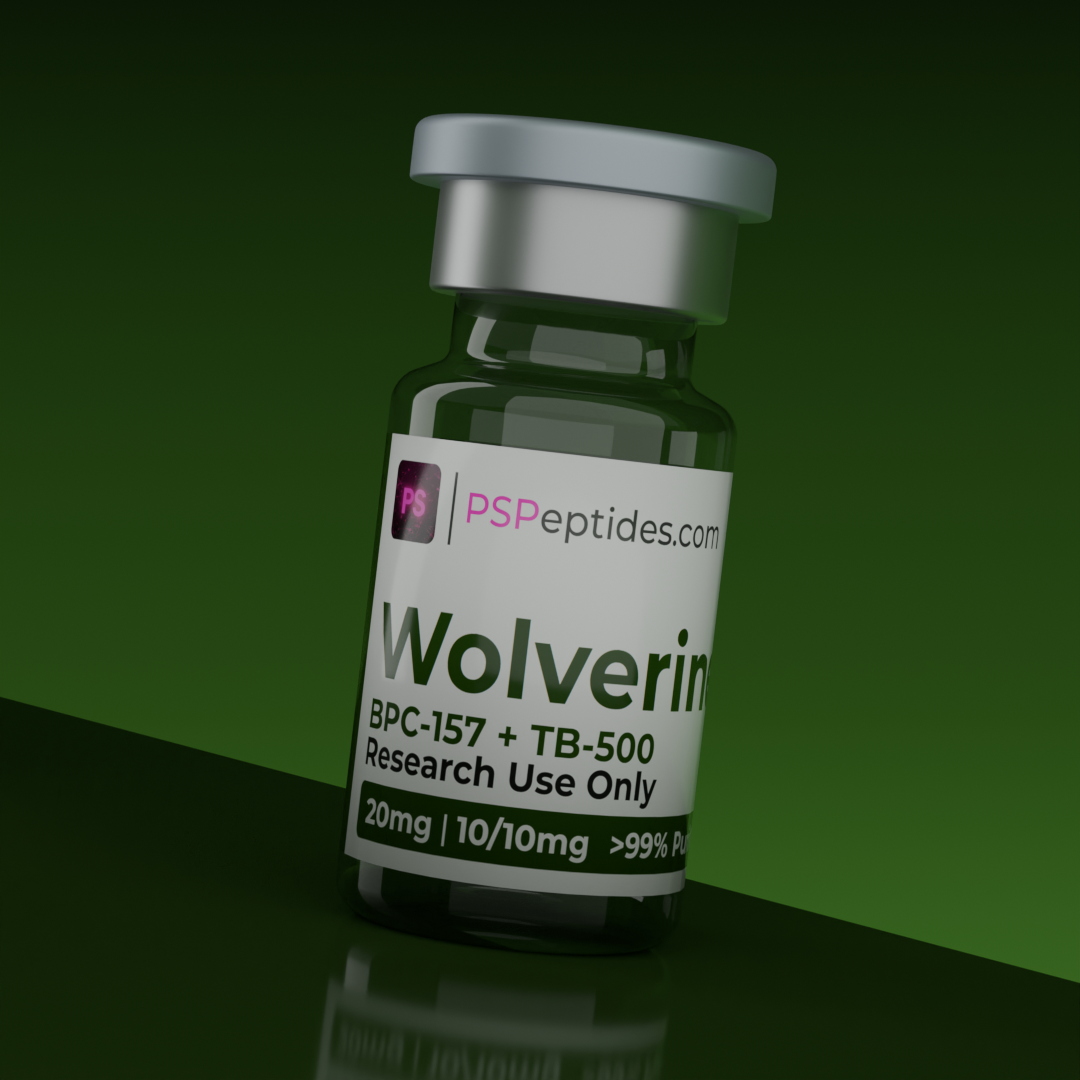
Researchers buy Wolverine Blend for multi-pathway tissue repair, musculoskeletal regeneration, and angiogenesis studies in preclinical laboratory settings. Orders placed before 2 PM EST ship the same day, and orders over $200 ship free via UPS 2nd Day Air.
The Wolverine Blend — known in research communities as the “Wolverine Stack” — combines two of the most extensively studied tissue-repair peptides in preclinical science at a fixed 1:1 ratio. BPC-157 (Body Protection Compound-157, CAS 137525-51-8) is a stable 15-amino-acid pentadecapeptide derived from a protective protein found in human gastric juice.
TB-500 (CAS 77591-33-4) is a synthetic analog of the active region of Thymosin Beta-4, a 43-amino-acid protein abundant in platelets, wound fluid, and nearly every cell type. Where BPC-157 acts locally at the injury site, TB-500 circulates systemically — which is exactly why the two are paired.
When you buy Wolverine Blend from PSPeptides, both compounds arrive pre-combined in a single verified vial, which removes the guesswork of co-dosing two separate products. Read our Wolverine Stack research overview and the BPC-157 TB-500 blend guide for the complete background.
Buy Wolverine Blend: Vial Sizes, Pricing & What’s Included
PSPeptides offers two ways to buy Wolverine Blend, both built on the same 1:1 BPC-157 to TB-500 ratio. The 10mg vial (5mg BPC-157 + 5mg TB-500) is priced at $59.99 and suits pilot studies or short protocols. The 20mg vial (10mg + 10mg) is $79.99, delivering twice the material for $20 more — the better value for most laboratories.
| Option | Contents | Price | Cost per mg |
|---|
| Wolverine Blend 10mg vial | 5mg BPC-157 + 5mg TB-500 | $59.99 | $6.00 |
| Wolverine Blend 20mg vial | 10mg BPC-157 + 10mg TB-500 | $79.99 | $4.00 |
| Separate vials (BPC-157 10mg + TB-500 10mg) | 10mg + 10mg in two vials | $169.98 | $8.50 |
Every order includes a batch-specific Certificate of Analysis documenting HPLC purity and mass-spectrometry identity for both peptides. Live pricing and stock are always shown in the selector at the top of this page. Labs that buy Wolverine Blend in multiples of three 20mg vials ($239.97) clear the $200 threshold for free UPS 2nd Day Air shipping.
Why Buy Wolverine Blend Instead of Separate Vials?
Buying BPC-157 10mg ($89.99) and TB-500 10mg ($79.99) separately costs $169.98 — more than double the $79.99 you pay when you buy Wolverine Blend 20mg. At the 5mg level the math is similar: $94.98 for two separate vials versus $59.99 for the blend. The savings come from manufacturing both peptides into one vial, not from lower purity; every component still carries ≥99% verification.
Beyond price, the blend guarantees a consistent 1:1 ratio in every draw, halves reconstitution and handling time, and reduces the number of vials to label, track, and store. Researchers who need to vary the ratio can still buy BPC-157 and buy TB-500 individually, but for fixed-ratio protocols the blend is the more efficient purchase.
Detailed Mechanism of Action
The Wolverine Blend operates through two complementary but mechanistically distinct repair cascades that target different stages and locations of the healing process. BPC-157 (Gly-Glu-Pro-Pro-Pro-Gly-Lys-Pro-Ala-Asp-Asp-Ala-Gly-Leu-Val) exerts its primary effects through the focal adhesion kinase (FAK)–paxillin pathway, which governs cell motility and fibroblast outgrowth from injured tendon explants. It also modulates the nitric oxide system and rapidly upregulates VEGFR2 expression in wound tissue.
TB-500 exerts its repair activity primarily through G-actin sequestration and actin polymerization. By binding monomeric G-actin, it promotes cytoskeletal reorganization in endothelial cells and keratinocytes, enabling systemic migration of repair-competent cells to injury sites. Unlike BPC-157’s localized action, TB-500 circulates broadly, and Thymosin Beta-4 also activates integrin-linked kinase (ILK), a regulator of cell-survival signaling first characterized in cardiac repair research.
Together, the two compounds create what researchers describe as a synergistic repair environment. BPC-157 anchors local cytoprotection — stabilizing cells under oxidative stress and regulating vascular tone — while TB-500 coordinates systemic recruitment of stem and progenitor cells. Both independently promote angiogenesis, BPC-157 via VEGFR2 activation and TB-500 via endothelial migration, so the blend provides broader vascular support than either compound alone.
Anti-inflammatory activity is a third shared mechanism: BPC-157 down-regulates NF-κB signaling while TB-500 suppresses TNF-α and IL-1β in independent preclinical models. This local-plus-systemic duality is the mechanistic reason researchers buy Wolverine Blend rather than a single peptide. For deeper context, see our BPC-157 research guide and TB-500 Thymosin Beta-4 guide.

Published Research
BPC-157 has one of the largest preclinical evidence bases of any research peptide. Chang et al. (2011, Journal of Applied Physiology) showed that BPC-157 accelerates tendon fibroblast outgrowth, improves cell survival under oxidative stress, and enhances migration via FAK–paxillin signaling — read the BPC 157 tendon healing study on PubMed.
The Sikiric group at the University of Zagreb has published extensively since the 1990s on gastric cytoprotection, systemic wound healing, and vascular effects, summarized in their BPC 157 gastrointestinal review on PubMed. Additional rodent work spans burn healing, spinal cord injury, and traumatic brain injury models.
TB-500 research is rooted in decades of Thymosin Beta-4 science. Malinda et al. (1999) demonstrated accelerated dermal wound closure through endothelial and keratinocyte migration, and Smart et al. (2007, Nature) showed that Thymosin Beta-4 mobilizes adult epicardial progenitor cells and drives neovascularization — see the Thymosin beta-4 epicardial progenitor study on PubMed. That cardiac finding substantially expanded interest in TB-500 as a systemic repair peptide.
Peer-reviewed studies on co-administration of the two peptides remain limited, but the mechanistic rationale — complementary cellular targets, independent angiogenic pathways, and additive anti-inflammatory effects — is well supported by each literature stream. Researchers testing the synergy hypothesis should review our BPC-157 vs TB-500 comparison, the peptides for joint and tendon repair guide, and our peptide stacking guide before designing protocols.
Wolverine Blend vs Alternatives
The table below shows exactly what you get when you buy Wolverine Blend 20mg compared with the single-peptide vials, on both the research and the cost side.
| Feature | Wolverine Blend (20mg) | BPC-157 Alone (10mg) | TB-500 Alone (10mg) |
|---|
| Total peptide content | 20mg (10mg + 10mg) | 10mg | 10mg |
| Price | $79.99 | $89.99 | $79.99 |
| Cost per mg | $4.00 | $9.00 | $8.00 |
| Primary mechanism | Dual local + systemic repair | Localized cytoprotection | Systemic cell recruitment |
| Angiogenesis pathways | VEGFR2 + actin remodeling | VEGFR2 activation | Actin remodeling |
| Anti-inflammatory targets | NF-κB + TNF-α + IL-1β | NF-κB modulation | TNF-α / IL-1β |
| GI cytoprotection data | Yes (BPC-157 component) | Yes | Limited |
| Cardiac repair data | Yes (TB-500 component) | Limited | Yes |
| Purity / COA | ≥99% per component, batch COA | ≥99%, batch COA | ≥99%, batch COA |
How to Buy Wolverine Blend Online in 3 Steps
Here is how to buy Wolverine Blend online from PSPeptides today:
- Choose your vial size: Select 10mg (5mg + 5mg) or 20mg (10mg + 10mg) from the selector at the top of this page and click Add to Cart.
- Check out securely: Pay by credit card, Apple Pay, or Google Pay, or split the total into installments with Afterpay or Klarna.
- Receive your order fast: Orders placed before 2 PM EST ship the same business day, and orders over $200 ship free via UPS 2nd Day Air.
To arrive ready for reconstitution, add bacteriostatic water and 1mL insulin syringes to the same cart. Labs comparing delivery formats can also review the pre-mixed BPC-157 + TB-500 spray, which requires no reconstitution step.
Shipping, Payment & Support
When you buy Wolverine Blend before 2 PM EST on a business day, your order is packed and dispatched the same day. Orders over $200 ship free via UPS 2nd Day Air, so a three-vial order of the 20mg size qualifies automatically. Smaller orders ship at standard rates calculated at checkout.
PSPeptides accepts all major credit cards, Apple Pay, and Google Pay, plus buy-now-pay-later through Afterpay and Klarna. If you have a question before you buy Wolverine Blend — about batch COAs, vial sizes, or stacking it with other research peptides — our support team answers by email, phone, or text seven days a week.
Reconstitution & Handling
Researchers who buy Wolverine Blend typically reconstitute the lyophilized powder with bacteriostatic water (BAC water) to produce a stable, sterile solution. A standard approach is 2mL of BAC water per vial, yielding 10mg/mL total (5mg/mL of each peptide) for the 20mg vial, or 5mg/mL total (2.5mg/mL of each peptide) for the 10mg vial. Let the water run down the inside of the vial wall rather than onto the powder cake.
Swirl gently — never shake or vortex — until the solution is clear to slightly opalescent with no visible particulates, and discard any vial showing cloudiness or discoloration. Follow our peptide reconstitution guide and the bacteriostatic water overview for step-by-step detail.
Accurate dosing requires a calibrated U-100 insulin syringe (1mL). Use our free peptide dosage calculator guide to determine draw volume for your target research dose, review the BPC-157 dosage guide for component-level reference ranges, and see our subcutaneous vs intramuscular comparison for route selection. Handle all materials under sterile conditions with appropriate PPE.
Storage & Stability
Lyophilized Wolverine Blend powder is stable at –20°C for up to 24 months in a sealed, moisture-protected container, or at 4°C for up to four weeks. Once reconstituted, store at 2–8°C and use within 28 days. Avoid repeated freeze-thaw cycles, which progressively degrade both peptides, and protect vials from direct light, since UV exposure accelerates oxidation in reconstituted form.
When transporting vials between facilities, use an insulated cooler with ice packs to maintain cold-chain integrity. Our peptide storage guide, peptide degradation guide, and peptide half-life chart cover stability windows and pharmacokinetic reference data in depth.
Certificate of Analysis
Every vial ships with a batch-specific Certificate of Analysis documenting ≥99% purity for each component, verified by HPLC retention-time and peak-area analysis and confirmed by mass spectrometry for molecular weight and sequence identity. HPLC alone cannot confirm identity, which is why PSPeptides requires both methods from independent third-party laboratories.
Self-reported purity without third-party verification is not an acceptable evidence base for rigorous research — one more reason researchers buy Wolverine Blend from a supplier that publishes batch data. Learn to interpret every line of your document in our COA reading guide, and contact support for batch-specific questions.
Where to Buy Wolverine Blend: Why Researchers Choose PSPeptides
- US Manufactured: Produced in US-based facilities under strict quality-control and clean-room protocols.
- Third-Party Tested: Independent HPLC and mass spectrometry verification — not manufacturer self-reporting.
- Fast Shipping: Free UPS 2nd Day Air over $200, same-day dispatch before 2 PM EST.
- Flexible Payments: Credit cards, Afterpay, Klarna, Apple Pay, Google Pay.
- 7-Day Support: Email, phone, or text.
- Transparent Value: One 20mg vial costs less than half of two separate 10mg vials, with the same ≥99% purity.
Choosing where to buy Wolverine Blend matters as much as choosing the peptide itself. Our guide to choosing a research peptide supplier and best peptide companies 2026 review explain the testing, documentation, and fulfillment standards to demand from any vendor.
Who Buys Wolverine Blend?
Orthopedic and sports-medicine research groups buy Wolverine Blend to model tendon, ligament, and muscle recovery where a local-plus-systemic repair signal is the variable under study. Tissue-engineering and angiogenesis labs use it to examine dual-pathway neovascularization, and gastrointestinal researchers value the BPC-157 component’s mucosal cytoprotection data alongside TB-500’s systemic reach.
Independent researchers and small labs also buy Wolverine Blend because it simplifies procurement: one SKU, one COA, one reconstitution step, and a lower cost per milligram than any two-vial alternative. For broader protocol design, see our peptides for muscle growth and recovery overview and the peptide cycling guide.
Regulatory & Research Context
Research peptides occupy a distinct category from pharmaceutical drugs and dietary supplements. In the United States, BPC-157 and TB-500 are sold for laboratory and preclinical use only and are not FDA-approved for human administration or therapeutic use. Anyone who plans to buy Wolverine Blend should review institutional requirements and applicable regulations before ordering.
PSPeptides operates within this framework by selling exclusively for research use, including batch-specific COAs with every order, and maintaining transparent labeling. Read our FDA peptide reclassification 2026 update and the research peptides vs prescription peptides comparison for the current regulatory picture.
Frequently Asked Questions
Where can I buy Wolverine Blend online?
You can buy Wolverine Blend online directly from this page at PSPeptides. Select the 10mg or 20mg vial, add it to your cart, and check out with a credit card, Apple Pay, Google Pay, Afterpay, or Klarna. Orders placed before 2 PM EST ship the same day, with free UPS 2nd Day Air on orders over $200.
Should I buy Wolverine Blend 10mg or 20mg?
The 20mg vial (10mg + 10mg) at $79.99 costs $4.00 per mg, versus $6.00 per mg for the 10mg vial at $59.99, so most laboratories running multi-week protocols buy Wolverine Blend 20mg. The 10mg vial is the right choice for pilot studies, single short experiments, or labs that prefer to reconstitute smaller amounts at a time.
Is it legal to buy Wolverine Blend in the USA?
Researchers can buy Wolverine Blend in the United States for laboratory and preclinical use only; BPC-157 and TB-500 are sold as research chemicals and are not FDA-approved for human administration. Researchers must comply with institutional and applicable regulations. Our are research peptides legal in 2026 guide covers the current regulatory landscape in detail.
Can I buy Wolverine Blend in bulk for my lab?
Yes. Add any quantity of either vial size to your cart; three or more 20mg vials ($239.97) automatically qualify for free UPS 2nd Day Air shipping. For larger institutional orders or recurring supply, contact our support team by email, phone, or text to discuss batch allocation and COA documentation.
How is the Wolverine Blend different from buying each peptide separately?
The blend delivers both peptides at a fixed 1:1 ratio in one vial, so every draw contains equal amounts of BPC-157 and TB-500 with a single reconstitution step. It also costs far less when you buy Wolverine Blend 20mg: $79.99 combined versus $169.98 for the two 10mg vials sold separately. Researchers who need custom ratios should purchase the individual peptides instead.
What reconstitution volume should I use for the Wolverine Blend?
Most protocols use 2mL of bacteriostatic water per vial, which yields 10mg/mL total for the 20mg vial or 5mg/mL total for the 10mg vial — half of each concentration is BPC-157 and half is TB-500. Use our peptide dosage calculator to convert your research dose into a draw volume.
Is the Wolverine Blend third-party tested?
Yes. Every batch is tested by independent laboratories using HPLC and mass spectrometry, and the batch-specific COA included with your order documents ≥99% purity for both components. When you buy Wolverine Blend from PSPeptides, that documentation ships with the vial rather than on request.
Related Resources
Before you buy Wolverine Blend, these guides cover the science, handling, and sourcing questions in more depth:
All PSPeptides products are sold exclusively for laboratory and research use. Not intended for human consumption.





 Made & Shipped