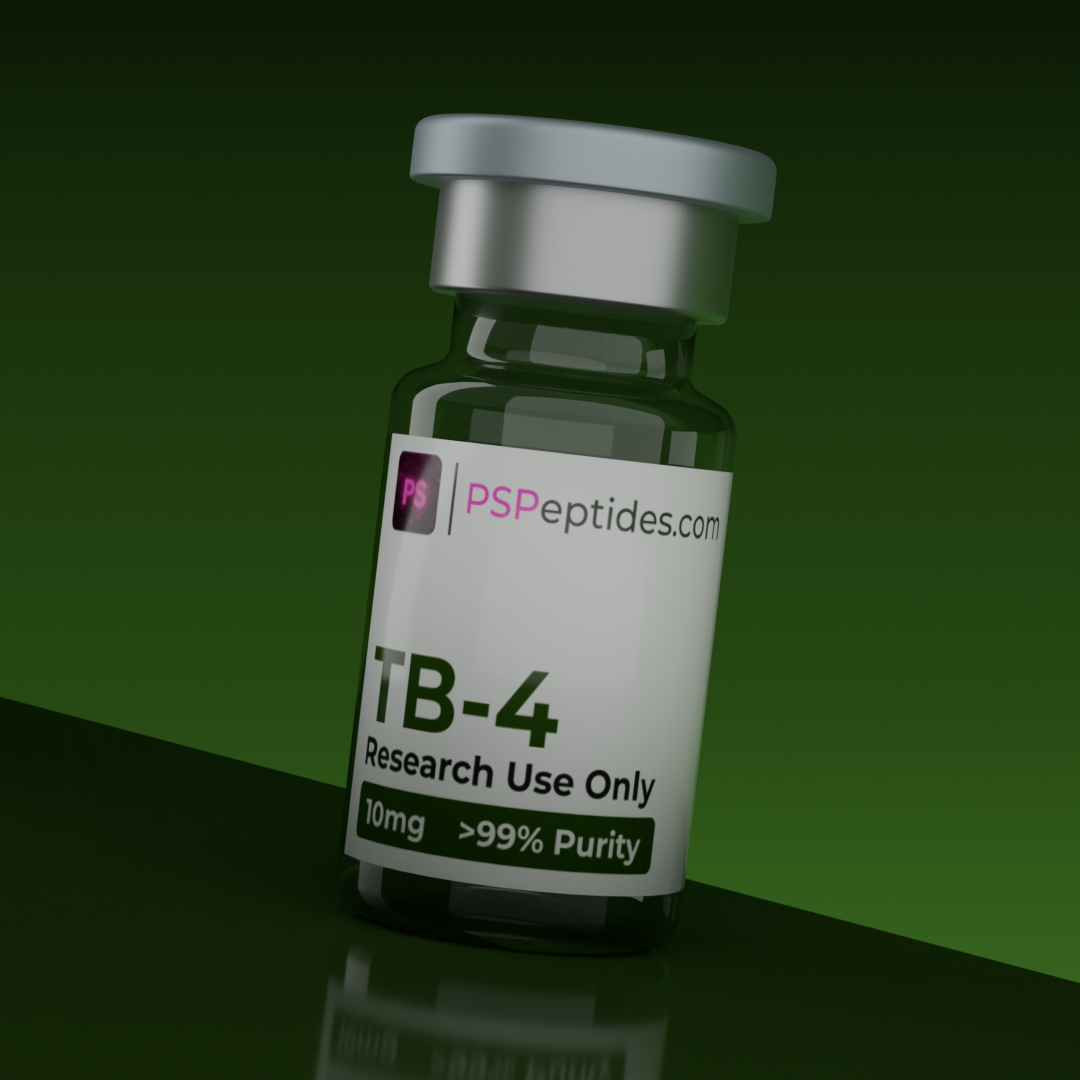
TB-4 is the complete, N-terminally acetylated Thymosin Beta-4 sequence — all 43 residues, roughly 4,963 Da — and the most abundant actin-binding peptide inside human and animal cells. Its core job is to hold monomeric G-actin in reserve so cells can rebuild their cytoskeleton on demand during migration, division, and repair.
When researchers buy TB-4 instead of a fragment, they get the whole molecule: the anti-inflammatory Ac-SDKP region at the N-terminus and the actin-binding LKKTETQ motif at residues 17–23. For the full background, read our complete TB-500 and Thymosin Beta-4 guide.
Tβ4 is encoded by the TMSB4X gene and is highly conserved across mammals (the human and mouse sequences are identical), which is why rodent data translate unusually well and why it has become a benchmark molecule in regenerative research.
Detailed Mechanism of Action
Thymosin Beta-4 is first and foremost an actin buffer. It binds monomeric G-actin in a 1:1 complex with sub-micromolar affinity, and because cells such as platelets and leukocytes carry it at concentrations in the hundreds of micromolar range, Tβ4 holds a large reserve of actin in a polymerization-ready but inactive state. The LKKTETQ motif at residues 17–23 anchors that interaction, while the N-terminal helix stabilizes the complex.
When a cell needs to move, divide, or close a wound, it releases that actin to build lamellipodia, filopodia, and stress fibers. This is the mechanism researchers buy TB-4 to study most often, and it is the reason the peptide shows up in nearly every model of cell migration and cytoskeletal remodeling.
The second layer of activity happens outside the cell. Although Tβ4 has no signal peptide, platelets release it at injury sites, where it engages the PINCH–ILK–parvin complex, activates integrin-linked kinase (ILK), and drives Akt phosphorylation. That ILK/Akt axis supports cardiomyocyte survival and migration, upregulates matrix metalloproteinases, and promotes endothelial tube formation and new vessel growth.
Tβ4 also interacts with cell-surface ATP synthase and purinergic signaling, which helps explain how an intracellular actin regulator can act as an extracellular messenger. In the heart, that extracellular signaling reaches the epicardium: Tβ4 mobilizes adult epicardial progenitor cells and promotes neovascularization in adult mouse hearts, an effect first reported in Nature in 2007 and still central to cardiac repair research.
Full-length TB-4 also carries two signaling domains that a short fragment lacks. The N-terminal tetrapeptide Ac-SDKP, released by prolyl oligopeptidase, is an anti-fibrotic and anti-inflammatory signal in its own right, and oxidation of methionine-6 produces Tβ4 sulfoxide, an anti-inflammatory metabolite generated by monocytes. Researchers who buy TB-4 for fibrosis or inflammation work are usually interested in exactly these domains.
Downstream, published fragment-mapping work assigns distinct jobs to distinct regions: residues 1–4 regulate anti-inflammatory and anti-fibrotic effects, residues 1–15 inhibit apoptosis and limit cell damage, and residues 17–23 drive angiogenesis and hair-follicle growth. The intact peptide blocks NF-κB activation, lowers TNF-α, IL-1β, and IL-6, and induces antioxidant and anti-apoptotic genes in cardiac fibroblasts.

Published Research
The modern framework for Tβ4 comes from Goldstein, Hannappel, and Kleinman, whose 2005 review in Trends in Molecular Medicine described how an actin-sequestering protein moonlights to repair injured tissues. It traced Tβ4’s effects on cell migration, angiogenesis, inflammation, and apoptosis across skin, cornea, and heart, and it remains the most-cited entry point for anyone who wants to buy TB-4 and design a first experiment.
The wound-healing data go back further. Malinda and colleagues (1999, Journal of Investigative Dermatology) applied Tβ4 to full-thickness dermal wounds in rats and reported accelerated wound closure with increased keratinocyte migration and collagen deposition. Later work in a rat skin-flap model found that 5 mg/kg twice daily produced the highest tissue survival rates, and topical Tβ4 accelerated hair growth in aged, sparse-haired mice for more than 26 weeks.
Cardiac work followed quickly. Bock-Marquette and colleagues (2004, Nature) showed that Tβ4 activates integrin-linked kinase, promotes cardiomyocyte migration and survival, and improves cardiac function after coronary artery ligation in mice. Smart and colleagues (2007, Nature) then demonstrated that Tβ4 mobilizes adult epicardial progenitors and drives neovascularization, which is why researchers buy TB-4 for ischemia-reperfusion and infarct models today.
Ophthalmic research has produced some of the most consistent findings. In corneal injury models, Tβ4 promotes epithelial cell migration and re-epithelialization while reducing inflammation and apoptosis, and it improves tear-film measures in dry-eye models. That body of work carried a Tβ4 eye-drop formulation into late-stage clinical trials for neurotrophic keratopathy and dry eye.
Human safety data exist as well. Ruff and colleagues ran a randomized, placebo-controlled phase 1 study of intravenous synthetic Tβ4 in 40 healthy volunteers at single doses of 42, 140, 420, and 1,260 mg, followed by 14 days of daily dosing. Adverse events were infrequent and mild to moderate, no dose-limiting toxicities or serious adverse events occurred, and exposure was dose-proportional.
Clinical programs have since tested Tβ4 formulations in the eye and in chronic wounds. A randomized phase 2 dry-eye trial reported a 35.1% reduction in ocular discomfort and a 59.1% reduction in corneal fluorescein staining versus vehicle, according to a 2021 review of Tβ4 function and application.
In chronic wounds, a 73-patient venous stasis ulcer trial saw roughly 25% of patients heal completely within three months, and a 143-patient study of pressure and venous stasis ulcers found healing accelerated by nearly a month in responders. These are the data sets researchers cite when they buy TB-4 for translational models.
TB-4 vs Alternatives: Should You Buy TB-4 or TB-500?
Should you buy TB-4 or TB-500? The answer depends on whether your protocol needs the complete native sequence or a cost-efficient fragment. TB-4 is the whole 43-residue molecule with every functional domain intact. TB-500 is the synthetic analog built around the actin-binding region, and BPC-157 is an unrelated gastric pentadecapeptide that works through different pathways.
| Feature | TB-4 (This Product) | TB-500 | BPC-157 |
|---|
| Sequence | Full native Thymosin Beta-4, 43 amino acids, N-acetylated | Synthetic Tβ4 analog built around the 17–23 actin-binding region | 15-amino-acid pentadecapeptide from a gastric protein |
| Molecular weight | ~4,963 Da | Lower than full-length (see batch COA) | ~1,419 Da |
| Core mechanism | G-actin sequestration plus ILK/Akt, Ac-SDKP, and sulfoxide anti-inflammatory domains | Actin-binding and cell-migration signaling | Nitric-oxide system, VEGFR2, and growth-factor signaling |
| Research focus | Whole-molecule Tβ4 biology: wound, cardiac, corneal, fibrosis, inflammation | Soft-tissue repair and recovery models | Gut, tendon, ligament, and vascular repair models |
| Vial options at PSPeptides | 10mg lyophilized vial | 5mg and 10mg lyophilized vials | Single vials and BPC-157/TB-500 blends |
| Reconstitution | 1–2 mL bacteriostatic water | 1–2 mL bacteriostatic water | 1–2 mL bacteriostatic water |
| Commonly stacked with | BPC-157, GHK-Cu | BPC-157 (Wolverine Stack) | TB-500 or TB-4 |
| Best choice when | You need the complete native sequence with all functional domains | You want a budget-friendly fragment for actin-related endpoints | Your model centers on gastric, tendon, or vascular endpoints |
Many laboratories buy TB-4 and BPC-157 together to run a full-length version of the classic Wolverine protocol. For a deeper head-to-head, see our BPC-157 vs TB-500 comparison, which covers the same endpoints that apply to full-length Tβ4.
Reconstitution & Handling
Let the vial reach room temperature, then add 1–2 mL of bacteriostatic water slowly down the inside wall of the glass. Swirl gently until the powder dissolves completely; never shake, because shear can fragment the peptide. Researchers who buy TB-4 for the first time usually choose 2 mL, which yields 5 mg/mL (5,000 mcg/mL), so 0.02 mL (2 units on a U-100 insulin syringe) delivers 100 mcg.
If your protocol calls for a more concentrated stock, 1 mL of bacteriostatic water produces 10 mg/mL. Use a sterile 29–31G syringe for every draw, wipe the stopper with alcohol before each use, and label the vial with the reconstitution date. Our how-to-reconstitute-peptides guide walks through the technique step by step, and the peptide dosage calculator guide converts any concentration into syringe units.
Pharmacokinetics & Protocol Design
Tβ4 is cleared quickly. The phase 1 data showed dose-proportional exposure with a half-life that lengthened at higher doses, but circulating levels still fall within hours rather than days, which is why most animal protocols dose daily or every other day rather than weekly. Plan sampling times and endpoint assays around that window.
Published rodent work spans a wide dose range, from microgram topical applications in wound models to 5 mg/kg systemic dosing in skin-flap survival studies, so match your dose to the model rather than borrowing a number from an unrelated study. Common readouts include scratch-wound closure, endothelial tube formation, Akt and ILK phosphorylation by Western blot, hydroxyproline for collagen content, and NF-κB reporter assays.
Researchers who buy TB-4 for stacking studies most often pair it with BPC-157, which works through nitric-oxide and growth-factor pathways rather than actin, so the two give complementary rather than redundant signals. GHK-Cu is the second most common partner in skin and wound protocols. Our peptide stacking guide covers sequencing, timing, and controls.
Storage & Stability
Lyophilized TB-4 is stable for extended periods at −20°C and tolerates short-term storage at 2–8°C, so the vial you buy TB-4 in today can wait in the freezer until your study begins. Keep it sealed, dry, and away from light; Tβ4 is relatively heat-tolerant compared with larger proteins, but repeated temperature cycling still degrades it.
Once reconstituted with bacteriostatic water, store the vial at 2–8°C and use it within about four weeks. Do not freeze a reconstituted vial, because freeze-thaw cycles cause aggregation and loss of activity. Our peptide storage guide covers temperature windows, light sensitivity, and the warning signs of degradation in more detail.
Lyophilized peptides tolerate the few days of ambient-temperature transit between our facility and your laboratory without measurable loss of purity, so there is no need for cold-chain shipping. Refrigerate or freeze the vial as soon as it arrives and note the receipt date on your lab log.
Certificate of Analysis
Every TB-4 batch ships with a Certificate of Analysis from an independent laboratory. The COA reports HPLC purity (99%+), mass spectrometry confirmation of the expected ~4,963 Da molecular mass, the lot number, and the test date, so you can tie the vial on your bench to a documented result. When you buy TB-4 from PSPeptides you never have to take purity on faith.
If you are new to reading these documents, our guide to peptide purity and COAs explains what the chromatogram, the retention time, and the mass peak each tell you about the product.
Lot tracking matters for reproducibility. Because every TB-4 vial carries a printed lot number that matches its COA, you can cite a specific purity and mass result in your methods section and reorder the same lot while it remains in stock. Laboratories that buy TB-4 for multi-month studies often order enough vials from one lot to cover the full protocol.
Why Researchers Buy TB-4 From PSPeptides
- Full-Length Sequence: Complete 43-residue Tβ4, not a fragment, so every functional domain described in the literature is present in the vial.
- US Manufactured: Synthesized in the United States under cGMP-compliant conditions, not re-labeled from an overseas bulk source.
- Third-Party Tested: Independent HPLC and mass spectrometry on every batch, with the COA included in your order.
- Fast Shipping: Free UPS 2nd Day Air over $200, and orders placed before 2 PM EST ship the same day.
- Flexible Payments: Credit cards, Afterpay, Klarna, Apple Pay, and Google Pay at checkout.
- 7-Day Support: Email, phone, or text, so a question about reconstitution or an order never waits until Monday.
How to Buy TB-4 Online
Ordering takes about a minute. Select the 10mg vial above, choose your quantity, and add it to your cart. Checkout accepts major credit cards, Afterpay, Klarna, Apple Pay, and Google Pay, and you can buy TB-4 online as a guest or create an account to track reorders and COAs in one place.
Orders placed before 2 PM EST leave our facility the same business day with tracking, and anything over $200 ships free by UPS 2nd Day Air. Many researchers reach that threshold by pairing TB-4 with BPC-157, GHK-Cu, or bacteriostatic water, so the whole stack arrives together.
If you plan to buy TB-4 in bulk for a multi-arm study, contact support for quantity pricing and lot availability before you check out.
Frequently Asked Questions
Should I buy TB-4 or TB-500?
Buy TB-4 when your work depends on the complete native Thymosin Beta-4 sequence, including the Ac-SDKP anti-fibrotic domain and the anti-apoptotic 1–15 region. TB-500 is the better fit for cost-sensitive protocols focused on actin-binding and migration endpoints. Both are tested to the same 99%+ purity standard at PSPeptides.
What exactly do I receive when I buy TB-4?
You receive one sealed vial containing 10mg of lyophilized, full-length Thymosin Beta-4 at 99%+ purity, plus access to the batch-specific Certificate of Analysis. Bacteriostatic water is sold separately so you can choose your own reconstitution volume.
How fast will my TB-4 order ship?
Orders placed before 2 PM EST ship the same day, and every order includes tracking. Shipments over $200 go out free by UPS 2nd Day Air, so most US researchers who buy TB-4 with a companion peptide have it on the bench within two business days.
How much bacteriostatic water should I add to a 10mg TB-4 vial?
Most protocols use 1–2 mL. Two milliliters gives a 5 mg/mL stock that is easy to measure on a U-100 syringe, while 1 mL gives a 10 mg/mL stock for protocols that need smaller injection volumes. Either way, add the water slowly and swirl rather than shake.
Can I buy TB-4 for research in the USA?
PSPeptides sells TB-4 strictly as a research chemical for laboratory and in vitro use, and it is not approved for human or veterinary use. Qualified researchers buy TB-4 online here every day; we simply ask that you confirm the product is intended for research when you place your order.
How is TB-4 purity verified?
Each batch is analyzed by an independent laboratory using HPLC for purity and mass spectrometry for identity. The resulting COA is tied to the lot number printed on your vial, so the 99%+ figure you see when you buy TB-4 is a measured result for the material you receive, not a generic claim.
Is TB-4 the same as thymosin beta-4?
Yes. TB-4 is simply the product name for synthetic, full-length thymosin beta-4 (Tβ4), the 43-amino-acid peptide encoded by the TMSB4X gene. It is distinct from TB-500, which is a shorter synthetic analog, and from thymosin alpha-1, an unrelated immune-signaling peptide.
Do you offer bulk pricing when I buy TB-4 in quantity?
Yes. Multi-vial orders already qualify for free UPS 2nd Day Air once the cart passes $200, and larger research orders can be quoted directly. Contact support by email, phone, or text before you buy TB-4 in bulk and we will confirm lot availability and quantity pricing.
What payment methods can I use?
Checkout accepts all major credit cards, Afterpay, Klarna, Apple Pay, and Google Pay. Afterpay and Klarna let you split a larger stack into installments, which is popular with laboratories that buy TB-4 alongside several companion peptides.
Related Resources
All PSPeptides products are sold exclusively for laboratory and research use. Not intended for human consumption.





 Made & Shipped