
Reviewed by
Brandon Johnson — Certified Personal Trainer, Nutrition Coach & Peptide Research Consultant
Brandon Johnson is a certified personal trainer, nutrition coach, and peptide research consultant with a background in kinesiology and over 15 years of experience in fitness and wellness. He reviews all PSPeptides educational content for scientific accuracy and practical relevance.
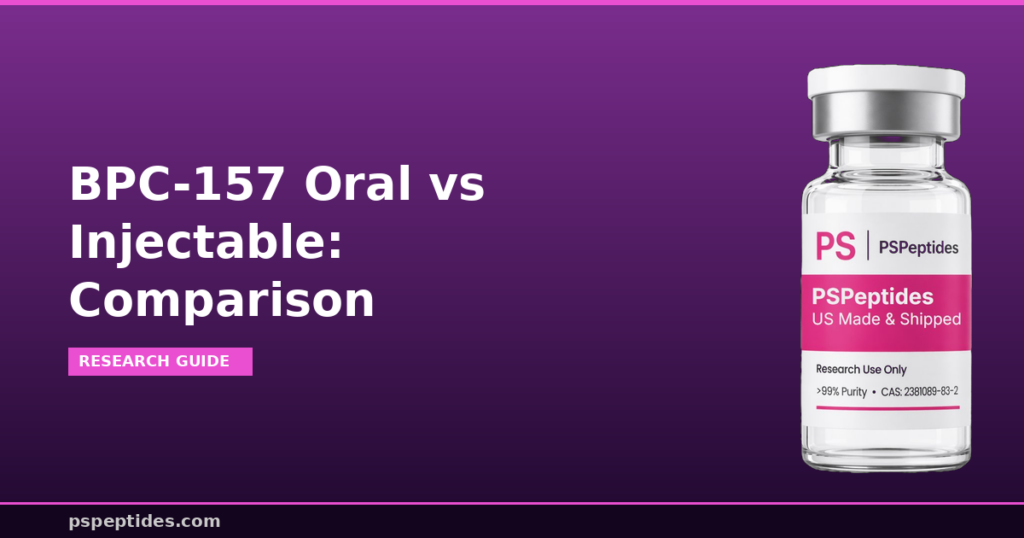
BPC-157 oral vs injectable is one of the most practical delivery questions in peptide research — and BPC-157 is uniquely positioned among peptides because it is one of the only compounds where oral delivery is genuinely viable. BPC-157 (Body Protection Compound-157) is derived from a protein found in human gastric juice, giving it an intrinsic stability in the acidic, enzyme-rich GI environment that destroys most other peptides on contact. This gastric origin means BPC-157 can be administered orally — as tablets, throat spray, or swallowed solution — and retain biological activity, while virtually every other peptide must be injected to reach its target tissue intact.
PSPeptides carries BPC-157 in every delivery format: injectable vial, oral tablets, throat spray, and the BPC-157+TB-500 combination spray. For the complete mechanism, see our BPC-157 research guide.
Why BPC-157 Is Different: Gastric Stability
Most peptides are degraded within minutes in the GI tract. Gastric acid (pH 1.5-3.5) denatures peptide structures, and digestive enzymes (pepsin, trypsin, chymotrypsin) cleave peptide bonds — destroying biological activity before absorption can occur. This is why most peptides must be injected: oral delivery would produce negligible systemic exposure.
BPC-157 is the exception. Published research by Sikiric and colleagues at the University of Zagreb has demonstrated that BPC-157 maintains structural integrity and biological activity in the gastric environment — consistent with its origin as a fragment of a protein naturally present in gastric juice. The peptide has evolved to function in the same acidic, enzymatic environment that destroys other peptides. The gastric stability extends beyond simple acid resistance. Published in vitro studies have demonstrated that BPC-157 maintains its tertiary structure — the three-dimensional folding pattern that determines biological activity — at pH values as low as 1.0 and in the presence of pepsin at concentrations exceeding physiological gastric levels. This structural resilience is not shared by other commonly studied tissue repair peptides — TB-500 (Thymosin Beta-4), for example, is rapidly degraded in the GI environment, which is why it must be administered by injection or nasal spray for systemic effects. BPC-157’s unique gastric stability makes it the only tissue repair peptide where oral delivery is a scientifically validated option rather than a theoretical possibility. Published preclinical studies have used oral administration of BPC-157 and documented systemic biological effects — confirming that the peptide survives GI transit and produces measurable activity when swallowed. A stable form called BPC-157 arginate has demonstrated oral bioavailability exceeding 90% in published research.
BPC-157 Oral vs Injectable: Complete Comparison
| Feature | BPC-157 Oral (Tablets/Spray) | BPC-157 Injectable (SC) |
|---|---|---|
| Delivery Route | Oral mucosa → GI tract | Subcutaneous tissue → bloodstream |
| GI Tissue Contact | Direct — oral, esophageal, gastric, intestinal mucosa | Indirect — systemic circulation only |
| Systemic Distribution | Moderate (absorbed from GI) | High (direct systemic access) |
| Best Applications | Gut health, gastric protection, IBD, leaky gut, oral mucositis | Tendon/ligament repair, muscle injury, systemic tissue repair |
| Preparation Required | None — ready to use | Reconstitution with BAC water |
| Convenience | Highest — swallow tablet or spray | Requires syringes, sterile technique |
| Published Preclinical Route | Extensively used (IP + oral in Sikiric studies) | Extensively used (SC + IP in animal studies) |
When to Choose Oral BPC-157
GI-focused research: For gastric ulcer protection, intestinal barrier integrity, inflammatory bowel pathology, esophageal healing, and any research targeting the gastrointestinal tract — oral delivery places BPC-157 directly on the tissue of interest. The peptide contacts the gastric and intestinal mucosa at concentrations that systemic injection cannot achieve at the mucosal surface. Published research by Sikiric et al. used oral administration for much of the foundational gastroprotective research.
Convenience-priority protocols: The BPC-157 Tablets and Throat Spray require zero preparation. For extended protocols (28+ days), the daily time savings versus injectable preparation compound significantly — directly improving protocol compliance. For travel, oral formats eliminate the need for bacteriostatic water, syringes, and sharps disposal. See our travel guide.

Needle-averse research subjects: For protocols where injection is a barrier to participation or compliance, oral BPC-157 provides the same compound without the injection requirement.
When to Choose Injectable BPC-157
Peripheral tissue repair: For tendon healing, ligament repair, muscle recovery, and musculoskeletal research — injectable delivery provides maximum systemic bioavailability for reaching peripheral tissues through the bloodstream. Published animal studies documenting BPC-157’s effects on Achilles tendon, quadriceps, and MCL healing used intraperitoneal or subcutaneous injection. For musculoskeletal research, see our joint and tendon guide.
Localized injection near injury site: Some protocols use subcutaneous injection near the target tissue — injecting close to an injured tendon or joint — to achieve local tissue concentrations higher than systemic delivery provides. This proximity-based approach is unique to injectable delivery and cannot be replicated with oral formats.
Maximum systemic bioavailability: When the research endpoint requires precise, maximum delivery of BPC-157 into systemic circulation — for pharmacokinetic studies, dose-response research, or protocols measuring systemic BPC-157 effects — injectable provides the most consistent and highest systemic exposure. Reconstitution requires bacteriostatic water per our reconstitution guide. Dosing calculations follow standard protocols in our calculator guide. Storage at 2-8°C for reconstituted solutions per our storage guide.
BPC-157 for Wound Healing: How Delivery Route Affects Tissue Repair Quality
BPC-157’s wound healing effects have been documented across both oral and injectable delivery routes in preclinical research — but the healing outcomes may differ depending on the tissue being repaired and the delivery route chosen.
For GI mucosal wounds (gastric ulcers, intestinal lesions, colitis-related mucosal damage), oral delivery places the healing peptide directly on the wound surface. The concentration of BPC-157 at the mucosal lesion site is substantially higher with oral delivery than with systemic injection — the peptide contacts the wound at full concentration rather than arriving diluted through systemic circulation. Published studies by Sikiric et al. using oral administration documented significant acceleration of gastric ulcer healing rates, confirming that oral BPC-157 achieves therapeutically relevant concentrations at GI wound sites.
For peripheral tissue wounds (tendon, ligament, muscle, skin), injectable delivery provides the systemic distribution needed to reach these tissues through the bloodstream. While oral BPC-157 is absorbed systemically to some degree, the systemic bioavailability is lower than injectable — meaning peripheral tissues receive less BPC-157 per dose through the oral route. For musculoskeletal research, our joint and tendon guide covers optimal delivery strategies, and the Wolverine Stack guide covers combining BPC-157 with TB-500 for comprehensive tissue repair.
The Gut-Brain Axis Dimension
BPC-157’s published effects on dopaminergic and serotonergic neurotransmission add an interesting dimension to the oral vs injectable comparison. BPC-157 modulates the gut-brain axis — the bidirectional communication system between the enteric nervous system and the central nervous system. Published preclinical data shows BPC-157 affects dopamine and serotonin systems through its interaction with the nitric oxide pathway.
For gut-brain axis research, oral delivery may be particularly relevant because it delivers BPC-157 to both sides of the axis — the enteric nervous system (through direct GI contact) and eventually the CNS (through systemic absorption and BBB crossing). This dual-access delivery pattern is physiologically relevant for research studying how gut-derived signals influence brain function. For researchers studying the brain side specifically, combining oral BPC-157 with nasal Selank or Semax sprays addresses the gut-brain axis from both ends simultaneously.
BPC-157 Stability Science: Why Oral Works
The scientific explanation for BPC-157’s exceptional oral stability lies in its origin and structure. As a fragment of a protein naturally present in gastric juice — a fluid with pH 1.5-3.5 containing potent digestive enzymes (pepsin, gelatinase) — BPC-157 has evolved structural features that resist the degradation mechanisms that destroy most peptides in the GI tract.
Published stability studies have demonstrated that BPC-157 maintains its secondary structure and biological activity at pH values as low as 1.0 — conditions that would denature most research peptides within seconds. The peptide also shows resistance to pepsin digestion that exceeds what its 15-amino-acid size would predict. These stability characteristics are not shared by other commonly used tissue repair peptides — TB-500 (Thymosin Beta-4), for example, does not have comparable oral stability and is best administered by injection for systemic effects. This is why PSPeptides offers TB-500 primarily in injectable and spray formats rather than as oral tablets.
The development of BPC-157 arginate — a salt form using the amino acid arginine as the counter-ion — further enhanced oral bioavailability, with published data reporting greater than 90% oral bioavailability for this formulation. This makes BPC-157 arginate potentially the most orally bioavailable peptide in the research landscape, approaching the absorption efficiency of small-molecule drugs rather than the typical single-digit oral bioavailability of peptides.
The 2026 Regulatory Context for BPC-157
BPC-157’s regulatory status has undergone significant changes. The FDA placed BPC-157 on the Section 503A Category 2 restricted list in 2023, limiting compounding pharmacy access. In April 2026, HHS announced the removal of approximately 14 peptides from the restricted list, and BPC-157 was scheduled for Pharmacy Compounding Advisory Committee (PCAC) review in July 2026. For researchers tracking these developments, our FDA reclassification guide covers the complete 2026 regulatory landscape, and our legal status guide covers the framework for research-use peptides. PSPeptides’ research-grade BPC-157 remains available in all formats — vial, tablets, throat spray, and combination spray — for laboratory research applications.
Combining Oral and Injectable Formats
Some research protocols use both formats simultaneously — oral BPC-157 for GI mucosal effects and injectable BPC-157 for systemic/peripheral tissue effects. This dual-route approach is mechanistically rational: oral delivery provides direct tissue contact with the GI mucosal surface, while injectable delivery provides maximum systemic exposure for reaching injured tendons, muscles, and joints through the bloodstream. The combination addresses gut and musculoskeletal healing simultaneously without requiring either format to do the job of the other.
For multi-peptide gut protocols, the oral BPC-157 tablets can be combined with KPV Spray (NF-κB-mediated anti-inflammatory) and the BPC-157+TB-500 Spray (adding TB-500’s actin-mediated cell migration) for comprehensive gut repair research. See our gut health guide for multi-peptide protocol design. For researchers who need both gut and musculoskeletal healing support, a practical dual-route protocol uses BPC-157 tablets in the morning on an empty stomach for GI mucosal effects, plus a BPC-157 subcutaneous injection near the musculoskeletal injury site in the evening for targeted peripheral tissue repair. This morning-oral and evening-injectable split provides 24-hour coverage of both tissue systems using the optimal delivery route for each target tissue. The BPC-157 dosage guide covers the specific dosing considerations for different delivery routes. For researchers comparing the broader spray vs injectable landscape beyond BPC-157 specifically, our spray vs injectable guide covers how PSPeptides’ advanced formulations achieve 80-85% of injectable bioavailability across all spray products.
Dosing Considerations Across Formats
Dosing for BPC-157 differs between oral and injectable formats due to their different bioavailability profiles, and researchers should not assume equivalent dosing between routes.
Injectable BPC-157: Published preclinical protocols typically use doses in the range of 1-10 mcg/kg body weight administered subcutaneously. The injectable dose enters systemic circulation with high bioavailability (estimated 60-90% for subcutaneous delivery), so the administered dose closely approximates the systemic exposure. Reconstitution with bacteriostatic water follows standard protocol — see our reconstitution guide and dosage calculator for the math.
Oral BPC-157: The PSPeptides BPC-157 Tablets deliver a standardized oral dose. While BPC-157’s oral bioavailability is exceptionally high for a peptide (published data on the BPC-157 arginate form reports greater than 90%), the systemic exposure from oral dosing still involves some GI-mediated losses. However, for GI-focused research, systemic bioavailability is less relevant than local tissue concentration — the oral dose delivers full-strength BPC-157 directly to the mucosal surface regardless of how much is subsequently absorbed into systemic circulation.

Throat spray BPC-157: The BPC-157 Throat Spray provides a hybrid delivery — some absorption through the oropharyngeal mucosa (rapid vascular absorption bypassing GI degradation) and the remainder swallowed to contact the GI tract directly. This dual-absorption profile may provide both rapid systemic onset (from pharyngeal mucosal absorption) and sustained GI tissue contact (from the swallowed portion) in a single administration. For the complete spray vs injectable comparison, see our delivery format guide, which covers how PSPeptides’ advanced formulations achieve 80-85% of injectable bioavailability.
Storage and Handling Across Formats
Different BPC-157 formats have different storage requirements. Injectable vials (lyophilized powder) should be stored at -20°C for long-term preservation or 2-8°C for shorter periods. Once reconstituted, the solution should be refrigerated and used within 28 days. Tablets should be stored in a cool, dry place in their sealed container — they are significantly more stable than reconstituted solutions and do not require refrigeration, making them the most practical format for researchers without dedicated laboratory cold storage. The throat spray should be refrigerated after opening to maintain the formulated solution’s stability and prevent microbial contamination. For comprehensive storage protocols covering all peptide formats, see our storage guide. For recognizing degradation in any format, see our degradation identification guide. For traveling with BPC-157, tablets are the most travel-friendly format — no liquid restrictions, no temperature management, no syringes — see our travel guide.
Making the Format Decision: A Practical Summary
The BPC-157 oral vs injectable decision ultimately reduces to a question about the primary tissue target. If the research endpoint involves the GI tract — gastric protection, intestinal barrier function, inflammatory bowel pathology, esophageal healing, oral mucositis — oral delivery (tablets or throat spray) is the superior choice because it places the peptide directly on the tissue of interest at full concentration. If the research endpoint involves peripheral musculoskeletal tissue — tendon healing, ligament repair, muscle recovery, joint protection — injectable delivery is the superior choice because it provides maximum systemic bioavailability for reaching distant tissues through the bloodstream. If the research protocol addresses both GI and peripheral tissue simultaneously, the dual-route approach (oral morning, injectable evening) leverages the optimal delivery route for each target tissue. PSPeptides’ availability of BPC-157 in every format — vial, tablets, throat spray, and combination spray — enables researchers to match the delivery route to the research question rather than accepting a single format that compromises on one endpoint or another.
Understanding bpc-157 oral vs injectable is essential for researchers navigating this rapidly evolving field in 2026.
Frequently Asked Questions
Can BPC-157 be taken orally?
Yes. BPC-157 is one of the only peptides with documented oral stability — derived from gastric juice, it maintains biological activity in the acidic GI environment that destroys most peptides. PSPeptides offers BPC-157 as tablets and throat spray alongside injectable vials.
Is oral BPC-157 as effective as injectable?
For GI-focused research, oral may be more effective because it delivers BPC-157 directly to the tissue of interest. For peripheral tissue repair (tendons, muscles), injectable provides higher systemic bioavailability for reaching distant tissues. They serve different research applications optimally.
Can I use both oral and injectable BPC-157 in the same protocol?
Yes — this dual-route approach is mechanistically rational. Oral provides direct GI mucosal effects while injectable provides systemic effects for peripheral tissues. Some researchers use both simultaneously for comprehensive healing protocols.
Which BPC-157 format is best for travel?
Tablets are the most travel-friendly — no reconstitution, no syringes, no liquid restrictions, temperature stable. The throat spray is also travel-practical (liquid, but small volume). Injectable vials require bacteriostatic water and syringes at the destination.
All PSPeptides products are sold exclusively for research and laboratory use.