
Reviewed by
Brandon Johnson — Certified Personal Trainer, Nutrition Coach & Peptide Research Consultant
Brandon Johnson is a certified personal trainer, nutrition coach, and peptide research consultant with a background in kinesiology and over 15 years of experience in fitness and wellness. He reviews all PSPeptides educational content for scientific accuracy and practical relevance.
GHK-Cu 2026 search volume has grown sharply year-over-year, making it one of the fastest-growing peptide keywords in the research and skincare communities. What was once a niche compound known only to peptide researchers and cosmetic chemists is now appearing in mainstream beauty publications, longevity podcasts, dermatologist recommendations, and social media feeds. The question is whether the science justifies the hype — and the data says yes.
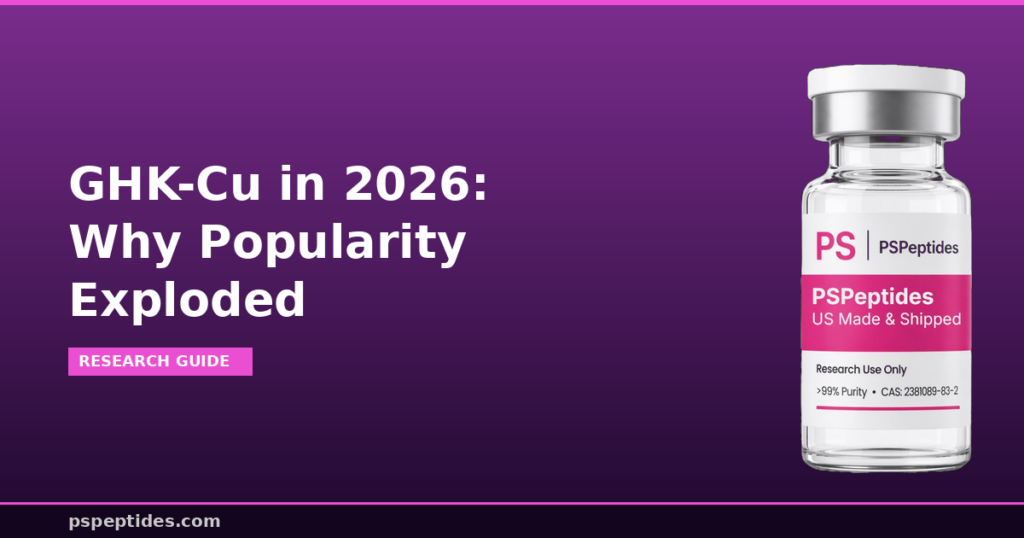
PSPeptides carries GHK-Cu as both an injectable research peptide and a ready-to-use topical serum, along with AHK-Cu for hair-specific research. This guide covers why GHK-Cu is trending, what the research actually shows, and how to get started.

Why Is GHK-Cu Trending in 2026?
The GHK-Cu explosion is not random. Several converging factors have pushed this compound from research databases into mainstream awareness.
Beauty industry adoption. Major skincare brands began incorporating copper peptides into serums and moisturizers in 2024-2025. As consumers researched the active ingredient, they found GHK-Cu — the specific copper peptide backed by the deepest scientific literature. Consumer-grade products contain trace amounts. Researchers seeking meaningful concentrations turned to research-grade suppliers like PSPeptides.
Dermatologist endorsements. Board-certified dermatologists on YouTube, Instagram, and TikTok began reviewing GHK-Cu literature on camera, noting its collagen-stimulating properties and gene expression data. These endorsements carry significant weight because they come from medical professionals rather than influencers.
Longevity community interest. Podcasts like Huberman Lab, Peter Attia’s The Drive, and longevity-focused content creators have discussed GHK-Cu’s gene expression research. The finding that a single tripeptide can modulate over 4,000 human genes generates genuine scientific intrigue that translates into search demand.
Social media visibility. Before-and-after content from DIY serum users on Reddit, TikTok, and skincare forums has created grassroots demand. While anecdotal, the volume of positive reports has amplified curiosity among researchers who then seek the published data.
The result is a compound that has crossed over from research literature into popular consciousness — and the science supporting it is robust enough to withstand the scrutiny that mainstream attention brings.
The Science Behind GHK-Cu 2026: What the Research Actually Shows
GHK-Cu (glycyl-L-histidyl-L-lysine copper complex) was first identified in human plasma by Loren Pickart in 1973. It is a naturally occurring tripeptide with a high affinity for copper(II) ions. Plasma concentrations decline from approximately 200 ng/mL at age 20 to 80 ng/mL by age 60 — a 60% decline that correlates with visible aging markers.
Gene Expression: The 4,000-Gene Finding
The most cited GHK-Cu research finding is its effect on human gene expression. A 2014 Broad Institute analysis using the Connectivity Map database demonstrated that GHK-Cu modulates the expression of 4,118 human genes — approximately 31% of the genome. Of these, 2,935 genes were upregulated and 1,183 were suppressed (PubMed).
The pattern of modulation is distinctly anti-aging: genes associated with collagen synthesis, stem cell activity, DNA repair, and antioxidant defense are upregulated, while genes linked to inflammation, fibrosis, and tissue destruction are suppressed. No other single compound in the research literature has demonstrated this scope of gene expression modulation.
Collagen Synthesis
GHK-Cu stimulates synthesis of both collagen type I and collagen type III — the primary structural proteins responsible for skin firmness and elasticity. It also promotes decorin production, a proteoglycan that regulates collagen fibril assembly, ensuring that new collagen forms organized, functional fibers rather than disorganized scar tissue.
Clinical research has demonstrated measurable improvements in skin elasticity, wrinkle depth reduction, and increased skin thickness following topical GHK-Cu application. One study reported a 70% increase in collagen synthesis in fibroblast cultures treated with GHK-Cu compared to controls. Read the complete data breakdown in the GHK-Cu copper peptide research guide.

Wound Healing
GHK-Cu accelerates wound healing through multiple mechanisms: increased fibroblast proliferation, enhanced angiogenesis (blood vessel formation), stimulation of glycosaminoglycan synthesis, and modulation of inflammatory cytokines. Studies have shown faster wound closure rates and improved tissue remodeling quality in GHK-Cu-treated models (PubMed).
Anti-Inflammatory Effects
GHK-Cu suppresses the expression of pro-inflammatory cytokines including interleukin-6 (IL-6) and tumor necrosis factor alpha (TNF-alpha) while supporting anti-inflammatory pathways. This dual action makes it relevant not only for skincare research but for broader tissue repair and chronic inflammation studies.

GHK-Cu vs AHK-Cu: Which Copper Peptide Do You Need?
PSPeptides carries two copper-binding peptides: GHK-Cu and AHK-Cu. While they share structural similarities, their research applications differ meaningfully.
AHK-Cu (Ala-His-Lys copper complex) has shown particular promise in hair follicle research. Studies demonstrate that AHK-Cu stimulates hair follicle growth and increases follicle size more effectively than minoxidil in comparative models. It promotes dermal papilla cell proliferation, the key cell type governing hair growth cycles.
The choice between GHK-Cu and AHK-Cu depends on your primary research focus.
| Factor | GHK-Cu | AHK-Cu |
|---|---|---|
| Primary Application | Skin, collagen, anti-aging, wound healing | Hair growth, follicle stimulation |
| Gene Expression Scope | 4,000+ genes | Narrower, follicle-focused |
| Collagen Synthesis | Strong (type I and III) | Moderate |
| Hair Follicle Research | Secondary application | Primary application |
| Research Depth | 50+ published studies, 50 years | Emerging, fewer studies |
| Available Forms | Injectable + topical serum | Injectable |
| PSPeptides Product | Order GHK-Cu | Order AHK-Cu |
For comprehensive skin and anti-aging research, GHK-Cu is the primary choice. For hair-specific research, AHK-Cu is the more targeted compound. Some researchers use both simultaneously, targeting different tissue types with the copper peptide most suited to each. For a deeper comparison, read the Matrixyl vs GHK-Cu skin peptide comparison.
GHK-Cu Product Options at PSPeptides
PSPeptides offers two distinct GHK-Cu product formats, each designed for a different research approach.
Injectable GHK-Cu
The injectable GHK-Cu is a lyophilized research peptide that requires reconstitution with bacteriostatic water and subcutaneous administration via insulin syringes or a peptide injection pen.
The injectable format delivers GHK-Cu systemically, allowing it to reach tissues throughout the body rather than only the application site. This is the format used in research studying GHK-Cu’s effects on internal tissue repair, systemic gene expression, and organ-level anti-aging mechanisms. Use the PSPeptides peptide calculator for reconstitution and dosing math.
GHK-Cu Topical Serum
The GHK-Cu serum is a pre-formulated topical product designed for direct skin application. It requires no reconstitution, no injection, and no additional supplies. Apply to skin and massage in. Done.
The serum format is ideal for skin-focused research: wrinkle reduction, collagen stimulation, skin elasticity, wound healing, and anti-inflammatory effects at the application site. It is also the lowest-barrier GHK-Cu product for beginners who want to start without injections. The GHK-Cu topical serum guide covers application protocols and concentration details.
Many researchers use both formats: the injectable for systemic effects and the serum for targeted facial or skin-site application. The two are complementary, not redundant.
DIY GHK-Cu Serum vs Pre-Made: What Researchers Should Know
A popular trend among GHK-Cu enthusiasts is creating DIY topical serums from injectable-grade peptide powder. While this is technically possible, the pre-made PSPeptides GHK-Cu serum offers significant advantages for most researchers.
Formulation stability. Copper peptides are sensitive to pH, light, and oxidation. Commercial formulations use stabilizers, pH-adjusted vehicles, and appropriate preservatives to maintain peptide integrity throughout the product’s shelf life. DIY formulations rarely achieve this level of stability.
Concentration consistency. The pre-made serum delivers a validated concentration in every application. DIY serums vary in concentration based on mixing precision, dissolution completeness, and volume accuracy.
Convenience. The serum is ready to use immediately. No weighing, no dissolving, no pH adjustment, no preservative calculation.
For researchers who prefer the DIY approach, the topical serum guide covers formulation considerations. For everyone else, the pre-made serum is the faster, more reliable starting point.

GHK-Cu Research Data: Specific Numbers Researchers Should Know
The strength of GHK-Cu’s position in 2026 rests on quantifiable research data, not just trend momentum. Here are the specific numbers that distinguish GHK-Cu from other anti-aging peptides.
Collagen synthesis increase: In vitro studies using human dermal fibroblasts demonstrated that GHK-Cu treatment increased collagen type I synthesis by approximately 70% compared to untreated controls. This is among the highest collagen-stimulation values reported for any single topical compound in the peer-reviewed literature.
Gene modulation scope: The 2014 Broad Institute Connectivity Map analysis identified 4,118 genes affected by GHK-Cu — 2,935 upregulated and 1,183 suppressed. No other commercially available peptide has demonstrated gene expression modulation at this scale. For context, retinoids (vitamin A derivatives) — the most established anti-aging ingredient in dermatology — affect a fraction of this number.
Wound healing acceleration: Animal wound models treated with GHK-Cu showed 40-70% faster wound closure rates compared to controls, depending on the study and wound type. GHK-Cu-treated wounds also exhibited superior collagen organization, meaning the healed tissue was structurally stronger, not just faster to close.
Plasma concentration decline: GHK-Cu concentration drops from approximately 200 ng/mL at age 20 to 80 ng/mL by age 60 — a 60% reduction. This decline correlates directly with the onset of visible skin aging, reduced wound healing capacity, and declining collagen density. Supplementation aims to restore youthful concentrations.
Anti-inflammatory potency: GHK-Cu reduced IL-6 (a key pro-inflammatory cytokine) expression in tissue models, with effects comparable to or exceeding several established anti-inflammatory agents. This is relevant not only for skincare but for systemic inflammation management in aging populations.
These numbers explain why GHK-Cu’s popularity surge is more than a social media trend — it is a compound with quantifiable, reproducible effects documented across decades of independent research. Order research-grade GHK-Cu or the ready-to-use serum from PSPeptides, each backed by third-party COAs.
GHK-Cu Safety Profile and Side Effect Considerations
As search volume grows and more researchers begin working with GHK-Cu, safety questions naturally arise. The existing data is reassuring.
GHK-Cu is a naturally occurring compound in the human body — present in blood plasma, saliva, and urine. It is not a synthetic drug designed in a laboratory. The body produces it endogenously and utilizes it in normal wound healing and tissue maintenance processes. Supplementation restores declining levels rather than introducing a foreign substance.
Over 50 years of published research has not identified significant adverse effects at standard research concentrations. The compound does not accumulate toxically. It does not bind irreversibly to receptors. Its gene expression effects promote repair and defense pathways rather than growth or proliferation pathways associated with safety concerns.
Topical application of the GHK-Cu serum carries even lower risk than injectable forms, as dermal absorption limits systemic exposure. The most commonly reported topical observation is temporary redness at the application site, which typically resolves within minutes. Consult the peptide side effects guide for comprehensive safety data across all peptide categories.
GHK-Cu in the Broader Anti-Aging Protocol
GHK-Cu is powerful on its own, but it becomes more potent when combined with compounds that address other aging mechanisms. The most common research pairings include the following.
GHK-Cu + Epitalon. GHK-Cu repairs tissue at the collagen and gene expression level. Epitalon maintains telomere length, ensuring cells retain the replicative capacity to carry out GHK-Cu’s repair instructions. Together, they address both tissue quality and cellular longevity. See the Epitalon guide for mechanism details.
GHK-Cu + BPC-157. Both compounds accelerate tissue repair, but through different mechanisms. GHK-Cu works via gene expression and collagen synthesis. BPC-157 works via nitric oxide modulation and growth factor signaling. The combination targets tissue repair from two directions. Learn more in the BPC-157 research guide.
GHK-Cu + NAD+. NAD+ provides the cellular energy required for collagen synthesis and gene expression — the very processes GHK-Cu activates. Pairing them ensures the cell has both the instruction (GHK-Cu) and the fuel (NAD+) for repair.
The complete four-compound longevity stack (Epitalon, NAD+, MOTS-c, GHK-Cu) is covered in detail in our best peptides for longevity guide. PSPeptides carries all four compounds.
How to Get Started with GHK-Cu from PSPeptides
Choose your format based on your research goals, add supplies if needed, and place your order.
| Product | Best For | Supplies Needed | Buy Link |
|---|---|---|---|
| GHK-Cu (Injectable) | Systemic anti-aging, internal tissue repair, gene expression research | BAC water + syringes | Order GHK-Cu |
| GHK-Cu Serum | Topical skin research, collagen, wrinkle reduction | None (ready to use) | Order GHK-Cu Serum |
| AHK-Cu | Hair follicle research, dermal papilla cell stimulation | BAC water + syringes | Order AHK-Cu |
| Bacteriostatic Water | Required for injectable reconstitution | — | Order BAC Water |
| Insulin Syringes | Required for injectable administration | — | Order Syringes |
| Peptide Calculator | Free dosing and reconstitution tool | — | Use Calculator (Free) |

Every GHK-Cu product ships with a third-party certificate of analysis. Verify purity on the certifications page. Same-day shipping on orders placed before 2 PM EST. Payment via credit card, debit card, Afterpay, or Klarna — no cryptocurrency, no KYC, no SSN required.
For the full scientific deep dive, start with the GHK-Cu complete research guide and explore the best peptides for skin research overview.
What the Future Holds for GHK-Cu Research
The GHK-Cu research pipeline extends well beyond skincare. Several emerging research directions are driving continued scientific interest in this compound through 2026 and beyond.
Organ-level tissue regeneration. Preliminary research has explored GHK-Cu’s effects on liver, lung, and bone tissue repair. The same gene expression modulation that makes it effective for skin collagen applies to connective tissue throughout the body. Studies examining GHK-Cu in post-surgical tissue recovery models are expanding the compound’s relevance beyond the dermatology and anti-aging communities.
Neurological applications. GHK-Cu’s anti-inflammatory and gene-modulating properties have attracted interest from neuroscience researchers studying neuroinflammation, a factor in cognitive decline and neurodegenerative conditions. While this research is early-stage, the finding that GHK-Cu can suppress pro-inflammatory cytokines while supporting tissue repair has generated multiple lines of investigation.
Combination protocols with other peptides. The growing peptide research community is systematically studying how GHK-Cu interacts with other compounds. Pairing GHK-Cu with BPC-157 for tissue repair, with Epitalon for comprehensive anti-aging, or with NAD+ for cellular energy support creates multi-mechanism protocols that individual compounds cannot achieve alone. The peptide stacking guide covers combination protocol fundamentals.

As research expands, the importance of sourcing high-purity, third-party-tested GHK-Cu increases. Lower-grade products introduce contaminants that can confound research results and compromise protocol integrity. PSPeptides’ commitment to independent certificates of analysis for every batch becomes more valuable as researchers design more sophisticated multi-compound protocols.
Frequently Asked Questions About GHK-Cu 2026
Is GHK-Cu safe for research use?
GHK-Cu is a naturally occurring compound present in human blood plasma, saliva, and urine. Research spanning over 50 years has established a favorable safety profile. It is one of the most-studied peptides in the scientific literature. Always source research-grade GHK-Cu with third-party COAs — PSPeptides GHK-Cu ships with independent purity verification for every batch. Review the peptide side effects guide for comprehensive safety data.
Should I use injectable GHK-Cu or the topical serum?
It depends on your research goal. The injectable form delivers GHK-Cu systemically for whole-body tissue repair and gene expression research. The topical serum targets skin-specific effects — collagen, wrinkles, elasticity — with no injection required. Many researchers use both simultaneously for comprehensive coverage.
What is the difference between GHK-Cu and AHK-Cu?
Both are copper-binding peptides, but they differ in primary application. GHK-Cu is the broader compound — skin, collagen, wound healing, 4,000+ gene modulation. AHK-Cu is more specialized, showing particular promise in hair follicle stimulation and dermal papilla cell proliferation research.
Why has GHK-Cu search volume increased so sharply in 2026?
Multiple factors converged: beauty industry adoption of copper peptides, dermatologist endorsements on social media, longevity podcast coverage, and grassroots before-and-after content from early adopters. Unlike many trending compounds, GHK-Cu’s popularity is backed by 50+ years of published research and rigorous gene expression data from the Broad Institute (PubMed).
All PSPeptides products are sold exclusively for research and laboratory use.