
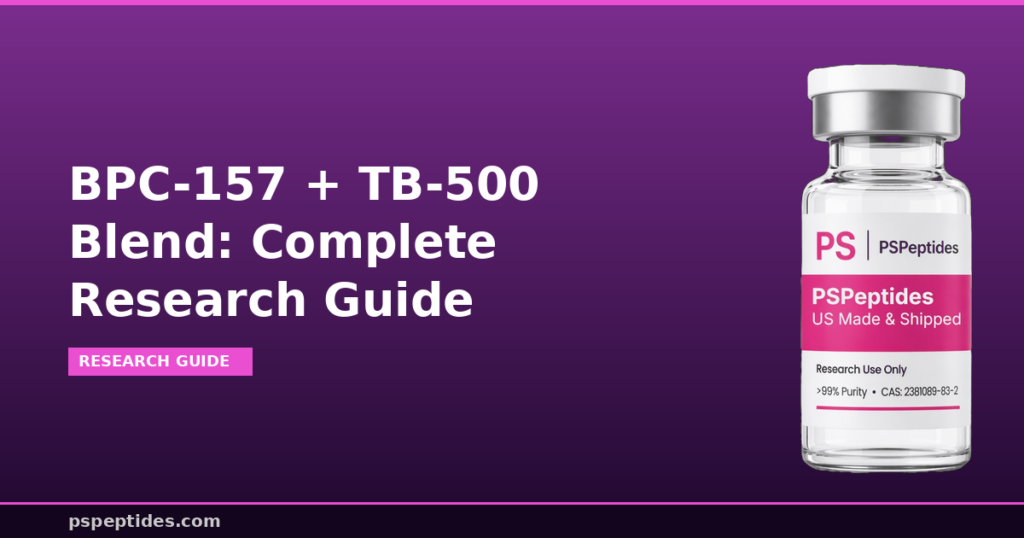
The BPC-157 TB-500 blend is one of the most researched peptide combinations in the tissue repair field, pairing two complementary compounds into a single research formulation. This BPC-157 TB-500 blend guide covers mechanism, published research, reconstitution, dosing, and safety for laboratory researchers.
What Is the BPC-157 + TB-500 Blend?
The BPC-157 + TB-500 blend combines two of the most extensively studied tissue repair peptides into a single vial — eliminating the need to purchase, reconstitute, and administer them separately. BPC-157 (Body Protection Compound-157) and TB-500 (a fragment of Thymosin Beta-4) target complementary phases of the tissue healing cascade, making their combination one of the most popular peptide stacks in the research community.
PSPeptides offers this blend at a 10mg/10mg ratio — 10mg BPC-157 and 10mg TB-500 per vial. This is the same dosing ratio most commonly discussed in research literature and community protocols. For individual deep-dives on each compound, see our BPC-157 Research Guide and TB-500 Research Guide, or compare them directly in our BPC-157 vs TB-500 comparison.
Why Combine BPC-157 and TB-500?
Tissue repair is not a single-step process — it involves sequential and overlapping phases that each require different biological mechanisms. BPC-157 and TB-500 address different phases of this cascade, creating a more comprehensive approach than either peptide alone.
BPC-157: The angiogenesis and growth factor driver
BPC-157 is a 15-amino acid peptide derived from human gastric juice. Its primary mechanisms relevant to tissue repair include:
- Angiogenesis — promotes new blood vessel formation through VEGFR2 (vascular endothelial growth factor receptor 2) activation. New blood vessels deliver oxygen, nutrients, and immune cells to damaged tissue — the foundation that all other repair processes depend on.
- Growth factor recruitment — upregulates multiple growth factors including VEGF, EGF (epidermal growth factor), and FGF (fibroblast growth factor) at injury sites, accelerating the proliferative phase of healing.
- Nitric oxide modulation — regulates the nitric oxide system, which controls blood flow, inflammation, and cellular signaling at wound sites. This dual-direction modulation (increasing NO when too low, decreasing when too high) is unique among healing peptides.
- Collagen organization — promotes organized collagen fiber deposition rather than disorganized scar tissue, improving the functional quality of healed tissue.
- Gastrointestinal protection — uniquely among tissue repair peptides, BPC-157 also demonstrates oral bioactivity and gut-protective effects, making it relevant for GI tract research alongside musculoskeletal applications.
TB-500: The cell migration and actin regulator
TB-500 is the active fragment of Thymosin Beta-4, a 43-amino acid protein found in virtually all human cells. Its primary mechanisms include:
- Actin regulation — TB-500 binds to G-actin (globular actin) and promotes its polymerization into F-actin (filamentous actin). Actin is the structural protein that drives cell shape, movement, and division. By regulating actin dynamics, TB-500 enables cells to migrate toward injury sites — a prerequisite for tissue repair.
- Cell migration — the actin-regulating effect directly translates to enhanced cell migration. Fibroblasts, endothelial cells, and keratinocytes move faster and more efficiently toward damaged tissue, accelerating wound closure and tissue remodeling.
- Anti-inflammatory action — TB-500 reduces inflammatory cytokine production at the tissue level, modulating the inflammatory phase of healing to prevent excessive inflammation that delays repair.
- Stem cell activation — published research suggests TB-500 promotes the differentiation and migration of resident stem cells toward injury sites, supporting regenerative repair rather than simple scar formation.
How the BPC-157 TB-500 Blend Works Together
The tissue repair cascade follows a general sequence: inflammation → cell migration → proliferation → angiogenesis → matrix remodeling. The BPC-157 TB-500 blend covers different parts of this sequence:
| Healing Phase | BPC-157 Role | TB-500 Role |
|---|---|---|
| Inflammation | Modulates NO system to regulate inflammatory response | Suppresses pro-inflammatory cytokines at tissue level |
| Cell migration | Recruits growth factors to injury site | Directly enables cell movement through actin regulation |
| Proliferation | Stimulates fibroblast and endothelial cell proliferation | Activates resident stem cells for regenerative repair |
| Angiogenesis | Primary driver — VEGFR2 activation, new blood vessel formation | Supports endothelial cell migration into new vessel structures |
| Remodeling | Promotes organized collagen deposition | Facilitates cytoskeletal reorganization in maturing tissue |
The result is coverage across all five phases of tissue repair — something neither peptide achieves alone. BPC-157 builds the vascular infrastructure and recruits growth signals; TB-500 enables the cells to actually move, migrate, and reorganize. Together, they create conditions for faster, more complete tissue healing.
This is why the combination is commonly referred to as the “Wolverine Stack” in the research community. For a broader guide on peptide combinations, see our Peptide Stacking Guide.
Published Research Supporting the BPC-157 TB-500 Blend
Both components of the BPC-157 TB-500 blend have extensive individual research portfolios. While direct comparative studies on the combined formulation remain limited, the mechanistic rationale for the BPC-157 TB-500 combination is well-supported by published preclinical data.
Key BPC-157 Research Findings
BPC-157 is one of the most studied peptides in the tissue repair field, with over 100 published preclinical studies. A 2021 study in the Journal of Orthopaedic Research (Chang et al.) demonstrated significantly accelerated muscle regeneration in a rat transection model. A 2018 review by Seiwerth et al. in Current Pharmaceutical Design confirmed BPC-157’s role in promoting angiogenic growth factors including VEGF and FGF.
Researchers studying the GI tract have noted protective effects in both gastric and intestinal models, with BPC-157 demonstrating accelerated anastomosis healing and reduced mucosal inflammation in IBD models. No mutagenicity or organ toxicity was identified in any of these published studies, and no lethal dose has been established in rodent models.
Key TB-500 Research Findings
TB-500 (Thymosin Beta-4 fragment) research demonstrates consistent wound-healing activity. A landmark study by Malinda et al. (1999) in the Journal of Investigative Dermatology showed 61% faster wound re-epithelialization in treated models compared to controls. Goldstein and Kleinman (2015) in Expert Opinion on Biological Therapy reviewed the breadth of Thymosin Beta-4 activity, noting cardiac repair, corneal healing, and neural regeneration applications beyond musculoskeletal repair. Published data also demonstrates TB-500’s capacity to reduce fibrosis in crush injury models — a finding that supports higher-quality tissue repair rather than simple scar formation.
Mechanistic Rationale for the BPC-157 TB-500 Combination
The BPC-157 TB-500 blend is studied on the premise that targeting multiple repair pathways simultaneously may produce additive or synergistic outcomes. BPC-157’s angiogenic activity creates the vascular foundation required for cell delivery and oxygenation, while TB-500’s actin-regulation enables those delivered cells to migrate effectively into damaged tissue. Research into the BPC-157 TB-500 combination suggests the two compounds complement rather than compete — operating through different receptor systems with no known pharmacological antagonism.
Research Applications
Published preclinical studies have investigated BPC-157 and TB-500 individually across a wide range of tissue types. While no published study has specifically tested the combined formulation, the complementary mechanisms support combination use for:
Musculoskeletal research
Tendon, ligament, muscle, and bone injury models are the most common applications. BPC-157 has demonstrated accelerated Achilles tendon healing, improved collagen fiber organization, and enhanced biomechanical strength in transection models. TB-500 has shown accelerated muscle recovery and reduced fibrosis in crush injury models. The BPC-157 TB-500 blend addresses both the structural (collagen) and cellular (migration, proliferation) components of musculoskeletal healing. See our Peptides for Joint and Tendon Repair Guide for broader context.
Skin and wound healing
Both peptides have independently demonstrated wound healing effects. BPC-157 promotes angiogenesis and growth factor signaling; TB-500 accelerates keratinocyte and fibroblast migration into the wound bed. For skin-specific peptide research, see our Best Peptides for Skin Research Guide.
Gastrointestinal research
BPC-157 is uniquely effective in GI models — demonstrating protection against gastric ulcers, accelerated intestinal anastomosis healing, and anti-inflammatory effects in IBD models. TB-500’s cell migration effects may complement BPC-157’s GI protection by enhancing mucosal cell migration and gut lining repair. For more on GI applications, see our Peptides for Gut Health Guide.
BPC-157 + TB-500 Blend vs Separate Vials
| Factor | Pre-Mixed Blend | Separate Vials |
|---|---|---|
| Convenience | One vial, one reconstitution, one injection | Two vials, two reconstitutions, two injections |
| Dosing flexibility | Fixed 1:1 ratio | Each peptide can be dosed independently |
| Cost efficiency | Typically lower per-dose cost | Higher total cost for two separate products |
| Stability | Co-lyophilized for stability | Each stored independently |
| Best for | Researchers who want both peptides at equal doses | Researchers who need different dose ratios |
Dosage in Research
The PSPeptides BPC-157 + TB-500 blend contains 10mg of each peptide per vial (20mg total). Based on published preclinical research and standard body surface area dose conversion:
| BAC Water Added | Total Concentration | BPC-157 per 0.1mL | TB-500 per 0.1mL |
|---|---|---|---|
| 2.0mL | 10mg/mL (5mg each/mL) | 500mcg | 500mcg |
| 2.5mL | 8mg/mL (4mg each/mL) | 400mcg | 400mcg |
| 4.0mL | 5mg/mL (2.5mg each/mL) | 250mcg | 250mcg |
For exact volume calculations based on your desired dose, use our free Peptide Reconstitution Calculator. For step-by-step reconstitution instructions, see our How to Reconstitute Peptides Guide.
For detailed dosage analysis of each compound individually, see our BPC-157 Dosage Guide.
Reconstitution Protocol for the BPC-157 TB-500 Blend
The BPC-157 TB-500 blend is supplied as a lyophilized (freeze-dried) powder. Reconstitute with Hospira bacteriostatic water using standard technique:
- Allow the vial to reach room temperature (15-20 minutes from freezer)
- Wipe both vial stoppers with alcohol swabs
- Draw the desired volume of BAC water into a sterile syringe
- Inject slowly down the inside wall of the vial — never directly onto the powder
- Gently swirl until dissolved — never shake
- Refrigerate immediately — use within 28 days
The reconstituted BPC-157 TB-500 blend solution should be clear and colorless. If cloudy or containing particles, do not use. Proper storage of the reconstituted blend at 2–8°C is critical to maintaining peptide integrity. For full storage guidance, see our Peptide Storage Guide.
Safety Profile
Both BPC-157 and TB-500 have demonstrated clean safety profiles in published preclinical research:
- BPC-157: No organ toxicity, no mutagenicity, and no lethal dose identified across hundreds of published animal studies — even at doses far exceeding the effective range.
- TB-500: No serious adverse events reported in published animal or limited human studies. Mild injection site discomfort and temporary lethargy have been noted in some reports.
- No known pharmacological interaction between BPC-157 and TB-500 — they operate through different receptor systems and signaling pathways.
The BPC-157 TB-500 blend has not been evaluated in formal clinical safety studies. All available safety data derives from individual peptide research. Researchers working with this BPC-157 TB-500 combination should refer to published preclinical safety literature for each compound individually. For a comprehensive overview of peptide safety profiles, see our Peptide Side Effects Guide.
How This Blend Compares to PSPeptides Multi-Peptide Blends
| Product | Contents | Focus | Price |
|---|---|---|---|
| BPC-157 + TB-500 Blend | BPC-157 (10mg) + TB-500 (10mg) | Pure tissue repair — angiogenesis + cell migration | Check product page |
| GLOW Blend | BPC-157 (10mg) + GHK-Cu (50mg) + TB-500 (10mg) | Tissue repair + collagen synthesis + skin regeneration | $79.99 |
| KLOW Blend | BPC-157 (10mg) + GHK-Cu (50mg) + TB-500 (10mg) + KPV (10mg) | Tissue repair + skin + anti-inflammatory coverage | $129.99 |
The BPC-157 + TB-500 blend is the focused option — two peptides, two complementary mechanisms, no additional compounds. GLOW adds collagen synthesis (GHK-Cu) and KLOW adds anti-inflammatory coverage (KPV) for broader multi-pathway research. For a comparison of GLOW and KLOW blends, see our GLOW vs KLOW Comparison Guide.
Frequently Asked Questions
What is the BPC-157 + TB-500 blend used for in research?
The BPC-157 TB-500 combination targets tissue repair across multiple phases — BPC-157 drives angiogenesis and growth factor signaling while TB-500 enables cell migration and reduces inflammation. Published research on each peptide individually covers tendon, muscle, ligament, bone, skin, and GI tissue repair models.
Can I take BPC-157 and TB-500 at the same time?
Yes — the pre-mixed BPC-157 TB-500 blend is specifically designed for simultaneous administration. The two peptides operate through different receptor systems with no known pharmacological interaction. Co-administration in a single injection is standard practice in research protocols.
How long does one vial last?
At 250mcg of each peptide per dose (reconstituted in 4mL BAC water, 0.1mL per injection), one vial provides 40 doses — approximately 40 days of daily administration.
Is this the same as the Wolverine Stack?
Yes — “Wolverine Stack” is the community term for the BPC-157 + TB-500 combination. The name references the regenerative properties of both peptides together. See our Wolverine Stack Guide for a detailed analysis.
Do I need BAC water and syringes?
Yes — the BPC-157 TB-500 blend is supplied as lyophilized powder and requires reconstitution before use. You will need Hospira Bacteriostatic Water ($19.99) and 1mL Laboratory Syringes ($9.99).
References
- Sikiric P, et al. Brain-gut Axis and Pentadecapeptide BPC 157: Theoretical and Practical Implications. Curr Neuropharmacol. 2016;14(8):857-865. PubMed
- Seiwerth S, et al. BPC 157 and Standard Angiogenic Growth Factors. Curr Pharm Des. 2018;24(18):1972-1989. PubMed
- Goldstein AL, Kleinman HK. Advances in the biology of thymosin beta4 and their therapeutic implications. Expert Opin Biol Ther. 2015;15(1):139-145. PubMed
- Malinda KM, et al. Thymosin beta4 accelerates wound healing. J Invest Dermatol. 1999;113(3):364-368.
- Chang CH, et al. BPC-157 Promotes Muscle Regeneration. J Orthopaedic Research. 2021;39(12):2628-2637.
Buy BPC-157 + TB-500 Blend → | Buy BAC Water → | Buy Syringes →
This content is for educational and research purposes only. All products are intended for laboratory research use only. Not for human consumption.
PSPeptides — US Made & Shipped | Third-Party Tested | 99%+ Purity | Same-Day Shipping
What is a BPC-157 TB-500 blend?
A BPC-157 TB-500 blend is a research formulation that combines two tissue repair peptides—Body Protection Compound-157 and Thymosin Beta-4 fragment—into a single reconstituted solution. This blend is designed for research protocols studying complementary healing mechanisms, as BPC-157 promotes angiogenesis and nitric oxide signaling while TB-500 facilitates actin regulation and cell migration. This combination allows researchers to study both peptides’ synergistic effects within a single administration protocol.
Why do researchers combine BPC-157 and TB-500 together?
Researchers combine BPC-157 and TB-500 because these peptides target different but complementary phases of the tissue repair cascade. BPC-157 primarily supports early-phase healing through angiogenesis, VEGF upregulation, and gastrointestinal protection, while TB-500 promotes later-phase repair through actin polymerization, cell migration, and anti-fibrotic activity. Studying this combination together allows researchers to examine whether addressing multiple repair pathways simultaneously produces enhanced outcomes compared to either peptide alone.
What is the typical ratio in a BPC-157 TB-500 blend?
The most commonly referenced research ratio in a BPC-157 TB-500 blend is based on each peptide’s standard individual dosing—typically 250-500 mcg of BPC-157 combined with 2-5 mg of TB-500 per administration. Some pre-formulated blends contain specific ratios optimized for convenience, though researchers often prefer separate vials for precise dose adjustment. The optimal ratio may vary depending on the specific tissue target and research objectives being studied.
Is the BPC-157 TB-500 blend the same as the Wolverine Stack?
Yes, the BPC-157 TB-500 blend is commonly referred to as the Wolverine Stack in the research community, named for its association with accelerated tissue repair mechanisms. Some expanded versions of the Wolverine Stack also include additional peptides like GHK-Cu for collagen support and KPV for anti-inflammatory modulation. Whether called the Wolverine Stack or this combination, the core concept involves combining these two peptides to study their synergistic effects on healing.
How do you reconstitute a BPC-157 TB-500 blend?
To reconstitute a BPC-157 TB-500 blend, slowly add bacteriostatic water to the lyophilized vial by directing the stream along the glass wall rather than directly onto the peptide powder. Allow the powder to dissolve naturally without shaking or vortexing, as aggressive mixing can damage the peptide bonds. The reconstituted solution should be stored refrigerated at 2-8C and typically remains stable for up to 4 weeks when handled with proper sterile technique.
What does research show about combining BPC-157 and TB-500?
While direct clinical studies on this combination are limited, extensive individual research supports the mechanistic rationale for pairing them. BPC-157 has demonstrated protective effects across over 100 preclinical studies involving tendons, ligaments, muscles, and GI tissue, while TB-500 has shown significant wound healing acceleration (61% faster re-epithelialization) and cardiac repair activity. This combination is studied based on the hypothesis that targeting both angiogenic and cytoskeletal repair pathways simultaneously may produce additive or synergistic tissue healing effects.
Can you take BPC-157 and TB-500 at the same time?
In research protocols, BPC-157 and TB-500 are frequently administered during the same period, either as a pre-mixed blend or as separate injections given concurrently. There are no published studies indicating antagonistic interactions between these two peptides when used together. This approach simplifies research protocols by reducing the number of separate administrations while maintaining the full dosing parameters of each individual peptide.
All PSPeptides products are sold exclusively for research and laboratory use.