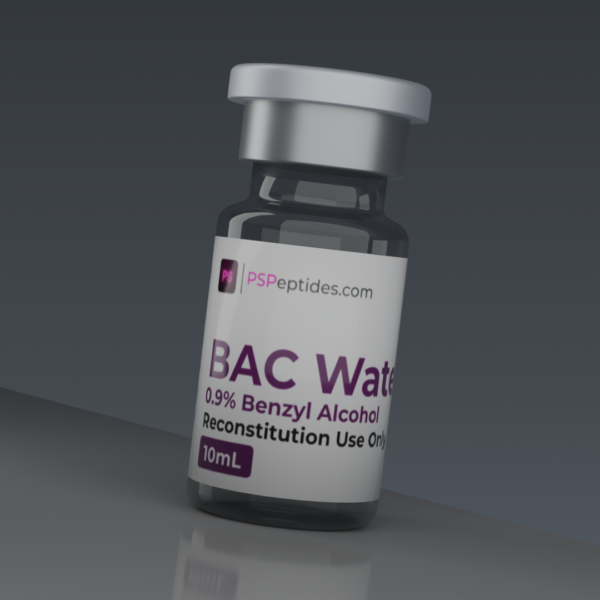
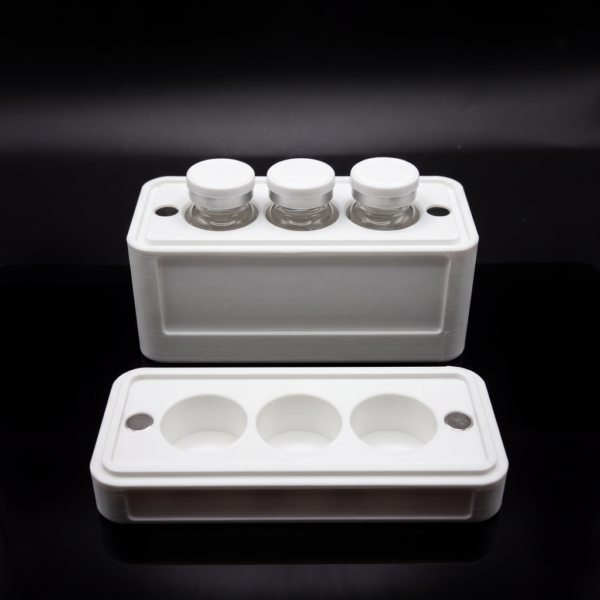
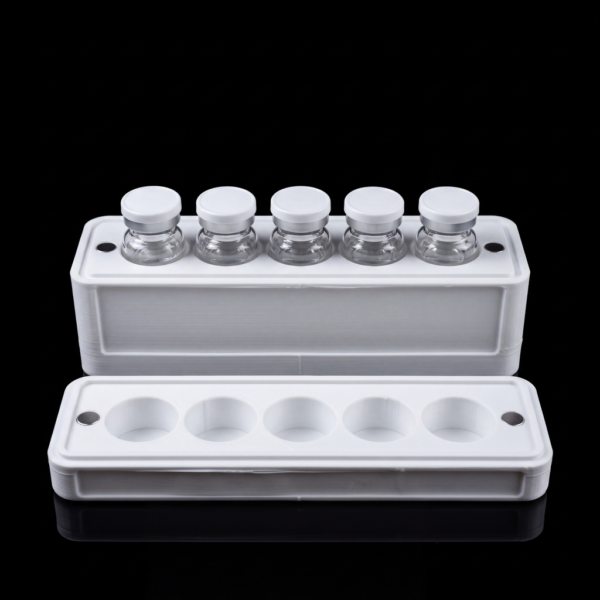
The 10mL peptide vial case is a purpose-built storage case for the larger 10mL vials used across peptide research, including bacteriostatic water and 10mL compound vials. Five individual slots hold each vial apart from its neighbors, and the lid closes over them with matching recesses.
Good organization supports good storage. For the full picture on temperature and light, read our peptide storage guide, or start with the complete guide to peptides if you are new to the field.
Ready to get organized? Add the 10mL peptide vial case to your cart above. It ships with the same fast fulfillment as every PSPeptides order.
How the 10mL Peptide Vial Case Works
The design is simple on purpose. The base holds five contoured slots sized for 10mL vials, set side by side. Each slot cradles the body of the vial, so vials cannot roll, tip, or knock into one another.
The lid mirrors the base. Five matching recesses sit over the vials when the case is closed, so every vial is held from both sides. Hinges keep the lid aligned, and snap latches hold it shut until you open it.
Because the 10mL peptide vial case is sized around the vial rather than around a generic box, there is no wasted space and no loose packing material to manage. Open the latches, lift the lid, and all five vials are visible at once.
That visibility matters more than it sounds. When every vial has a fixed position, a missing or misplaced vial is obvious at a glance. A labeled slot map turns the case into a simple inventory system.

Why Vial Organization Matters in Peptide Research
Research peptides are sensitive materials. Lyophilized powders and reconstituted solutions both respond to heat, light, moisture, and repeated handling. A storage routine that limits those exposures protects the integrity of the material and the quality of the data that depends on it.
Loose vials create avoidable problems. Glass can chip or crack when vials collide. Labels rub off. Similar-looking vials get mixed up, and a mix-up in a research setting can compromise weeks of work.
10mL vials raise the stakes because they hold more volume. A single 10mL vial of bacteriostatic water may support many reconstitutions, so losing one to a drop or a crack is costly. A 10mL peptide vial case gives each of those vials a protected, dedicated place.
Organization also shortens handling time. The less time a vial spends out of cold storage while you search for it, the better. For signs that a peptide has already been compromised, see our guide on how to tell if a peptide has degraded.
Published Research on Peptide Storage and Stability
The case itself is a storage accessory, but the reason it exists is well documented. Peptides and proteins are prone to chemical and physical instability, and storage conditions strongly influence how fast those changes happen.
In a widely cited review, Wang (1999) described how protein-based materials usually need cold storage or freeze-drying to reach an acceptable shelf life. The review, published in the International Journal of Pharmaceutics, covers instability during freeze-thawing, drying, and storage in solution.
Manning and colleagues (2010) updated that picture in Pharmaceutical Research. Their review separates chemical instability from physical instability, which includes denaturation, aggregation, precipitation, and adsorption, and it addresses the role packaging plays in maintaining stability.
The practical takeaway for a research bench is consistent across this literature: keep material cold, limit light and agitation, and reduce unnecessary handling. A 10mL peptide vial case does not replace refrigeration, but it supports each of those habits by keeping vials still, covered, and organized.
10mL Peptide Vial Case vs Alternatives
| Feature | PSPeptides 5-Slot Case | Loose in Original Box | Generic Storage Bin |
|---|
| Fit for 10mL vials | Slots sized for 10mL vials | Varies by box | No dedicated fit |
| Vial separation | Individual slot per vial | Vials may touch | Vials touch and roll |
| Closure | Hinged lid with snap latches | Cardboard flap | Varies |
| Inventory visibility | All five vials visible when open | Must unpack | Must dig through |
| Breakage protection | Vials held by base and lid | Limited | Limited |
| Portability | Compact and latched | Not secure | Bulky |
| Inventory tracking | Fixed positions support a slot map | None | None |
The comparison comes down to fit. A case built around one vial size holds that size securely, and a generic container cannot do the same.
Researchers working with smaller vials should look at our 10-slot peptide vial storage case, which is sized for 3mL vials. The 10mL peptide vial case is the right choice when your vials are the larger 10mL format.
What to Look for When You Buy a Peptide Vial Case
Not every case suits every vial. Before you buy, check a few basics so the case you choose matches the vials you actually use.
- Vial size: Slots must match the vial. A case made for 3mL vials will not accept 10mL vials, and 10mL slots leave 3mL vials loose.
- Separation: Each vial should have its own slot. Shared compartments let glass touch glass.
- Closure: The lid should stay shut on its own. Latches matter the moment a case is carried or bumped.
- Capacity: Choose a size that fits your working set. Five slots suit most 10mL setups without taking over a shelf.
- Visibility: You should see every vial when the case is open, with no stacking or digging.
The PSPeptides 10mL peptide vial case checks each of those boxes for 10mL vials. It is a focused product: one vial size, five slots, one secure lid.
Common Storage Mistakes This Case Helps Prevent
Most vial losses come from ordinary habits, not unusual accidents. A dedicated case removes several of the most common ones.
- Vials left standing alone at the back of a shelf, where they get knocked over.
- Several vials held together with a rubber band or bag, so labels scuff and glass collides.
- Opened and unopened vials mixed together with no record of which is which.
- Vials carried by hand or in a pocket between rooms.
- Diluent stored apart from the compounds it is used with, which adds handling time.
Each of these adds risk or wasted time. Moving your working set into a 10mL peptide vial case replaces all five habits with one consistent routine.
Loading, Handling & Reconstitution Workflow
Load the case with clean, dry hands or gloves. Place each 10mL vial into its slot, close the lid, and press the latches until they catch. Check that the lid sits flat before moving the case.
Many researchers use the 10mL peptide vial case as a reconstitution station. One or two slots hold bacteriostatic water, and the remaining slots hold the 10mL vials in current use. Our article on what bacteriostatic water is explains why it is the standard diluent.
When it is time to reconstitute, take out only the vials you need and leave the rest latched in the case. Step-by-step technique is covered in how to reconstitute peptides, and the peptide dosage calculator guide walks through concentration math for research protocols.
Return each vial to the same slot when you finish. Consistent positions make it easy to confirm that nothing was left on the bench.
Five Practical Slot-Map Tips
- Number the slots: Count one through five from left to right, and keep the numbering the same every time.
- Write a slot map: Record which compound, lot number, and date sits in each position.
- Give diluent a fixed home: Keep bacteriostatic water in the same slot so it is never confused with a compound vial.
- Date every vial: Note the date a vial was first opened or reconstituted on the label or the map.
- Review weekly: Check the map against the case and remove anything expired or empty.
A slot map takes a minute to write and saves far more than that every week. Tape a copy inside your storage area, or keep it in your research log next to the case.
Building a Complete 10mL Vial Storage Setup
A case works best as part of a simple system. Pair it with a few basics and your storage routine largely runs itself.
- The case: Holds and protects the five 10mL vials in current use.
- Labels: Clear labels on every vial, with compound, lot number, and date.
- A slot map or log: A written record of what sits in each position.
- Proper cold storage: A refrigerator set to the range your compounds require.
- Reserve stock: Unopened vials stored separately until a slot opens up.
Running more than five 10mL vials? Order a second 10mL peptide vial case and dedicate one to diluent and reserve stock and the other to vials in active use. Two labeled cases are easier to manage than one overfilled container.
Storage & Stability
Follow the storage guidance for each compound first. As a general rule, lyophilized peptides are kept cold and dry, and reconstituted peptides are kept refrigerated and used within the window their research protocol specifies.
The 10mL peptide vial case is compact enough to sit on a shelf or in a drawer alongside your other supplies. With the lid closed, vials are covered and kept out of direct light, which helps because light is one of the common stress factors for peptides.
Keep the case itself clean and dry. Wipe it with a soft cloth, and let any condensation on vials dry before closing the lid for long periods.
A case does not control temperature. Think of it as the organization layer in a storage system that also includes proper refrigeration, clear labels, and a written log.
Moving Vials Between Workspaces
Vials are most at risk when they are in motion. Carrying them by hand, in a pocket, or loose in a bag exposes glass to drops and impacts.
With the latches closed, the 10mL peptide vial case keeps all five vials held in place while you move from storage to the bench and back. Carry the case level, and avoid leaving it in a warm vehicle or in direct sun.
Temperature still matters during any move. The case protects against knocks, not heat, so keep time out of cold storage as short as your protocol allows.
Certificate of Analysis & Batch Tracking
Every PSPeptides research peptide ships with batch-specific documentation. A Certificate of Analysis reports the purity and identity results for that lot, based on HPLC and mass spectrometry testing.
The case helps you keep that paper trail intact. Record the lot number for each slot on your slot map, and store printed COAs with the case or note where the digital copies live.
If you are new to reading these documents, our guide to peptide purity and how to read a COA explains each section. Matching the right COA to the right vial is far easier when every vial in your 10mL peptide vial case has a fixed position.
Who Should Buy This 10mL Peptide Vial Case?
This case is built for researchers who work with 10mL vials and want a simple, reliable way to store them. If you keep bacteriostatic water, 10mL compound vials, or both on hand, the five-slot layout covers a typical working set.
- Researchers running several compounds at once who need clear separation between vials.
- Labs that share storage space and want each person’s vials kept together.
- Anyone who has lost a vial to a drop, a crack, or a mix-up.
- Buyers who want their supplies as organized as their protocols.
It is also a smart add-on to any order. If you are already buying 10mL vials, adding a 10mL peptide vial case at checkout means your vials have a home the day they arrive.
Ordering, Shipping & Payment
Ordering is simple. Add the 10mL peptide vial case to your cart, add any peptides or supplies you need, and check out with a credit card, Afterpay, Klarna, Apple Pay, or Google Pay.
Orders placed before 2 PM EST ship the same day, and orders over $150 ship free by UPS 2nd Day Air. Questions before you buy? Our support team answers by email, phone, or text seven days a week.
Why Researchers Choose PSPeptides
- US Manufactured: PSPeptides research peptides are made in the United States.
- Third-Party Tested: Independent HPLC and mass spectrometry on research peptides, with batch-specific COAs.
- Fast Shipping: Free UPS 2nd Day Air over $150, same-day before 2 PM EST.
- Flexible Payments: Credit cards, Afterpay, Klarna, Apple Pay, Google Pay.
- 7-Day Support: Email, phone, or text.
The same standards apply to our supplies. When you order a 10mL peptide vial case, it is packed and shipped with the same care as every other item in your order.
Frequently Asked Questions
How many vials does the 10mL peptide vial case hold?
The case holds five 10mL vials. Each vial has its own slot, so the vials stay separated when the case is closed.
Will 3mL vials fit in this case?
The slots are sized for 10mL vials, so smaller 3mL vials will not be held securely. For 3mL vials, choose our 10-slot peptide vial storage case instead, which is built for that size.
Can I store bacteriostatic water in the 10mL peptide vial case?
Yes. Standard 10mL bacteriostatic water vials are a common use for this case. Many researchers keep diluent and 10mL compound vials together so everything for a session is in one place.
Does the case keep vials cold?
No. The case organizes and protects vials, but it does not provide cooling or insulation. Store vials at the temperature each compound requires, and use the case to keep them organized there.
Are vials included with the 10mL peptide vial case?
No. The case is sold on its own, and vials are sold separately. You can add research peptides, bacteriostatic water, and other supplies to the same order.
Is the case reusable?
Yes. Reload the slots as vials are used up and replaced. Update your slot map each time a new vial goes in so your records stay accurate.
How do I clean the case?
Wipe the case with a soft, dry or lightly damp cloth and let it dry fully before loading vials. Avoid harsh solvents, which can damage plastic surfaces.
How fast does the 10mL peptide vial case ship?
Orders placed before 2 PM EST ship the same day. Orders over $150 qualify for free UPS 2nd Day Air.
Related Resources
All PSPeptides products are sold exclusively for laboratory and research use. Not intended for human consumption.





 Made & Shipped