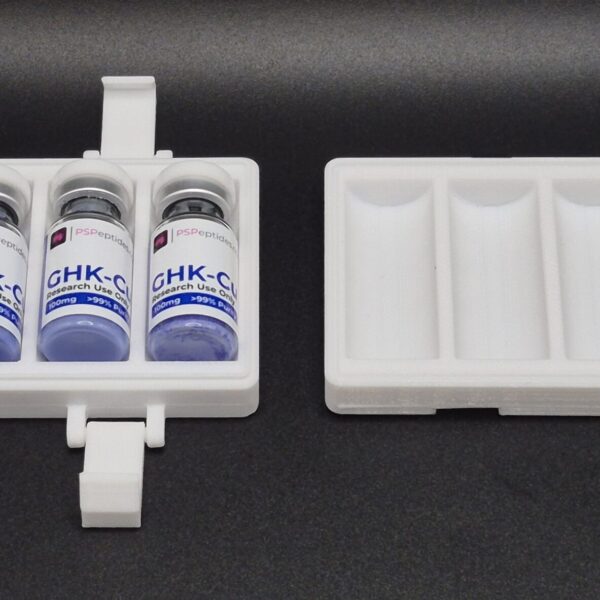
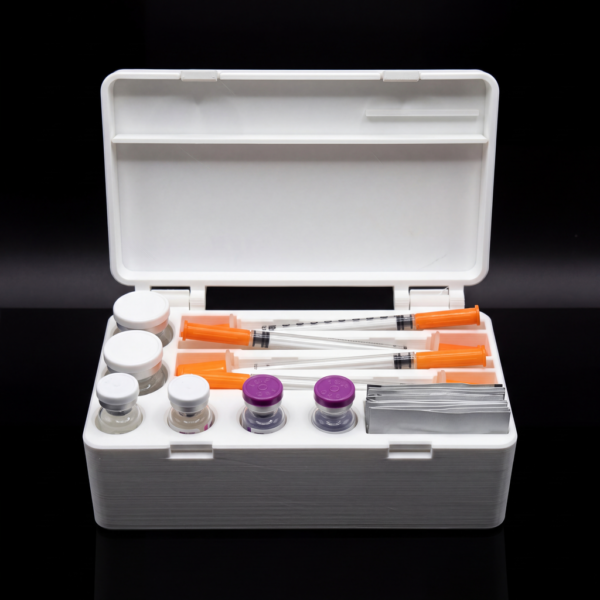
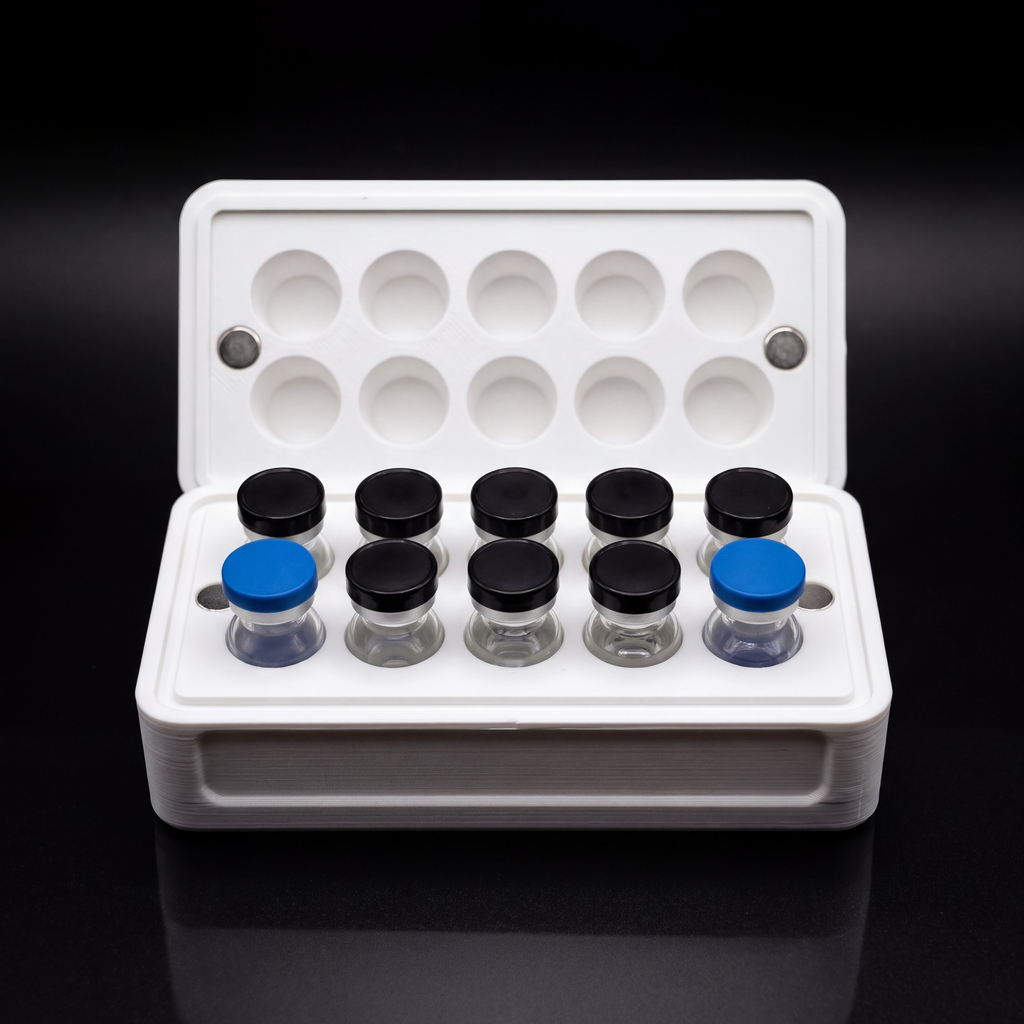
This peptide vial storage case is a purpose-built holder for 3mL peptide vials. Ten individual slots, arranged in two rows of five, keep each vial standing upright and apart from its neighbors. The magnetic lid closes over the top, with a matching recess for every vial cap.
It is made for researchers who want a tidy, repeatable way to store and move a working set of vials. For the fundamentals of temperature, light, and shelf life, read our peptide storage guide.
Ready to get organized? Add the 10-slot peptide vial storage case to your cart above. It ships with the same fast fulfillment as every PSPeptides order.
How the Peptide Vial Storage Case Works
The design is simple on purpose. The base holds ten round slots sized for 3mL vials, laid out in two rows of five. Each slot surrounds the lower body of the vial, so vials stand upright and cannot roll, tip, or knock into one another.
The lid mirrors the base. Ten matching recesses sit over the vial caps when the case is closed, so every vial is held from above as well as below. Magnets set into the lid and the base pull the two halves together and keep the case shut without latches, zippers, or straps.
Opening it takes one hand. Lift the lid and all ten positions are visible at once, caps facing up for quick identification. Close it again and the magnets seat the lid for you, so there is no clasp to line up and nothing to forget.
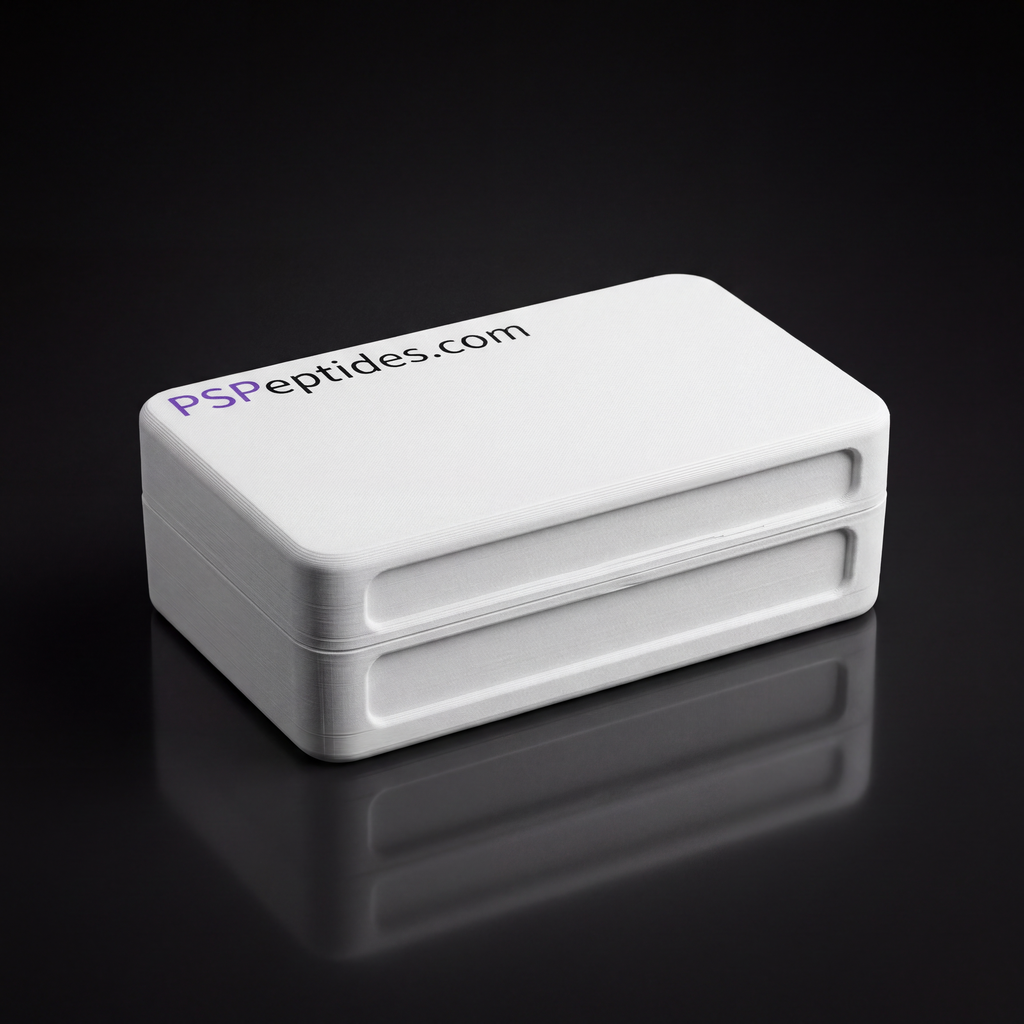
Because the case is small and hard-sided, it works just as well parked on a shelf as it does packed in a bag. The PSPeptides.com mark on the lid makes it easy to spot among other lab supplies. In short, this peptide vial storage case replaces improvised boxes, rubber bands, and bubble wrap with one dedicated tool.
There are no loose parts to lose and no inserts to cut or trim. The slots are fixed in place, which means position three is always position three. That consistency is what turns a simple container into a working part of your record keeping.

Why Vial Organization Matters in Peptide Research
Most 3mL vials look identical. Same glass, same stopper, same crimp, and often the same cap color. When several compounds share a shelf, the only thing separating one from another is a small label that can smudge, peel, or rotate out of view.
Loose storage makes that worse. Vials roll to the back of a box, labels rub against each other, and finding one vial means handling all of them. Every extra touch is another chance to warm a vial in your hand, bump it, or put it back in the wrong place.
A peptide vial storage case solves this by giving each vial a permanent address. You always know where a compound lives, and you can confirm at a glance whether a slot is full or empty. Nothing shifts when the case is moved, so the layout you set up is the layout you find later.
Fixed positions also support better documentation. Number the slots one through ten, then record the compound, lot number, and reconstitution date for each position in your notes. With a peptide vial storage case, the slot becomes a second identifier that backs up the label on the glass.
Organization also saves money. A vial that cannot be identified with confidence cannot be used with confidence, and a vial that rolls off a bench is simply gone. Compared with the cost of the material inside ten vials, a dedicated case is inexpensive insurance.
New to working with these compounds? Our complete guide to peptides covers the basics, and the peptide glossary explains the terminology used throughout this page.
Published Research on Peptide Storage and Stability
A peptide vial storage case does not change peptide chemistry, and it would be misleading to claim otherwise. What the published literature does show is why careful physical handling and storage are worth the effort. Peptides and proteins are sensitive molecules, and how they are kept matters.
Manning and colleagues (2010), writing in Pharmaceutical Research, reviewed the chemical and physical pathways by which these molecules lose integrity and highlighted the role packaging plays in maintaining stability. See Stability of protein pharmaceuticals: an update on PubMed.
Zapadka et al. (2017), in Interface Focus, reviewed the intrinsic and external factors that drive peptide aggregation, including physical parameters such as temperature and agitation. Their paper, Factors affecting the physical stability of peptide therapeutics, is a useful primer on why rough handling is best avoided.
Wang (1999), in the International Journal of Pharmaceutics, noted that protein-based materials usually have to be stored cold or freeze-dried to achieve an acceptable shelf life. The full review is indexed as Instability, stabilization, and formulation of liquid protein pharmaceuticals.
The practical takeaway is consistent across these reviews: control temperature, avoid unnecessary shaking and handling, and know exactly what is in every container. A peptide vial storage case helps with the handling and organization side of that list. Your refrigerator or freezer still does the temperature work.
If you want to recognize the visible signs of a compromised vial, our guide on how to tell if a peptide has degraded walks through what to look for.
Peptide Vial Storage Case vs Alternatives
Most researchers start with whatever is on hand: the box the vials shipped in, or a zip bag in a drawer. Both work for a day or two. The table below shows how they compare with a dedicated case once vials are being stored and handled regularly.
| Feature | 10-Slot Peptide Vial Storage Case | Original Shipping Box | Zip Bag or Pouch |
|---|
| Dedicated slot per vial | Yes, 10 individual slots | Usually not | No |
| Vials held upright | Yes | Not reliably | No |
| Closure | Magnetic lid | Cardboard flap | Zipper or seal |
| Vial-to-vial contact | Separated | Possible | Likely |
| Fixed positions for slot mapping | Yes | No | No |
| Finding one vial | Open lid, all 10 visible | Sort through contents | Dig through contents |
| Built for repeated use | Yes | Wears out quickly | Yes, with little protection |
| Portability | Compact, closes securely | Awkward once opened | Compact, vials unprotected |
The shipping box is designed to get vials to your door once. After it has been opened a few times, the flaps soften and the contents start to move. It was never meant to be a long-term home.
A bag or pouch is portable, but the vials inside rest against each other and against whatever else is nearby. Labels rub, and you have to empty the bag to find the one vial you want.
The peptide vial storage case is the only option of the three built around the vial itself. Each of the ten slots is sized for a 3mL vial, the lid holds the caps in place, and the magnetic closure makes it quick to open and shut many times a day.
Loading, Handling & Reconstitution Workflow
Loading the peptide vial storage case takes under a minute. Open the lid, seat each 3mL vial upright in its own slot, and close the lid until the magnets engage. Fill the slots in a consistent order so your notes always match the layout.
A simple slot map makes the system work. Write the slot number, compound name, lot number, and the date each vial was opened or reconstituted. Keep the map with your lab notes, or tape a small copy inside your storage area.
When it is time to reconstitute, remove a single vial and leave the rest seated. Add diluent slowly down the inside wall of the vial and swirl gently rather than shaking. Our step-by-step article on how to reconstitute peptides covers the full technique.
Concentration is simple arithmetic. As an example, adding 2 mL of diluent to a vial containing 10 mg of lyophilized material gives 5 mg per mL. To check your own numbers, follow our guide on how to use the peptide dosage calculator.
Once you are finished, return the vial to its slot in the peptide vial storage case and close the lid. Putting each vial straight back in its numbered position is the habit that prevents mix-ups. For background on diluents, see what bacteriostatic water is and when it is used.
Handle vials by the body rather than the cap, and avoid dropping them into the slots. Lower each one in gently. Glass is durable, but it does not need to be tested.
Five Practical Slot-Map Tips
A storage system is only as good as the habits around it. These five tips take a few minutes to set up and keep a ten-vial inventory accurate for months.
- Pick a direction and keep it: Number the back row one to five and the front row six to ten, always reading left to right from the same side of the case.
- Group by project: Put the vials for one protocol side by side so related compounds are never split across the case.
- Separate opened from unopened: Use one row for sealed vials and the other for vials already in use, so you can see remaining stock instantly.
- Update the map the moment something changes: When a vial is finished or replaced, cross out the old entry and write the new lot number straight away.
- Leave empty slots empty: Do not fill gaps with unrelated items. An empty slot is useful information, because it tells you what needs to be reordered.
None of this requires special software. A notebook page or a simple spreadsheet with ten rows is enough. What matters is that the record and the physical layout always agree, so anyone in your lab can pick up the case and understand it.
Storage & Stability
The peptide vial storage case is an organizer and protective carrier, not a cooler. It does not chill vials, and it does not replace refrigerated or frozen storage. Temperature control still comes from your refrigerator, freezer, or other cold-storage equipment.
As a general rule, lyophilized peptides are kept cold and dry, with freezer temperatures commonly used for longer-term storage and refrigeration for the short term. Reconstituted solutions are typically refrigerated and used within the window your protocol specifies. Always follow the documentation supplied with each compound.
Repeated freeze-thaw cycles and prolonged time at room temperature are widely regarded as things to avoid. Plan your work so vials spend as little time out of cold storage as possible. Having all ten vials in one place makes that easier, because you are not hunting for the one you need.
Light is another consideration. Keep your peptide vial storage case closed whenever you are not actively working, so vials stay covered rather than sitting exposed on an open shelf or bench.
To care for the case itself, wipe it with a soft, dry or lightly damp cloth and let it dry fully before reloading. Avoid harsh solvents unless you have confirmed they are compatible with the surface. Store the case closed so dust stays out of the slots.
Certificate of Analysis & Batch Tracking
The peptide vial storage case itself is an accessory, so it does not carry a Certificate of Analysis. The peptides you keep in it are a different matter. PSPeptides peptides are supplied with batch-specific COA documentation showing purity and identity testing for that lot.
This is where a fixed-slot system pays off. Record the lot number for each position on your slot map, and every vial in your peptide vial storage case can be traced back to its COA in seconds. If a question ever comes up about a result, you know exactly which batch was in which slot.
If you have never read one closely, our guide to peptide purity and how to read a COA explains HPLC traces, mass spectrometry results, and what the purity figure actually means.
Who Should Buy This Peptide Vial Storage Case?
This case is for anyone who keeps more than a couple of 3mL vials on hand. If your current system is a shipping box with the flaps folded in, this is the upgrade. It is especially useful when several different compounds are in rotation at the same time.
Researchers running multi-compound protocols get the most from it. Dedicate one peptide vial storage case per project so each study has its own self-contained set of vials. Our peptide stacking guide explains how multi-compound research protocols are typically structured.
It also suits anyone who moves vials regularly, whether that is between a storage room and a bench or between two work sites. The case is small enough to carry easily, and the magnetic lid keeps everything in place while it is closed.
Finally, it is a smart add-on. Orders over $150 qualify for free UPS 2nd Day Air, so it makes sense to add a peptide vial storage case to your next order of peptides and supplies and have everything arrive together, ready to be put away properly.
Why Researchers Choose PSPeptides
- US Manufactured: PSPeptides peptides are manufactured in the United States.
- Third-Party Tested: Independent HPLC and mass spectrometry on peptide batches, with batch-specific COAs.
- Fast Shipping: Free UPS 2nd Day Air over $150, same-day before 2 PM EST.
- Flexible Payments: Credit cards, Afterpay, Klarna, Apple Pay, Google Pay.
- 7-Day Support: Email, phone, or text.
Choosing a vendor is about more than price. Our article on how to choose a research peptide supplier lists the questions worth asking before you order from anyone.
Frequently Asked Questions
How many vials does the peptide vial storage case hold?
The peptide vial storage case holds ten vials. The slots are arranged in two rows of five, and each vial sits in its own individual position. Nothing is stacked or doubled up.
What vial size fits the peptide vial storage case?
The slots are sized for 3mL vials. If you work with a different vial size and are unsure whether it will fit, contact our support team before ordering and we will help you confirm.
How does the magnetic lid stay closed?
Magnets built into the lid and the base hold the two halves together. There are no latches or zippers to operate. Lift the lid to open it, and lower it to close.
Does the peptide vial storage case keep peptides cold?
No. The peptide vial storage case organizes and protects vials, but it is not insulated cold storage and does not regulate temperature. Continue to follow the cold-storage requirements for each compound.
Is the case easy to carry?
Yes. It is small and portable by design, sized to hold ten 3mL vials without wasted space. It fits easily on a shelf, in a drawer, or in a bag.
Can I buy a peptide vial storage case online with my other supplies?
Yes. You can buy the peptide vial storage case online at PSPeptides and check out in the same order as your peptides and supplies. Orders placed before 2 PM EST ship the same day.
Should I order more than one?
Many researchers do. One case per project, or one for unopened vials and one for vials in use, keeps things clearly separated. Each case holds ten vials, so two cases cover a twenty-vial inventory.
Related Resources
Order your peptide vial storage case today and give every vial in your inventory a proper home.
All PSPeptides products are sold exclusively for laboratory and research use. Not intended for human consumption.





 Made & Shipped