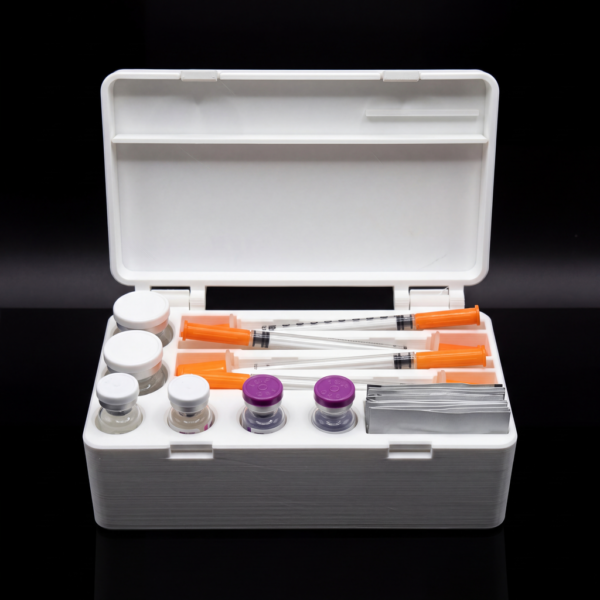
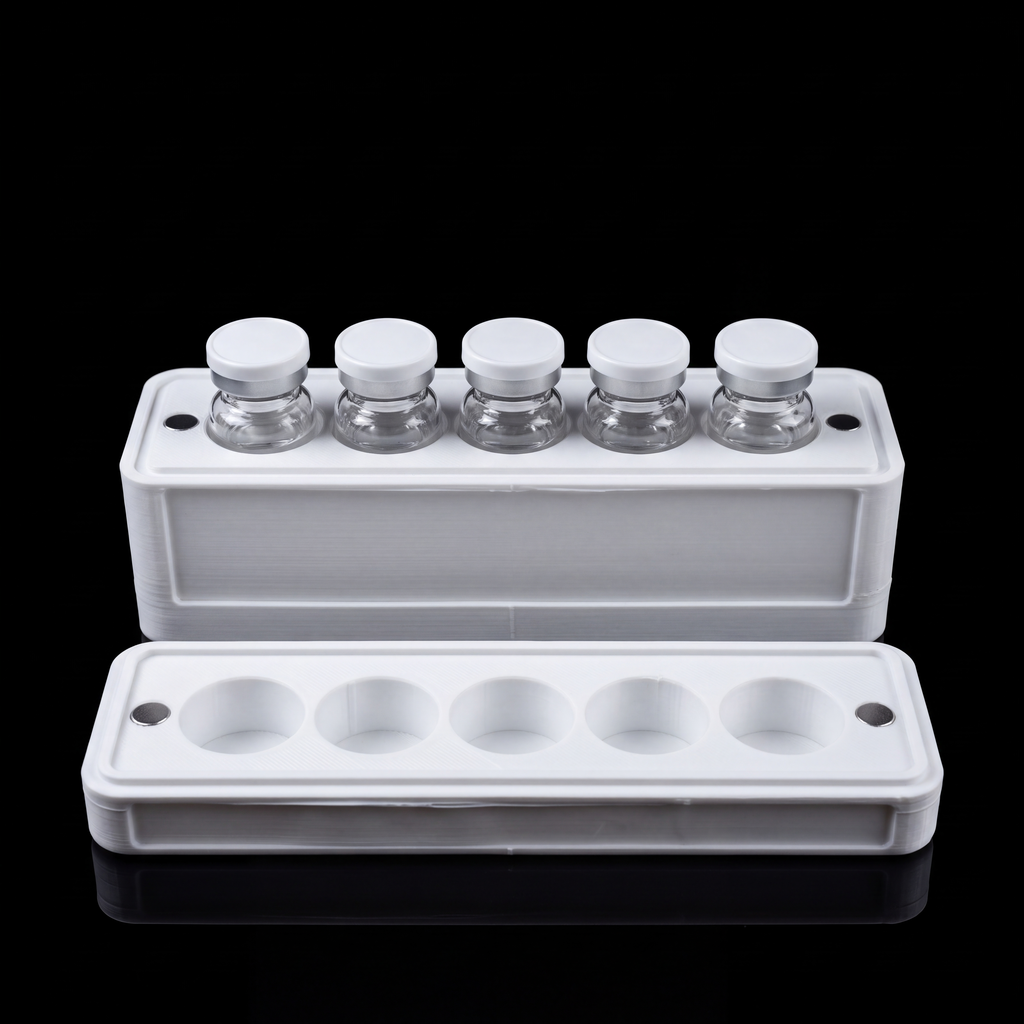
This 5-slot BAC water vial case is a purpose-built storage case for the 10mL vials that bacteriostatic water ships in. Five round wells in the base hold each vial upright, and the lid carries five matching recesses that close over the caps. Magnets at both ends pull the two halves together, so there are no clips, zippers, or straps to fight with.
It is made for researchers who reconstitute often and want their diluent in one known, protected spot. New to diluents? Read our guide on what bacteriostatic water is, then stock the case with our Bacteriostatic Water (BAC) vials.
Ready to buy? Add the 5-slot BAC water vial case to your cart above. Orders placed before 2 PM EST ship the same day.
How the 5-Slot BAC Water Vial Case Works
The design is simple on purpose. The base is a solid white block with five round wells set in a single row. Each well is sized for a 10mL bacteriostatic water vial, so the vial drops in and stands upright without leaning on its neighbor.
The lid mirrors the base. It has five matching recesses that settle over the tops of the vials when the case is closed. Because every vial is held from below and from above, nothing slides or rattles when the 5-slot BAC water vial case is moved.
The closure is magnetic. Magnets set into both ends of the base line up with magnets in the lid and pull the two halves together. To open the case, lift the lid straight up. To close it, lower the lid and let the magnets seat it.
That matters more than it sounds. Latches and zippers usually take two hands, and two-handed fumbling is how vials get dropped. A magnetic lid opens and closes in one motion, which keeps your other hand free for a syringe, a swab, or a notebook.

5-Slot BAC Water Vial Case Design Details That Matter
Small details separate a real storage tool from a generic box. These are the features researchers notice first.
- Five individual wells: One vial per well means no glass-on-glass contact and no rolling.
- Upright storage: Vials stand with the stopper up, a common preference for punctured multi-dose vials.
- Magnetic opening: No latches to snap, no zipper to snag, and nothing to fumble with at the bench.
- Single-row layout: Every vial is visible at a glance, so counting stock takes a second.
- White finish: A clean, bright surface makes labels, lot numbers, and liquid levels easy to read.
- Compact footprint: One row of five takes little shelf, drawer, or bench space.
Put together, those details turn the 5-slot BAC water vial case into a fixed home for your diluent. You always know where the bacteriostatic water is, how many vials are left, and which one is open.
Why Bacteriostatic Water Deserves Its Own Case
Bacteriostatic water is sterile water that contains 0.9% benzyl alcohol as a preservative. That preservative is what makes a vial suitable for repeated withdrawals. It is the diluent most research protocols use to reconstitute lyophilized peptides.
A 10mL vial is used many times. Every use means the vial is picked up, swabbed, punctured, and set back down. More handling means more chances to knock a vial over, mix up an opened vial with a sealed one, or lose track of when it was first punctured.
Peptide vials usually get careful storage. Diluent vials often end up loose in a drawer. A dedicated 5-slot BAC water vial case closes that gap and gives your bacteriostatic water the same organized treatment as the compounds it reconstitutes.
Want the bigger picture first? Our complete guide to peptides explains where diluents, reconstitution, and storage fit into a research workflow.
Published Research on Multi-Dose Vials and Storage
Peer-reviewed literature explains why careful handling of preserved, multi-use vials matters. In a 2007 review in the Journal of Pharmaceutical Sciences, Meyer and colleagues surveyed antimicrobial preservative use in parenteral products. They reported that benzyl alcohol and phenol were the two preservatives used most often in peptide and protein products.
Handling counts as much as chemistry. Mattner and Gastmeier (2004) collected 227 opened multiple-dose vials on a single day in a 1,300-bed hospital and found a contamination rate of 0.9%. Their recommendations included appropriate storage temperatures and marking each vial with its opening time.
A more recent hospital study archived by the National Library of Medicine found bacterial contamination in 5.5% of multiple-dose vials and in none of the single-dose vials sampled. The authors tied contamination to improper handling. The takeaway for any lab is consistent: label vials, date them, and store them properly.
Physical conditions matter for peptides as well. Zapadka and colleagues (2017) reviewed the factors affecting the physical stability of peptide therapeutics, including temperature and agitation. A case cannot control temperature, but it does cut down on knocks, drops, and needless shaking.
A 5-slot BAC water vial case will not sterilize or preserve anything. What it does is support the habits the literature points to: one known place for every vial, upright storage, and room for clear date labels.
5-Slot BAC Water Vial Case vs Alternatives
How does a dedicated case compare with other ways of storing 10mL vials? The table below lines up the most common options.
| Feature | 5-Slot BAC Water Vial Case | 10mL Peptide Vial Case | Loose in a Box or Bag |
|---|
| Designed for | 10mL bacteriostatic water vials | 10mL peptide vials | Nothing specific |
| Capacity | 5 vials | 5 vials | Varies |
| Closure | Magnetic | Latching lid | None or zipper |
| Individual vial slots | Yes | Yes | No |
| Glass-on-glass contact | None | None | Likely |
| Opening | Lift the lid, no latches | Release the latches | Dig through contents |
| Position tracking | Fixed wells | Fixed slots | Not possible |
| Best use | A dedicated diluent supply | A working set of 10mL peptide vials | Short-term only |
Need storage for peptide vials too? See the 10mL Peptide Vial Case for larger vials or the 10-Slot Peptide Vial Storage Case for 3mL vials. Pairing a 5-slot BAC water vial case with a peptide case gives diluent and compounds each their own labeled home.
Loading, Handling & Reconstitution Workflow
A good case makes a routine faster and more repeatable. Here is a simple workflow built around the 5-slot BAC water vial case.
- Inspect: Check each bacteriostatic water vial for an intact flip-off cap, a clear solution, and a readable lot number.
- Load: Seat one vial in each well with the label facing forward, then lower the magnetic lid.
- Assign positions: Use the left-most well for the vial in use and keep sealed vials to the right.
- Date the open vial: Write the first-puncture date on the label before the vial goes back in its well.
- Draw: Swab the stopper, draw the volume your protocol calls for, and return the vial to the same well.
- Rotate: When the open vial is finished, move the next sealed vial into the first position.
Volumes depend on the protocol. As a simple illustration, adding 2 mL of bacteriostatic water to a 10 mg vial gives a 5 mg/mL solution. One 10mL vial covers several reconstitutions at that volume, which is why a five-vial supply goes a long way.
For the full technique, read how to reconstitute peptides. To work out concentrations quickly, use our peptide calculator guide.
Five Practical Tips for Your 5-Slot BAC Water Vial Case
- Label the case itself: Mark the lid so nobody confuses it with a peptide case.
- Keep one vial open at a time: Finish the vial in the first well before puncturing the next.
- Log lot numbers: Note the lot of each vial as you load it, so records stay traceable.
- Close the lid after every draw: A closed case keeps vials covered and away from bench clutter.
- Restock before you run out: When two wells are empty, reorder so a protocol never stalls for lack of diluent.
None of these steps takes more than a few seconds. Together they make the 5-slot BAC water vial case the most reliable part of your reconstitution routine.
Common BAC Water Storage Mistakes to Avoid
- Leaving vials loose: Unsecured glass vials roll, tip, and chip against each other.
- Mixing opened and sealed vials: Without fixed positions, it is easy to puncture a second vial by accident.
- Skipping the date: An undated open vial forces a guess about how long it has been in use.
- Ignoring the label: Storage temperature and expiry are printed on every vial for a reason.
- Storing diluent with unrelated supplies: A shared drawer invites mix-ups and wasted time.
Each mistake has the same fix: one dedicated, organized place for diluent. That is exactly what this 5-slot BAC water vial case provides.
Storage & Stability
Always follow the storage instructions printed on your bacteriostatic water vial. Many labels call for controlled room temperature, roughly 68–77°F (20–25°C), away from heat and freezing. The case does not heat, cool, or insulate, so temperature depends on where you keep it.
Once a multi-dose vial has been punctured, a commonly cited guideline is to discard it after 28 days unless the manufacturer states otherwise. Dating each vial at first puncture makes that easy to follow. A fixed “in use” well makes it easier still.
Keep your 5-slot BAC water vial case on a stable shelf or in a drawer, out of direct sunlight. Reconstituted peptides are a different matter and usually need refrigeration. Our peptide storage guide covers temperatures and timelines, and our article on how to tell if a peptide has degraded explains the warning signs.
To clean the case, wipe it with a soft, lightly damp cloth and let it dry completely before loading vials. Avoid harsh solvents and soaking.
Certificate of Analysis & Lot Tracking
The 5-slot BAC water vial case is a storage accessory, so it does not carry a Certificate of Analysis. The products you keep in and around it do. PSPeptides research peptides come with batch-specific COAs, and our bacteriostatic water has a lot COA published online.
Good storage keeps that paperwork useful. When every vial sits in a known well with its label visible, matching a lot number to its COA takes seconds. Learn what the numbers mean in our guide on how to read a peptide COA.
Is a 5-Slot BAC Water Vial Case Worth It?
Consider what the case protects. A five-vial supply of bacteriostatic water supports dozens of reconstitutions, and every one depends on a clean, intact, correctly dated vial. One dropped or mixed-up vial can stall a protocol while a replacement ships.
The case also saves time. Instead of searching a drawer, you lift one lid and see your whole diluent supply. Stock checks take a glance, and reordering happens before you run out instead of after.
Finally, it keeps a workspace professional. A labeled, purpose-built case is a visible sign of a careful process, and careful processes are easier to repeat and document.
Whether you call it a 5 vial BAC water case or a 10mL bacteriostatic water vial case, the job is the same: one protected, organized place for your diluent.
Build a Complete Reconstitution Setup
A 5-slot BAC water vial case works best as part of a simple, repeatable system. It makes sense to order the supplies that go with it at the same time.
- The case: One 5-slot BAC water vial case keeps a five-vial diluent supply in a single place.
- Bacteriostatic water: Fill it with PSPeptides Bacteriostatic Water in 10mL vials.
- Syringes: EasyTouch 1mL syringes for accurate measuring and transfer.
- Peptide storage: A separate peptide vial case for each compound or protocol.
- Labels and a log: The low-cost step that makes everything else traceable.
Ordering together also saves on shipping. Orders over $150 ship free by UPS 2nd Day Air, so adding a 5-slot BAC water vial case to a peptide order is usually the most economical way to buy one.
Who Should Buy This 5-Slot BAC Water Vial Case?
- Frequent reconstituters: Researchers who open bacteriostatic water every week and want it within reach.
- Multi-compound labs: Teams running several protocols that share one diluent supply.
- Bulk buyers: Anyone who orders BAC water five vials at a time and needs somewhere to keep it.
- Organized benches: Researchers who already case their peptides and want diluent stored to the same standard.
- New researchers: Anyone setting up a first workspace who wants good habits from day one.
If any of those sound familiar, this is the 5-slot BAC water vial case for sale that fits your workflow. It is a small purchase that removes a daily annoyance.
Why Researchers Choose PSPeptides
- US Manufactured: PSPeptides research peptides are made in the United States
- Third-Party Tested: Independent HPLC and mass spectrometry on peptide batches
- Fast Shipping: Free UPS 2nd Day Air over $150, same-day before 2 PM EST
- Flexible Payments: Credit cards, Afterpay, Klarna, Apple Pay, Google Pay
- 7-Day Support: Email, phone, or text
Comparing vendors before you buy? Our checklist on how to choose a research peptide supplier covers testing, documentation, and shipping standards. When you are ready, you can buy a 5-slot BAC water vial case online here in under a minute.
Frequently Asked Questions
How many vials does the 5-slot BAC water vial case hold?
It holds five 10mL vials in a single row. Each vial has its own well in the base and its own recess in the lid, so no two vials touch.
What size vials fit the 5-slot BAC water vial case?
The wells are sized for 10mL bacteriostatic water vials. Vial dimensions vary between manufacturers, so if you plan to store a different 10mL vial, compare it with the product photos or contact support first.
Is bacteriostatic water included?
No. You receive one empty 5-vial case. The vials shown in the product photos illustrate fit and are sold separately. You can add bacteriostatic water to the same order.
How does the magnetic closure work?
Magnets at both ends of the base attract matching magnets in the lid. Lower the lid and it seats itself. Lift it straight up to open. There are no latches or zippers to wear out.
Do the vials stand upright?
Yes. Every vial stands upright in its own well with the stopper facing up. That makes the 5-slot BAC water vial case a good fit for opened multi-dose vials that you want to keep vertical.
Can I store peptide vials in it?
This case is designed around 10mL bacteriostatic water vials. For peptides, we recommend a dedicated case such as the 10mL Peptide Vial Case or the 10-Slot Peptide Vial Storage Case, so diluent and compounds stay separate.
Does the case keep vials cold?
No. It organizes and protects vials, but it does not cool or insulate them. Store the case wherever the label on your vials says they should be kept.
How do I clean it?
Wipe the base and lid with a soft, lightly damp cloth, then let both halves dry fully before you reload them. Skip harsh solvents and do not soak the case.
How fast does the 5-slot BAC water vial case ship?
Orders placed before 2 PM EST ship the same day. Orders over $150 qualify for free UPS 2nd Day Air.
Where can I find a 5-slot BAC water vial case for sale?
Right here. Add the case to your cart at the top of this page and check out with a credit card, Afterpay, Klarna, Apple Pay, or Google Pay.
Related Resources
All PSPeptides products are sold exclusively for laboratory and research use. Not intended for human consumption.





 Made & Shipped