Order this peptide vial case from PSPeptides to keep a three-vial research set organized, protected, and ready for your next session. Orders placed before 2 PM EST ship the same day.
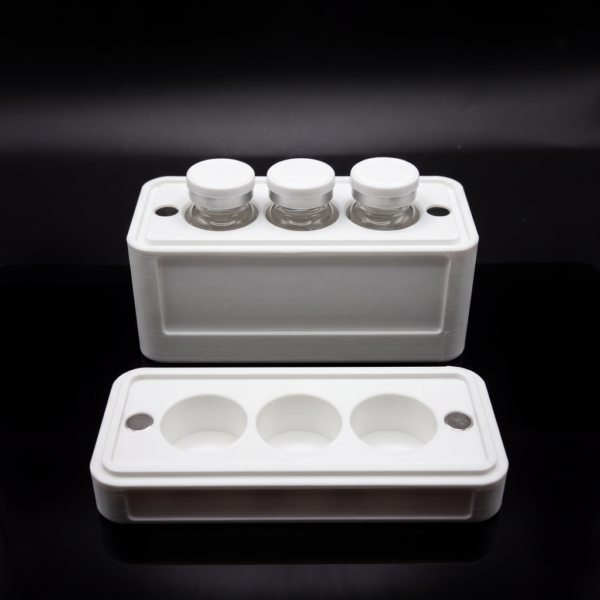
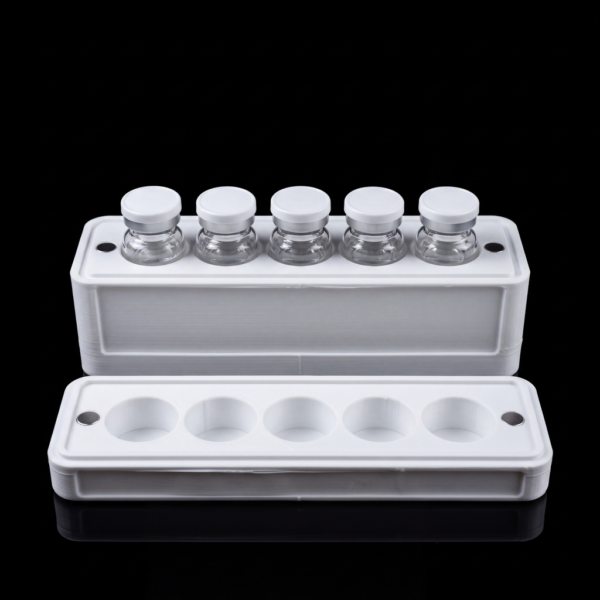
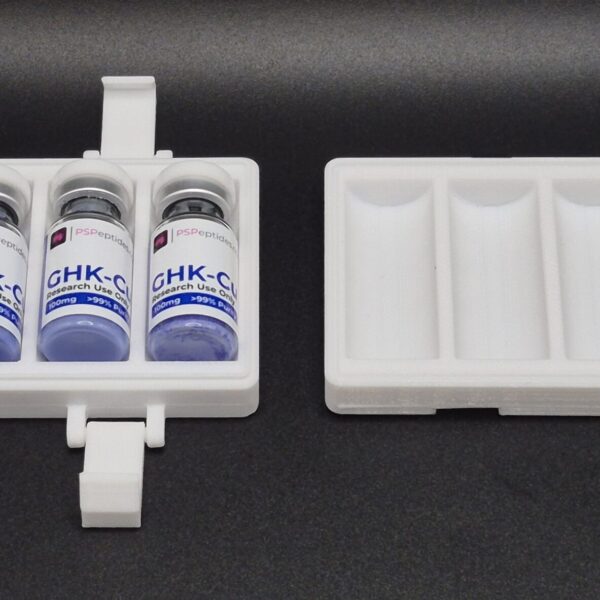
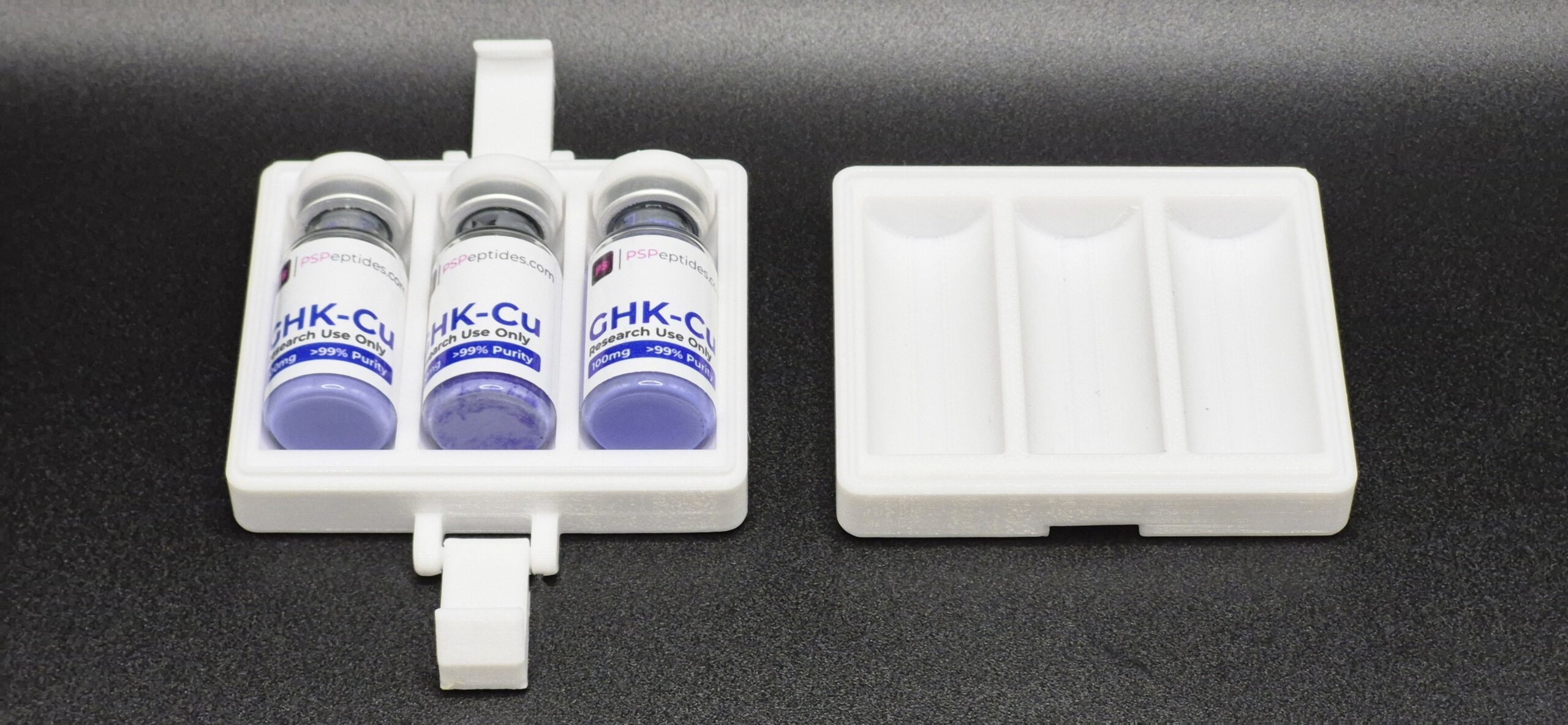
The peptide vial case is a compact, two-piece white shell with three molded cavities sized for standard 3mL research vials. A fitted lid closes over the vials and a snap latch holds everything shut, which stops vials from rolling, tipping, or knocking together. For background on why careful handling matters, read our peptide storage guide.
It is built for researchers who keep a small working set of vials and want them stored as one tidy, protected unit. Load it once, latch it, and your vials stay exactly where you left them until the next time you need them.
How the Peptide Vial Case Protects Your Vials
Glass research vials fail in predictable ways. They roll off shelves, tip over in door bins, and knock against each other until a wall chips or a crimp seal loosens. A peptide vial case removes those failure points by giving every vial a fixed, dedicated position.
Each of the three slots is molded to the profile of a 3mL vial. The vial body rests in the base while the matching cavity in the lid closes over it, so the vial is held on both sides rather than sitting loose in an open tray.
The latch matters as much as the slots. Open trays and cardboard boxes spill the moment they are bumped or tilted. With the latch closed, the case can be lifted, carried, or stacked without the vials shifting inside.
The shell also puts a solid barrier between your vials and everything around them. When closed, it helps block light from refrigerator bulbs and bench lamps, and it keeps labels from rubbing against other containers. Legible labels are a small but real part of good research records.
Finally, the case works as an organizational unit. Three vials from one batch, or three compounds from one protocol, stay together from delivery through the last withdrawal. That makes it much harder to confuse look-alike vials on a crowded shelf.

Design Details
Every part of this peptide vial case has a job. The details below explain what you are getting and why each one earns its place.
- Three individual slots: One vial per cavity, with a divider between each, so vials cannot slide into one another.
- Matched base and lid: Both halves are shaped to the vial, which holds it in place when the case is closed.
- Snap latch: Closes the case securely and releases when you are ready to work.
- Rigid shell: Resists the squeezing and bumping that would crush a cardboard box.
- Clean white finish: Easy to spot in a refrigerator and easy to mark with a label or lot number.
- Compact footprint: Only as large as three 3mL vials require, so it takes up very little shelf space.
Published Research on Peptide Stability
Storage accessories matter because peptides are fragile molecules. In a widely cited review, Manning and colleagues (2010) described how peptides and proteins degrade through both chemical and physical routes, in solution and in the dried state. Read the abstract of Stability of Protein Pharmaceuticals: An Update on PubMed.
Temperature is the best-known stress. Wang (1999) reviewed why these molecules usually need to be stored cold or freeze-dried to reach an acceptable shelf life, and surveyed the physical and chemical instabilities behind that requirement. See Instability, Stabilization, and Formulation of Liquid Protein Pharmaceuticals for the abstract.
Light is another recognized factor. A 2023 survey in Pharmaceutical Research reviewed storage conditions across licensed therapeutic protein formulations and reported that light and temperature sensitivity are prevalent among them. The open-access paper is available from NIH PubMed Central.
None of this research was performed on a storage case, and no case changes the chemistry of a peptide. What a peptide vial case does is make good storage habits easier to keep: vials stay closed up, shaded, separated, and undisturbed between uses.
Peptide Vial Case vs Alternatives
Most researchers start with whatever is on hand. The table below compares this peptide vial case with the two most common substitutes.
| Feature | This Product | Original Shipping Box | Loose Vials or Zip Bag |
|---|
| Vial separation | Individual molded slots | Varies by packaging | None |
| Secure closure | Snap latch | Tuck flap | Zip seal only |
| Crush and impact resistance | Rigid shell | Low (cardboard) | None |
| Light shielding when closed | Yes | Yes | No (clear bag) |
| Stops vials rolling | Yes | Sometimes | No |
| Sized for 3mL vials | Yes | Varies | No |
| Tolerates condensation | Wipes dry | Cardboard softens | Moisture collects inside |
| Reusable | Yes | Limited | Limited |
A generic foam tray or pill organizer can hold vials, but slots that are too wide let vials rattle and slots that are too narrow put stress on the glass. A purpose-built peptide vial case sized for 3mL vials avoids both problems.
Cost is the other consideration. Replacing one cracked or compromised vial can cost more than the case that would have protected it. That is why it makes sense to add a peptide vial case to your first order rather than your fifth.
Who Should Buy This Peptide Vial Case?
This case is the right buy if you keep a small working set of 3mL vials and want them stored as one tidy unit. It suits a single compound bought in a three-vial quantity as well as a three-compound protocol.
- Researchers running multi-vial protocols: Keep every vial for a study in one place from start to finish.
- Labs sharing refrigerator space: Clearly separate one project’s vials from another’s.
- Anyone moving vials between rooms: The latched shell is far safer than a pocket, a bag, or a bare hand.
- First-time buyers: Build a complete setup with vials, diluent, and storage in a single order.
It is also a practical choice for anyone who has already lost a vial to a drop or a knock. A single incident is usually enough to show that a few seconds spent latching a case is worth more than the cost of starting over.
If you stock more than three vials, order one peptide vial case per protocol or per compound. Separate cases make it simple to pull exactly the set you need without handling everything else.
How to Set Up Your Peptide Vial Case
- Inspect: Open the case and check that the slots are clean and dry before loading.
- Label: Add a small label to the lid with the compound name, batch or lot number, and the date received.
- Load: Place one 3mL vial in each slot with the labels facing up so they can be read at a glance.
- Latch: Close the lid and secure the latch before you move the case.
- Store: Put the case in cold storage at the temperature specified for the compounds inside.
The whole routine takes about a minute. After that, the peptide vial case goes back to the same spot every time, which is what keeps a storage system reliable.
Reconstitution & Handling
The case is built around the handling routine, not just storage. Before reconstituting, remove one vial, close the case on the other two, and return them to cold storage so they are not sitting out while you work.
Let a cold vial come toward room temperature before you pierce the stopper, which limits condensation. Wipe the stopper with an alcohol swab and add diluent slowly down the inside wall of the vial. Our step-by-step reconstitution guide covers the full procedure.
Volumes depend on the compound and the concentration your protocol calls for. As a simple illustration, adding 2mL of bacteriostatic water to a 10mg vial gives 5mg per mL, while adding 1mL gives 10mg per mL. Use our peptide calculator guide to work out exact figures for your vial.
Once a vial is reconstituted, swirl it gently rather than shaking it, then mark it with the date and concentration. Returning each vial to the same slot in the peptide vial case every time is a simple way to avoid mix-ups.
Storage & Stability
Always follow the storage instructions supplied with each compound. As general guidance, lyophilized peptides are usually kept frozen at around -20°C for long-term storage or refrigerated at 2–8°C for shorter periods. Reconstituted peptides are refrigerated at 2–8°C and used within the window your protocol specifies.
The peptide vial case is compact enough to sit on a refrigerator shelf, where temperature is steadier than in the door. Keeping vials inside a closed case also means they are not handled or exposed every time someone reaches past them.
Position matters too. Place the case toward the middle or back of a shelf rather than at the front edge, where it is more likely to be knocked when other items are moved. Keep it clear of the cooling element so vials are not exposed to unintended freezing.
Avoid repeated freeze-thaw cycles for reconstituted material, and keep vials away from direct sunlight and heat sources. If condensation forms on the outside of the case after it leaves cold storage, wipe it dry before opening.
Check your vials each time you open the case. Cloudiness, visible particles, discoloration, or a collapsed lyophilized cake are all reasons to set a vial aside and review its history before using it in research.
To clean the case between uses, wipe the inside and outside with a soft cloth and let it dry fully before reloading. A clean, dry peptide vial case is the best home for a fresh set of vials.
Common Storage Mistakes This Case Helps Prevent
- Loose vials in the door bin: Door storage means constant movement and temperature swings. A case gives vials a stable place on the shelf.
- Unlabeled look-alikes: Many 3mL vials look identical once a label smudges. Keeping sets together in a labeled case prevents guesswork.
- Vials left out on the bench: When the vials you are not using stay latched in the case, they go back to cold storage in one move.
- Glass-on-glass contact: Vials stored in a bag or cup knock together. Individual slots stop that entirely.
- Lost paperwork: A lot number on the lid ties every vial back to its test report.
Certificate of Analysis
The case is a storage accessory, so it does not carry a Certificate of Analysis of its own. The peptides you store in it should. PSPeptides peptides are supplied with batch-specific COAs backed by independent HPLC and mass spectrometry testing.
Good practice is to keep documentation matched to the vials. Write the batch or lot number of each vial on a label on the case, or keep a printed COA with the set, so the paperwork and the material never get separated.
If you are new to reading test reports, our guide on how to read a peptide COA explains purity percentages, chromatograms, and mass confirmation in plain terms.
What to Order With Your Peptide Vial Case
A case is most useful when the rest of the setup is ready too. Consider adding these to the same order so everything arrives together.
- Research peptides in 3mL vials: The case is sized for this format, so new vials go straight from the shipping box into their slots.
- Bacteriostatic water: The standard diluent for reconstituting many lyophilized research peptides.
- A second case: One for vials in current use and one for sealed backups keeps opened and unopened material apart.
Combining items is also the easiest way to pass the $150 mark for free UPS 2nd Day Air shipping.
Why Researchers Choose PSPeptides
Buying your peptide vial case from the same supplier as your vials means one order, one shipment, and one support team.
- US Manufactured: Research peptides synthesized in the United States
- Third-Party Tested: Independent HPLC and mass spectrometry
- Fast Shipping: Free UPS 2nd Day Air over $150, same-day before 2 PM EST
- Flexible Payments: Credit cards, Afterpay, Klarna, Apple Pay, Google Pay
- 7-Day Support: Email, phone, or text
Ready to order? Choose your quantity above, add the peptide vial case to your cart, and check out in a couple of minutes.
Frequently Asked Questions
How many vials does the peptide vial case hold?
It holds three vials, each in its own molded slot. The slots are sized for 3mL research vials, which is the format shown in the product photo.
Are peptide vials included with the case?
No. This listing is for the peptide vial case only, and the vials in the photo are shown for illustration. Add the peptides you need to the same order and everything ships together.
Will other vial sizes fit?
The case is designed for 3mL vials. Larger formats such as 10mL vials will not seat in the slots, and much smaller vials may sit loosely. For a secure fit, use it with 3mL vials.
Can I keep the peptide vial case in the refrigerator?
Yes. The case is compact enough for a standard refrigerator shelf, which is where working vials are normally kept. Wipe off any condensation before opening it at room temperature.
Does the case keep peptides cold?
No. The peptide vial case is a protective organizer, not an insulated cooler, and it has no cooling element. It protects and organizes vials while your refrigerator or freezer controls the temperature.
Is a peptide vial case worth buying for only a few vials?
A few vials is exactly what it is built for. Small sets are the ones most often left loose on a shelf, where a single knock can crack glass. A case is inexpensive insurance compared with replacing a damaged vial.
Is the case reusable?
Yes. When one set of vials is finished, wipe the case clean, let it dry, relabel the lid, and load the next set. One case can serve protocol after protocol.
How should I label the case?
Use a small adhesive label or a strip of lab tape on the lid. Note the compound, the batch or lot number, and the date, and replace the label whenever you load a new set of vials.
Can I order more than one peptide vial case?
Yes. Set the quantity on this page before adding to your cart. A common approach is one case per compound, or separate cases for sealed and reconstituted vials.
How fast will my order ship?
Orders placed before 2 PM EST ship the same day. Orders over $150 qualify for free UPS 2nd Day Air, and support is available seven days a week by email, phone, or text.
Related Resources
Shop the peptide vial case above to give your next set of research vials a proper home.
All PSPeptides products are sold exclusively for laboratory and research use. Not intended for human consumption.





 Made & Shipped