Peptide Storage Case
$79.99
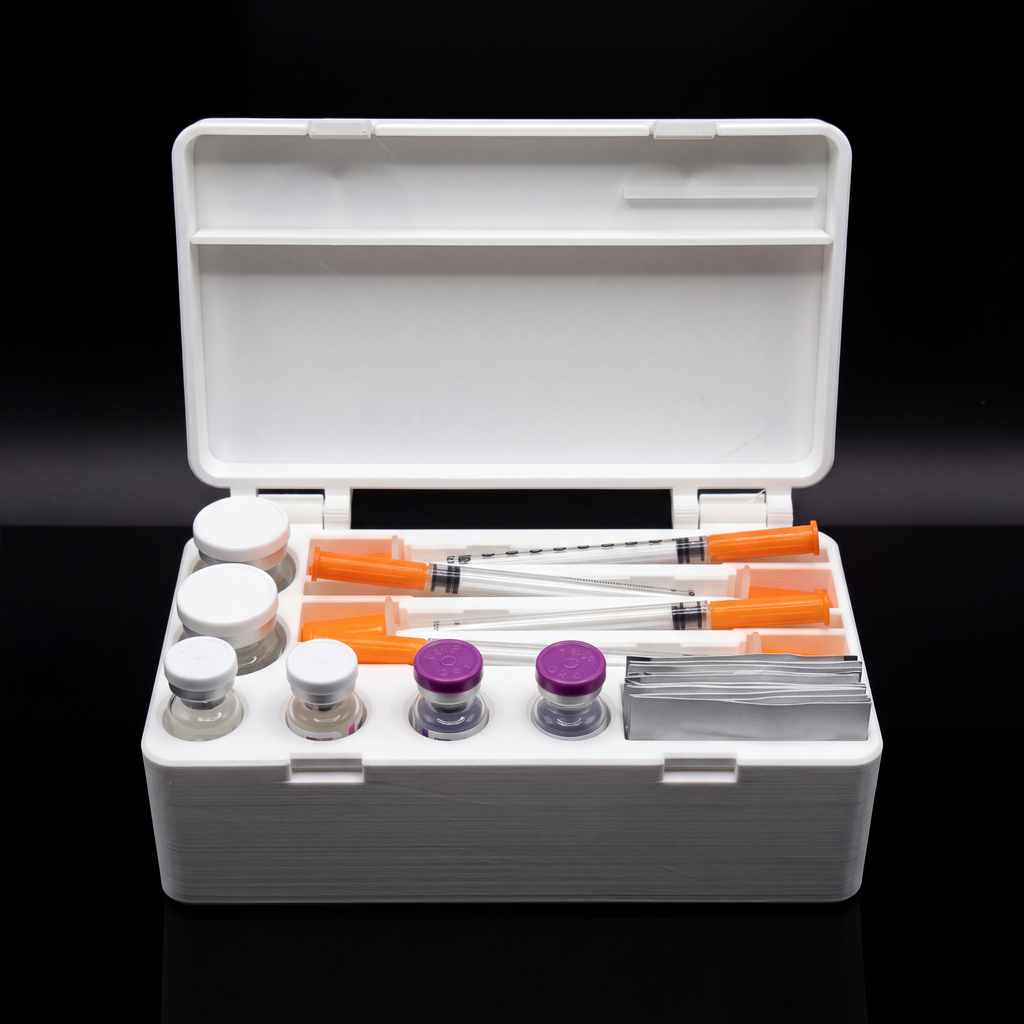
Peptide Storage Case — white peptide travel case with locking lid. Holds 4x 3mL vials, 2x 10mL vials, 4x 1mL syringes and ~25 alcohol pads. Fridge and travel ready.




 Made & Shipped
For laboratory and research use only. This product is not a drug, food, or cosmetic and is not for human or animal consumption. It is not intended to diagnose, treat, cure, or prevent any disease. These statements have not been evaluated by the FDA. Sold solely to qualified researchers and licensed laboratories. Certificate of Analysis available on request.
Description
Peptide travel case — the PSPeptides Peptide Storage Case is a white, compact case with a secure locking lid, built to keep a complete research kit in one place: 4x 3mL vials, 2x 10mL vials, 4x 1mL syringes and roughly 25 alcohol prep pads. It is sized to sit on a refrigerator shelf between sessions and to travel safely whenever your research does.
What Is the PSPeptides Peptide Travel Case?
The Peptide Storage Case is a purpose-built peptide travel case for researchers who are tired of loose vials, rolling syringes and alcohol pads scattered across a fridge shelf. The lid opens fully for easy access, then locks shut so nothing shifts in a bag, cooler or suitcase.
Inside, dedicated slots hold each item upright and separated. That keeps reconstituted vials from knocking together, keeps sterile syringes sealed and clean, and keeps your prep pads within reach. Read our peptide storage guide for the conditions this case is designed to support.
Key Uses for This Peptide Travel Case
- Refrigerator organization: Keep every reconstituted vial, syringe and prep pad in one locking peptide travel case on a middle fridge shelf instead of loose on the door.
- Travel and field work: The secure locking lid protects glass vials from knocks, spills and tipping in a carry-on, backpack or cooler bag.
- Multi-compound protocols: Six vial slots (4x 3mL and 2x 10mL) hold several research peptides plus a vial of bacteriostatic water side by side.
- Contamination control: Sterile 1mL syringes and sealed alcohol pads stay dry, clean and separated from everything else in the refrigerator.
Product Specifications
| Color | White |
| Vial capacity | 4x 3mL vials and 2x 10mL vials (6 vials total) |
| Syringe storage | 4x 1mL syringes |
| Alcohol pad storage | Approximately 25 alcohol prep pads |
| Lid | Full-opening lid with secure lock |
| Refrigerator use | Yes — designed to sit on a standard refrigerator shelf |
| Travel use | Yes — locks closed for bags, coolers and luggage |
| Best for | Organizing a complete research peptide kit at home, in the lab and on the road |
| Ships from | PSPeptides, USA — same-day dispatch on orders placed before 2 PM EST |
▼ Read Full Research Description
How a Peptide Travel Case Protects Your Research Materials
Research peptides are fragile molecules. Once a lyophilized vial is reconstituted with bacteriostatic water, the peptide sits in solution where heat, light, agitation and repeated temperature swings can all speed up degradation. A dedicated peptide travel case solves the physical half of that problem by keeping every vial upright, still and together.
Temperature is the first concern. Most reconstituted research peptides are kept refrigerated at 2–8°C (36–46°F), and the largest temperature swings inside a household fridge happen on the door and against the back wall near the cooling element. A single locking peptide travel case on a middle shelf makes it easy to keep every vial in the most stable zone of the refrigerator.
Agitation and impact are the second concern. Shaking a reconstituted vial can encourage aggregation, and a dropped glass vial is a lost batch. The individual slots in this peptide travel case stop vials from rolling, clinking and tipping, whether the case is sitting on a shelf or riding in a bag.
Contamination is the third concern. Keeping sterile 1mL syringes and sealed alcohol pads inside the same locked case as your vials means every prep item is clean, dry and immediately at hand — no digging through a drawer and no handling a vial cap with unwashed hands. For technique basics, see our guide to subcutaneous vs intramuscular peptide injection.
Organization is the fourth, quieter benefit. When several compounds are in use at once, a peptide travel case with every vial visible and upright makes it far easier to label, date and rotate stock — and far harder to pick up the wrong vial by mistake.
What Published Research Says About Peptide Storage
The stability science behind this peptide travel case is well established. In a widely cited review in Pharmaceutical Research, Manning, Chou, Murphy, Payne and Katayama (2010) separated protein and peptide instability into chemical pathways (deamidation, oxidation and hydrolysis) and physical pathways (denaturation, aggregation, precipitation and adsorption), and highlighted the role of packaging in maintaining stability (Manning et al., Pharm Res 2010).
Wang (1999), reviewing liquid protein pharmaceuticals in the International Journal of Pharmaceutics, concluded that protein and peptide products usually have to be stored cold or freeze-dried to reach an acceptable shelf life — the core reason reconstituted research peptides belong in a refrigerator rather than on a bench (Wang, Int J Pharm 1999).
Light matters as well. A 2023 survey of licensed biotechnology drug products, published in Pharmaceutical Research and available through the NIH, found that light and temperature sensitivity are prevalent across therapeutic protein formulations, with many products labeled to protect from light and not to freeze (NIH PMC10338390). Keeping vials inside a closed case in the refrigerator limits their light exposure between uses.
Real-world temperature data make the case for better organization. In a study presented at the 2018 EASD Annual Meeting and later published in Diabetes Technology & Therapeutics (2019), Braune and colleagues placed temperature sensors beside insulin stored in 388 participants’ home refrigerators or carried in their bags.
Of 400 temperature logs, 79% contained excursions outside the recommended range. Refrigerated insulin was out of range about 11% of the time (roughly 2.5 hours per day), and 17% of sensors recorded freezing temperatures. The lesson for peptide researchers is simple: where your peptide travel case sits in the fridge matters, and a basic fridge thermometer is a worthwhile companion.
Peptide Travel Case vs Alternatives
How does a dedicated peptide travel case compare with the ways researchers usually store vials? The table below sets the PSPeptides Peptide Storage Case against a zip bag or shipping box and a generic pill organizer or insulin pouch.
| Feature | PSPeptides Peptide Storage Case | Zip bag or shipping box | Generic pill organizer / insulin pouch |
|---|---|---|---|
| Secure locking lid | Yes — locks closed for transit | No | Rarely; usually a zipper or snap |
| Dedicated vial slots | 4x 3mL and 2x 10mL, held upright | None — vials roll loose | Few, and often sized for pens rather than 10mL vials |
| Syringe storage | 4x 1mL syringes, separated and clean | Loose, mixed with vials | Usually none |
| Alcohol pad storage | About 25 pads in their own section | Loose | Usually none |
| Fits on a fridge shelf | Yes — compact footprint, lid stays locked | Takes up space and offers no protection | Varies; soft pouches absorb fridge moisture |
| Impact protection while traveling | Locking lid keeps glass vials from shifting or tipping | Minimal | Limited — soft sides, no vial separation |
| Easy to sanitize | Yes — wipe with an alcohol pad | Single use | Fabric is difficult to clean |
| Complete kit in one place | Vials, syringes and pads together | Scattered | Partial at best |

Who This Peptide Travel Case Is For
- Researchers running multiple compounds: Six vial slots keep up to six reconstituted peptides or diluents organized and labeled in one peptide travel case.
- Frequent travelers: The locking lid keeps vials, syringes and pads secure through airport security trays, hotel mini-fridges and long drives.
- Shared refrigerators: A closed, locked case keeps your research materials separate from food and other household items.
- Small labs and home offices: A compact footprint means the case fits on a standard fridge shelf without displacing everything else.
- First-time buyers: If you are ordering your first research peptide and bacteriostatic water, adding a peptide travel case to the same order means your kit arrives organized from day one.
Choosing a Peptide Travel Case: What to Look For
Not every container sold as a peptide travel case is designed for glass vials. Before buying, check four things: a lid that genuinely locks rather than snaps, slots that hold vials upright and apart, room for the diluent vial you actually use, and enough space for syringes and prep pads so the whole kit travels as one unit.
Size is the trade-off. A case large enough for dozens of vials rarely fits on a fridge shelf, while a soft pouch offers almost no protection against impact. The PSPeptides Peptide Storage Case sits in the middle: six vials, four syringes and a month’s worth of alcohol pads in a footprint that still fits in a refrigerator and a carry-on.
Finally, consider cleaning. Any case will eventually see a leaked vial or a sweating cold pack, so a wipeable interior matters more than it sounds. Fabric pouches hold moisture and odors; a wipe-down case can be sanitized with a single alcohol pad.
Packing & Handling Guide
Packing this peptide travel case takes about a minute. Wipe the interior with an alcohol pad and let it dry, then place reconstituted vials upright in the four 3mL slots and your bacteriostatic water or larger vials in the two 10mL slots. Keep the syringe slots for sealed 1mL syringes and the pad section for roughly 25 alcohol prep pads.
Reconstitute before you travel, not on the road. Follow our step-by-step guide on how to reconstitute peptides, confirm your volumes with the peptide dosage calculator, and read what bacteriostatic water is before deciding which vial fills each 10mL slot.
For longer transit, place the locked peptide travel case inside an insulated bag with a cold pack, but never let the cold pack touch a vial directly — freezing a reconstituted peptide can be as damaging as heat. Keep the case upright, and keep your batch COAs and labels with it so every vial stays identifiable.
When you arrive, move the peptide travel case straight back onto a refrigerator shelf. Between sessions, keep the lid locked so syringes and pads cannot spill into the rest of the fridge, and wipe the exterior down if it has been in a shared bag.
A simple travel checklist for your peptide travel case:
- Reconstituted vials seated upright in the 3mL slots, caps wiped and labeled
- Bacteriostatic water seated in a 10mL slot
- Four sealed 1mL syringes in the syringe slots
- A fresh supply of alcohol prep pads (about 25 fit)
- Printed or digital COAs and your dosing notes
- Lid locked, case upright, cold pack separated from the vials
Storage & Stability
Lyophilized (freeze-dried) research peptides are typically stored sealed at 2–8°C, or frozen for long-term holding, and remain stable for months to years. Once reconstituted, most peptides should be refrigerated at all times and used within weeks; our peptide storage guide covers compound-specific windows.
Avoid repeated freeze-thaw cycles, direct light and heat above room temperature. Keep your peptide travel case on a middle fridge shelf, away from the back wall, the freezer compartment and the door, and check vials regularly for cloudiness or particulates — both covered in our guide to how to tell if a peptide has degraded.
Short trips out of the refrigerator are normal: most peptides tolerate the few minutes needed to draw a dose. What they do not tolerate is hours in a hot car or a checked bag, which is why a case that keeps the kit together, locked and easy to move back into the cold makes a real difference.
The case itself is easy to care for. Wipe the interior and exterior with an alcohol pad, let it dry completely, and it is ready for the next batch. Because it is white, any spills or residue are easy to spot and clean before they reach a vial.
A refrigerator thermometer is an inexpensive addition. Place it on the same shelf as the case, note the reading when you open the fridge each morning, and adjust the dial if readings drift toward 0°C or above 8°C. Many household fridges run colder at the back and warmer in the door, so a middle-shelf position with a thermometer beside it is the most reliable way to confirm vials are staying in range.
Inventory & Labeling Tips
A peptide travel case works best as part of a simple system. Label every reconstituted vial with the compound, concentration and reconstitution date, and keep a one-page log with the case or in your phone. Rotate older vials to the front, check volumes weekly, and reorder before the last vial is empty so your protocol never stalls.
If you run several compounds, assign each a fixed slot in the case so you can find it by position even in low light. Keeping a matching list of lot numbers from your COAs makes it easy to trace any vial back to its purity data.
Certificates of Analysis & Documentation
Every research peptide PSPeptides sells ships with a batch-specific Certificate of Analysis from third-party HPLC and mass spectrometry testing. We recommend keeping a printed or digital copy of each COA with your peptide travel case so that every vial inside can be matched to its purity data, lot number and reconstitution date.
Learn how to interpret purity percentages, retention times and mass spectrometry results in our guide to reading a peptide COA, and see our complete guide to peptides for the fundamentals.
Why Researchers Choose PSPeptides
- US Manufactured: Research peptides synthesized in the USA, with every order shipped from our US facility
- Third-Party Tested: Independent HPLC and mass spectrometry on every batch
- Fast Shipping: Free UPS 2nd Day Air over $150, same-day before 2 PM EST
- Flexible Payments: Credit cards, Afterpay, Klarna, Apple Pay, Google Pay
- 7-Day Support: Email, phone, or text
Pair this peptide travel case with any PSPeptides research peptide and a vial of bacteriostatic water, and your complete research kit arrives in one shipment, ready to go straight into the refrigerator.

Frequently Asked Questions
What fits inside the peptide travel case?
Four 3mL vials, two 10mL vials, four 1mL syringes and about 25 alcohol prep pads. That covers several reconstituted peptides, a vial of bacteriostatic water and all the prep supplies for a typical research protocol.
Can I keep this peptide travel case in the refrigerator?
Yes. It is designed to sit on a standard refrigerator shelf, keeping vials upright and syringes dry. Place it on a middle shelf rather than the door or against the back wall for the most stable temperature.
Does the lid actually lock?
Yes. The lid opens fully for easy access and locks securely closed, so vials, syringes and pads stay in place in a backpack, carry-on, cooler bag or suitcase.
Is the peptide travel case insulated like a cooler?
It is built for organization and protection. For extended time away from a refrigerator, place the locked case inside an insulated bag with a cold pack, keeping the pack from touching the vials directly.
Will a 10mL bacteriostatic water vial fit?
Yes. The two 10mL slots are sized for standard 10mL vials, a common bacteriostatic water size, so your diluent travels alongside your peptides.
Can I order the peptide travel case together with my peptides?
Yes. Add the case to the same order as your research peptides and bacteriostatic water, and everything ships together from PSPeptides with the same fast shipping and flexible payment options.
What size syringes does it hold?
The syringe slots are sized for four standard 1mL syringes — the insulin-style syringes most commonly used for subcutaneous research dosing.
Is this case suitable for lyophilized (unreconstituted) vials?
Yes. Sealed lyophilized vials fit the same 3mL and 10mL slots, so the case works for storing unopened stock in the refrigerator as well as reconstituted vials in active use.
How do I clean the peptide travel case?
Wipe the interior and exterior with an alcohol pad, allow it to dry fully, then reload. Clean it any time a vial leaks or after it has been through a shared bag or cooler.
Related Resources
- Peptide Storage Guide: Temperatures, Light and Shelf Life
- How to Reconstitute Peptides Step by Step
- What Is Bacteriostatic Water?
- Peptide Degradation: How to Tell
- How to Read a Peptide COA
All PSPeptides products are sold exclusively for laboratory and research use. Not intended for human consumption.
Related products
-
 BAC Water & Peptide Supplies
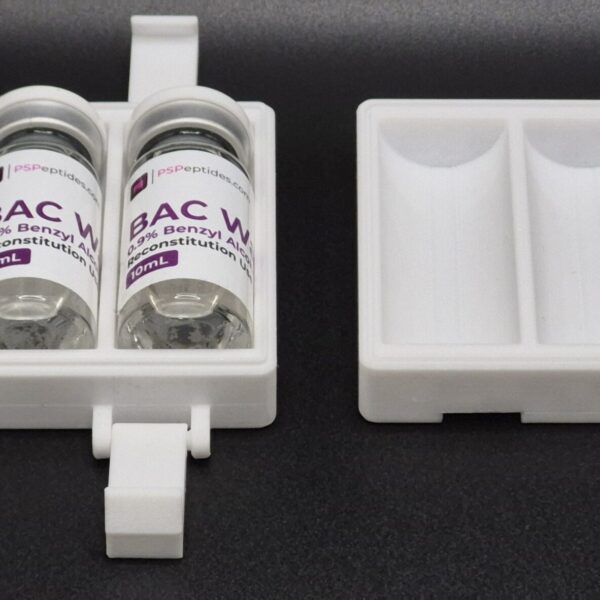
Peptide Vial Case | For 5x 10mL Peptide Vials
$24.99 Add to cart -
BAC Water & Peptide Supplies
Acetic Acid Reconstitution Solution | Research Grade 10mL
$14.99 Select options This product has multiple variants. The options may be chosen on the product page -
BAC Water & Peptide Supplies · 2 options
3mL Peptide Pen Refill Cartridges
Price range: $3.99 through $11.99 Select options This product has multiple variants. The options may be chosen on the product page -
BAC Water & Peptide Supplies
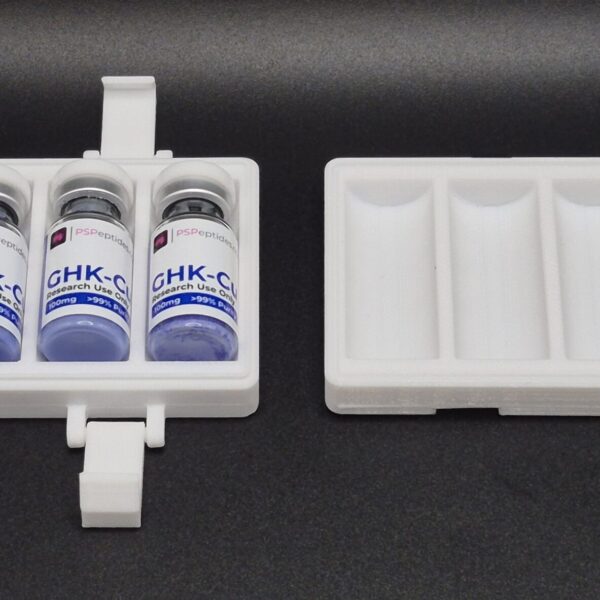
Peptide Vial Case | For 5x 3mL Peptide Vials
$24.99 Add to cart